Type of Object
Material
Type of Object
Material
From the historian’s perspective, it is fitting that this book of artists’ things should end with wine. Not just because of its associations with toasting endings and beginnings but because wine has so often been the first “thing” encountered in our inquiries into the material worlds of eighteenth-century artists. When notaries undertook the lengthy task of an estate inventory, itemizing the contents of a deceased person’s home, they usually started their cataloging efforts in the cave (cellar), which, if the dwelling had one, was the most common space for storing one’s wine. Consequently, wine regularly features in the initial glimpse of an artist’s material possessions, offering tantalizing insights into the extent of their wealth, their tastes as a consumer, and, above all, their drinking proclivities.
Jean-Baptiste Greuze, for instance, emerges somewhat against the grain as a strong proponent of white wine, owning sixty bottles of white but not a single bottle of red.1 Jean-Siméon Chardin leaned more conventionally the other way, with a collection of fifty bottles of red wine but not a single bottle of white.2 Charles-Antoine Coypel, meanwhile, was more ecumenical in his consumption, keeping in his cellar sixty bottles of red (all Burgundies) and sixty bottles of white wines of various kinds.3
Individual tastes in wine evidently varied, but its consumption was almost universal. Wine in eighteenth-century France was a vast commercial industry (one of the state’s three largest sources of tax revenue), and its trade was already driven by those familiar dynamics of regional rivalries, consumer preferences, and market trends.4 While there were some small vineyards in Paris, the enormous amounts of wine needed to supply the capital were imported from the provinces with, according to Daniel Roche, 50 to 60 percent coming from the Orléanais and Blésois regions, 15 percent from Champagne, and 12 percent from Lower Burgundy.5 The contents of artists’ cellars, however, indicate something of an elite art-world preference for Burgundies (both white and red), which, given the region’s prized reputation, was indicative of the relative wealth and sociocultural status of many of the Académie’s members (including such Burgundy drinkers as Coypel, Jean-Baptiste-Marie Pierre, François-Hubert Drouais, and Claude-Joseph Vernet).6 Wines from the rival region of Champagne were also enjoyed, though they tended to be kept in smaller quantities and so presumably drunk less frequently, except in the case of Jean-Baptiste Le Prince, who had a country house between Paris and Reims and showed a clear preference for the region.7 While there was a marked propensity for French wines, some artists’ tastes and budgets also extended internationally. Drouais had eight half bottles of Malaga, and Pierre had three half bottles of “Hungarian wine” (probably Tokaji), the small size of the bottles suggesting dessert wines and possibly the indulgence of a sweet tooth (further confirming the assumption made from Drouais’s possession of a ).8
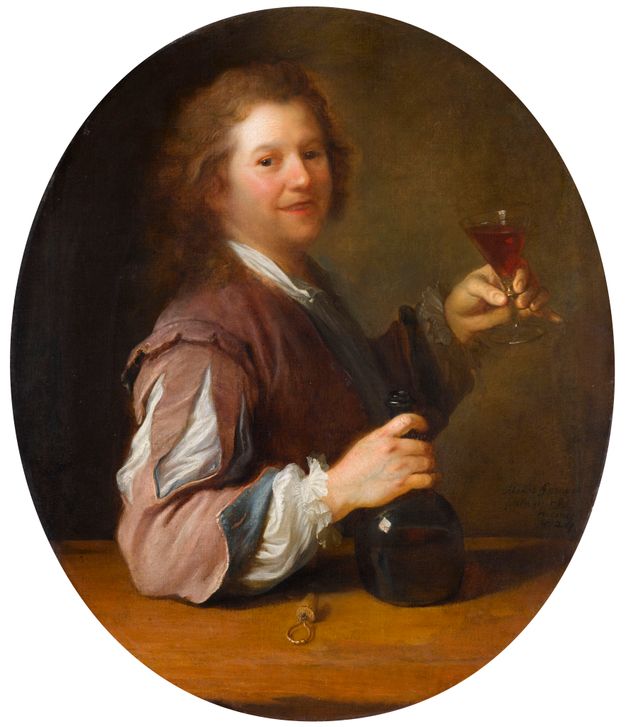
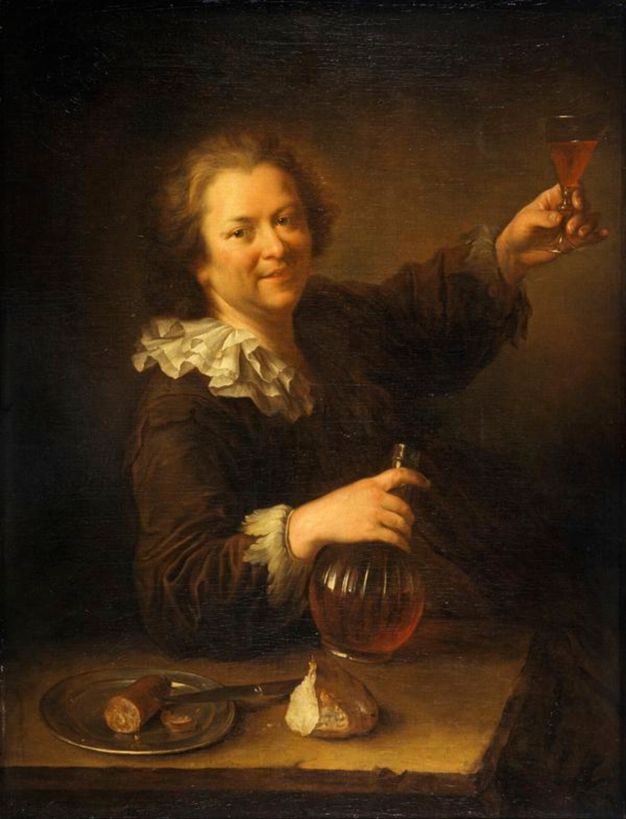
Aside from suggesting its contents, the kind of receptacle in which artists stored their wine also gives some insight into their rate of consumption, or at least the size of their collection. Most wine in artists’ cellars was kept in bouteilles (bottles) or carafons (carafes) made from gros verre (rough glass) (as in fig. 190), which were vessels that could be brought directly to the table or decanted into finer glassware for more formal occasions (as in fig. 191). Along with the full ones, most also kept numerous empties (sometimes hundreds of them), which could be taken to the marchand de vin (wine merchant) for refilling, or, in some cases, refilled on the spot.9 For, space and budget permitting, some artists also kept much larger quantities of wine stored in various-size barrels or casks: Pierre, for instance, had three feuillettes (approximately 137 liters each) of red Burgundy, while Drouais had two larger demi-queues (approximately 213 liters each) of “vin rouge cru” from Mâcon.10 Le Prince, meanwhile, outdid everyone in quantity, though possibly not in quality. From the apparatus in the cellar of his country house (including two grape-picking baskets, a large vat, and a bucket with a funnel), it seems Le Prince engaged in some amateur winemaking activities, the results of which were presumably the substantial quantities (nineteen barrels) of “vin du pays” (local wine) stored in both his property at Lagny-sur-Marne and the cellar of his Louvre logement.11 Not surprisingly, the notaries valuing these artists’ wine collections proffered a higher price for Pierre’s Burgundy than for Le Prince’s countryside “vin du pays.”
Wine kept in a cellar, whether homemade or commercially bought, was consumed at meals within the home, even at breakfast (François Lemoyne’s servant noted that his master generally took wine, with bread and water, at 9 o’clock after a morning session in the studio with his students).12 But wine was also bought and consumed in spaces outside the home. Commercially, the wine trade was strictly controlled, divided between marchands de vin (some selling wholesale, others retail) who sold wine from shops to stock people’s cellars, and taverniers or aubergistes, who sold wine in taverns and inns for consumption on the premises.13 Such public establishments were important social spaces for artists, accommodating different kinds of interactions from those taking place in the relative privacy of the home or studio, or within the formalized structures of the Académie. Socializing in taverns and inns could be relatively sedate experiences, like the convivial meals with colleagues and family that Wille occasionally mentions in his . But wine’s intoxicating effects could also lead to dangerous disorder, as during an infamous art-world drunken brawl in 1741. Following an afternoon of boozing at a cabaret near the Louvre called the Galerie d’Avignon, several artists (among them Charles Parrocel, Georges-Frédéric Schmidt, and the cabinetmaker Charles-André Boulle) witnessed an argument escalate to a street scuffle, during which Joseph-Ferdinand Godefroy, a picture dealer and restorer, was stabbed with a and killed by the painter Jérôme-François Chantereau.14
When it comes to drinking in taverns, the artist most associated with this side of the wine trade is without doubt Alexis Grimou. The portraitist had a direct connection to tavern life via his wife, Gabrielle Petit, niece of Francesco Procopio, proprietor of the Left Bank’s Café Procope, a renowned meeting place for philosophes and now reputedly the oldest Parisian café in continuous operation.15 More intriguing, however, is the intentional association with wine that Grimou created through his artistic practice, where that liquor flows with conspicuous abundance. Most striking is the unconventional series of self-portraits that Grimou painted throughout his career, including one in the guise of Bacchus, Roman god of wine (1728, Dijon, Musée Magnin), and at least two “as a drinker,” presenting himself at a tavern table partaking merrily in the fruits of the vine (see figs. 190, 191).
Yet after the painter’s death in 1733, these epicurean images took a less mirthful turn, feeding into a posthumous biographical narrative in which Grimou “the drinker” was recast as Grimou the “utter drunkard” (to quote Pierre-Jean Mariette).16 Excessive consumption of alcohol and a weakness for the good life became a frame for explaining Grimou’s professional path, in particular his unusual decision to abandon his chance at an academic career to instead join the guild. This was a story that neatly tapped into the already ingrained institutional tropes of the elite measured academician versus the bawdy intemperate guildsman.17 More recently, Melissa Percival has pushed back against this problematic image of Grimou as a dissolute renegade, arguing, among other things, that a nuanced understanding of the cultural and symbolic values of wine in eighteenth-century France actually places Grimou’s portraits, and the artist himself, within much more elevated discourses of taste, connoisseurship, and pleasure.18
Grimou’s self-portraits certainly emphasize the sensory qualities of wine, but in doing so, they also bring us back to its thingness. This is a different sense of thingness from wine’s existence as property found in those artists’ inventories: contained in bottles and casks; valued for its regional origins and the quality of its vintage; sold, bought, and then stored in a cellar. Instead, Grimou’s paintings attend to the feel of wine as a substance: the tactility of the glass vessels that hold it; the viscosity of its liquid form; the resonance of its translucent color; the depth of its taste; and the warm glow of its gently intoxicating effects on the body and mood of the drinker. Here, as often throughout this book, the artist’s portraits gesture to the relationship between owner and thing. Where notarized inventories clarify the facts of property (who owned what), these images speak to engagement, connection, and interaction (what it meant to possess that thing). As an act of self-representation, Grimou’s portraits draw the artist out of the working space of the studio into the social space of the tavern, constructing a self-image, via things, that lingers in a post-Regency mood of light indulgence, while gently mocking the formal pretensions of his academic colleagues. Grimou adopts the habitual pose of self-portraiture but replaces the “things” conventionally held. Abandoning the tools of and brush, Grimou instead takes up those vessels of leisure—bottle and glass—and raises a toast with his beholder to the entwined connoisseurial pleasures of art and wine. ‡
Jean-Baptiste Greuze, “Inventaire après décès,” 25 March 1805, AN, MC/ET/XVI/960. ↩︎
Jean-Siméon Chardin, “Inventaire après décès,” 18 December 1779, AN, MC/ET/LVI/246. ↩︎
Charles-Antoine Coypel, “Inventaire après décès,” 25 September 1752, AN, MC/ET/LXXVI/337. ↩︎
On the wine trade, see Jacques Savary des Bruslons, Dictionnaire universel de commerce (Waesberge: Jansons, 1726–32), 1950–63. ↩︎
Daniel Roche, A History of Everyday Things: The Birth of Consumption in France, 1600–1800, trans. Brian Pearce (Cambridge: Cambridge University Press, 2000), 232. ↩︎
Charles-Antoine Coypel, “Inventaire après décès,” 25 September 1752, AN, MC/ET/LXXVI/337; Jean-Baptiste-Marie Pierre, “Inventaire après décès,” 25 May 1789, AN, MC/ET/XXXI/253; François-Hubert Drouais, “Inventaire après décès,” 12 December 1775, AN, MC/ET/LIII/521; and Joseph Vernet, “Inventaire après décès,” 2 March 1790, AN, MC/ET/LVI/369. ↩︎
Pierre had fifty-five bottles and three large casks of wines from Burgundy, but only three bottles of wine from Champagne. Le Prince had a cask of champagne and sixty bottles of red wine from Champagne in his country house and a smaller cask of red from Champagne in his Louvre apartment. The scellé (30 September 1781) and inventory (10 October 1781) of these properties are transcribed in Jules Hédou, Jean Le Prince et son oeuvre (Paris: Baur, 1879), 209, 260. On the Burgundy-Champagne rivalry in the eighteenth century, see Jean-Baptiste de Salins, Défense du vin de Bourgogne contre le vin de Champagne (Paris: 1702). ↩︎
“Inventaire après décès,” of Drouais (1775) and Pierre (1789). ↩︎
For instance, Coypel had 100 empty bottles, Pierre had 150 empty bottles, and Drouais had 80 empty carafons. ↩︎
“Inventaire après décès,” of Drouais (1775) and Pierre (1789). Cask names and capacities varied enormously by region. For a directory of relative sizes, see Manuel des propriétaires et des marchands de boissons (Paris: Garnery & Rondonneau, 1809), 147–48. ↩︎
This included eight pièces (approximately 183 liters) and one demi-pièce (approximately 91 liters) at Lagny-sur-Marne, and nine demi-pièces and a feuillette (approximately 137 liters each) at the Louvre. Hédou, Jean Le Prince, 209, 260. ↩︎
“Information faite par le commissaire Daminois au sujet de la mort violente du sieur Lemoyne,” NAAF, 1877, 195. ↩︎
Savary des Bruslons, Dictionnaire universel, 1954–55. Étienne Jeaurat’s brother, François, was a marchand de vin living on the same street as the painter in the 1740s (possibly in the same dwelling), AN, MC/ET/CXV/548. ↩︎
For the case reports, see Jules Guiffrey, Scellés et inventaires d’artistes français du XVIIe et du XVIIIe siècle (Paris: Charavay, 1884), 1:394–417. On Godefroy’s connections to the neighborhood, see Noémie Étienne, “A Family Business: Picture Restorers in the Louvre Quarter,” Journal18 2 (2016), https://www.journal18.org/830. ↩︎
Melissa Percival, “Taste and Trade: The Drinking Portraits of Alexis Grimou (1678–1733),” Art Bulletin 101, no. 1 (2019): 19–20. ↩︎
“[U]n franc ivrogne,” Abecedario de P. J. Mariette, ed. Philippe de Chennevières and Anatole de Montaiglon (Paris: Dumoulin, 1853–1854), 2:335–36. On Grimou’s posthumous biographical narrative, see George Levitine, “The Eighteenth-Century Rediscovery of Alexis Grimou and the Emergence of the Proto-Bohemian Image of the French Art,” ECS 2, no. 1 (1968): 58–76. ↩︎
Grimou was agréé in 1705 but never submitted his reception pieces; his provisional status was canceled in 1709. PV, 4:78–79. The Académie’s vision of the guild as a community of bawdy drinkers was cemented in the institution’s first set of Statutes (1648), where Article III banned its members from all “drunkenness, debauchery, and gambling,” PV, 1:7. ↩︎
Percival, “Taste and Trade,” 6–25. ↩︎
| words