Type of Object
Umbrella
- Jacques-Philippe Le Bas (1707–83)
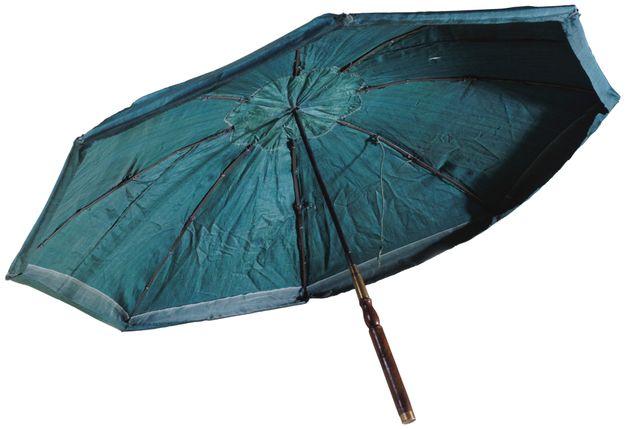
A rare green silk umbrella (fig. 170) is one of the eighteenth-century treasures of the Palais Galliera, the Paris museum of fashion. It has a turned oak handle, an eight-rib hinged metal frame, and a retracting and divisible central pole to enable the close and collapse of the umbrella into a pocketable thing (fig. 171). Although the framework of the umbrella was sometimes made of other materials (wood, baleen), the structure of this type of umbrella was generic to both umbrellas and parasols, which differed, when they did, only in the stuff of the canopy.1 A close taffeta weave was the choice treatment for resistance to sun and rain and for pliable stiffness. The cloth was sometimes given additional proofing by a coat of gum, oil, or wax, though eighteenth-century dictionary definitions suggest that a distinction was not thereby routinely made between umbrellas (parapluies) and parasols.2
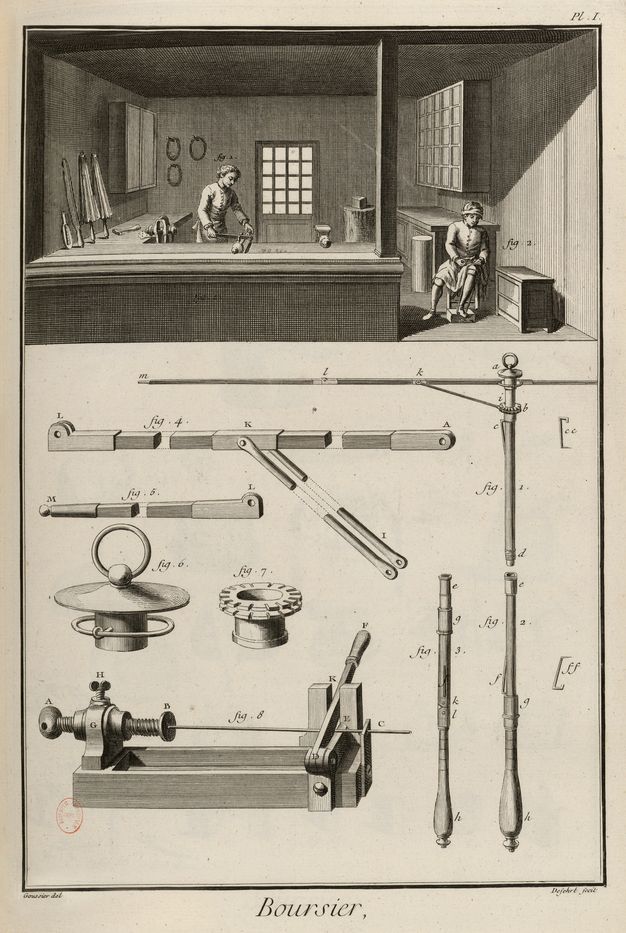
The telescopic mechanism of the Galliera umbrella was of a type invented and patented by purse maker Jean Marius at the beginning of the eighteenth century, for the umbrella-parasols he sold at his shop, The Three Funnels, on Rue des Fossés Saint-Germain.3 It transformed the parasol from a heavy and cumbersome object, permanently open and used by the elite on ceremonial occasions, into an every-rainy-day consumer item.4 Competition for control of the rapidly expanding market for collapsible umbrellas after Marius’s patent expired in 1715 was vigorously conducted by members of three guilds: the turners, licensed by statute to make the wooden handles; the purse makers, who, as depicted in the Encyclopédie (see fig. 171), cut wire for the ribs and sewed gores of stuff to the frame for the canopy; and the petty mercers of incidentals and accessories, or peigneurs-tabletiers, who enjoyed the legal right to sell them. The ultimate victors were the peigneurs-tabletiers, some of whom began in the 1760s to specialize in umbrella vending, becoming marchands de parasols. Their stock continued to be supplied by turners and purse makers for the sticks and canopies, but the petty mercers were able to organize their subcontracting on a scale large enough to drive down unit cost and thereby the price of umbrellas. According to Cissie Fairchilds’s calculations, by 1785 over 30 percent of lower- and middle-income households in Paris owned an umbrella or parasol.5 The engraver and highly successful printseller and publisher Jacques-Philippe Le Bas was among them.6 A “green parasol,” very possibly resembling the one at Galliera, was listed at his death in his probate inventory; it was in a cupboard in his bedroom, on the first floor of a house he rented on Rue du Foin-Saint-Jacques.7
For Fairchilds, the significance of the umbrella is the part it played in the consumer revolution that transformed the urban economy and, in turn, destabilized the social hierarchy of the ancien régime. She brackets umbrellas with fans, , stockings, , and gold under the heading of “populuxe” goods—cheap copies of aristocratic luxury items, desired, she argues, not for their utility but rather for the touch of class they added to working-class and bourgeois lives. Le Bas’s things, as inventoried in 1783, seem to confirm her findings. Among them were a porcelain , a London-made gold , and a china tea set. Moreover, his wardrobe was exceptionally fashionable; it included fine linen, cotton and silk stockings, lace cuffs, silver buckles, gold buttons, and a gold-knobbed cane (perhaps the one depicted by Moreau the Younger in his ).8 However, the fashionable picture this acquisitiveness appears to paint of Le Bas does not entirely chime with the contemporary biographies of the engraver, or rather his lives challenge the presumption of many histories of consumption: that rises in luxury spending were inspired by social ambition and personal pleasure and expressed a modern kind of individualism.
Though Le Bas was an academician, indeed elected one of the Académie’s councilors in 1771, the authors of his lives belonged to the print trade and were not “amateur” members of the Académie or professional men of letters, as was usually the case with the biographers of painters and sculptors. François-Charles Joullain, a printmaker and art dealer, wrote two lives of Le Bas: a formal historical biography published with the sale catalog of Le Bas’s collection and stock in 1783, and an informal and unpublished life inserted at the beginning of the Oeuvre of Le Bas that he compiled and donated in 1789 to the royal library.9
What sets these texts apart from those written for the Académie’s conférences is the license Joullain took, on the basis of his direct and close knowledge of his subject, to multiply the number of personal “anecdotes.”10 When such miscellaneous facts (faits divers) feature in academic lives, they exemplify and endorse the ideal image of the artist as learned, naturally gifted, or, in private life, modest and disinterested.11 In Joullain’s lives, however, things are not in the service of such literary tropes, but nor are they things in themselves. Rather, they serve as the occasion and stuff of social relationships, often structuring the brief narratives of the anecdotes: the set of clothes given him by his mother, an impoverished widow, the moment he leaves home on life’s adventure, the jewels he bestowed on Elisabeth Duret to secure her hand and which he sold in a crisis shortly after the wedding day.12 Even seemingly trivial and inconsequential transactions embody enduring social bonds: Le Bas’s offer of his coat for Chardin’s Still Life with a Hare (1728–29, New York, Metropolitan Museum of Art) is vividly reported as a favor, mutually felt, cementing a lifelong friendship.13
When Joullain does invoke the semantic value of objects as signs of distinction, they challenge the official history of the noble order of academic artists with their “low history” (petite histoire) of unpretending talent. Dress illustrates Le Bas’s refusal to stand on ceremony. Apparently, on memorable occasions the engraver served at the counter in his shop, greeting his elite customers in shirtsleeves and cap.14 In fact, Joullain reserved his most colorful and surprising anecdotes to illustrate Le Bas’s radical egalitarianism, his insistence on engaging with the world on terms of equality, grounded in talent, not rank or birth.15
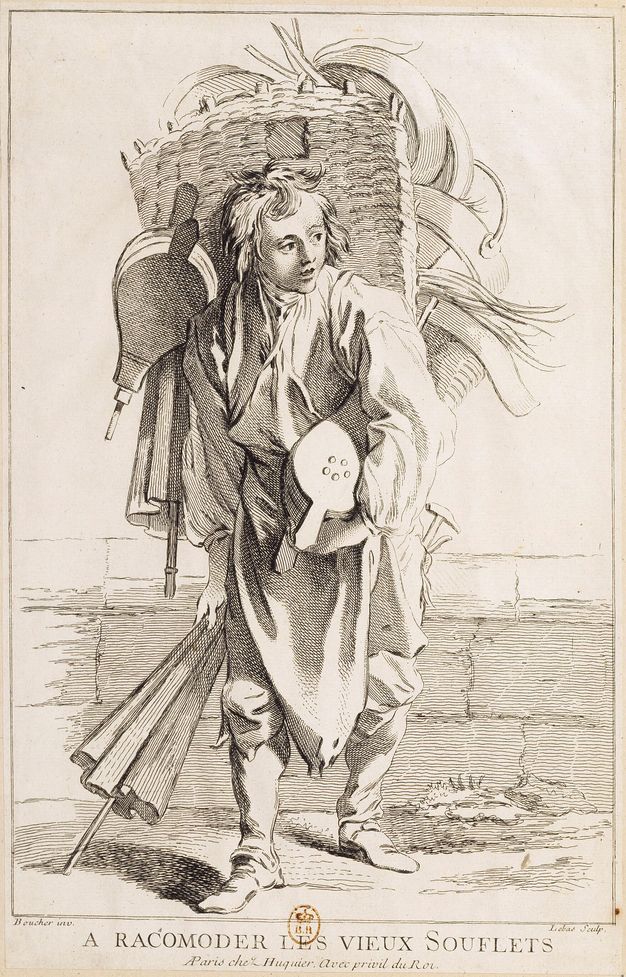
What bearing does this have on Le Bas’s umbrella? It suggests that although the low cost of its materials and manufacture and the cheap market price qualified it as “populuxe” by Fairchilds’s criteria, its attraction for Le Bas was not necessarily its agency as an index of status. If the umbrella signified class, it is not clear that it did so unequivocally: Louis-Antoine, the marquis de Caraccioli, remarked in 1768 that in Paris the umbrella was “the sign of having no ” and of having to walk on foot. Consequently, it was shunned by those of rank and title, who willingly took the risk of getting wet rather than be “confounded with the vulgar.”16 Joullain does not directly connect Le Bas and the umbrella, but he does associate him with the urban street, the prime location, as Le Bas’s own etching of a peddler (fig. 172) in François Boucher’s Cris de Paris indicates, of their sale and use.17 In one anecdote, Le Bas plays the jealous husband, pursuing his wife, whom he wrongly suspects of infidelity, in a taxi (fiacre); disillusioned and humiliated, he returns home in the rain, sopping and mud-spattered, presumably having left his umbrella in the cab, or forgotten it in his haste.18 Le Bas’s identity was, according to Joullain, grounded in the neighborhood street, specifically Rue de La Harpe, where he lived for forty-seven years, the address inscribed on the vast majority of the prints he published.19 “I have seen him,” writes Joullain, “magnificently dressed, stopping at the shop of a craftsman, or waylaying common folk in the middle of the road, either to buy from them things he did not need, and which he later gave away to others, or to ask them about themselves, their circumstances, their family, and their needs. [The street] provided him with manifold opportunities for benevolence.”20 Silver buckles, gold buttons, and a collapsible umbrella were not, in Joullain’s discourse, the glittery trappings of upward social mobility but symptoms of the generosity he extended to himself and to others.
Joullain’s biographies of Le Bas manifestly draw on tropes and themes from the literature of sensibilité, and some of the things mentioned in the lives function as sentimental objects whose personal meaning transcends their material and economic value: the portrait of Le Bas’s mother, for example, before which, according to Joullain, Le Bas regularly shed the tears of a dutiful son throughout his life.21 However, what distinguishes Le Bas’s umbrella from things recorded and valued as commodities in his inventory, and also from those objects that manifestly serve as touchstones of private emotion in the biographies, is the umbrella’s materiality and dependence on the energy and interaction of the human body to bring it to life. Umbrellas require skill and dexterity. Once opened up, they invite the freedom to venture forth in all weather, the opportunity to extend relief and hospitality to others under the intimate circumference of their cover. Human and thing become entangled in networks of material and social relations.
It is of course possible that the confinement of the green parasol in Le Bas’s bedroom cupboard indicates a forgotten or discarded thing, not one kept handy, or, that it had originally belonged to Mme Le Bas and that the engraver cherished it as a keepsake. But Joullain’s relentless focus on the externalities of Le Bas’s life, on what connected him to the collective—family, friends, workshop, neighborhood—supports the argument made here that the shape and rhythm of Le Bas’s life depended on the things that he took out into the world, his umbrella perhaps especially. It entrapped him into keeping his responsibilities and commitments and fulfilling his duties come rain or shine. §
-
On the fabrication of umbrellas, see Jeremy Farrell, Umbrellas and Parasols (London: Batsford, 1985), 9–17. ↩︎
-
See Antoine Furetière, Dictionnaire universel, 2nd ed. (The Hague: Arnould & Reinier Leers, 1701), 2: s.vv. “Parasol,” “Parapluie,” Encyclopédie, http://encyclopedie.uchicago.edu/, 11:922. The Dictionnaire de l’Académie française, 4th ed. (Paris: Brunet, 1762), does, however, carefully distinguish the two with separate, not overlapping entries for “Parapluie” and “Parasol.” ↩︎
-
On Jean Marius, see Joan De Jean, The Essence of Style (New York: Free Press, 2005), 217–30. ↩︎
-
As in, for example, Charles Le Brun’s Portrait of Chancellor Séguier at the Entry of Louis XIV to Paris in 1660 (Paris, Musée du Louvre). ↩︎
-
Cissie Fairchilds, “The Production and Marketing of Populuxe Goods in Eighteenth-Century Paris,” in Consumption and the World of Goods, ed. John Brewer and Roy Porter (London: Routledge, 1994), 239. According to De Jean, the cost of a collapsible umbrella in 1754 was between 15 and 22 livres (compared to 9 livres for a fixed one). This is expensive, and the price must have dropped to achieve the level of market penetration calculated by Fairchilds. ↩︎
-
On Le Bas, see Roger Portalis and Henri Beraldi, Les graveurs du XVIIIe siècle (Paris: Morgand & Fatout, 1880–82), 2:564–90. ↩︎
-
Jacques-Philippe Le Bas, “Inventaire après décès,” AN, MC/ET/XLV/582, 23 April 1783; the street disappeared with the opening of the Boulevard Saint-Germain in 1855. ↩︎
-
Le Bas, “Inventaire après décès.” Canes and especially stockings are identified by Fairchilds as “populuxe.” ↩︎
-
See Hayot de Longpré, Catalogue de tableaux, sculpture, desseins, estampes . . . provenant de la succession de feu M. Le Bas (Paris: Clousier, 1783); and François-Charles Joullain, L’oeuvre de Jacques-Philippe Le Bas, Graveur, 5 vols. (1789), BnF, Département des Estampes et de la Photographie: (Ee11–Ee11d in-fol. See also Charles-Étienne Gaucher, “Nécrologie [de M. Le Bas],” Journal de Paris, 12 May 1783, 554–55. ↩︎
-
Joullain, “L’oeuvre,” “Avertissement,” n.p. See Lionel Gossman, “Anecdote and History,” History and Theory 42, no. 2 (2003): 143–68. ↩︎
-
An exception is the chevalier de Valory’s life of Jean-François De Troy; see Mémoires inédits, 2:255–88. ↩︎
-
Hayot de Longpré, Catalogue, v (clothes); and Joullain, L’oeuvre (Ee 11), iv–v (wedding jewels). ↩︎
-
Joullain, L’oeuvre (Ee 11a), 7. On the picture and the question of its provenance, see Chardin (1699–1779), exh. cat. (Paris: Grand Palais, 1979), no 21. A similar anecdote involving a , not a coat, was told by Caylus about Watteau, but in that instance the anecdote served emblematically to illustrate Watteau’s modesty. See . ↩︎
-
Hayot de Longpré, Catalogue, xxi. ↩︎
-
See Hayot de Longpré, Catalogue, xxi–xxiii: Le Bas invited a “président à mortier du Parlement d’une des premières Villes du Royaume” to dinner with other artists in the summer of 1782. When the president took his leave, Le Bas remarked: “You see, Sir, that although I did not place you among your equals in rank and birth, I took care to include with you (in this dinner) only Men of talent, and Talents Equalize Men [Vous voyez, Monsieur, que si je ne vous ai pas mis avec vos égaux pour le rang et la naissance, j’ai eu soin de ne rassembler avec vous que des Gens à talents, et LES TALENS RAPPROCHENT LES HOMMES].” On surprise being a defining feature of “faits divers,” see Roland Barthes, “Structure du fait divers,” in Essais critiques (Paris: Seuil, 1964), 188–97. ↩︎
-
Quoted in Farrell, Umbrellas, 23. Robinson Crusoe made himself an umbrella as a basic necessity; see Irene Fizer, “The Fur Parasol: Masculine Dress, Prosthetic Skins, and the Making of the English Umbrella in Robinson Crusoe,” in Eighteenth-Century Thing Theory in a Global Context, ed. Ileana Baird and Christina Ionescu (London: Routledge, 2013), 209–26. ↩︎
-
That Le Bas identified himself with the street is suggested by his claim, reported by Joullain, that he had learned to read on the street, from the shop signs of Paris (L’oeuvre [Ee 11], iii) and that the memorial he cherished for himself was a series of distance markers on the road from Paris to Bicêtre with his prints posted upon them “so that passers-by are entertained and that they regret (the passing) of their author [afin que les Passans s’en amusent et plaignent leur auteur].” (L’oeuvre [Ee 11] xi). Moreover, Le Bas owned Chardin’s shop sign for a barber-surgeon (now lost), a street-scene, which hung in his salon. See Chardin, no 1. ↩︎
-
Joullain, L’oeuvre (Ee 11), ix–x. ↩︎
-
See Hayot de Longpré, Catalogue, xiii, on Le Bas’s change of address. ↩︎
-
Joullain, L’oeuvre (Ee 11), ix. ↩︎
-
Hayot de Longpré, Catalogue, vi. On sentimental objects, see Lynn Festa, Sentimental Figures of the Empire in Eighteenth-Century Britain and France (Baltimore: Johns Hopkins University Press, 2006), esp. 67–110. ↩︎