Hot-Air Balloon
- Jean-François Janinet (1752–1814)
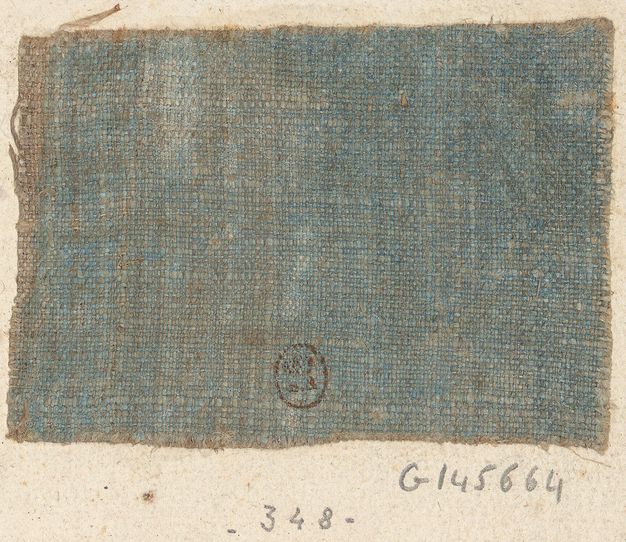
According to Denis Diderot, the material conditions for something to be called “balloon” are that it is round and hollow, no matter how it is made, or what it is for.1 A balloon is an envelope, casing, or wrapper that encompasses something other. Does it qualify as a thing, specifically an artist’s thing? Should we not, rather, be indexing it by its contents? At the time of the Encyclopédie’s publication (1751–77) “balloon” was generally a glass object, a component in a scientific apparatus used in chemical and physical experiments to produce compound substances such as the pigments verdigris and orpiment.2 The printmaker Janinet’s balloon was, however, a different, inflatable type of thing, a hot-air balloon, the invention of which in 1783 was the by-product of the seventeenth century’s discovery of the materiality, that is the weight, of air. We have a scrap of the cerulean balloon that Janinet and the abbé Laurent-Antoine Miollan were primed to launch from the Luxembourg gardens on 11 July 1784 (fig. 77).
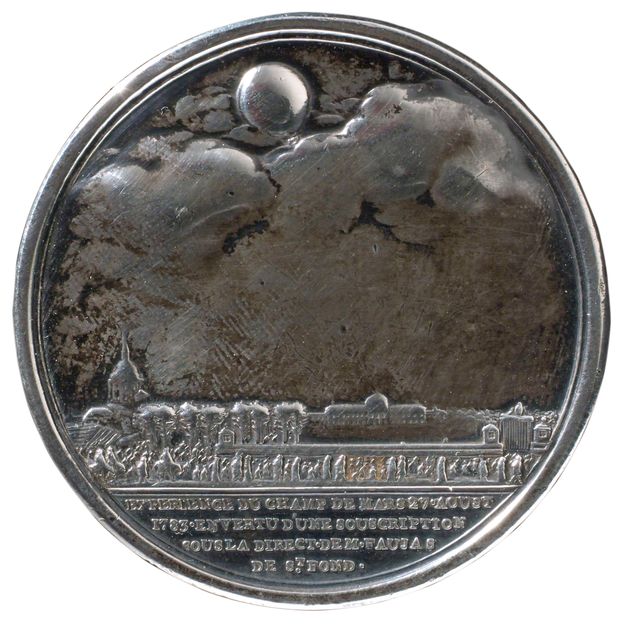
Janinet and Miollan were not, of course, the inventors of the hot-air balloon. That honor goes to the Montgolfier brothers, who had successfully launched the first balloon at Annonay in June 1783 and had repeated the performance in front of Louis XVI and the court at Versailles in September of the same year.3 Their success in rendering “navigable the air” detonated an explosion of ballooning in Paris, which attracted huge crowds of curious onlookers from all ranks and professions, including artists.4 The German engraver Johann Georg Wille attended the Montgolfier launch at the Réveillon wallpaper factory in the Faubourg Saint-Antoine in October 1783 and the first manned assent in Paris at the Tuileries gardens in December, from which he returned home stunned, dizzy and unable to think of anything else, according to the late-night entry in his .5 Ten days later he bought a silver medal to commemorate the Montgolfier invention (fig. 78), whose obverse bore the double profiles of genius, designed by the sculptor Jean-Antoine Houdon. Wille added it to his collection of European medals illustrating the monuments of the modern age.6 Janinet, however, was not content to be a spectator, nor even an amateur scientist, for whom the market soon produced balloon kits for making and flying miniature model balloons.7 Hot-air balloons were not entertainment or toys to him; rather, the balloon was his thing, in the sense of his métier, in 1784.
Janinet styled himself an artist-physicist. How, when, and where he acquired his science is uncertain; he may have attended the abbé Miollan’s public lectures on physics.8 Whatever the case, by February 1784 the two men were embarked on a joint venture to send up their own montgolfière, as the hot-air balloon was popularly called, and to that end they opened a subscription to finance the project and sold tickets.9 From the ticket etched by the “artist” Janinet (see fig. 79), the purchaser learned that the Miollan–Janinet flying machine was to consist of not one but three balloons, loosely tied together with string, and that an aerial rudder would be attached to the gondola. The authors explained in the prospectus that their prime objective was to be useful. Their balloon would be a flying laboratory, in which observations and demonstrations of “the density and qualities of the different layers of the atmosphere” could be made. The small upper balloon would rise above the other two because it was filled with hydrogen. The lowest balloon would sink below the two others because it was filled with cold air—a lesson for all to see in the relative densities of gasses and in the effects of heat upon them.10 The rudder and lateral vent in the big balloon, inferable from the ticket by the burst of radiating lines Janinet etched to represent escaping air, would demonstrate a combination of means to pilot the flying ship: by leverage and by propulsion. To date, no one had successfully devised a technology to steer balloons, which severely compromised the balloon’s perceived utility.11
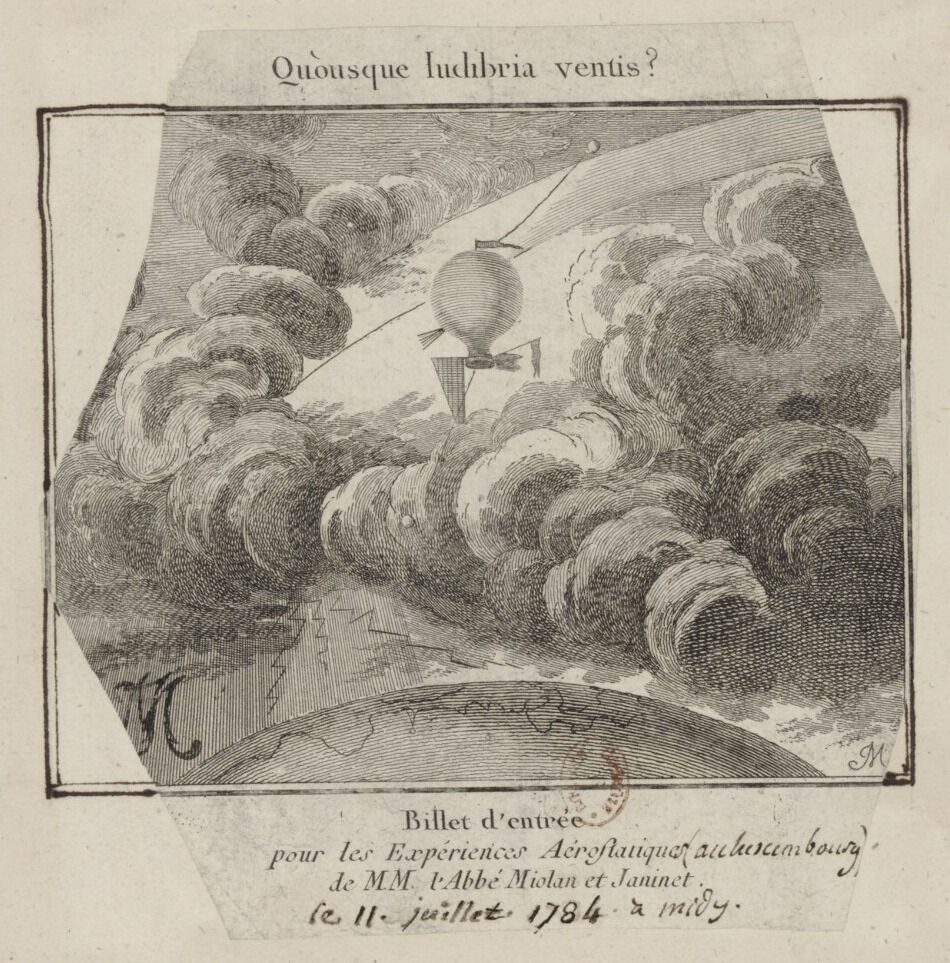
In the immense space of the heavens and relative to the globe, the balloon, blown by “long laughing winds” (quousque iudibria ventis), looks small and delicate, and yet it was then the largest balloon to have been launched aloft, a gigantic azure machine 100 feet high and 80 feet in diameter, on a scale and of a color, in fact, to equal the hue and cumuliform of Janinet’s skyscape. The creation of so large a thing apparently demanded an approach to production liberated from the traditional mindset of craft; Miollan and Janinet emphasized the modernity of their balloon’s technology in the press releases they regularly made to the newspapers.12 The design of the burner, for example, would be informed by Antoine Quinquet’s improvements to the oil lamp; the gondola would be built in the lightest of materials, a reinforced paper invented by the model maker Montfort and already in use for and .13 The most expensive tickets bought not only the best seats for the launch but access also to the workshops in which the new technologies were being developed, and entry to the exhibition of the 1:10 maquette or of the balloon at the Grands Augustins on 31 March 1784, coincidentally at the same time and in the same place that Jean-Joseph Sue was giving a lecture to Académie students on the importance of the study of human anatomy to the practice of art.14
After successful test flights of the full-scale balloon at the Observatoire in June and July, the “physicists” fixed the day of the official public launch for Sunday, 11 July 1784, at noon. Wille, who almost certainly knew Janinet, was eager to go.15 He proposed buying tickets for the enclosure at the Luxembourg (see fig. 79), but his wife could not face the crowds; they made their way instead to a convenient viewing spot on the boulevard.16 About two o’clock they saw rising in the sky not the balloon but a pall of smoke. Miollan and Janinet had repeatedly tried to inflate the envelope and failed.17 Instead, it caught fire, though whether by accident or torched by the disappointed crowd is not clear. According to draftsman and printmaker Charles-Nicolas Cochin, the moment the would-be aviators accepted defeat, the crowd of angry, non-ticket holders outside the enclosure broke in, ripped up the stands, and fed the fire with chairs and fencing. What they did not set alight they tore up and took as trophies (see fig. 77).18 His account of the day’s events was written in a letter to the painter Jean-Baptiste Descamps, to whom in bafflement Cochin remarked of Janinet: “What was he thinking?”
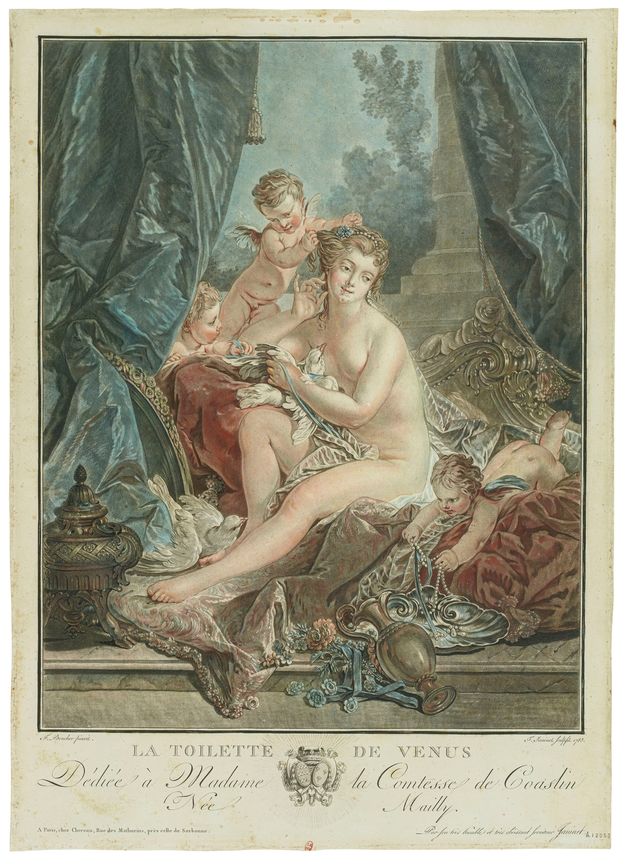
Had Janinet perhaps felt himself interpolated by Gudin de Brenellière’s rousing imperatives in the wake of the first balloon ascent,19 and published in the Journal de Paris, to “Follow Montgolfier . . . ,” to “Leave, fly, and discover air less even, purer horizons in these, our cerulean planes”? Had he thought that his practical knowledge specifically marked him out? He certainly saw no contradiction in principle between scientific and artistic ambition: in March 1784 he put an advertisement in Annonce, affiches et avis divers with news scrambled in a single paragraph both of his print after François Boucher’s Toilette of Venus (fig. 80) and of the subscription to launch the balloon.20
The relic of his and Miollan’s attempted flight indicates a dense inner envelope of linen, possibly hemp, tough but not woven tightly enough to contain air. It was almost certainly covered with outer layers of paper and varnish, materials common to the printmaker’s studio, in order to seal it properly. Moreover, Janinet had brought experimentation to his art. He had adapted the process of color printing using multiple plates, learned in the workshop of the pastel-manner etcher Jean-Claude Bonnet to the technique of acquatint, a development that had required experimental manipulation of varnishes (to protect the copperplate), acids (to bite the design), and inks, including indigo (to print the image). He could legitimately lay claim to a practical knowledge of chemistry that was there to be mobilized for the science as well as the arts of ballooning, including perhaps the making of hydrogen by the chemical reaction of acid on metal.21
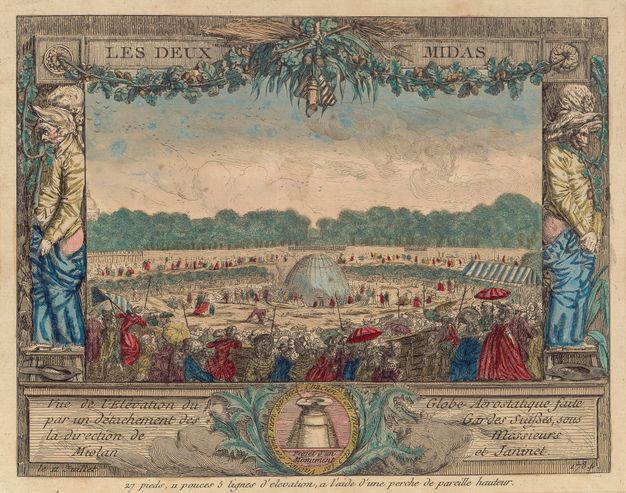
The thrust of the caricatures, satirical songs, and critiques that flooded the market in the immediate aftermath of the Luxembourg gardens fiasco was deflationary—an assault, that is, on the puffed and false science of Miollan and Janinet. Janinet was routinely portrayed as an ass. In Les deux Midas (fig. 81) his ears identify him as the left caryatid, tangled up with Miollan the cat, on the right, by a skein running along the top of the frame, their pursuit of scientific knowledge exposed as half-assed, as a pseudo, alchemical art that licenced renaming them “Midas.” Furthermore, the recorders (flutes à bec) that the two men have in their mouths by the wrong end illustrate the idiocy of those who pretend to experimentation without knowledge of scientific principles.22 This was satire by the elite against the pretentions of outsiders and against the opening up of science to a wider public of artisans and amateurs. In the middle of the bottom rail of the frame, the caricaturist had drawn a medal, “Project of a Monument,” around which runs the proverb: “To each his craft, and the cows will be well guarded.” Both the turn of events and such caricatures punctured Janinet’s sublime ambition, stayed his willingness to risk in order to be “king of the elements,” master of air. Provenance of the balloon fragment at the Bibliothèque Nationale de France is unknown, but we can be sure it was no souvenir of Janinet’s. Humiliated, both by public ridicule and, no doubt, by the pity of academic colleagues, this heaven-headed printmaker forgot the dreams that had inspired the design of his ticket and returned to the everyday, earth-bound business of earning a living.23 §
-
“Ballon,” Encyclopédie, http://encyclopedie.uchicago.edu/, 2:47. ↩︎
-
“Orpiment, ou Orpin” and “Verd-de-gris, ou Verdet,” Encyclopédie, http://encyclopedie.uchicago.edu/, 11:665, 17:58. ↩︎
-
There is a vast secondary literature on ballooning in the eighteenth century. See, among others, Charles Coulson Gillispie, The Montgolfier Brothers and the Invention of Aviation, 1783–1784 (Princeton: Princeton University Press, 1984); and Marie Thébaud-Sorger, L’aerostation au temps des lumières (Rennes: Presses Universitaires de Rennes, 2009). ↩︎
-
Michael Lynn estimates that approximately 400,000 people, or half the population of Paris, watched the first assent at the Tuileries in 1783. See Lynn, Popular Science and Public Opinion in Eighteenth-Century France (Manchester: Manchester University Press, 2006), 136. ↩︎
-
Mémoires et journal de J-G Wille, ed. Georges Duplessis (Paris: Renouard, 1857), 2:65 (6 October 1783); 2:76–78 (2 December 1783). Setting off for the Tuileries on 2 December, Wille had been too impatient to write a proper letter to Jean-Baptiste Descamps. On his return he met up with others who had also been at the launch: “Nous dînâmes chez nous, et ne parlâmes que de ce que nous avons vu et n’en parlâmes qu’avec feu.” ↩︎
-
Wille, Mémoires, 2:81. ↩︎
-
See, for example, those sold by Blondy, cul-de-sac de Rouen, advertised in the Journal de Paris, 17 September 1783; also, Marie Thébaud-Sorger, Une Histoire des ballons: Invention, culture matérielle et imaginaire, 1783–1909 (Paris: Editions du Patrimoine Centre des Monuments Nationaux, 2010), 88–101. ↩︎
-
See Journal de Paris, 11 April and 4 December 1783. ↩︎
-
Journal de Paris, 26 February 1784. ↩︎
-
“Observatoire volant” was in the same year the title of a poem by Arnaud de Saint-Maurice: L’Observatoire volant et le triomphe héroïque de la navigation aérienne (Paris: Cussac & Samson, 1784). ↩︎
-
See the debate in the Journal de Paris, 30 August 1783. ↩︎
-
Journal de Paris, 29 March 1784. Jean Sgard argues in “Les philosophes montgolfères,” SVEC, 303 (1992): 105, that ballooning was the occasion for putting into practice the enlightened principles of the Encyclopédie. ↩︎
-
Journal de Paris, 21 March 1784, 29 March 1784. Montfort is identified as “ancien officier d’artilerie” and “Directeur des plans en relief des fortifications du Royaume.” ↩︎
-
Journal de Paris, 29 March 1784. ↩︎
-
Janinet had reproduced two of Wille fils’s early genre paintings, Le Repas des moissonneurs (1774) and La Noce de Village (1775). See Inventaire du fonds français: graveurs du XVIIIe siècle (Paris: Bibliothèque nationale de France, 1973), 12:9-10. ↩︎
-
Wille, Mémoires, 2:94–95 (11 September 1784). ↩︎
-
This was almost certainly because of the midday heat. Generally, hot-air ballooning takes place at first light when the differential in the temperatures inside and outside the balloon is especially marked. ↩︎
-
See Charles-Nicolas Cochin fils to Jean-Baptiste Descamps, 2 June 1784, published in Christian Michel, “Lettres adressées par Charles-Nicolas fils à Jean-Baptiste Descamps, 1757–1790,” AAF 28 (1986), Letter LXXXVI, 75–76. See also Correspondance littéraire, ed. Maurice Tourneux (Paris: Garnier, 1877–82), 14:9–11. ↩︎
-
Journal de Paris, 28 August 1783. ↩︎
-
Annonce, affiches et avis divers, 23 March 1784. ↩︎
-
On “practical knowledge” and ballooning, see Marie Thébaud-Sorger, “Capturing the Invisible: Heat, Steam, and Gases in France and Great Britain, 1750–1800,” in Lisa Roberts and Simon Werret, eds., Compound Histories: Materials, Governance and Production, 1760–1840 (Leiden: Brill, 2018), 85–106. ↩︎
-
The joke was informed by the connection that Antoine Rivarol made between the technologies of air used, respectively, in ballooning and in the abbé Mical’s “Talking Heads,” the first successful reproduction of the human voice. See Rivarol, Lettre à M. le Président de *** sur le globe airostatique, les têtes parlantes et l’état present de l’opinion publique à Paris (London: Cailleau, 1784), 20–22, 29–30. ↩︎
-
According to Portalis and Béraldi, Janinet produced his best prints in the immediate aftermath of this failure. See Inventaire du fonds français: graveurs du XVIIIe siècle, vol. 3. ↩︎