Type of Object
Wig
- Claude-Joseph Vernet (1714–89)
In July 1762 Claude-Joseph Vernet was on the hunt for a new wigmaker. He had just arrived in Paris after nearly ten years traveling around the country—from Marseille to La Rochelle—painting his twenty Ports of France. After this long peripatetic stage of his career, Vernet was keen to settle his family and establish his artistic practice in the capital. His first activities in this endeavor addressed the essentials of Parisian life: wig and wardrobe. According to the purchases he recorded in his , Vernet began by kitting out the family in the latest fashions: a mantelet and headdress for Madame Vernet, bonnets and collars for the children, and a new silk suit for himself.1 Shopping for clothes proved straightforward, but the wig situation involved a more assiduous search. After all, this was not just a one-off commercial transaction like buying a hat but, rather, the beginning of a significant new relationship.
In eighteenth-century Paris, one did not so much acquire a wig as a wigmaker. Thing and person came together, the one unmanageable without the other. Wigs were sold as durable products, but ones that, as Mary K. Gayne has shown, required ongoing maintenance, occasional repairs, and frequent refreshments.2 Vernet eventually settled on a Parisian perruquier (wigmaker) in August, but only after an unsuccessful month with the first one he trialed. From the terms of engagement that Vernet reached with his new wigmaker, it is clear why it was so important to find the right person for the job: for a retainer of 10 livres a month, the wigmaker would attend three times a week to the wigs of Vernet and his father-in-law, twice a week to those of his eldest son, plus occasional services for the youngest son, the future painter Carle Vernet.3 Vernet’s wig thus entailed a very personal relationship, not only with the thing itself that would be worn for hours a day on his head, but with a person that he would see more regularly than most colleagues, and with whom he and his family would come into close physical contact several times a week to be shaved, combed, powdered, and plumped.
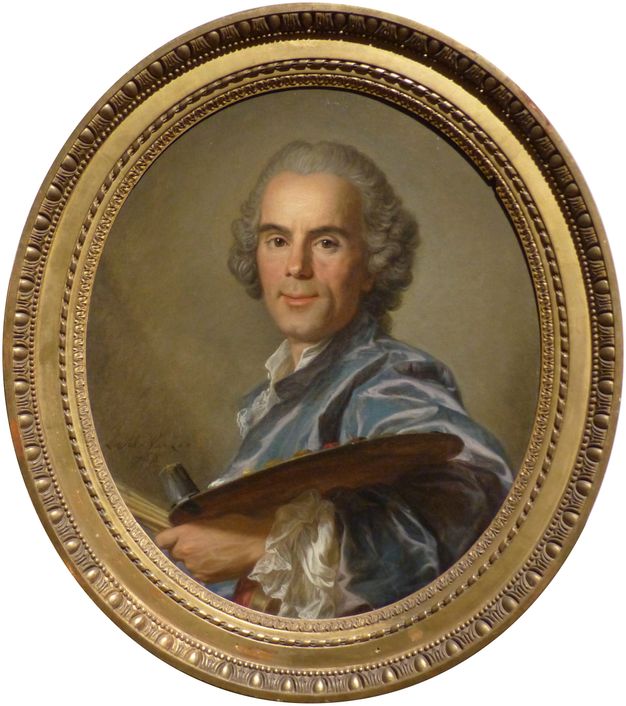
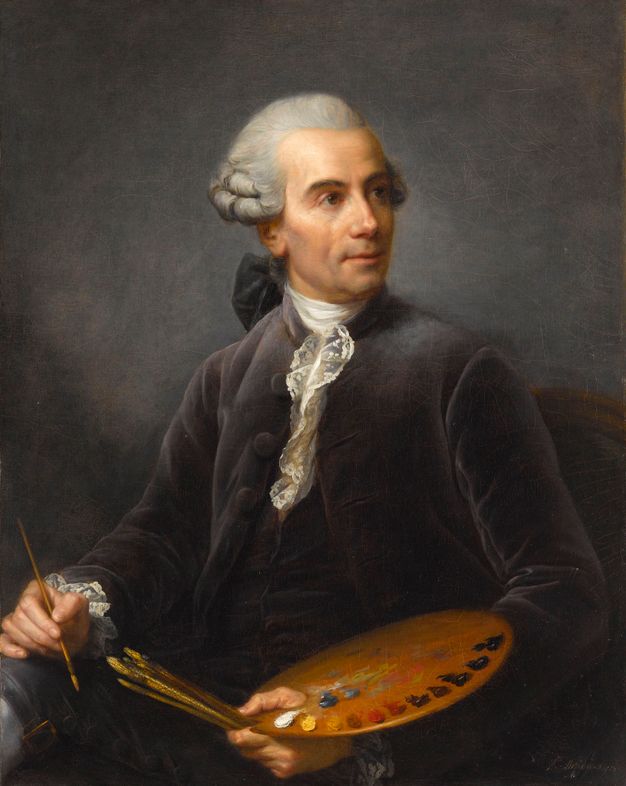
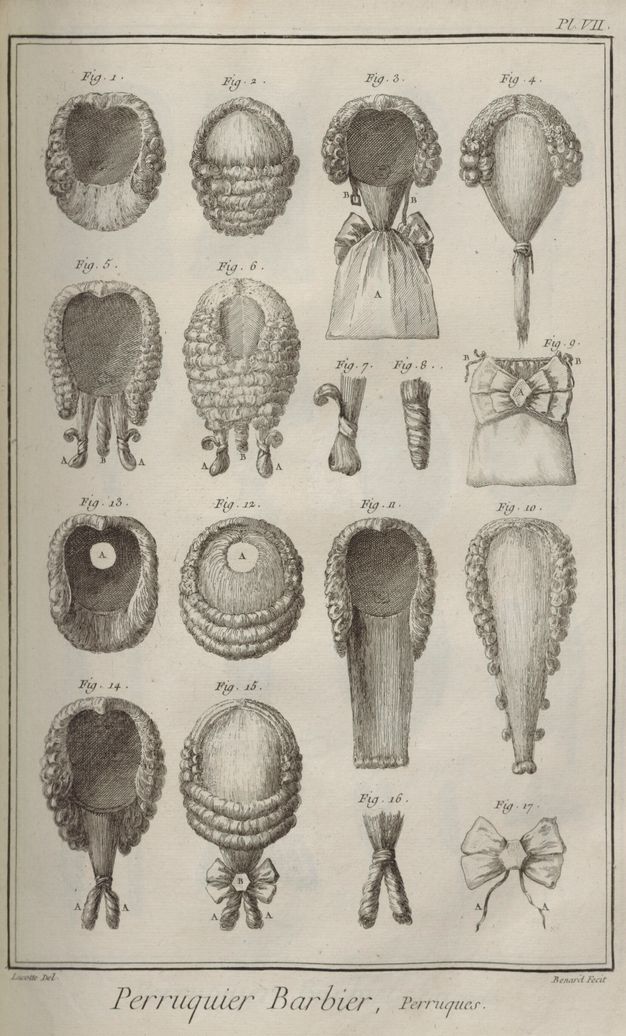
When it came to his wig of choice, Vernet’s portraits show at least two preferences, possibly changing over the years. In 1768 he sported a looser perruque en bonnet (bonnet wig) for his portrait by Louis-Michel Van Loo (fig. 182), while in 1778 he opted for the tightly side-curled perruque à bourse (bag wig) when sitting for Elisabeth Vigée-Lebrun (fig. 183). Both styles were at the height of fashion during those decades—fort à la mode (strongly on trend)—and appeared at the top of the Encyclopédie’s illustrated taxonomy of perruques (fig. 184).4 Shown from front and back, the plate reveals, more than the portraits, the elaborate extent of each wig, whether in the bulk of curls or the additional accessories of bows and bags. Indeed, the weight of the wig was considerable, as was its aroma, due to the materials from which it was made and maintained. Some wigs incorporated horse and other animal hair for strength, but the best were made from human hair (preferably women’s, especially from the countryside, and ideally from cooler climates like Normandy or Flanders).5 Color options varied, with the most sought-after being white, blond, or jet black (brown hair being the most common in France and so the easiest to source), but the eighteenth-century trend for powdering wigs meant that most, like Vernet’s, ended up looking gray, whatever the original color.6 Beyond its chromatic effects, wig powder (a concoction of wheat flour or starch with perfumed additions) also added to the wig’s overall smell, as did the pomade (made from lard) with which it was combined for styling purposes.7 Added regularly to “refresh” the wig, the powder was fine and unruly, often finding its way to the wearer’s shoulders and giving that distinctive powdery glow evident in Vernet’s portrait by Vigée-Lebrun.
For Vernet, owning a wig also meant owning an extensive paraphernalia of products and accessories. Powder and pomade were obviously essential for styling, but Vernet also kept other apparatus required for maintaining, storing, and adorning his wigs, and for preparing his own head to wear them. Among such items, Vernet possessed houppes (powder puffs) for applying powder; powder sacks and a special knife for removing the powder; bourses (bags) to accessorize his wigs; têtes à perruques (wig stands) for storing wigs not in use; combs and fers pour friser (curling irons) to service and revolumize the wig; and razors and scissors for cutting his own hair underneath.8 Indeed, Vernet owned so many of the items that formed the tools of the perruquier’s trade that it seems likely he enjoyed home visits, rather than going out to the wigmaker’s shop as many did. Moreover, it meant he was well equipped to travel (as he so often had) and maintain his wig on the road, simply employing the services of a perruquier en route (something he did twice during voyages to Rochefort in the 1760s).9
Vernet’s vested interest in wigs may have developed early, when in his twenties he lived in Rome and rented rooms in the home of a wigmaker.10 For an academician, even a future one, there was a social distinction between the elite circles of the liberal arts and the corporate trade of wigmaking, but Vernet’s was not the only intersection between these worlds.11 In Paris, the engraver Louis I de Silvestre lived for most of his career with a wigmaker on Rue du Mail, and the engraver Jacques-Philippe Le Bas was the son of a master wigmaker, whose corporate status the son was able to surpass thanks to his artistic facility.12 Even at his professional peak, Vernet chose once again to share his home with a perruquier, but this time in a way that indicated the more elevated social status he had attained since his student days in Rome. In 1779, when his royal pension was raised to 1,200 livres a year, Vernet made a financial summary in his order book, which included 300 livres per annum for a lacquais perruquier (wig servant).13 Vernet had several other servants (though none as highly paid) and also allocated 72 livres a year for a wigmaker to attend to Madame Vernet. Thus it seems Vernet was willing to devote a quarter of his royal salary to his own wig requirements.
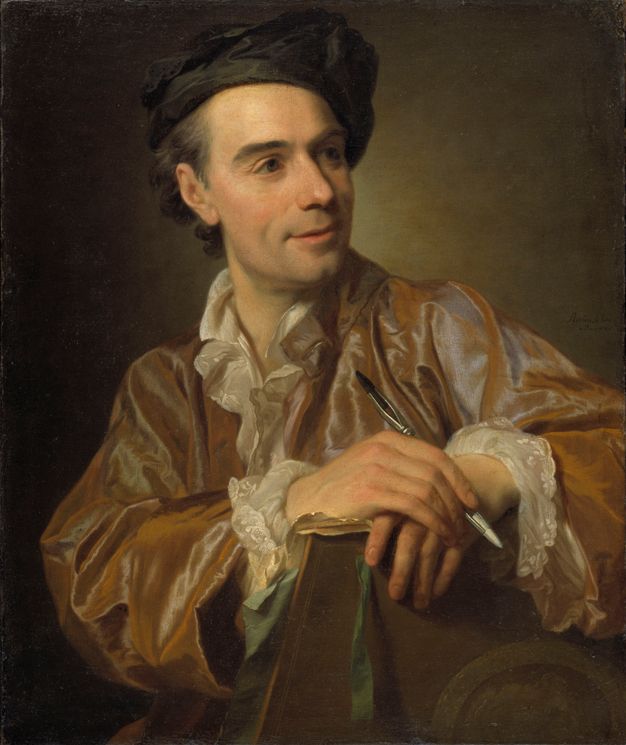
From Vernet’s financial expenditures, material surroundings, and personal relationships, it is clear that he took his wig very seriously indeed. This may simply have been part of Vernet’s general investment in sartorial matters (which was considerable judging by his wardrobe), but the wig was a singular item in this regard—somewhere between clothing and body, yet neither hat nor hair.14 As such, the wig’s significance is perhaps best understood by considering it in moments of presence versus absence: when it was worn and what it meant. Unlike , customarily worn only by nobility, wigs encompassed a wider social spectrum, reaching from the court to the middling sort. While thus broadly a marker of social class, the wig was more subtly a signifier of sociable formalities. Take, for instance, Alexander Roslin’s portrait of Vernet (fig. 185), where the landscapist appears without a wig, his cropped and naturally dark hair tucked under a cap. Though he wears practically the same outfit as in Van Loo’s portrait (lace shirt, silk ), his unwigged head immediately codes him as more casual, more at ease, as though there is a social boundary in one encounter that does not exist in the other. This boundary is not, however, a straightforward line between public and private spheres; in both portraits, Vernet is professionally “at work” and consciously appearing before an audience. Instead, this is a blurrier scale from semipublic to semiprivate, where the wig connotes respectful formality and its absence suggests intimacy and familiarity. As a man who invested so earnestly in his wigs as material things, we can only imagine that Vernet was equally attuned to the sophisticated social codes that these items of dress, or bodily extensions, could navigate. ‡
-
Léon Lagrange, Joseph Vernet et la peinture au XVIII siècle, avec le texte des livres de raison et un grand nombre de documents inédits (Paris: Didier et Compagnie, 1864), 119, 388. ↩︎
-
Mary K. Gayne, “Illicit Wigmaking in Eighteenth-Century Paris,” ECS 38, no. 1 (2004): 121. ↩︎
-
Lagrange, Joseph Vernet, 388. ↩︎
-
François-Alexandre-Pierre Garsault, Art du perruquier, contenant la façon de la barbe, la coupe des cheveux, la construction des perruques d’hommes et de femmes, le perruquier en vieux, et le baigneur-étuviste (n.p., 1767), 6. On artists and hair trends, see Alden Cavanaugh, “The Coiffure of Jean-Baptiste Greuze,” ECS 38, no. 1 (2004): 165–81. ↩︎
-
Garsault, Art du perruquier, 7–8. ↩︎
-
“Perruque,” Encyclopédie, http://encyclopedie.uchicago.edu/, 12:401–402; and Garsault, Art du perruquier, 7–8. ↩︎
-
“Poudre à cheveaux,” Encyclopédie, http://encyclopedie.uchicago.edu/, 13:196. ↩︎
-
Lagrange, Joseph Vernet, 252, 387. ↩︎
-
Lagrange, Joseph Vernet, 387. ↩︎
-
Lagrange, Joseph Vernet, 24. ↩︎
-
Hairdressers (coiffeurs), a separate profession, had their own artistic aspirations to break-free of the corporate world. See Alicia Caticha, “‘Neither Poets, Painters, nor Sculptors’: Classical Mimesis and the Art of Female Hairdressing in Eighteenth-Century France,” Eighteenth-Century Fiction 31, no. 2 (2019): 413–38. ↩︎
-
Hannah Williams and Chris Sparks, Artists in Paris: Mapping the 18th-Century Art World, www.artistsinparis.org; and Roger Portalis and Henri Béraldi, Les graveurs du dix-huitième siècle (Paris: Damascène Morgand & Charles Fatout, 1881), 2:565. ↩︎
-
Lagrange, Joseph Vernet, 430. ↩︎
-
For Vernet’s wardrobe, see Claude Joseph Vernet, “Inventaire après décès,” 2 March 1790, AN, MC/ET/LVI/369. ↩︎