Dog
- Joseph-Siffred Duplessis (1725–1802)
What is a dog doing in a book about things? Like many artists before and since, Joseph-Siffred Duplessis lived with a dog. On the one hand, Duplessis’s pet was a possession, something that belonged to him, like any other item of property in his Louvre logement (his , for instance, discussed elsewhere in this book). On the other hand, as an animate being rather than an inanimate object, the dog was unlike anything else in his home and unlike nearly everything else in this book. Like Collot’s , the only other animal in this collection of things, Duplessis’s dog holds an ambiguous place in these pages: it is a thing with value (both monetary and sentimental) and material properties, which Duplessis acquired, owned, maintained, and eventually disposed of; but also, it is a living creature who could behave independently of its owner and with whom Duplessis could interact and relate in very different ways. Pondering the “thingness” of Duplessis’s dog draws us into distinctly Enlightenment debates about the subjectivity of animals, a subject that many philosophers, naturalists, and theologians explored at length, usually as terrain for understanding the human condition. Were animals, following Descartes, simply automata, machines without thought, language, or feeling?1 Or were they, as the abbé de Condillac argued, sentient beings capable of reflection, sociability, and emotion?2 Modern perceptions of animals incline firmly to the latter, but Duplessis’s dog invites us to consider the nature of the pet in the eighteenth century.3 What role did the dog play in this artist’s life? And what was the affective relationship between this particular master and hound?
Ironically, the only surviving trace of Duplessis’s dog comes from the day she died. On 15 August 1788, Duplessis wrote an extremely long letter to the comte d’Angiviller, the directeur général des bâtiments du roi (director general of the king’s buildings), seeking permission to make changes to his Louvre apartments for the sake of his health and his working conditions. At the very end, the painter made a final, much more personal request, and in doing so divulged the tragedy of his very recent loss. “Permit me, Monsieur le comte, to remind you that over a year ago you once promised me a little dog that I might raise myself, from a breed of which you have both males and females, namely small Braques. Not wanting to add torments of jealousy to the existing infirmities of my old dog, I prayed that you might reserve me this favor for another time. Today she died and finding myself in such solitude following the marriage of my ward, I feel the need more than ever for that kind of company.”4
While we never discover the name or even the breed of Duplessis’s dog, the letter reveals many insights into his feelings for his pet, along with some salient details about her. For instance, we learn that she was a “chienne” (a bitch); that she was old—suggesting Duplessis had had her for a long time; that she had been sick or infirm for over a year; and that Duplessis had kept looking after her until she died. Caring for the hound through her frailty is already an indication of Duplessis’s attachment to his pet, but there is a sense of an even more complex affective relationship in the painter’s concern for her mental well-being as well as her physical health. Duplessis projects upon her the very human emotion of jealousy when he imagines how she might have felt should he have disloyally introduced a new dog into the home. While this might tell us something about the dog’s personality, it is probably more suggestive of Duplessis’s anxieties than hers, and of his dependence on her canine devotion for staving off that “solitude” that he now found descending following her death.
For an artist who never married or had children, and who lacked an extensive social circle, Duplessis’s dog had become an alternative source of companionship, upon which, it would seem, he had come to rely quite desperately. The painter lived with servants and, until she married, his ward, but loneliness was a pressing issue for Duplessis, one compounded by both physical conditions and personality traits. Duplessis suffered from numerous health complaints (of which we discover many through the story of his ), but it was his deafness that proved most detrimental to his social life. Hearing problems, he once claimed, made conversation so difficult that they had forced him to withdraw from society, instead spending long evenings miserably alone.5 Despite being so often at home, he seems not to have socialized much with his Louvre neighbors (with the possible exception of Vernet) and was apt to assume cantankerously that his colleagues were being granted privileges that he was being denied.6 With human society proving such a challenge, Duplessis’s dog became a stand-in to satisfy the artist’s needs for social interaction. Indeed, the extent to which Duplessis seems to have replaced human with canine companionship is suggested in both the crisis of loneliness prompted by her death and the solution he finds for it, namely the acquisition of a new dog. After all, that was the kind of “société” (company) that he found himself craving.
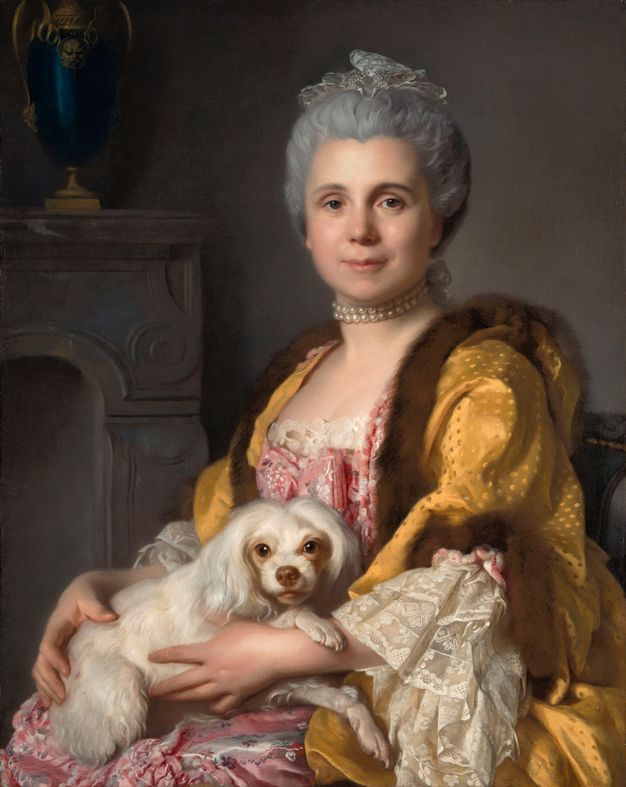
Duplessis’s brief mention of his dog in the letter is full of tantalizing insights, but it does not offer an actual encounter between master and hound, written, as it was, in the pain of her absence. We do, however, find occasional glimpses of the painter’s canine interactions in his portraits, like the exquisite Madame Fréret d’Héricourt and Her Dog (fig. 42). If a portrait is the trace of an encounter between artist and sitter, then this painting is as much a record of Duplessis’s encounter with the lap dog as it is with the lady. Certainly it is a painting that demands to be read as a double portrait. The little spaniel might be a possession like the luxurious vase behind, or an accessory like the fur-lined mantelet over her shoulders, but it is also a living being, interacting socially with both its owner and the stranger looking at it. Even if we did not know that Duplessis was a dog person, his acute attunement to the dog’s behavior in this portrait would seem enough to out him as a follower of Condillac rather than Descartes. Not only does the work bring center stage the affective relationship between a woman and her dog—their affectionate gestures of hand and paw, reaching to hold each other—but it can also be read as an articulation of canine consciousness. The spaniel’s gaze is as direct and as attentive to the artist-viewer’s presence as its owner’s, but with those heightened white highlights, the dog’s eyes become the dominant pair. Whether it was a trace of the experience or an imagined conceit, Duplessis gives the lap dog a penetrative and knowing stare with which to observe its interlocutor.
Be it in representations of endearing cognizant spaniels or in epistolary revelations about the depth of his emotional attachment to his own dog, Duplessis’s canine interactions appear strikingly familiar to the modern mindset. This is perhaps most resonant in his reaction to her death, for any pet owner who has experienced the loss of a long-term companion would recognize the infinite emptiness of a home bereft of its presence. At the same time, however, there is an unsettling disjunction in Duplessis’s reaction: between, on one hand, his distress at the loss of his beloved old dog and, on the other, the ease and immediacy with which he decides to fill the void by getting a new one. Mere hours after her death, the painter was already setting plans in motion to replace her. Duplessis’s response thus looks less like grief at the death of a particular hound—an individual with whom the painter had a unique relationship—and more like generalized anxiety at finding himself alone in his home. Nevertheless, this reaction underscores Duplessis’s feelings toward his dog, very different than those toward any other thing in his apartments, and the distinct role the pet played in his life. There may have been some sense of interchangeability (any dog would do), but no other material object in his Louvre logement could stave off loneliness and become a replacement for human company.
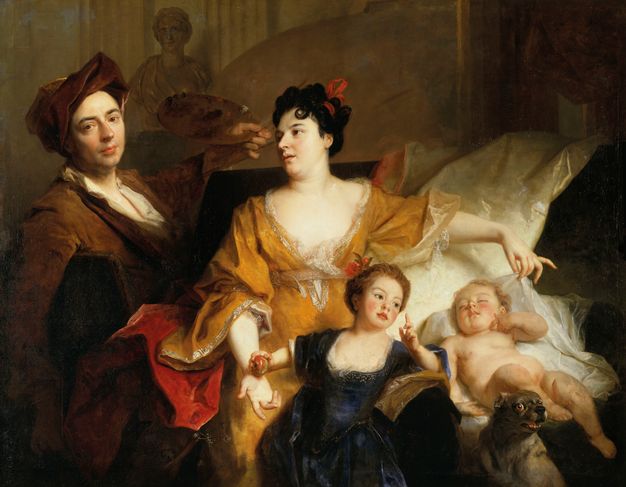
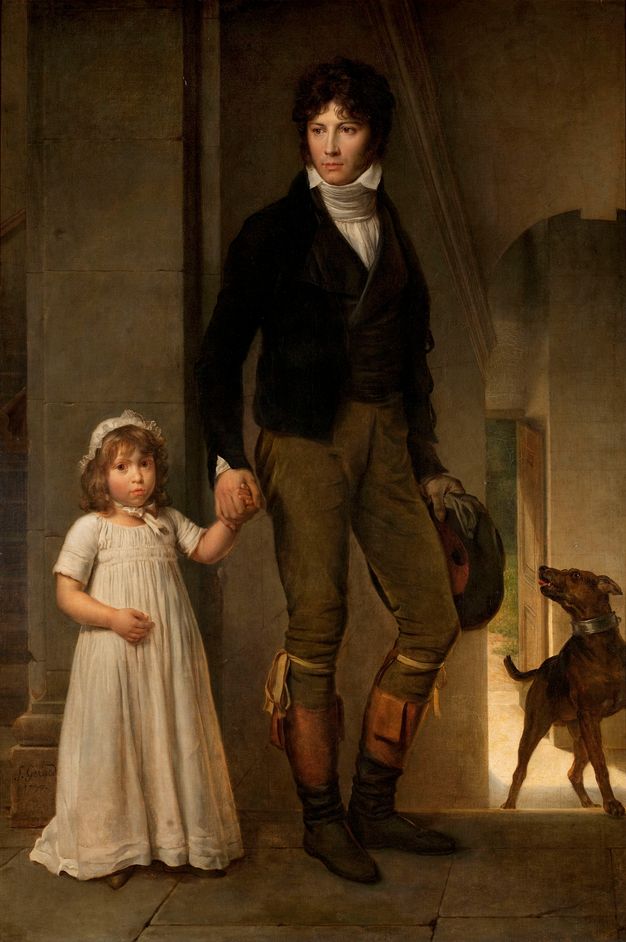
Duplessis may have been more dependent on his dog than some people, but he was far from alone in his canine preferences. Dogs were, according to the naturalist Louis-Jean-Marie Daubenton, the most popular pets in eighteenth-century France because they were the animals that attached themselves most easily to humans.7 It is difficult to discern quite how many of Duplessis’s colleagues were fellow dog owners, because the animals seldom appear in archival records: there was no paperwork associated with dog ownership (no licenses or permits), and unlike inanimate objects, they do not feature in after-death inventories. But if family portraits are evidence to go by, then other dog-owning artists certainly emerge. Nicolas de Largillière appears to have been the proud owner of a charming doguin, or pug, who springs into the foreground of the painter’s Portrait of the Artist and His Family (fig. 43). Jean-Baptiste Isabey, meanwhile, is shown with a larger dog—an early pinscher or terrier, or a mixed breed, known at the time as a “chien des rues” (street dog)—who bounds up the steps in his collar to join his master in François Gérard’s Jean-Baptiste Isabey and His Daughter, Alexandrine (fig. 44).8 Choice of breed, as ever, reveals something about the owner, even if merely a suggestion of lifestyle.9 Largillière’s pug—a favored lap dog of noble ladies—conjures urbane and aristocratic connotations, while Isabey’s seems a more practical choice, both pinschers and terriers being bred to chase vermin (particularly useful for any artist living in the Louvre, which was known to have a rat problem).10 While the breed of Duplessis’s beloved old dog remains unknown, the breed of his potential new dog is mentioned explicitly as a Braque, a type of French hunting dog, usually white with brown or black markings, and distinguished by its large, hanging ears.11 Rather than indicating any inclination on Duplessis’s part to engage in sporting activities, his choice seems to have been entirely determined by the fact that this was the type of dog that d’Angiviller bred. Indeed, Duplessis specifies that he wanted a Braque “de petite espèce” (of a small size), suggesting he was aware that this was not the most appropriate breed for an urban lifestyle and ensuring he got a small one that would be content living in his Louvre lodgings.
As source proved more important than suitability for Duplessis, in this instance, choice of breed reveals less about the painter’s lifestyle and more about his relationship with the directeur général des bâtiments. For as much as this is a story about a man and his dog, it is also a story about an artist and his patron. At the very end of his letter, Duplessis makes quite overt how entwined the two relationships were, adding a final rhetorical flourish to drive home his request: “If I got it [the dog] from you, I would love it even more, and I could say in truth that I do not possess anything—not even my dog—that was not a kindness from you.”12
In a deft display of professional bargaining (or emotional manipulation, depending how you read it), Duplessis made a plea that would have been difficult to refuse. Not only did he solicit the dog as a gift, he also established the terms upon which that gift would be given, namely a “bienfait”—an act of kindness. Like any other academician living in the Louvre, Duplessis was dependent on the directeur général des bâtiments as both employer and landlord. Wielding power over an artist’s professional success and their quotidian comforts, it was d’Angiviller who distributed the commissions for royal portraits that had made Duplessis’s name, and d’Angiviller who made every decision about lodgings in the Louvre (including the drama of Duplessis’s ). In the context of that dynamic, the painter’s request for a dog was a dexterous ploy to push their professional relationship firmly into the personal: this particular “kindness” would be a gift from the man (d’Angiviller), rather than the role (the directeur général des bâtiments). Indeed, it is hard to imagine any other inanimate object being quite as effective in this regard as the dog. Not only did Duplessis connect with d’Angiviller’s own penchant for dogs (and his preferred breed), but even more compellingly, Duplessis’s affective relationship with the dog became a proxy for tacitly expressing an affective relationship with the comte: were it a gift from you, “I would love it even more.” Sadly, there is no surviving response to Duplessis’s letter, so we may never know the outcome of his impassioned canine gambit. ‡
-
Peter Harrison, “Descartes on Animals,” Philosophical Quarterly 42, no. 167 (April 1992): 219–27. ↩︎
-
Étienne Bonnot de Condillac, Traité des animaux (1755) (Paris: Librairie Philosophique, 2004), 150–87. ↩︎
-
On modern relationships between dogs and humans, see Majorie Garber, Dog Love (New York: Touchstone, 1996). ↩︎
-
Letter from Duplessis to d’Angiviller, 15 August 1788, AN, O11674. Jules Belleudy, J-S Duplessis, peintre du roi, 1725–1802 (Chartres: Durand, 1908), 106. ↩︎
-
Duplessis made these remarks in another letter to d’Angiviller. Belleudy, Duplessis, 97. ↩︎
-
See for instances of Duplessis claiming that other artists were allowed what he was being denied. On another occasion, Duplessis complained that he had been forced to take in a royal officer as a lodger when his neighbors—Hubert Robert, Alexander Roslin, and Anne Vallayer-Coster—had been exempt from this service. Belleudy, Duplessis, 97, 106–7. ↩︎
-
“Chien,” Encyclopédie, http://encyclopedie.uchicago.edu/, 3:327–28. Cats have since taken over in popularity in France, but in the eighteenth century cats held a much more ambiguous place, as fascinatingly discussed in Amy Freund and Michael Yonan, “Cats: The Soft Underbelly of the Enlightenment,” Journal18 7 (Spring 2019), http://www.journal18.org/3778. ↩︎
-
Georges-Louis Leclerc, comte de Buffon, “Le Chien,” Histoire naturelle, générale et particulière, 36 vols. (Paris: L’Imprimerie Royale, 1755), 5:229. With thanks to Rebecca McAuley and her colleagues for assistance identifying the breed of Isabey’s dog. ↩︎
-
On common dog breeds in eighteenth-century France, see Buffon, “Le Chien,” 5:239–63. ↩︎
-
Mercier describes “a multitude of rats” making their home in the Louvre. Louis-Sébastien Mercier, Tableau de Paris, 12 vols. (Amsterdam: n.p., 1783), 5:239. ↩︎
-
On dogs and hunting in this period, see Amy Freund, “Sexy Beasts: The Politics of Hunting Portraiture in Eighteenth-Century France,” Art History 42, no. 1 (2019): 40–67. ↩︎
-
Duplessis to d’Angiviller, 15 August 1788, AN, O11674. Belleudy, Duplessis, 106. ↩︎