Journal
- Johann Georg Wille (1715–1808)
For four decades Johann Georg Wille, the German-born, Paris-based engraver, kept a journal.1 From 1759 to 1793, regular entries record his quotidian doings from when he was a forty-something agréé (provisional member) at the Académie until a few months after his seventy-eighth birthday. In our search for things through which to retrieve their owners’ lives, an artist’s journal presents the ultimate biographical metaobject: a thing that exists entirely in order to record that person’s experiences in firsthand accounts. Usually, the biographical value of a journal comes from considering it as a text. Indeed, ever since the publication of Wille’s journal by the art historian Georges Duplessis in 1857 (forty-nine years after the artist’s death), it has been read as a crucial source of insights, most of which can be gleaned by merely consulting Duplessis’s transcription.2 Wille’s writings grant access to his professional activities, international social networks, and personal relationships, and as a whole the text offers a fascinating encounter with a singular moment of French history. Inadvertently chronicling the final chapter of the ancien régime, Wille’s journal takes its reader on a journey from the seeming immutability of Louis XV’s reign, through the escalating uncertainty of the Revolution, to the chaotic dismantling of an entire social order as the new Republic emerged. But what if Wille’s journal is encountered not just as a text but as a “thing”? What stories emerge not from the meaning of the words but from the materiality of the notebooks that contain them? When it is the biography of the object itself—rather than the autobiographical text inscribed in it—what else might Wille’s journal reveal about the engraver’s habitual quirks, lived rhythms, and unexpected disruptions?
As a material thing, Wille’s journal survives as a set of five bound notebooks (fig. 86), dispersed today between the Bibliothèque Nationale de France (the four volumes that Duplessis published, all donated to the library by Wille’s son, Pierre-Alexandre, in 1834) and the Frits Lugt Collection (a volume that had been thought lost but which reemerged in 2005).3 Even from a first glance at these notebooks, there are patterns of consistency and deviation in their materiality that reveal histories of use—habits and departures—suggesting Wille was a man who enjoyed routine without being beholden to it.
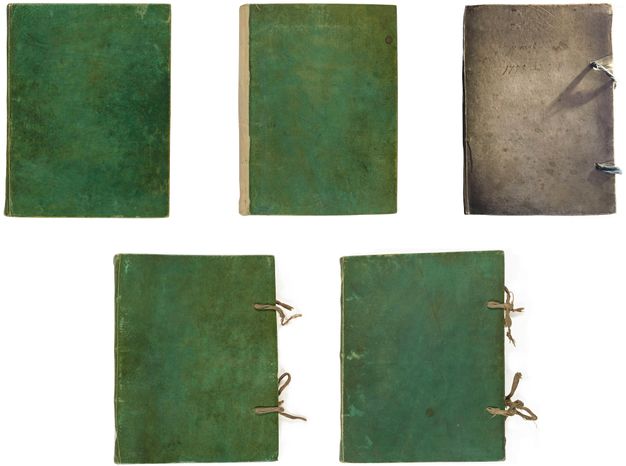
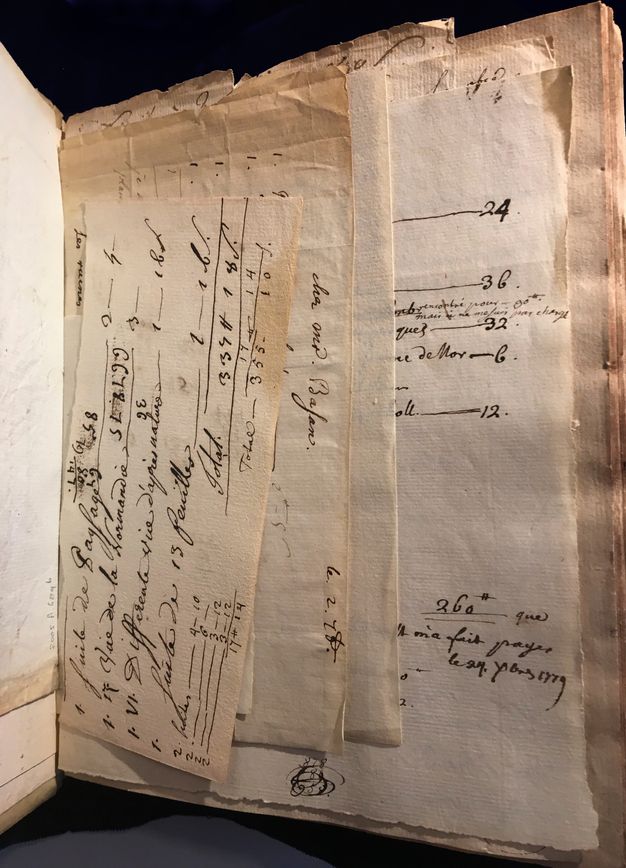
Anyone who keeps a diary or notebook for random jottings will understand the importance of its physical characteristics for determining aspects of use and storage, both during its active life and in retirement. All Wille’s notebooks were the same size and format: octavo carnets of around 22 by 17 centimeters. Too large to be easily carried in a pocket, Wille’s journal was probably a homebound object, likely a denizen of his “cabinet de travail” (workroom), given the prominence of work-related matters in the entries: business activities, correspondence, and other professional affairs.4 It is not difficult to envisage the evenly sized volumes of his journal stored together, somewhere readily accessible for reference, gradually accumulating over the years into a set, albeit a mismatched one. For, despite their prevailing physical similarities, there are also minor differences: four of the notebooks are covered in green parchment and one in natural parchment; three have integrated ribbons to tie them shut, and two have none. Given the stash of notes, letters, and random slips of paper (lists, calculations of prices, business cards, etc.) still tucked into the inside cover of the Frits Lugt volume (fig. 87), the ribbon ties were no doubt a practical solution for this “temporary” filing system, keeping every scrap safely contained. It certainly seems as though Wille developed a preference for ribbons, as only the earliest volumes are without this handy feature. Wille’s color choices, meanwhile, reveal an interruption rather than a change of habit, with the anomalous natural-covered notebook disrupting Wille’s evident aesthetic preference for green covers. Perhaps this was an experimental switch that did not stick, or perhaps green notebooks were just temporarily out of stock in December 1776, when Wille had filled his previous notebook and was on the hunt for a new one.
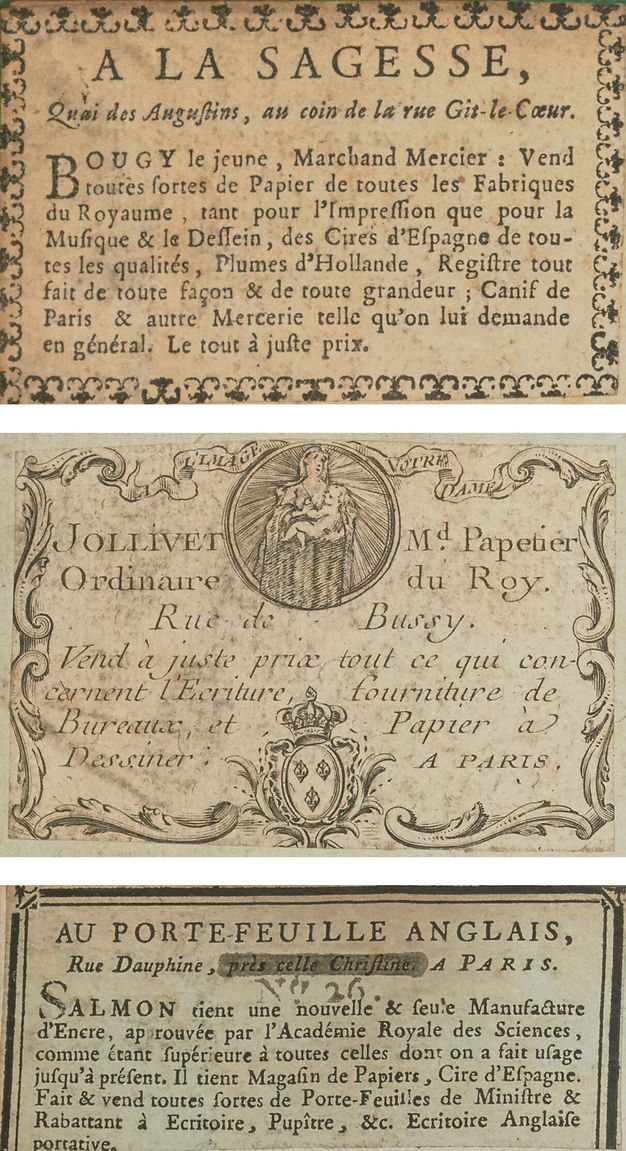
The question of where Wille purchased his notebooks can be answered with remarkable specificity. Unlike most of the commodities in this book, whose precise point of retail can only be guessed, three of Wille notebooks still bear the small trade cards that stationery merchants often pasted inside the cover of carnets and ledgers (fig. 88). Each seller’s label is from a different shop, suggesting that whatever preferences Wille formed regarding his notebooks, those habits did not extend to the act of procuring them. One came from “A La Sagesse,” a marchand mercier on Quai des Augustins that specialized in paper, sealing wax, and writing ; another was bought at “L’Image de Notre Dame,” a marchand papetier (stationer) on Rue de Buci selling office supplies, drawing paper, and writing equipment; and another was from “Au Portefeuille Anglais” on Rue Dauphine, run by an ink manufacturer, who sold paper and wax but specialized in stationery wallets and portable writing desks. These ephemeral vestiges of commerce draw attention to the ready availability of consumable items like notebooks, stamping each of these strikingly similar objects as an item sold in three different kinds of shop. But as all these shops were located within a few streets of each other, the trade cards also evocatively locate Wille’s journal in a particular Parisian neighborhood.
Most artists would not have had quite so many stationery options on their doorstep, but Wille’s Left Bank quarter of Saint-André-des-Arts was in the heart of Paris’s printmaking and bookselling districts, so paper—bound, loose leaf, printed, or plain—was the specialty of the area. Not surprisingly, this was the neighborhood that Wille (along with many of his engraver colleagues) lived throughout his career, in the same house on Quai des Augustins, overlooking the Seine and the Île de la Cité.5 As the journal of a German émigré who settled in Paris in 1736 but maintained active international business connections, Wille’s writings have often been used as a source for thinking about quite global ideas, from Franco-German cultural transfer to European art markets.6 But the trade cards in these notebooks are a material reminder of Wille’s more local experiences in the streets of Paris. Indeed, in the pages of his diaries, international art deals are frequently recorded alongside quieter observations of life in the city, like the time in February 1764 when the Seine flooded so badly he had to use a boat to leave his house, or his encounter in July 1784 in the Jardin du Luxembourg with the latest aeronautical technology (as described in this book’s entry on Janinet’s ).7 As “lived” objects that themselves once resided in that Quai des Augustins home, Wille’s notebooks have a particular poignancy when recording things experienced in those very spaces, whether crises of family life (like in 1762, when both his sons caught chicken pox at the same time), or frustrations of artistic practice (like in 1773, when he had to abandon months of work on an uncooperative plate, causing him to bemoan “the maliciousness of copper”).8 Most striking of all, however, are the accounts of dramatic historic events that happened on his doorstep and that Wille witnessed from his home. From the vantage of his window onto the Seine, for instance, Wille watched all night on 8 June 1781 as the Paris Opera burned to the ground, and he stood there again eleven years later, on 12 August 1792, to watch the revolutionaries topple the statue of Henri IV on Pont-Neuf.9
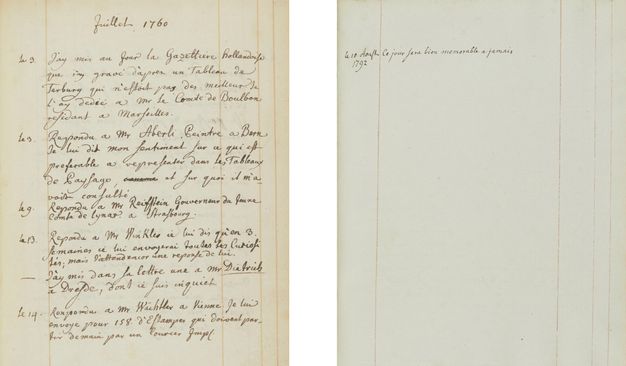
Kept regularly for decades, Wille’s journal was both a record and a practice. Over time it became a useful chronicle of everyday minutiae and extraordinary events; but in its making, it was a routine of writing that became habitual. This makes us wonder when Wille began his diary, how his rhythms developed, and why he eventually stopped. While there is likely a missing first volume, which, if ever found, might shed light on Wille’s initial intentions, the surviving material evidence suggests that Wille may have originally planned to keep an (like Lagrenée’s, discussed elsewhere in this book).10 The notebooks’ red-ruled pages reveal a stationery selection oriented to accounting (fig. 89). Their five columns of different widths are designed to accommodate bookkeeping records of date, item, and price in livres (pounds), sols (shillings), and deniers (pence). Every volume of Wille’s journal is thus an account book, distinguished as such by these prominent red lines, and yet in none of the surviving notebooks did he ever use the columns as they were intended. Writing against the affordances of the page, Wille always wrote his entries in prose, even when noting sums of money spent or received. But whatever the rationale behind Wille’s original choice, his continued preference for account books might be explained in the habits of practice he developed around those red lines. As evident on a sample page from July 1760 (see fig. 89), for instance, Wille tended to deploy the first column as it was intended, to record the date, and then the last two narrow columns to serve as a page margin, only occasionally letting a misjudged word trail over the lines.
Over the years, certain patterns of use became fixed, but Wille’s relationship with the journal and its role in his life were far from static. There were, for instance, annual rhythms. Wille made his entries frequently, usually several times a month, though not always with predictable regularity, except for his habitual entry on 1 January to mark the new year. His longest entry of the year, meanwhile, tended to come in September, when he usually traveled to the countryside for a drawing holiday and so interrupted the quotidian flow of city life. But over the decades, there were also changing practices. Most notable is the gradual shift in form and content: from short, succinct, businesslike entries recording almost exclusively professional matters, to longer, more anecdotal entries interweaving the professional and the personal and including more observations and narrative accounts. Indeed, as time went by, each notebook served him fewer and fewer years as his longer entries filled them more quickly: the first lasted nearly ten years (1759–68), the next just over eight years (1768–76), then six and a half (1777–83), then six exactly (1783–89), and finally four (1789–93), although the last notebook did not get filled.
Along with gradual changes, there were also sudden ruptures, when Wille’s habitual rhythms and evolving patterns were halted completely. Like any life, Wille’s was occasionally interrupted by unanticipated events, some of which were so disruptive that they left their mark in the journal as either physical or temporal gaps. On 15 October 1778, for instance, Wille’s younger son, Louis-François, died unexpectedly at twenty years of age.11 Describing it as “the saddest day of my life,” Wille recorded the tragic incident in his journal and then left five unexplained blank pages after the entry. Perhaps, when Wille made his fragile return to the journal three weeks later, it was simply too difficult to carry on as before without creating some distance from that fateful day. A handful of blank pages provided a material buffer—like a physical passage of mourning—creating respectful and emotional space before an attempt to return to everyday life. A few years later, Wille experienced another death that left a different kind of gap. On 29 October 1785, Wille’s wife of nearly forty years, Marie-Louise Deforge, died after a period of worsening ill health. So overwhelmed was the engraver by this loss that, for the first time in his life, he stopped writing in his journal completely. For over a year, he wrote nothing, as though in a kind of hiatus, unable to reconnect with the routines and rhythms of his previous existence when nothing around him was the same. Then, at the beginning of 1787, he came back to the notebook to make a tentative reprisal of his old journaling habits. In this moment of re-engagement, he made a rare self-reflexive mention of the diary itself, writing: “Since the month of December 1785, I have written almost nothing in this journal, having had such sadness in my heart from the death of my dear wife, who I will never forget—and here we are in the month of March 1787.” Somehow, in order to overcome the gap, Wille first needed to articulate it, but even then it took him many months to reestablish former rhythms and create new habits.
Despite disruptions and detours, Wille maintained a relationship with his journal for four decades. What compelled him, it is difficult to say. As the essayist Joan Didion notes, sometimes the impulse to write things down is peculiarly compulsive: “inexplicable to those who do not share it, useful only accidentally, only secondarily, in the way that compulsion tries to justify itself.”12 This certainly seems to have been the case for Wille. In 1792 he reflected on his journaling practice in an act of retrospective repurposing. A German printseller had asked him for “the story of his life,” and Wille noted that, while he was not vain enough to have produced such a thing, if, after he was gone, anyone should want to write his story, they would find what they needed in these pages.13 Though not intended as such from the outset, this was the function Wille started envisaging for his journal, perhaps as a result of the self-conscious turns it took during the Revolutionary years. As the world transformed around him, and ordinary life became a constant source of extraordinary experience, Wille’s entries developed a new historicizing tone and sometimes paralyzing self-awareness. On 10 August 1792, for instance, the day the new Republic was declared, Wille began his entry grandly, proclaiming, “This day will be remembered forever” (see fig. 89). But there he ran out of steam and he wrote nothing more. Perhaps feeling unable to do the account justice that day, he left three pages, presumably planning to return when he could find the words it deserved. But he never did. And the following year, Wille stopped writing his journal altogether, though the notebook was only half full and he would go on to live for fifteen more years.14 Whether it was the impending weight of posterity or something else that disrupted Wille’s journaling habits, it is no surprise really that Wille should end his old routines in 1793, that year of endings and new beginnings for the entire nation.15 It was, in many ways, a fitting time to finish. ‡
-
It is possible that Wille began keeping the journal before 1759. If so, the earlier volume is currently untraced. ↩︎
-
Mémoires et journal de J.-G. Wille, graveur du roi, ed. Georges Duplessis, 2 vols. (Paris: Veuve Jules Renouard, 1857). Some of the most comprehensive explorations of Wille’s journal are to be found Élisabeth Décultot, Michel Espagne, and François-René Martin, eds., Johann Georg Wille (1715–1808) et son milieu: Un réseau européen de l’art au XVIIIe siècle (Paris: École du Louvre, 2009). On the journal as a source for understanding Wille’s friendship with Greuze, see Hannah Williams, “Academic Intimacies: Portraits of Family, Friendship, and Rivalry at the Académie Royale,” Art History 36, no. 2 (April 2013): 338–65. ↩︎
-
For a detailed analysis of the Frits Lugt volume, see Peter Fuhring and Hans Buijs, “Quelques relations de Wille en Hollande: Lecture préliminaire d’un volume du Journal récemment apparu,” in Décultot, Espagne, and Martin, Johann Georg Wille, 223–46. ↩︎
-
Cabinet de travail is the term Wille uses to refer to his studio. ↩︎
-
On the geography of Paris’s engraver communities, see Marianne Grivel, Le commerce de l’estampe au XVIIe siècle (Geneva: Droz, 1986); and Hannah Williams, “Artists and the City: Mapping the Art Worlds of Eighteenth-Century Paris,” Urban History 46, no. 1 (2019): 106–31. ↩︎
-
See several of the essays in Décultot, Espagne, and Martin, Johann Georg Wille, and the introductory sections to Elisabeth Decultot, Michel Espagne, and Michael Werner, Johann Georg Wille (1715–1808): Briefwechsel (Tübingen: Max Niemeyer, 1999). ↩︎
-
Johann Georg Wille, Journal, BnF, 1:102v; BnF, 3:27v. ↩︎
-
Wille, Journal, BnF, 1:73; and BnF, 2:116v. ↩︎
-
Wille, Journal, Frits Lugt volume, n.p.; and Wille Journal, BnF, 4:58. ↩︎
-
In 1792 Wille claims to have been keeping his journal for “more than forty years,” but the surviving volumes cover a total of only thirty-four years. Wille, Journal, BnF, 4:86. On the likelihood of another volume, see also Fuhring and Buijs, “Quelques relations de Wille,” 224. ↩︎
-
Wille, Journal, Frits Lugt volume, n.p. ↩︎
-
Joan Didion, “On Keeping a Notebook,” Slouching towards Bethlehem (London: Fourth Estate, 2017), 132. ↩︎
-
Wille, Journal, BnF, 4:85v, 86. Duplessis cites this justification in his preface, Mémoires et journal de J-G Wille, xv–xvi. Ironically, Wille did write a biographical account, known as his “mémoires,” which was published by Duplessis in 1857 in the first volume of the journal. ↩︎
-
On Wille’s reasons for stopping this and his other writing activities during his later years, see Fuhring and Buijs, “Quelques relations de Wille,” 224. ↩︎
-
The year 1793 began with the execution of the king, Louis XVI, in January and continued with the dismantling of former state structures, including, in August, the Académie Royale de Peinture et de Sculpture. ↩︎