Type of Object
Crayon
- Jean-Baptiste Huët (1745–1811)
Crayon is a generic term for a commonplace object found in every eighteenth-century studio.1 In spite of its ubiquity, we know little about it. We grasp the crayon only indirectly, through its products: the mass of sketches, studies, and drawings it drew forth. However, a set of four chalk head studies by the painter Jean-Baptiste Huët, reproduced by Louis-Marin Bonnet sometime after 1780 (fig. 32), allows us to begin to understand the crayon from the other end. The prints inform the viewer that the specific crayons used by Huët had been manufactured by André Nadaux, whose shop was located on the Rue de la Vieille Draperie, Île de la Cité.2 They were sold in packets of a dozen, wrapped in blue paper and sealed with wax stamped with a fleur-de-lis.
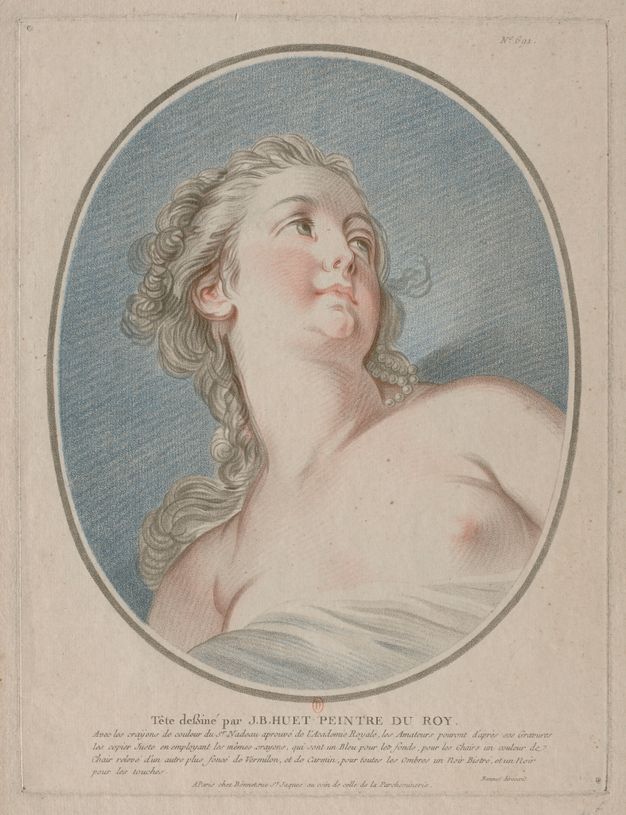
Nadaux, a printmaker, draftsman, and natural scientist, was also a shopkeeper and specialist supplier of artists’ crayons.3 In 1780 he bought the exclusive rights to the “secret” of his crayons de composition from Gabriel Dumarest, a “draftsman” on the Pont Notre-Dame. From the contract of sale between the two tradesmen we learn that for an annuity of 200 livres, Dumarest agreed to provide Nadaux with recipes for assorted crayons and a written explanation of the techniques necessary to their production.4 In addition, he consented to assist Nadaux practically in mastering the “secret,” time and inclination permitting. Before Conté, it seems, therefore, crayons were produced on a small scale and that the integrated process could only be fully transferred by demonstration.5
Dumarest had built up his business in the 1750s supplying the Académie and its members, a market that Nadaux hoped to take over, notwithstanding the fact that in the deed of sale Dumarest expressly declined to recommend Nadaux’s crayons to his former clients. Undaunted, Nadaux presented a copy of the notarized contract to the Académie in April 1780 in order to obtain its imprimatur and formal recognition of himself as Dumarest’s legitimate successor.6 In October, he successfully petitioned the Maison du Roi for the title of Fabrique Royale de crayons de composition, and at the very end of the year he published an account of his success together with a full description of his products in a pamphlet for which he designed an ostentatious frontispiece (fig. 33).7 Where, as Charlotte Guichard has argued, Bonnet’s prints after Huët sought to attract the attention of amateurs, Nadaux’s pamphlet strongly suggests that his crayons were primarily things for professional use.8 Indeed, such allegedly was his concern for the Académie and its members that he promised to discount the price of his crayons for its students.9
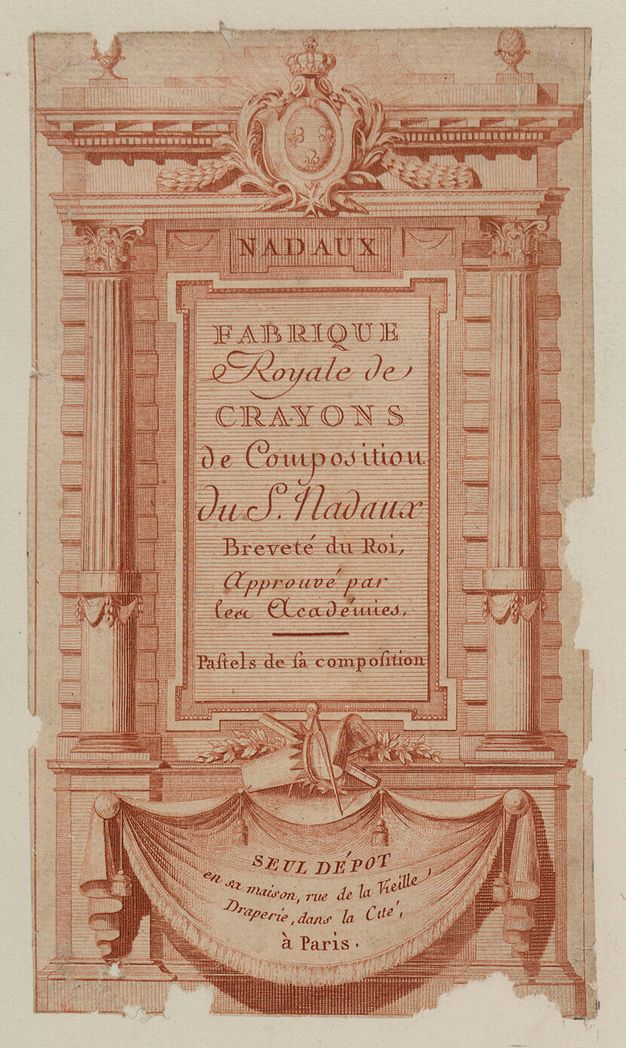
Intimately associated with the conceptual dimension of art, with the contours of thought, how can we understand the thingness of this thing, that which emerges only in practice? Nadaux was not willing to divulge his secret; the matter and composition of his crayons remains unknown.10 However, if we divert our attention from the mystifications of his publicity and redirect it at his critique of conventional drawing materials, his crayon will become historically present to us in new ways. Nadaux stressed the flaws in naturally occurring red and black chalk and in charcoal. He described the ways in which impurities interrupt the flow of the drawing line and how the frangibility of some minerals compromised both the permanence and price of the disegno. When natural sanguine is too soft, the pencil point breaks; when it is too dry and hard, it “skins” the support.11 Dry charcoal is, he notes, unstable, and lines drawn using it often detach themselves from the paper; meanwhile, the vitriol in oiled charcoal attacks the paper, and the linseed oil with which it is infused can turn black lines a brassy yellow.12 In these instances of breakdown, we momentarily glimpse the thingness of crayon;13 simultaneously, we are also made aware of the socially and culturally encoded values attributed to the properly functioning object. That is to say, that the qualities that Nadaux singled out as virtues of his alternative, “chemically” produced compounds were those that, metaphorically speaking, were also said to define properties of rational thinking: firmness, clarity, integrity, coherence, stability, and permanence. The challenge is to find the materiality in this (drawing) instrument, which seems precisely to disavow it.
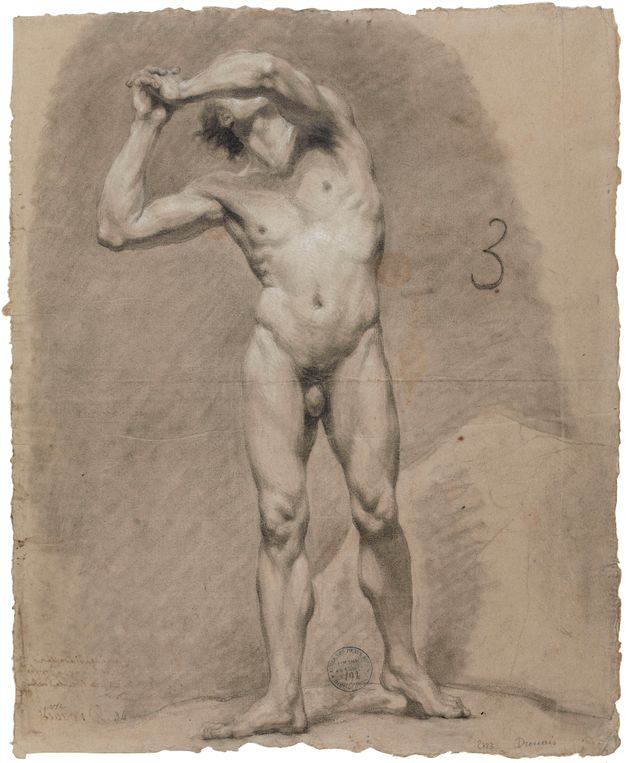
Nowhere was the conceptual thinking associated with drawing made more explicit than in the teaching at the life school, and in so-called académies, drawings of the nude (fig. 34).14 The male nude was its focus because, according to tradition, the complexity of man’s body was such that study of it encompassed all others for shape and shading, line, and light. The uncompromising, categorical division that the “firm” line contours between figure and ground coupled with the complications of the human body led Charles-Antoine Jombert to propose problem-solving techniques: an ocular compass for the perceptual measurement of symmetries and alignments of the body’s parts, and for calculation of their relative proportions, or an abstract, mental grid of perpendicular lines to net the body and allow the draftsman to grasp the angles of deviations of the body’s curves.15 Such strategies of process predate, of course, the invention of Dumarest-Nadaux’s crayons but what these crayons, offered in terms of improved flow, evenness, and firmness very likely promoted further the role of perception and strategic thinking over motor control of the medium as the defining art of drawing.
If we can say that the material properties of drawing media enabled and furthered the development of cognitive thinking, that thinking nevertheless returns to the body, both the physical and the social body. Not just in the anecdotal, everyday sense that crayons were often pocket objects for artists,16 doubly intimate, by physical proximity and by association with bread (crayon’s eraser), but also because in terms of art’s objects, the body was not only its greatest challenge, it was also its most familiar and intimate subject: experienced and known from the inside. Calculation of shape and size were made in relation to the artist’s own (generally male) body, and in relation to the drawing tools that did its duty.17 In Charles Natoire’s depiction of the life school (fig. 35), a student in a black hat, on the far right, raises his pencil to measure the proportions of the models before him. Crayon holders () were, according to Claude-Henri Watelet, a standard size: a demi-pied (half foot).18 Units of measure in the eighteenth century were based on the body: thumbs, hands, feet, stride. For the eighteenth-century artist, the body was by default the site of skilled perception, or what Jombert termed “justesse” (accuracy).19
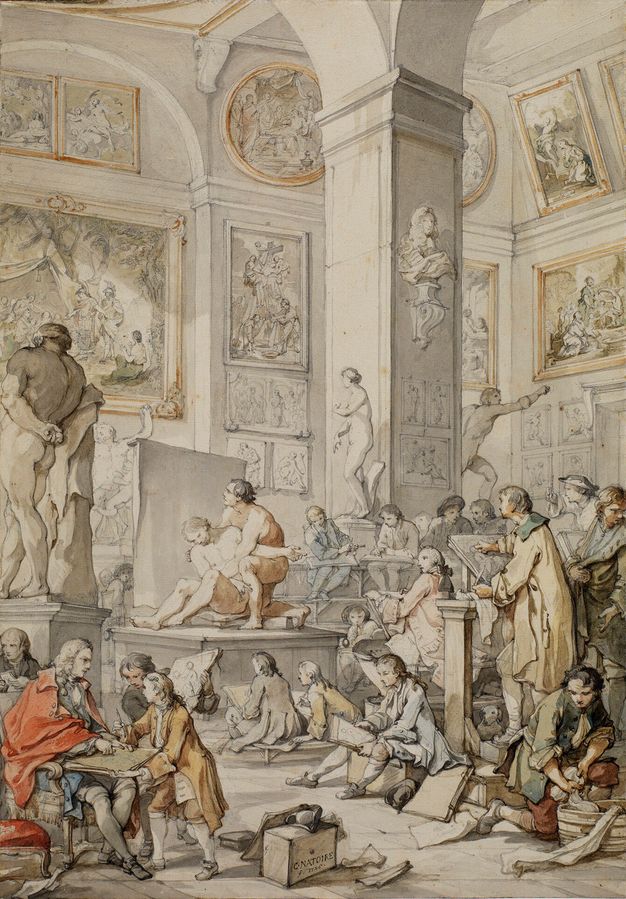
That mathematical and geometrical sensibility was not developed in isolation and alone but in the thick of the drawing school: with others. The arrangement of the benches and desks in tiers and in a semicircle around the model, as shown in Natoire’s watercolor, served to activate the young draftsman’s proprioception and allowed him to learn from his awareness of his own body’s position in relation to those of others, as well as from the object of his task. Above–below, near–far, greater–smaller, before–behind were experienced as the material conditions of perception as well as the syntax of visual representation.
Natoire’s image depicts not only the arrangement of persons and things in his narrative of learning, it also encodes social values. The beginners are positioned unchaired and below the more advanced students, and the professor sits before, enthroned in the foreground. He, possibly Natoire himself, holds his students to order, a discipline he enacted not only formally by his rank but also by his posing of the model and through the matter of crayon. According to Jombert, professors often forbade students to sharpen their pencils more than once during a drawing session, and in so doing compelled them to reproduce the hierarchies of sharp outline (trait) and blunt shading, representation and illusion, that were the foundation of the humanistic theory of art.20
At the time that Huët had bought and was using Nadaux’s crayons, he had long since left the classroom. For him, as no doubt for the purchasers of Bonnet’s prints after his Têtes de femmes, the attraction and value of Nadaux’s products lay in their colors—red, blue, and green.21 Arguably that freedom to cherish crayons on grounds other than line was won by the prior internalization of linear values to the point that habituation pushed them below the level of conscious notice. §
-
We have chosen the French crayon over the English pencil because a pencil refers to a drawing tool with a graphite core, whereas crayon is an inclusive noun whose meaning included charcoal, black and red chalk, and pastel, in addition to graphite. For contemporary definitions, see Jacques Lacombe, Dictionnaire portatif des beaux-arts (Paris: Hérissant & Estienne, 1752), s.vv. “Crayon,” “Crayons,” “Crayonner”; Antoine-Joseph Pernéty, Dictionnaire portatif de peinture, de sculpture et de gravure (Paris: Bauche, 1757), s.vv. “Crayon,” “Crayonner.” For the evolution of crayons into modern pencils, see Henry Petroski, The Pencil: A History of Design and Circumstance (London: Faber & Faber, 1989). ↩︎
-
On the prints, see Jacques Hérold, Louis-Marin Bonnet (1736–1793): Catalogue de l’oeuvre gravée (Paris: Société pour l’Étude de la Gravure Française, 1935). ↩︎
-
On André Nadaux (1726–1800), see Neil Jeffares, Dictionary of Pastellists before 1800, http://www.pastellists.com/Articles/Nadaux.pdf. ↩︎
-
Constitution viagère, 12 February 1780, AN, MC/ET/CIX/751. ↩︎
-
On the transformations in manufacturing brought about by Nicholas-Jacques Conté, see Petroski, The Pencil, 70–78. ↩︎
-
PV, 9:19. ↩︎
-
For the correspondence between Antoine-Jean Amelot and the comte d’Angiviller on this matter, see AN, O1/1916:1780/345, 355, 356. ↩︎
-
Charlotte Guichard, Les Amateurs d’art aux XVIIIe siècle (Seyssel: Champ Vallon, 2005), 244–45. ↩︎
-
André Nadaux, Fabrique royale: Description et analyse des crayons de composition (Paris: Nadaux, 1780). See AN, O1/1674/171, 174, 175 on Charrier, former laboratory assistant to Claude de Bernières at the Ponts et Chaussées, who lived at the Louvre and claimed to have invented “crayons de composition” that he sold to Académie students in the 1780s. ↩︎
-
Nadaux refused to reveal his secret and forfeited a medal awarded him by the Société d’émulation for its invention; see Lilianne Hilaire-Perez, Invention technique au siècle des Lumières (Paris: Albin Michel, 2000), 214–15. ↩︎
-
Nadaux, Fabrique royale, 9–10. ↩︎
-
Nadaux, Fabrique royale, 28–30. ↩︎
-
On “thingness,” see Bill Brown, “Thing Theory,” Critical Inquiry 28, no. 1 (2001): 1–22. ↩︎
-
See L’Académie mise à nu, exh. cat. (Paris: ENSBA, 2009), especially cat. no. 26. ↩︎
-
Charles-Antoine Jombert, Méthode pour apprendre le dessein (Paris: Jombert, 1755), 59–60. See also Trevor Marchand, “Towards an Anthropology of Mathematizing,” Interdisciplinary Science Reviews 43, nos. 3–4 (2018): 295–316. ↩︎
-
Charles-Antoine Jombert, following de Piles, warned students against pocketing crayons because body heat dried them out. See Jombert, Élémens de peinture pratique par M. de Piles (Paris: Jombert, 1766), 39. ↩︎
-
On mathematizing in the arts, see Marchand, “Towards an Anthropology of Mathematizing,” 295–316. ↩︎
-
“Dessein,” Encyclopédie, https://encyclopedie.uchicago.edu/, 4:890. ↩︎
-
Jombert, Méthode, 59–60. ↩︎
-
Jombert, Méthode, 64. ↩︎
-
Nadaux, Fabrique royale, 33–34. ↩︎