Robe de Chambre
- Louis-Michel Van Loo (1707–71)
“Robe de chambre” (dressing gown), “robe de nuit” (nightgown), “Indienne” (India gown), “robe interieur” (house coat): these are just some of the words used in the eighteenth century to denote the garment depicted by Louis-Michel Van Loo in two self-portraits, the first in 1762, the second a year later (figs. 140, 141). The portraits describe a kimono-style robe de chambre. It has no arm or shoulder seams, and no revered collar. Instead, two widths of shot bleu céleste silk taffeta, joined, we infer, by a central seam at the back, fall over Van Loo’s shoulders and down the front. A small and simple upright band of silk inserted into slits on the shoulder line builds up the neck, and prevented the back seam from splitting.1 The detail of the visual record of cut, color and styling, the reproduction of the gown from different angles in the two self-portraits, and its reappearance in 1767 in Van Loo’s celebrated Portrait of Diderot (see fig. 137), leads Lesley Miller to propose the existence of a model object, an actual dressing gown, one belonging to Van Loo and later lent to the philosophe.2 The self-portraits thus raise specific questions about Van Loo’s wardrobe and about how he wished to be seen and remembered. They also prompt general reflection on the practices and meaning of artists’ clothing before the emergence of self-consciously styled artistic dress in the nineteenth century.3
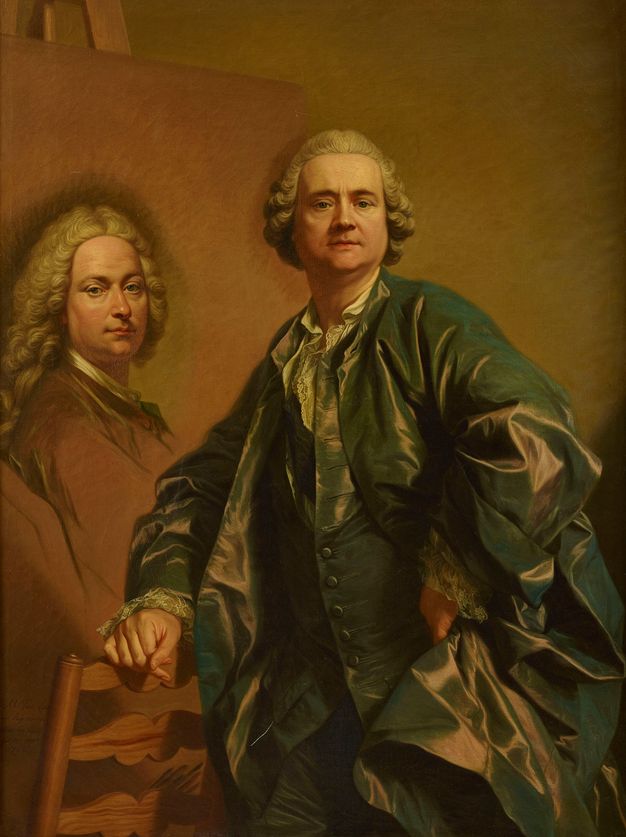
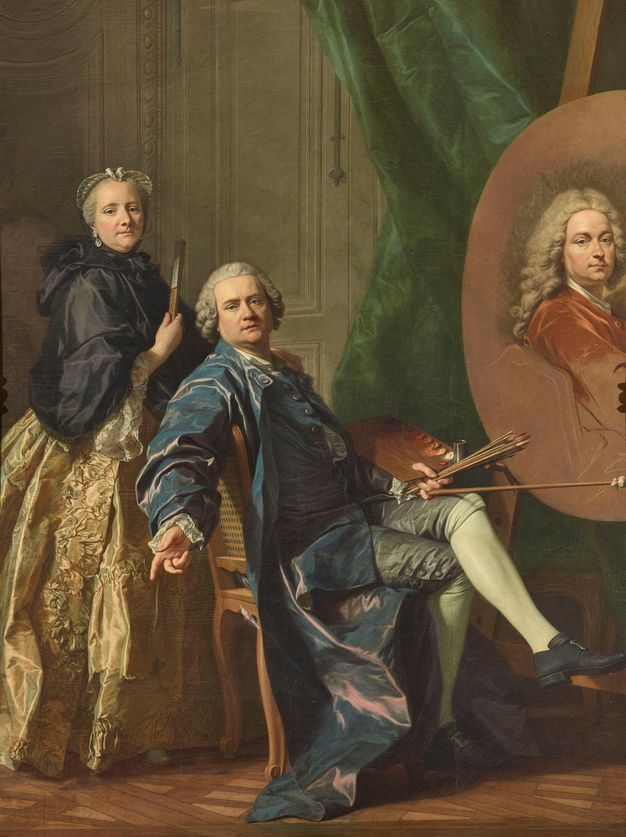
The only source of information about Van Loo’s wardrobe, other than the self-portraits, is the inventory taken after his death in 1771, or nearly a decade after his essays in self-portrayal.4 Obviously, it must be used with caution to reconstruct and interpret Van Loo’s earlier dressing habits. According to the inventory, his wardrobe was substantial and expensive. He owned nine three-piece suits (habits complets), two coats (habits), three coats with matching breeches (culottes), two coats with matching waistcoats (vestes), three frocks (fracs), two of them with matching waistcoats, two overcoats (surtouts), one of them with matching waistcoat and breeches, and five waistcoats, valued all together, with assorted hats, wigs, gloves, and shoes, at 1,816 livres, a consequential sum, roughly comparable in value to the wardrobes of the lesser court nobility.5
Nothing in the inventory corresponds to the depicted dressing gown exactly; indeed, no robe de chambre of any kind is listed, although record is made of a pair of slippers. Among Van Loo’s suits, however, is one described as of shot camlet (camelot), a stuff of mixed animal fibers (originally including camel hair, hence the name) that was produced domestically, often as imitation silk.6 It seems possible that the breeches and waistcoat depicted in the portraits are idealized versions of this set of clothes, which may originally have included a matching robe de chambre. Unlike Diderot, who famously regretted the loss of his “old dressing gown,” Van Loo seems to have had no moral or sentimental attachment to his old clothes.7 None is described in the inventory as old or worn. On the contrary, Van Loo appears to have updated his wardrobe regularly. His outfits were fashionable, as befitted a man who had been directly involved in the silk industry.8 At his death, two widths of silk embroidered with silver purl thread and sequins were found in a chest of drawers, ready for making into a waistcoat. He recycled only old linings: “different colored,” “old silk” ones.9 The inventory appears, in summary, to support the compelling evidence of the paintings—or it does not absolutely contradict it: that in the 1760s Van Loo had owned a robe de chambre of blue shot stuff that, spoiled or shabby, he had later abandoned.
What was a robe de chambre? And why, of all items of clothing, select it for this book? The dressing gown was introduced to the European wardrobe in the seventeenth century, a garment imported at first from India, the Levant, and also Japan via the Netherlands.10 By the eighteenth century both the cloth and the needlework were generally of European origin. We know, for instance, that in the 1740s, when Jean-Étienne Liotard, the so-called Turkish painter, was in Paris he had gowns of the more fitted variety, listed later in his inventory as “Greek,” with “Turkish” sashes, made by a seamstress on the Pont Notre-Dame.11 However, its association with the rare, the curious, and with luxury persisted.
Though called dressing gowns, robes de chambre were not specifically for bed but for indoors generally. Liotard earned his soubriquet not simply for possessing one but for his idiosyncratic custom of wearing his “Turkish” gown abroad, in public places.12 We adopted the eighteenth-century French term robe de chambre for our book in order to defamiliarize a little the thing we now call a “dressing gown” and invariably associate with . Not only was it not specifically connected to bedtime, it was also not necessarily a private and personal piece of clothing like linen. It could be dressed up with a wig and shoes for receiving guests or dressed down with cap and slippers when alone.13 It was, however, linked to intimacy. In the 1738 seduction scandal involving the ornamental bronze sculptor Philippe Caffieri and the daughter of landscape painter Louis Silvestre, testimony that Caffieri had been seen on the steps of the Silvestre house in a robe de chambre served as compelling evidence that the sculptor was no casual visitor to the house on Rue du Mail, but residing, in fact, cohabiting.14 Caffieri, contended his father, had been diverted from the life class at the Académie, his proper path and his filial duty, by Mlle Silvestre, whose seduction of him the dressing gown embodied: originally hers, it had been altered to fit him.15
We picked the robe de chambre for Artists’ Things because, although symptomatic of deviancy in Caffieri’s case, historians today have proposed a connection between the gown and the eighteenth-century artist so close and so general that it virtually assumes the condition of normative occupational dress.16 Liotard, who adopted the gown on his trip to Constantinople in 1738 and thereafter wore it to the exclusion of conventional dress, seems to confirm the contention. Arguably, however, his “exotic” dress served him in lieu of recognition by the Académie, and of the legal status of peintre du roi enjoyed by the likes of Louis-Michel Van Loo.17 To judge by the morceaux de réception at the Académie, the high point of artist portraits en robe de chambre was not the eighteenth century but the last quarter of the seventeenth century: in the seventy-five years after 1700, the proportion of artists depicted gowned dropped from 56 percent to just 18 percent.18 The overwhelming majority (83 percent) of portraits-morceaux executed between 1700 and 1775 depicted academicians in coats and three-piece suits, that is, formally, as public persons. The robe de chambre was not, it seems, artists’ dress in the iconic manner, say, of the artisan and the apron. The relationship between nightgown, body, and identity was rather more complex and unstable.
Claudia Denk relates developments in costume in eighteenth-century artist portraiture—specifically the (as scarf and headdress), and less categorically the dressing gown—directly to changes in modes of consumption: from luxury spending and the semiotics of appearance to being and ordinary living.19 She illustrates her case with a comparison of Van Loo’s 1762 self-portrait (see fig. 140), a conventional portrait d’apparat apparently, and Jean-Siméon Chardin’s unprecedented pastel self-portraits (see fig. 67), in which the aged still-life painter reveals himself unwigged and at work in the studio. We are led to understand that Chardin’s portrayal is at one with his occupation (unlike Van Loo’s) and to infer the cause of the fit in the actuality of Chardin’s dress practice. Chardin, Denk implies, dressed not to communicate something about his self but in order to paint; he picked clothes unconsciously, comfortable clothes because they were right for his task.20
Comfort was certainly the alibi that Liotard gave for preferring a Turkish gown to the formal French habit.21 The warm folds of the robe de chambre en chemise, which encompasses some seven plus yards of cloth, generously drapes the body and can be gathered close and tethered with a sash or left loose.22 Pace Denk, Van Loo, not Chardin, is the painter so dressed in the pictures. In the 1762 Self-portrait, the gown visibly takes the mold of Van Loo’s left arm and shoulder and rises curved over his breast. Folds are lifted and tucked in at the waist by the painter’s hand in one self-portrait; trusted to move aside for the gesture of painting in the other (see fig. 140). The dressing gown thus responds dynamically, both to and independently of the body, a freedom represented in painting by loosened collars and unbuttoned coats and waistcoats. Gores in the side seams flared the gown, releasing the arms for liberal movement, and the simple shirt-styled cuffs vouchsafed spoiling a detail of dress that fashion reserved on the coat for decoration: simple bands of braid or more elaborate embroidery.23 Among the practical conveniences of the robe de chambre, additional to cover and wrap, Diderot noted that its surplus stuff at front and hem afforded the writer a “third hand” to unclog pens, mop messes, and dust surfaces.24 To the painter, the prosthesis provided an extra hand with the potential to clean brushes and wipe palettes, blend pigments and erase lines.25
Describing the feel and agency of stuff runs the risk of assuming that the comfort, free movement, and multiple utilities afforded by nightgowns are natural bodily satisfactions common to all and self-evidently desirable, too, as conditions for work. However, in his life of Carle Van Loo (1765), Michel-François Dandré-Bardon described his subject (Louis-Michel’s uncle) as, on the contrary, intentionally uneasy in his practice, hard on himself. Carle eschewed comfort, apparently; he always worked standing and refused a fire even in the coldest weather.26 Though Dandré-Bardon does not specifically mention Carle’s clothes, the character he and others gave the great history painter suggests that Carle dressed formally to paint, that he submitted mind and body to the molding of the clothes he wore because the noble ideal embodied in gentleman’s dress was the one he wished to instill in his figurative work.27 The morceaux de réception portraits of artists in coats, not gowns—coats that by virtue of the narrow cut at back and sleeve forced an upright bearing on the wearer, shoulders back—may likewise represent the “reality” of other artists’ vocation, if not the actual daily goading provided by the clothes that wore them.28
By this account, being an artist was accomplished differently in a robe de chambre and in a coat. However, Louis-Michel’s wardrobe complicates matters. It indicates a sensitivity to the feel of cloth that extended beyond the body’s subconscious desire for comfort to a sophisticated appreciation of surfaces. The wool of his woolens was dense and soft (drap), loose and nubby (ratine), woven and knitted. The silk of his silks was “coarse grained” (gourgouran), thick ribbed (gros de Naples), close piled (velvet), and smoothly glossy (satin). Stuffs were both robust and delicately sheer (voile). Ornament was feather trimmed and embroidered with metal braid and spangles, not flat (woven or printed). To his expert’s knowledge of texture, Van Loo added an amateur’s eye, filling his wardrobe with stuffs that attracted light’s play upon them:29 the silk lining of one suit interplayed with the voile facing, shimmering forth shades of black and gray with every movement of light and every adjustment of the body. The calendared finish of another suit produced, when worn, fleeting swells of brightness and shadow, like the fall of light on water.30 The iridescence created by the different colors of warp and weft of his shot camlet suit (depicted with the matching silk nightgown) drew attention to the endless mutability of color in binary combination. The vibrant matter of his various stuffs, especially conspicuous in the generous folds of the robe de chambre, called out to Van Loo and drew him into conscious reflection on the sensuousness of surfaces perhaps every bit as inspiring to the painter of portraits as austerity was, apparently, to the painter of ancient history.
What, finally, of the robe de chambre? In Self-Portrait with His Sister (see fig. 141), its bright, almost metallic radiance unfolds and breaks against the steady glow of white stockings and the long lines of shadow twisting across the green drapery. More importantly, it tells of the difference between things with and without a sealed surface, between the open, inviting, almost hungry-looking primed canvas on the easel, willing its under-wear overpainted, and the tight, sealed surfaces of the waxed or varnished parquet floor, chair frame, and . But if on the one hand, the robe de chambre tells of painting as a process, on the other, it spoke also of the painter.
At the time Louis-Michel painted his self-portraits, he was seeking appointment to the directorship of the French School in Rome. Promotion to such high academic office favored ennobled candidates—to be exact, chevaliers of the Order of Saint Michel, the highest civil order of the ancien régime.31 Both Carle and Louis-Michel Van Loo had been knighted in the early 1750s, and in 1753 Carle exhibited a portrait of himself wearing the . The portrait was scorned for its ostentatious parade of noblesse, shockingly misplaced, according to one Salon critic, in a man of talent.32 Humiliated, Carle destroyed the work.33 When Louis-Michel turned to portraiture to promote himself a decade later, he was more circumspect (see fig. 140). He avoided symbols and resorted to body language. So convincing is his Van-Dyckian swagger that Claudia Denk sees the Maltese cross and black sash at his elbow, though neither is actually present in the picture.34 The order’s regalia included a ceremonial cape, which was closely comparable in its cut to the robe de chambre.35 By substituting the robe de chambre for the cape in the self-portraits, Van Loo discovered in this robe of Bourbon blue not only a cover to veil merit in modesty but also a visual metaphor with which to ground and naturalize artistic distinction in the everyday, locating its field of honor in the studio. §
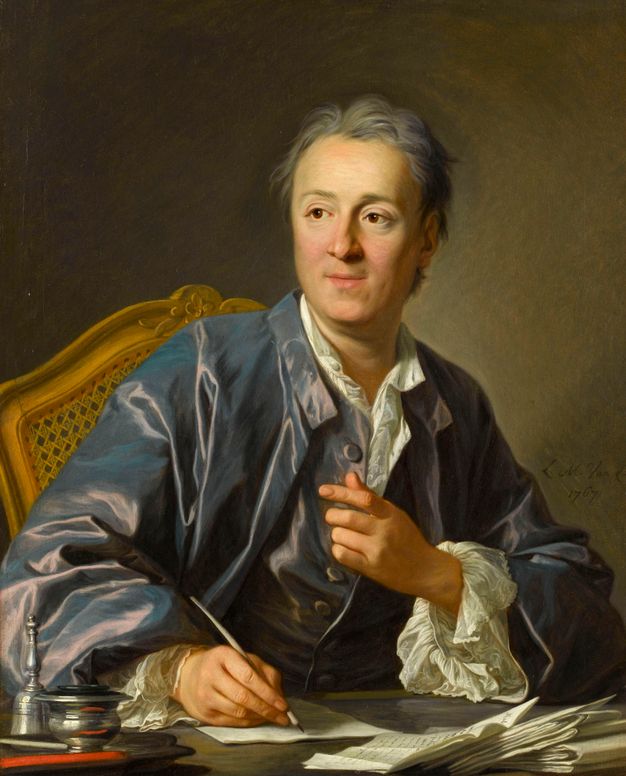
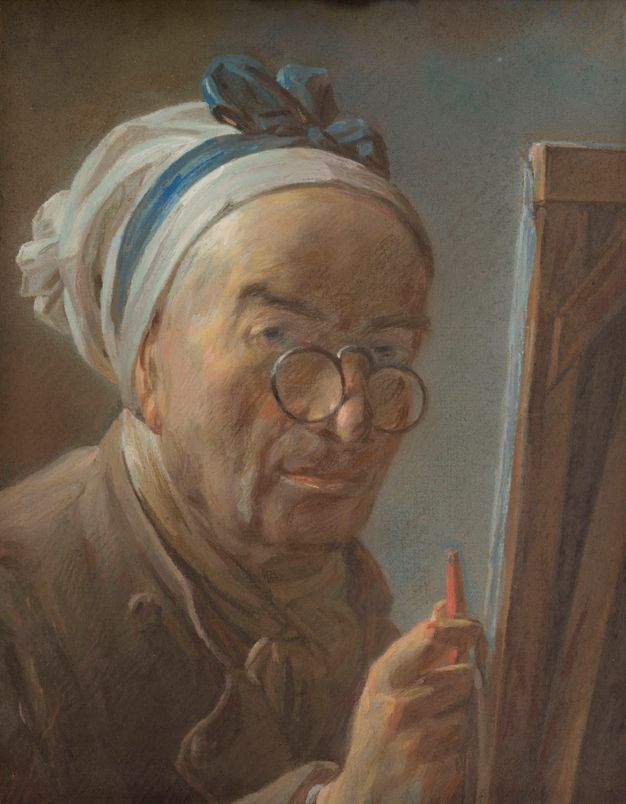
-
See François-Alexandre-Pierre de Garsault, L’art du tailleur (Paris: Latour, 1769), 21 and plate 11; and Margaret Swan, “Nightgown into Dressing Gown,” Costume 6 (1972): 10–21. ↩︎
-
Lesley Ellis Miller, “A Portrait of the ‘Raphael of Silk Design,’” V&A Online Journal 4 (2012) http://www.vam.ac.uk/content/journals/research-journal/issue-no.-4-summer-2012/a-portrait-of-the-raphael-of-silk-design/. For other instances of clothes sharing by sitter and artist, see Jean-Marc Nattier’s Portrait of His Wife (1760, private collection). Mme Nattier wears the dress in which her husband had depicted queen Marie Lescinska in 1748. Guillaume Faroult and Catherine Voiriot, “De Chardin à Voiriot: Destinée du ‘merveilleux portrait de femme à la brochure’ du Louvre,” Revue du Louvre 58, no. 3 (2008): 60–68, fig. 9. ↩︎
-
See Colin Cruise, “Artists’ Clothes,” in The Gendered Object, ed. Pat Kirkham (Manchester: Manchester University Press, 1996), 112–19; Elizabeth Wilson, “Bohemian Dress and the Heroism of Everyday Life,” Fashion Theory 2, no. 3 (1998): 225–44; and Robyne Calvert, “Manly Modes: Artistic Dress and the Styling of Masculine Identity,” Visual Culture in Britain 16, no. 2 (2015): 225–42. ↩︎
-
Louis-Michel Van Loo, “Inventaire après décès,” AN, MC/ET/LVI/166, 22 April 1771. The sections of the inventory relating to clothes are published in Autour des Vanloo: Peinture, commerce de tissus et espionage en Europe (1250–1830), ed. Christine Rolland (Rouen: Publications des Universités de Rouen et du Havre, 2012), 56–57. ↩︎
-
On court dress, see Daniel Roche, The Culture of Clothing, trans. Jean Birrell (Cambridge, England: Cambridge University Press, 1989), 184–220, 429–30. ↩︎
-
See Jacques Savary des Bruslons, Dictionnaire universel du commerce, 3 vols. (Paris: Estienne, 1723–30), s.v. 1: “Camelot.” ↩︎
-
See Denis Diderot, “Regrets on Parting with My Old Dressing Gown,” trans. Kate Tunstall and Katie Scott, Oxford Art Journal 39, no. 2 (2016): 175–84. ↩︎
-
His frocks—coats with turn-down collars (fracs)—were of a style imported from England in the 1760s, one of many fashions associated with Anglomania. On Van Loo’s partnership in the Lyon silk firm Berger, Vanloo et Cie, see Christine Rolland, “Louis-Michel Van Loo, Premier Peintre to the King of Spain,” in Spanien und Portugal im Zeitlater der Aufklärung, ed. Christoph Frank and Sylvaine Hänsel (Frankfurt am Main: Vervuert, 2002), 295–311. For comparison, see the wardrobe of Bonnaventure Carret, traveling salesman for the Lyon silk industry, in Lesley Ellis Miller, “Dressing Down in Eighteenth-Century Lyon: The Clothing of Silk Designers from Their Inventories,” Costume 29 (1995): 25–39. ↩︎
-
“Inventaire après décès,” in Autour des Vanloo, 56. On recycling, see The Afterlife of Used Things, ed. Ariane Fennetaux et al. (London: Routledge, 2015), especially the essays by Natacha Coquery, 13–24, and Fennetaux, 122–41. ↩︎
-
See Martha Hollander, “Vermeer’s Robe: Costume, Commerce and Fantasy in the Early Modern Netherlands,” Dutch Crossing 35, no. 2 (2011): 177–95; and, most recently, Susan North, “Indian Gowns and Banyans—New Evidence and Perspectives,” Costume 54, no. 1 (2020): 30–55. Warm thanks to Lesley Miller for these references. ↩︎
-
See Marcel Roethlisberger and Renée Loche, Liotard: Catalogue, sources et correspondence (Beukenlaan: Davaco, 2008), 1:68. ↩︎
-
See Étienne Liotard’s 1753 enamel self-portrait (London: Royal Collection, Windsor Castle) for detailed visual record of his dress. Roethlisberger and Loche, Liotard, 2: no. 262. ↩︎
-
See Gallerie des Modes (1780), cahier 31: “Robe de chambre à manche en pagoda”; discussed in Anne de Thoisy-Dallem, “La vieille robe de chambre de Diderot et les vêtements d’intérieur masculins au siècle des lumières,” Revue du Louvre, 2016, no. 1, 69. ↩︎
-
See Jules Guiffrey, Les Caffiéri sculpteurs et fondeurs ciseleurs (Paris: Morgand & Fatout, 1887), 101–8. ↩︎
-
Guiffrey, Les Caffiéri, 106. ↩︎
-
See Ariane Fennetaux, “Men in Gowns: Nightgowns and the Construction of Masculinity in Eighteenth-Century England,” Immediations 1 (2004): 83–84; and Thoisy-Dallem, “La vieille robe de chambre.” ↩︎
-
See Roethlisberger and Loche, Liotard, 1:66. According to his eldest son, Liotard always twinned his gown with a and hat, “because it was these that distinguished the French from others.” ↩︎
-
The figures are calculated from the catalog of morceaux de réception in Les peintres du roi 1648–1793, exh. cat. (Tours: Musée des Beaux-Arts, 2000), 221–83. ↩︎
-
Claudia Denk, “‘Chardin n’est pas un peintre d’histoire mais c’est un grand homme’: Les auto-portraits tardifs de Jean-Siméon Chardin,” in L’art et les normes sociales, ed. Thomas Gaehtgens et al. (Paris: Editions de la Maison des Sciences de l’Homme, 2001), 279–97. ↩︎
-
Denk, “Chardin,” 288–97. ↩︎
-
Roethlisberger and Loche, Liotard, 1:66. On eighteenth-century comfort, see John E. Crowley, “The Sensibility of Comfort,” American Historical Review 104, no. 3 (1999): 749–82. ↩︎
-
Garsault, L’art du tailleur, 21. ↩︎
-
Garsault, L’art du tailleur, 30–31; and Sarah North, 18th-Century Fashion in Detail (London: V&A, 2018), 66–67. ↩︎
-
On the prosthetics of dress, see Daniel Miller, Stuff (Oxford: Polity, 2010), 23–31. ↩︎
-
On the importance of cleanliness in the studio, see Elisabeth Lavezzi, “La peinture au supplice,” Cycnos 11/1 (2008), http://revel.unice.fr/cycnos/index.html?id=1368. ↩︎
-
Michel Dandré Bardon, La vie de Carle Van Loo (Paris: Desaint, 1765), 51. ↩︎
-
See Johann Christian Mannlich’s account of the formalities attending entry to Carle Van Loo’s studio, in Histoire de ma vie (Trier: Spee, 1993), 2:50–51. ↩︎
-
See Jessica Munns and Penny Richards, The Clothes that Wear Us (Newark: University of Delaware Press, 1999), 9–32. ↩︎
-
See Jouer la lumière, exh. cat. (Paris: Paris de la Mode et du Textile, 2001), 109–23. ↩︎
-
Warm thanks to Lesley Miller for information and interpretation of the stuffs and clothing listed in Van Loo’s inventory. ↩︎
-
See . Also Benoît de Fauconpret, Les chevaliers de Saint-Michel 1665–1790: Le premier ordre de mérite sociale (Paris: Patrice du Puy, 2007). ↩︎
-
See Étienne de La Font de Saint-Yenne, “Sentiments sur quelques ouvrages de peinture, sculpture et gravure,” in La Font de Saint-Yenne: Oeuvre critique, ed. Étienne Jollet (Paris: ENSBA, 2001), 286. Charles-Nicolas Cochin’s official reply on behalf of the Académie’s painters did not contradict the critique of the self-portrait. For a contrary view, see abbé Charles Le Blanc, Observations sur les ouvrages de MM. de l’Académie (n.p., 1753), 11. ↩︎
-
See Dandré Bardon, La vie de Carle Van Loo, 34. ↩︎
-
Denk, “Chardin,” 282. ↩︎
-
See Garsault, L’art du tailleur, 21–23, pls 10–11. Van Loo owned two: one silk; the other wool, see “Inventaire après décès,” in Autour des Vanloo, 56. ↩︎