Type of Object
Marriage Contract
- Jean-Baptiste Greuze (1725–1805)
There were many happily married artists in eighteenth-century France. But Jean-Baptiste Greuze was not among them. According to their marriage contract (fig. 102), Greuze and Anne-Gabrielle Babuty (1732–1811), the daughter of a Paris bookseller, were married on 31 January 1759, when the groom was thirty-three, the bride twenty-six.1 Greuze had supposedly been struck by her beauty when he walked into her father’s shop one day on Rue Saint-Jacques, but he would later claim that he was tricked into the union, and that their relationship started to fall apart a few years later.2 After many years of escalating domestic discontent, acts of betrayal, cruelty, and rage, the marriage eventually ended thirty-four years after it began. In light of these unfortunate circumstances, it may appear a little sensationalist to select Greuze’s marriage contract for this book, given how many other contracts from happier artists’ marriages are likewise preserved in the notarial records of the Archives Nationales in Paris. But it is the very demise of Greuze’s marriage that makes the contract—as a thing—more intriguing, not least because the ensuing events gave the document a more active role than usual.
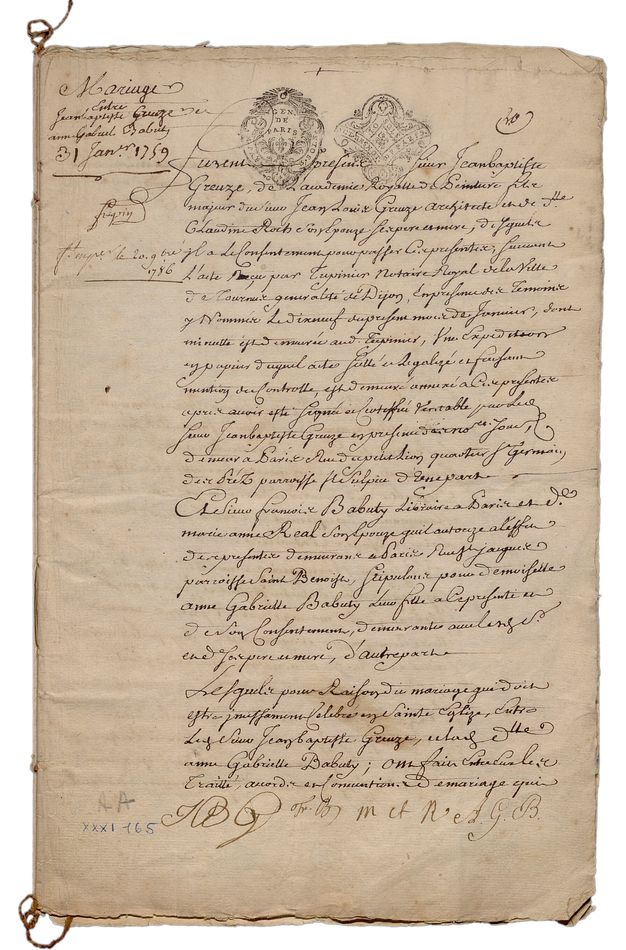
In ancien régime France, marriage involved a combination of religious and civil acts: a holy sacrament received from a priest and a legal agreement drawn up by a notary. There is no surviving trace of the wedding that Greuze and Babuty celebrated in the parish church of Saint-Médard on 3 February, but the civil procedures from four days earlier are preserved in this marriage contract. When encountering a document produced during such an important life event, it is tempting to envisage the marriage contract as an embodiment of the relationship—a material thing representing the union of two people. But the reality is far less romantic. On closer perusal, the language and contents of the document make clear its actual purpose, namely the legal arrangements of not a loving union of persons but a fiscal union of properties. In Greuze and Babuty’s case, the contract established a communauté de biens (joint estate), consolidating all their finances and possessions, and recorded the contractual provisions made by each party, including: a dot (dowry) of 10,000 livres paid by Babuty’s parents and a douaire (dower) from Greuze of a lifetime pension of 1,000 livres.3 Once the terms had been agreed to, the contract was signed and witnessed, like any other legal or financial arrangement, by all the relevant parties: groom, bride, parents of the bride, witnesses for both sides, and the notary, Alexandre Fortier.
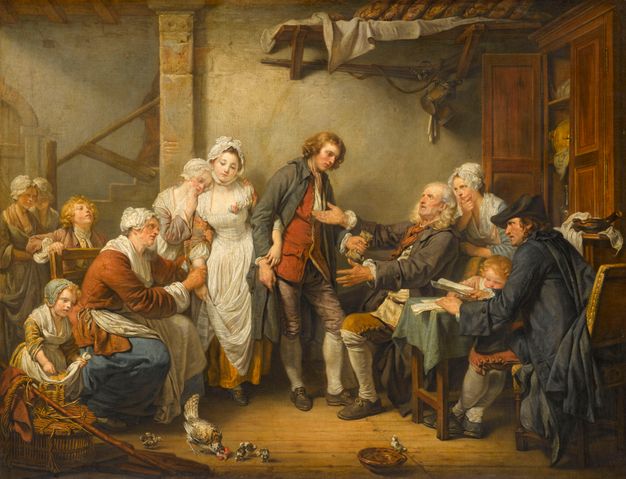
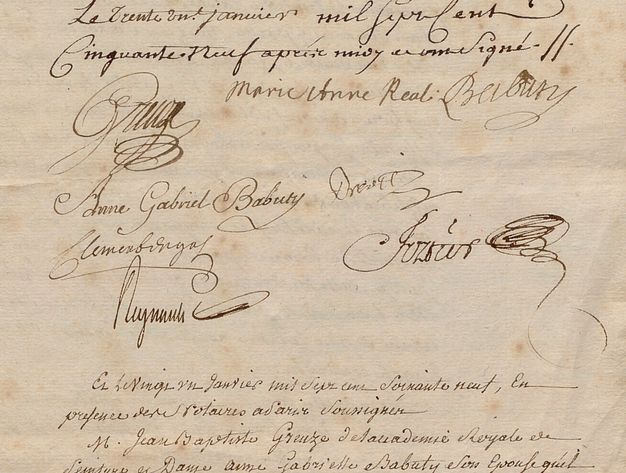
Coincidentally (or not), within two years of this contractual act, Greuze became the artist responsible for the eighteenth century’s most celebrated visualization of a marriage contract. The Village Bride (fig. 103), exhibited at the Salon of 1761, originally appeared under a longer title describing the action as a precise stage of the civil proceedings: Un marriage, & l’instant où le père de l’Accordée délivre la dot à son Gendre (A marriage, & the moment the father of the bride hands the dowry to his son-in-law).4 The contract itself is also present, on the table at the right, shown at its moment of creation by the notary. Greuze’s painting has been the subject of much art-historical interpretation, with compelling readings seeing it alternatively as depicting a patriarchal transaction between two men, with the woman as commodified object, or a reformist model of marriage as a civil consensual exchange.5 Whether or not this painting was informed by the artist’s own experience (connections have certainly been drawn),6 Greuze and Babuty’s contract provides documentary evidence for both of these visions of eighteenth-century marriage. Babuty was indeed traded for the price of 10,000 livres paid by her father, but her signature demonstrates her independent agency in this agreement (fig. 104). Meanwhile, the douaire promised by Greuze indicates the mutual financial commitment involved in this two-way exchange, and the legal outcome of this contract, that communauté de biens, meant that whatever belonged to Greuze now also belonged to Babuty. Marriage made the bride property, but the contract, at least in this case, also made the wife joint holder of the estate.
In a twist of conjugal fate, this contractual consolidation of wealth and property, which in 1759 had symbolized their nuptial union, would eventually become a contributing factor in its rupture. Among the many accusations leveled by Greuze against his wife during the process of separation—including numerous extramarital affairs, acts of physical violence, and efforts to destroy his professional reputation—he also charged her with financial fraud.7 Greuze claimed that Babuty, who (like many artists’ wives) had been in charge of the couple’s fiscal affairs, had embezzled the proceeds of his lucrative artistic practice (to the enormous tune of 120,000 livres, by Greuze’s calculation) and then destroyed the account books to cover up the deception.8 While not a criminal act per se, thanks to their communauté de biens, it became a compelling part of the grounds for separation as their relationship broke down irreparably and they sought to extricate themselves from their contractual marital bind.
Greuze’s unhappy marriage is now a well-known saga precisely because of the documents that were produced to enable the dissolution of that original contract. During the religiously observant ancien régime, divorce was not permitted, so in 1786 the contractual obligations of the marriage were instead ended with a séparation de biens (separation of assets). To achieve this, Greuze lodged a plainte (complaint) at the Châtelet colorfully describing his wife’s misconduct.9 While the couple lived separately from that point, their civil contract disbanded, their marriage continued in the eyes of the Church. After the Revolution, as the new regime sought to separate French law from the tenets of Church law, Greuze and Babuty were quick to take advantage of the nation’s first divorce law—introduced in 1792—permitting the dissolution of marriages on numerous grounds (including incompatibility, madness, mistreatment, moral misconduct, and abandonment).10 Greuze had ensured an evidentiary record of several of these grounds in a mémoire detailing more of Babuty’s misdemeanors, which eventually brought the ratification of their divorce in 1793.11 There is, unfortunately, no comparable set of documents to relate Babuty’s side of the story.
After these legal proceedings, Greuze and Babuty’s marriage contract would make one final appearance, in another notarial document that forms its resonant counterpart: an inventaire après divorce (post-divorce inventory) taken in 1793.12 Following a detailed description of the possessions in Greuze’s home (furniture, linen, , jewelry, silverware, artworks, etc.), the notary reached a commode where important papers were kept in a drawer. Right at the top was the marriage contract.13 Beyond merely itemizing its presence, the notary proceeded to read it, recording salient details about the couple’s property and its legal entailment in that erstwhile communauté de biens that had been dissolved in the divorce. Both the contract and this inventory were, after all, things that organized the redistribution of things. Thus, in some ways, although separation was never the intended outcome of the marriage, the contract had been created for precisely this kind of moment, when a new distribution of property was necessary.
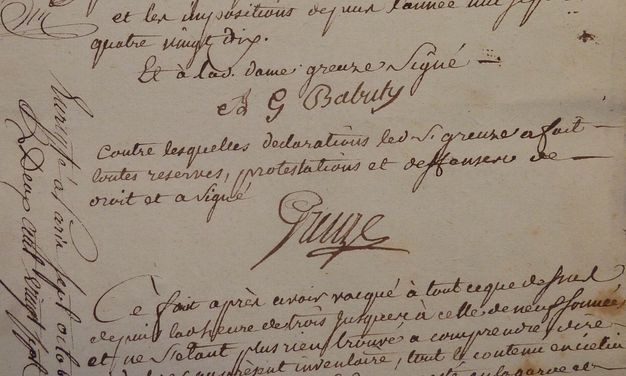
As detached as notarial documents may seem as sources, the marriage contract and the post-divorce inventory remain the material vestiges of two civic rituals that marked the beginning and end of a relationship. As such, these things also bear a trace of the human experience. This emerges perhaps most strikingly in the couple’s signatures and the poignant contrast between their confident ebullience at the marriage of 1759 (see fig. 104) (Babuty’s elegant and calligraphic; Greuze’s complete with flourishing underwhirl) and their austere pragmatism at the divorce of 1793 (fig. 105) (Babuty’s reduced version written in a tremulous hand; and Greuze’s perfunctory in its lack of ornament). Indeed, in the latter, the names are not even signed in the same ink, suggesting either they refused to share a or, more likely, they signed on separate occasions. In one document, a bride and groom are standing together surrounded by friends and family; in the other, an acrimoniously divorced couple is unwilling to share the same space. ‡
-
Marriage contract, Jean-Baptiste Greuze and Anne-Gabrielle Babuty, 31 January 1759. AN, MC/ET/XXXI/165. ↩︎
-
“Mémoire de Greuze contre sa femme,” (ca. 1791), transcribed in AAF (1852–53), 154–60. ↩︎
-
Marriage contract, Jean-Baptiste Greuze and Anne-Gabrielle Babuty. ↩︎
-
Explication des peintures, sculptures, et gravures de Messieurs de l’Académie royale (Paris: Collombat, 1761), 26. ↩︎
-
On these debates, see especially Bernadette Fort, “Framing the Wife: Jean-Baptiste Greuze’s Sexual Contract,” in Framing Women: Changing Frames of Representation from the Enlightenment to Postmodernism, ed. Sandra Carroll, Birgit Pretzsch, and Peter Wagner (Tübingen: Max Niemeyer, 2003), 93–99; and Emma Barker, Greuze and the Painting of Sentiment (Cambridge: Cambridge University Press, 2005), 46–64. ↩︎
-
For an autobiographical interpretation, see Edgar Munhall, Diderot et l’art de Boucher à David, exh. cat. (Paris: Hôtel de la Monnaie, 1984), 225. Without going so far, Fort also points to compelling resonances between life and art, not least the physiognomic similarities between Babuty and the bride, and between Babuty’s father and the father of the bride: Fort, “Framing the Wife,” 97–98. ↩︎
-
For Greuze’s account of the marriage, see Edmond and Jules de Goncourt, L’art du XVIIIe siècle (Paris: Charpentier, 1881–82), 32–49; and, more recently, Fort, “Framing the Wife,” especially 92–93. ↩︎
-
“Mémoire de Greuze contre sa femme,” 163. ↩︎
-
“Plainte de Greuze au sujet de l’inconduite de sa femme” (1785), in BSHAF (1877): 164–66. ↩︎
-
Roderick G. Phillips, “Le divorce en France à la fin du XVIIIe siècle,” Annales: Economies, sociétés, civilisations 34, no. 2 (1979): 385. ↩︎
-
“Mémoire de Greuze contre sa femme,” 153–64. ↩︎
-
Jean-Baptiste Greuze et Anne-Gabrielle Babuty, “Inventaire après divorce,” 30 August 1793, AN, MC/ET/XLVIII/375. ↩︎
-
One copy of Greuze and Babuty’s marriage contract was kept in their home, the other (the one that survives today) was kept by the notary. ↩︎