Theme
Quill
- Étienne-Maurice Falconet (1716–91)
The goose, observed Georges Louis Leclerc, comte de Buffon, in his Histoire naturelle (1749–88), is unjustly overshadowed by the swan; not only does she provide meat, she also affords “the delicate duvet feather on which idleness likes to repose, and that other flight feather, quill of our thoughts, with which,” he added, “I here write her eulogy.”1 To put figures on the goose’s utility: in March and September she molts a maximum of ten feathers fit for quills.2 In the eighteenth century, the best such feathers were imported from the Netherlands at 16 sous per thousand and 8 sous per hundred.3 Guyenne, Normandy, and the environs of Nevers supplied the rest of the capital’s less exacting middle market.4 Customers bought their quills from stationers, individually and in packets, rough or dressed, cut or uncut.5
If, as Buffon suggests, farmyard familiarity had bread contempt of the bird, the ubiquity of her non-singularized quills may explain blindness to pens in the historical record of artists’ things. were routinely itemized in postmortem inventories; quills, however, were not, though they were common enough instruments for drawing, and essential implements for writing.6 Oppenord’s penwork on his copy of Cesare Ripa’s Iconologie () combines the two practices: lines of letters share the page with figures and ornament.7 Penmanship is responsible also for other things indexed in this book: the and the , and legal documents such as the and the . Moreover, data on and and more generally about timekeeping and memory, taste, and shopping habits, social ties and legal claims, were secured by the formal practices of writing.8
Why chose the sculptor Étienne-Maurice Falconet’s quill out of all the thousands of lost pens that once belonged to eighteenth-century artists? Because Falconet, unlike Wille (), Lagrenée () and Massé (), was one of the few eighteenth-century artists, other than the secretaries and historiographers of the Académie, to take up the pen self-consciously.9 On 27 March 1772 he sent Voltaire a copy of his translation of books 34, 35, and 36 of Pliny’s Natural History (77–ca. 79).10 “If you find my work absolutely awful, have the goodness to tell me,” he begged in the accompanying note, “and I will throw my pen on the fire; I don’t, however, promise to do the same with my chisel.”11 Writing was more than a technology to Falconet; pen and ink, more than a medium. His letters suggest that for him the pen was an alluring object. Its qualities, unlike the chisel’s, were out of reach.
Falconet started writing around 1760. The lecture on sculpture he gave at the Académie in June 1760 was published as a pamphlet the following year.12 Five years later, in December 1765, it was republished in edited form as articles in the Encyclopédie, cementing both Falconet’s membership of the philosophes’ clan and his friendship with Denis Diderot.13 In the same month, Falconet and Diderot began an exchange of philosophical letters on the subject of posterity.14 Louis-Michel Van Loo’s portrait of Diderot (fig. 137), completed in 1767, is perhaps not coincidentally an epistolary one. Diderot sits at his desk replying to letters (recognizable among the papers by their characteristic folds),15 fictions, perhaps, of those missives actually sent by Falconet from Saint Petersburg in February and April that year.16 The portrait depicts not just letter writing; it also describes the paraphernalia necessary to it: ink, sealing wax, bell to summon the messenger, and, of course, (Diderot’s) pen.
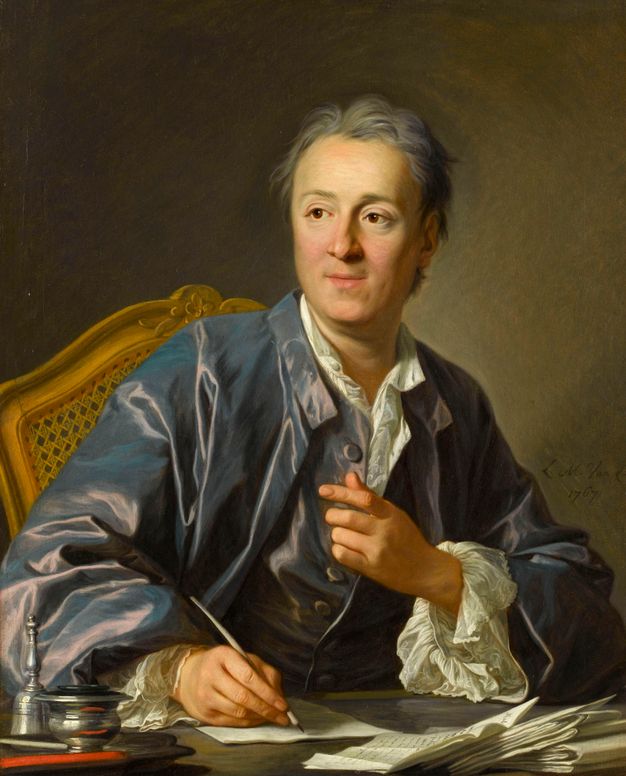
Thin bodied and black tongued, it appears to have submitted unreservedly to the flaying, cropping, lopping, picking, and splitting by which, as Jonathan Swift mockingly described, the gracefully fringed feather was brutally reduced to a writing implement.17 The goose’s reality, her personal stories of flight and float invoked in Buffon’s “eulogy,” were voided in Van Loo’s visual record. The once sensuous and multipurpose feather had been turned, by the “dutching” of industry18 and the cut of the user’s penknife, into a single-purpose thing, interchangeable with others of its kind: Van Loo depicted a second, virgin quill waiting on Diderot’s silver inkstand, ready should the first fur and fail to force forth his words. The implement of the professional writer is, as Van Loo depicts it, pure functionality.19 It lacks substance, body: a short white line tapering into translucency, it points to the black lines of writing and draws attention not to itself but to the ink held in reserve at its point for imminent notation.20
It is tempting to paint a mirror image: Falconet sitting, writing at a desk at his house, Rue d’Anjou, in the northwest of Paris, diagonally opposite Diderot at his apartment, Rue Taranne, in the southeast of the city. Falconet reading letters and writing replies at one of the two desks listed in the inventory of his furniture drawn up in August 1766, shortly before his departure to Saint Petersburg.21 Falconet pressing Diderot to respond to his arguments, not selectively but point for point, and drafting his own replies, apparently, in between the lines Diderot had written to him.22 But this effort at dialogue notwithstanding, Falconet felt outmatched by Diderot’s literariness.23 In one of his letters he lamented the “dryness” and the “heaviness” of his own hand.24 Though it was his style not his handwriting, his phrasing not his pen, to which Falconet was ostensibly referring, fluidity and lightness—that is, the binary opposites of heavy and dry—were the very qualities that writing masters extolled in a good pen and a good hand, and that Van Loo attributed to Diderot: the point of Diderot’s pen hovers above the letter paper momentarily paused in flow.25
In Diderot’s view, Falconet’s writing was not heavy in the sense of crabbed, awkward or clumsy, but he did concur that Falconet landed points like blows. With some admiration he noted, “You turn with the wind, you make arrows from any wood. . . .Sometimes, facing forward, you loose your arrow with force; sometimes appearing to run away, you turn your bow back.”26 Diderot’s arrow metaphor draws on “graphien,” the Greek word meaning “to write,” or literally to pierce, score, or inscribe a surface. It confirms, rather than contradicts, Falconet’s perception of his writing as weighty, even penetrative, an intermittent jabbing characterized by lifts of the hand rather than fluid joins between marks. Diderot observed that Falconet’s writing was incoherent, the points scattered instead of arranged in constructive argument or pleasing digression.27
In an earlier letter, Falconet had named his talent “Pegasus,”28 after the divine winged horse of Greek mythology whose attributes of boldness and grace were commonly confounded with those of the genius writer. Falconet was being ironic. “My Pegasus,” he confided to Diderot, “is not bold.” He was “solid,” a “carthorse” (lourdier), who, rather than deviating from the common track in Pegasus-like leaps of imagination, traveled “straight” and arrived at his mark by right reason.29 Like the self-deprecating description of his writing hand, the target of Falconet’s irony was himself, not the metaphor. Falconet set great store by his reason and by his historical and technical knowledge, resources with which he fully intended to win the debate with Diderot. Nevertheless, Pegasus stands for all that he found other and alluring in the pen.
The philosopher Graham Harman defines “allure” as an enlightenment of the object, a moment when objects cease to be fused with their defining qualities and functions and become more fully visible.30 We can examine the difference between use and allure in the diverse ways in which Falconet spoke about his chisel and his quill. When addressing Diderot’s claim that posterity inspires great works, Falconet countered that art comes into being unmotivated, through the mechanical emulation of praxis.31 In practice, the chisel is its instrumental value, or the sum total of its carving potentialities. Falconet’s description of inspiration (“enthousiasme”) in full flood is one where tools perform their functions so utterly that they become invisible agents, obscured by the arc of the artist’s intention. If the tool fails, an equivalent is improvised: “in the absence of ink, one would write with a burning coal.”32
By contrast, Falconet did not extend his being and doing through the pen. He did not identify with it, as far as we can see, and his pen did not denote his writing gesture in the way that, according to the dictionary of the Académie française, the expression “avoir une excellente plume” (to have a good quill) commended an individual’s personal literary style.33 It was rather a thing apart. The metaphorical name Pegasus attributed to the quill values—freedom, innovation, spirit—not ordinarily listed in the description of its technological function or calculated in its exchange value. Moreover, these mythological allusions did not exhaust all the possible points of likeness between pens and horses, winged or otherwise.34 In Buffon’s Natural History, a book Falconet read, the horse is exalted for sharing as well as embodying mankind’s ideals of courage and glory as well as for its noble bearing and beauty, its obedience to the hand.35 Buffon likens mankind’s empire over animals to that of spirit over matter. In naming his horse Pegasus, even mockingly, Falconet tacitly recognized in the pen a richer, less circumscribed, and therefore more alluring reality, one that perhaps quickened in him dreams of mastery.
This is not to say that Falconet aspired to the status of man of letters. On the contrary, he repeatedly declared himself an artist and writer, not an author.36 His opposition to posterity was entangled with his conviction that, in matters of art, the works themselves and the judgment of artists are the only reliable sources of reputation. He thus conspicuously avoided oratorical appeals to sentiment and the virtues of ancient texts in setting out his case against posterity.37 He introduced specific examples to anchor the debate in the concrete. He countered Diderot’s poetic comparison of posterity to a sweet, distant melody overheard with his prosaic claim that the only praise worth having, now and in the future, was that which he could hear with the same two ears as those attuned to the birds singing in his garden as he wrote.38 He argued that for every Diderot who rose each morning and begged posterity to inspire and not to abandon him, another found in a cup of coffee the more effective motivation to excel.39 Self-consciously adopting ordinary language and common sense, yet also giving his pen a figurative name, suggests that Falconet’s relationship with his quill was ambivalent. He was enthralled by its rhetorical promise yet committed to write materially grounded and banally truthful statements with it. §
-
Georges-Louis Leclerc, comte de Buffon, Histoire naturelle et particulière, 36 vols. (Paris: Imprimerie Royale, 1749–1804), 17:36–39. Swan, raven, and crow feathers were also used to make quills; the best for writing were goose feathers. Crow feathers were used for drawing and to make plectra for . ↩︎
-
Jacques Savary des Bruslons, Dictionnaire universel de commerce (Paris: n.p., 1741), 3: s.v. “Oye.” ↩︎
-
Savary des Bruslons, Dictionnaire, 3: s.v. “Plume.” In the late 1760s a six-pound loaf of bread cost approximately 12 to 14 sous. ↩︎
-
Savary des Bruslons, Dictionnaire, 3: s.v. “Plume à écrire.” ↩︎
-
See “Plume à écrire,” Encyclopédie, http://encyclopedie.uchicago.edu/, 12:800. For examples of stationers selling quills in the 1750s to 1770s, see, for example, the trade cards of Basan (À la Justice), Cabaret (Au Griffon), and Cheron (Au Temple du Goût) at Waddesdon Manor (invs. 3686.1.80.160; 3686.1.101.210; and 3686.2.3.4). ↩︎
-
See Charles-Antoine Jombert, Méthode pour apprendre le dessein (Paris: Jombert, 1755), 74–75. See Carbonnel’s trade card (Aux Armes de la Princess de Conti), Waddesdon Manor (inv. 3686.1.60.109). ↩︎
-
See Oppenord’s two frontispieces, cartouche, and monogram reproduced in Jean-François Bédard’s facsimile Decorative Games: Ornament, Rhetoric and Noble Culture in the Work of Gilles-Marie Oppenord (1672–1742) (Newark: University of Delaware Press, 2011), 43, 45, 47. On the creative interdependency of writing and drawing, see David Rosand, Drawing Acts (Cambridge, England: Cambridge University Press, 2002), 139–44. ↩︎
-
Savary des Bruslons, Dictionnaire, 3, s.v. “Plumes à écrire.” Handwriting in the eighteenth century was not primarily a personal matter. The different hands (ronde, batarde, and coulée) were suited to different purposes. See for examples Louis Rossignol, L’art d’écrire (1756). ↩︎
-
For a comparison with Charles-Nicolas Cochin, secretary of the Académie between 1755 and 1773, see Anne Betty Weinshenker, Falconet: His Writings and His Friend Diderot (Geneva: Droz, 1966), 118–24. ↩︎
-
Étienne Maurice Falconet, Traduction des XXXIVe, XXXVe, et XXXVIe livres de Pline (Amsterdam: Rey, 1772). ↩︎
-
See Jules Guiffrey, “Correspondance des artistes français travaillant à l’étranger,” NAAF, 1878, 81–82. ↩︎
-
Étienne-Maurice Falconet, Réflexions sur la sculpture (n.p.: n.p., 1761). See Falconet, “Reflections on Sculpture,” in Lectures on Art: Selected Conférences from the Académie Royale de Peinture et de Sculpture, 1667–1772, ed. Christian Michel and Jacqueline Lichtenstein, trans. Chris Miller (Los Angeles: Getty Research Institute, 2020), 408–27. ↩︎
-
See the entries “Sculpture” and “Relief,” Encyclopédie, http://encyclopedie.uchicago.edu/, 14:834–37 and 14:107–9. ↩︎
-
The correspondence was first published by Yves Benot in 1958 under the title Diderot et Falconet—Le pour et le contre (Paris: Éditeurs Français Réunis, 1958). For the most recent critical edition with a material history of the letters, see Emita Hill’s Le pour et le contre, vol. 15 of Diderot’s Oeuvres complètes (Paris: Hermann, 1986). ↩︎
-
On letters and their folds, hear Peter Stallybrass, “What Is a Letter?,” Wing Foundation Lecture on the History of the Book, The Newberry, Chicago (12 October 2017), https://soundcloud.com/newberrylibrary/what-is-a-letter. ↩︎
-
Letters XXII, XXIII, and XXV, in Benot, Le pour et le contre, 233–41, 243. ↩︎
-
Jonathan Swift, “On a Pen,” in The Poems of Jonathan Swift, ed. William Browning (London: Bell, 1910), 62. ↩︎
-
So-called “dutching” or “dressing” enhanced the strength, durability, and flexibility of the quill. See, Encyclopédie, http://encyclopedie.uchicago.edu/, 12:800. ↩︎
-
Compare the quills in Jacques Aved’s Portrait of Jean-Gabriel du Theil, 1738–40 (Cleveland Museum of Art) or Maurice-Quentin de La Tour, Portrait of President des Rieux, 1739–41 (Los Angeles, J. Paul Getty Museum) with Van Loo’s portrait. The seal, not the quill, identifies the sitter. ↩︎
-
On ink, see Adrian Johns, “Ink,” in Materials and Experience in Early Modern Europe: Between Market and Laboratory, ed. Ursula Klein and E. C. Spary (Chicago: University of Chicago Press, 2010), 101–24. ↩︎
-
AN, MC/XCI/1036, 21 August 1766. The inventory was drawn up in the name of Falconet’s wife Anne Suzanne Moulin, who had died in 1748. Falconet bought the property in 1756 from the heirs of the sculptor Jules Martin Desjardins (AN, MC/ET/LXXVII/251, vente 2 June 1756). There was a desk in the antechamber and another, of walnut, in the cabinet on the first floor. ↩︎
-
See Letters IV and VI in Benot, Le pour et le contre, 60, 67, 71. Falconet took two letters from Diderot with him when he left for Russia, and he inserted a draft of his responses between Diderot’s lines. See Emita Hill, “Diderot’s Letter to Falconet, Summer 1767,” Diderot Studies 20 (1981): 125–41. None of the original letters of the correspondence survive, only fair copies. See Biblithèque Nationale de France, Département des Manuscrits, n.a.f. 24983. ↩︎
-
Letter IX, in Benot, Le pour et le contre, 101. ↩︎
-
Letter VI, in Benot, Le pour et le contre, 71. ↩︎
-
Smoothness and flow were recurrent points of concern in the writing manuals of the period. See, in relation to the gesture of writing, Honoré-Sébastien Roillet, Les Nouveaux principes de l’art de l’écriture (Paris: Mesnier, 1731), 14–17; and Nicolas Duval, Pratique universelle des sciences les plus nécéssaires dans le commerce et en la vie civile (Paris: Mesnier, 1735), 1:10, 12–13, 16–18, 19–24. ↩︎
-
Letter VIII, in Benot, Le pour et le contre; and Diderot, Oeuvres completes, 89. ↩︎
-
Letter VIII, in Benot, Le pour et le contre; and Diderot, Oeuvres completes, 89. ↩︎
-
Letter IV, in Benot, Le pour et le contre, 60–61. ↩︎
-
Falconet was no doubt thinking about the kind of carts used to shift stone; see . ↩︎
-
Graham Harman, Guerrilla Metaphysics: Phenomenology and the Carpentry of Things (Chicago: Open Court, 2005), 141–43; and Graham Harman, “A Larger Sense of Beauty,” Dialogica Fantastica (2011), www.dialogicafantastica.wordpress.com/2011/02/01=a-larger-sense-of-beauty/. ↩︎
-
Letter II, in Benot, Le pour et le contre, 52. “Mechanical” is implicitly opposed to “moral” in the context of critique. In writing manuals, on the contrary, manual and moral emulation are combined in the writing samples. See, for example, Louis Rossignol, L’art d’écrire (1756). ↩︎
-
Letter X, in Benot, Le pour et le contre, 131. ↩︎
-
Dictionnaire de l’Académie française, 4th ed. (Paris: Brunet, 1762), 2: s.v. “Plume.” ↩︎
-
Mythology is used in the Barthian sense here, although Roland Barthes argues that to discuss writing instruments is generally an “anti-mythological” action. See Roland Barthes, “An Almost Obsessive Relation to Writing Instruments,” in The Grain of the Voice (Berkeley: University of California Press, 1991), 17–82. ↩︎
-
Buffon, Histoire naturelle, s.v. “Cheval,” 4:174–77, 197. See Falconet’s extended critique of Pliny the naturalist by comparison to Buffon in Traduction des XXXIVe, XXXVe, et XXXVIe livres de Pline, 2nd ed. (The Hague: Monnier, 1773), 2:33–45. ↩︎
-
Letter X and Letter XIX, in Benot, Le pour et le contre, 135, 212. See also Falconet, Réflexions sur la sculpture, “Avertissement”; Traduction de . . .Pline, 2:109; and Weinshenker, Falconet, 58–82. Falconet was contributing to a broader quarrel between artists and men of letters on who had the better claim to judge art. See Stéphane Peltier, “‘Les Misotechnites aux enfers,’ ou l’imposture de la critique selon Charles-Nicolas Cochin,” in L’Invention de la critique de l’art, ed. Pierre-Henry Frange and Jean-Marc Poinsot (Rennes: Presses Universaires de Rennes, 2002), 107–20. ↩︎
-
See Letters XV, XVII, XIX, in Benot, Le pour et le contre, in which Falconet sets the writings of the ancients, notably Pliny, against critique and example. ↩︎
-
Letter IV, in Benot, Le pour et le contre, 64. ↩︎
-
Letter X, in Benot, Le pour et le contre, 130. ↩︎