Type of Object
Theme
Type of Object
Theme
It is difficult to take one’s eyes off François-André Vincent’s glasses. In his portrait, at forty-nine, painted by Adélaïde Labille-Guiard—a lifelong acquaintance who would become his wife five years later—Vincent’s glasses are a conspicuous accessory (fig. 65).1 They occupy only a fraction of the canvas’s surface area, but their location over the eyes of the sitter—where the beholder’s own eyes are inevitably drawn and redrawn—ensure that this optical device becomes the focus of everyone’s gaze. Yet what is perhaps most distracting about Vincent’s glasses is less their lenses than their arms. Compositionally and formally, these insistent appendages demand attention, with their sudden stark linearity amid the soft contours of his face, with the darkness of the metal against his pale skin and gray hair, and with the quietly observed detail of their engineered construction. The lug and hinge at the front, where the arm meets the frame, is a regular feature of spectacles to this day; but far less familiar to the modern eye is the other end, where instead of curving gently around the ear, the arm bends abruptly at a sharp angle behind Vincent’s head. This tiny detail may also have caught the attention of Vincent’s contemporaries, though for entirely different reasons. For what appears today as a cumbersome, outmoded feature was, in the eighteenth-century, the height of optometric technology.
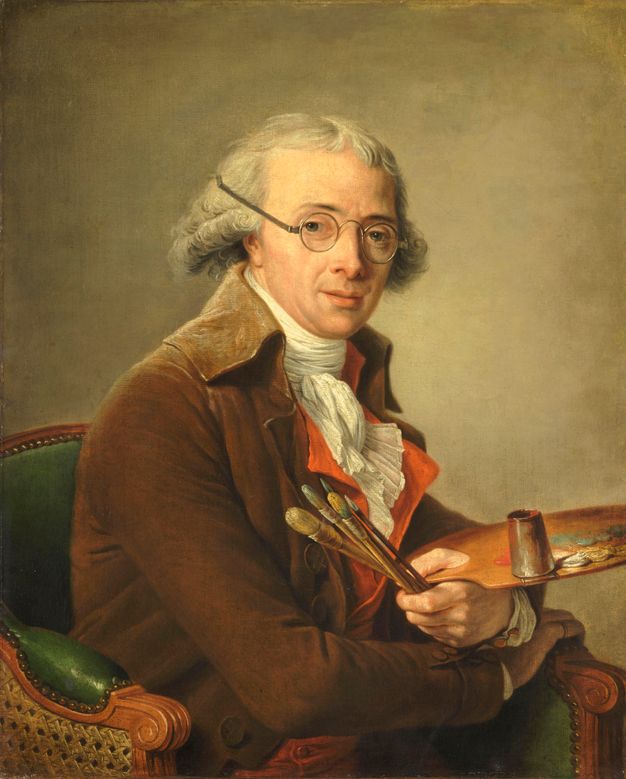
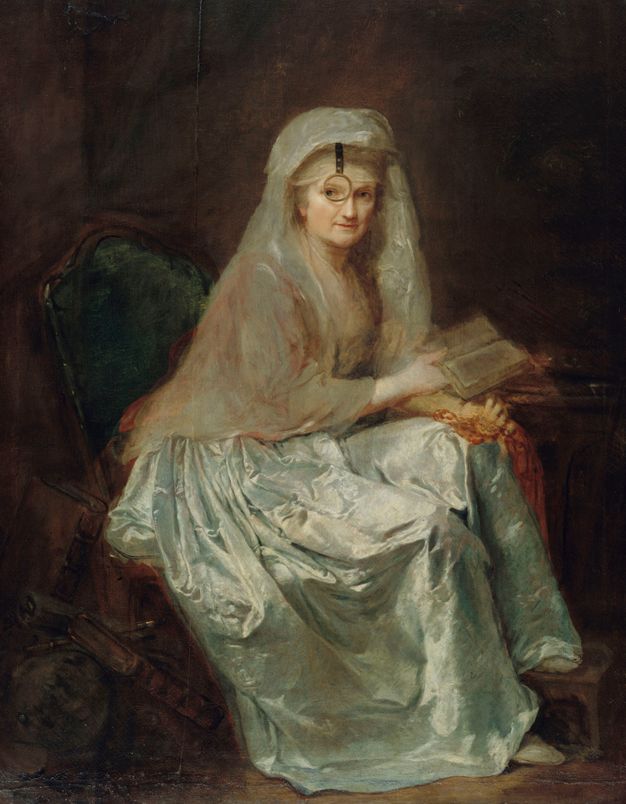
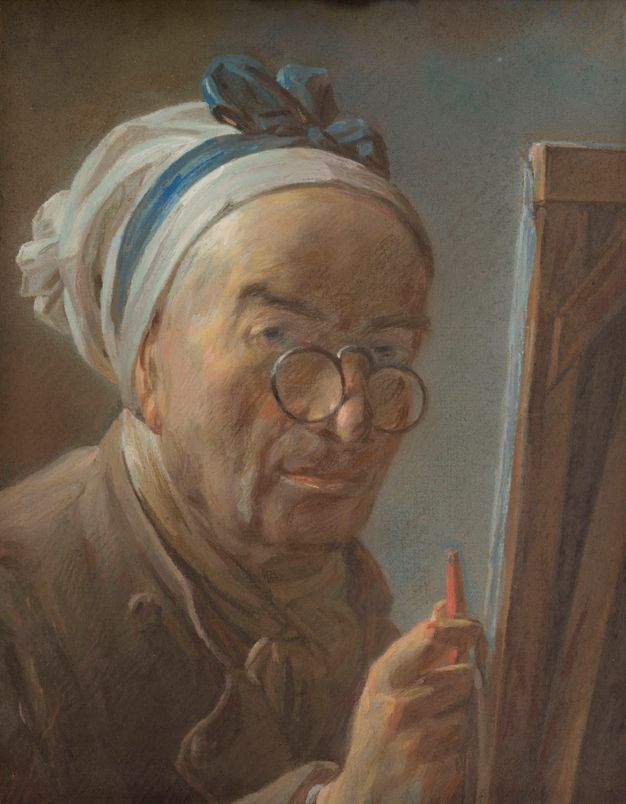
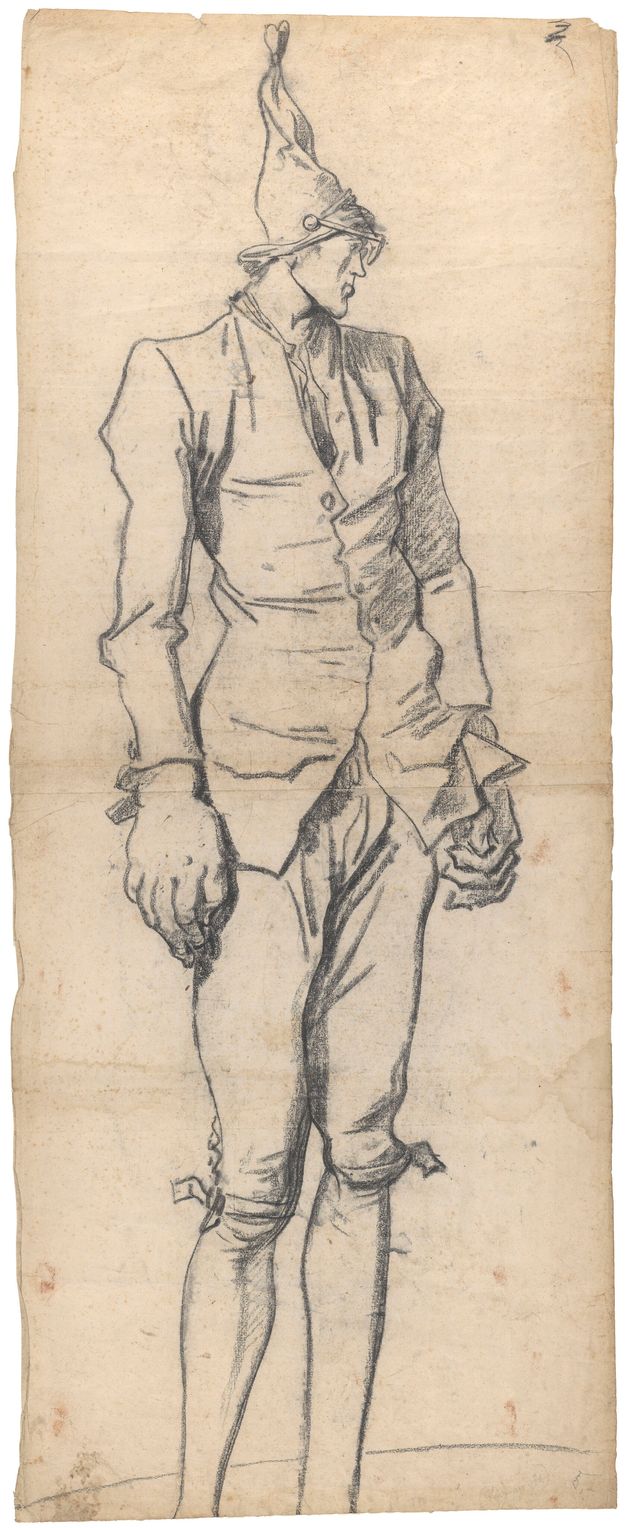
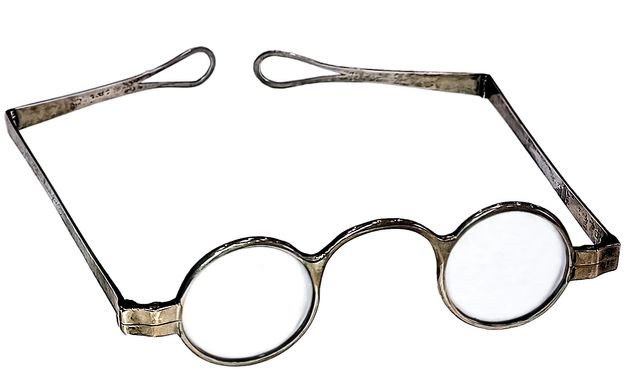
By the time Vincent was sporting his spectacles in the 1790s, lens technology was long-established (dating back at least to the thirteenth century), but the development of the arm had been one of the eighteenth century’s major design innovations.2 For an artist like Vincent, or indeed anyone who required glasses in their work, the invention of the arm as a means of securing lenses to the face had been a liberating convenience. Before these lateral appendages, lenses either had to be attached to headwear—like Anna-Dorothea Therbusch’s reading monocle in her Self-Portrait (fig. 66)—strapped to the head with cords or ribbons, or clamped to the nose—like Jean-Siméon Chardin’s precarious besicles, worn in his Self-Portrait (fig. 67), which pinched so tightly that they restricted breathing. But at midcentury, a renowned Parisian lunetier, or eyeglass maker, Marc Mitouflet Thomin, advertised for sale in his shop “glasses with silver or steel arms,” whose major selling points were that they “cling to the temples” and “do not impede respiration.”3 A pair of this first generation of armed spectacles were sketched by Vincent in Rome, clasped to the head of his fellow pensionnaire Pierre-Charles Jombert (fig. 68), revealing their rounded ends, which were sometimes padded with velvet to alleviate pressure on the side of the head. But Vincent’s glasses were an example of the next advancement—the double-hinged side (fig. 69). No longer constraining breathing or pressing on the temples, these modern spectacles were specially designed with elongated and articulated arms to wrap neatly and lightly around the wigged head of the wearer.4
Technologies of design no doubt influenced Vincent’s decision in his acquisition of this latest development in eyewear. But while arms were important, it was the lenses that were crucial; remaining comfortably attached to the face was a desirable quality for a pair of glasses, but their principal function was correcting vision. As sight was an indispensable sense for an eighteenth-century painter, correcting its deterioration or dysfunction was essential for continued professional activity. Indeed, the lunetier Mitouflet Thomin considered artists among those “who have the greatest need to spare and fortify their sight with the aid of . . . glasses,” and he described many items in his shop as being of particular use to the artistic professions.5 Most of these instruments were made using lenses ground precisely from glass into one of three main types: concave lenses for correcting shortsightedness; convex lenses for correcting longsightedness; and double-sided convex lenses for the intense magnification required in items like telescopes and microscopes.6 Aside from spectacles, these were the kinds of optical devices that Mitouflet Thomin envisaged for his artist customers: magnifying glasses and handheld microscopes for painters and engravers; lenses that shrunk objects, for the use of miniature painters; glass prisms with which painters could learn about color; and for “drawing with no master.”7
Vincent did not purchase his glasses from the shop of Mitouflet Thomin, who died many years before the history painter’s vision required correcting.8 While Vincent’s particular spectacle maker is not known, it is quite likely that he acquired this pair from a lunetier somewhere on the Île de la Cité. In 1798, when the Almanach du Commerce began its annual record of the trades of Paris, there were still only fifteen lunetiers in the city, and all but four of them were on the island.9 The greatest concentration was on Quai de l’Horloge, where its seven spectacle shops helped earn the street its nickname, “Quai des Lunettes.”10 Vincent was living in the Louvre in the 1790s (remaining there until 1802, when he moved across the river to the Palais des Beaux-Arts in the Institut), so the Quai de l’Horloge was certainly a convenient shopping destination for a man who would have crossed Pont-Neuf with regularity.11 And given the number of optical aids in Vincent’s possession, he must have been a keen and frequent customer of the lunetiers of Paris.
When the inventory was taken of Vincent’s apartments in the Palais des Beaux-Arts after his death in 1816, there were at least seven devices for correcting or enhancing the artist’s vision.12 This optical haul included three pairs of glasses: two pairs of lunettes with steel frames (like those depicted in Labille-Guiard’s portrait), and one more glamorous pair with gold arms, which was kept in a bespoke shagreen case with silver decoration (this pair alone was valued at 60 francs). In addition, Vincent also owned a loupe (a magnifying glass); two lorgnettes de spectacle (opera glasses with handles), one ivory, one tortoiseshell; and a lunette à longue vue (a spyglass or small telescope). Despite this extensive list of optical instruments, it is difficult to determine the kind of vision problems that afflicted Vincent.13 His magnifying glass would have been used for close work; his opera glasses and spyglass for viewing at distance; and his pairs of lunettes could have corrected either myopia or hyperopia, depending on the shape of the lenses. While lens type can sometimes be deduced by seeing the eye behind its lens (the convex lenses correcting hyperopia making eyes appear larger and the concave lenses for myopia making them smaller), even Labille-Guiard’s portrait cannot assist in a definitive diagnosis, for neither eye looks particularly enlarged or reduced. However, the fact that Vincent gazes through the lenses, as he looks over at his companion painting the portrait, would seem to tip the scales in favor of myopia. In contrast to the apparently hyperopic Chardin (see fig. 67), who looks over his besicles to see himself in the mirror, and Therbusch (see fig. 66), who has donned her monocle to read her book, Vincent seems to require his lunettes to focus on something farther away.14
For a history painter, distance vision was more important than it was for many other artists. While miniature painters and engravers worked in close proximity to both their subjects and their supports, history painters were often pushed back: looking at posed models across a room, studying spaces for settings, and forming compositions on large canvases. Among the Académie’s genres, perhaps only the landscapist required a longer gaze. In a period when painting was still necessarily an art of visual representation, failing eyesight was a dire affliction for a painter, threatening the ability to continue professional practice. For Chardin, visual impairment is commonly attributed as the cause of his shift from oils to pastels in his later years. Writing to the comte d’Angiviller only of his “infirmities,” Chardin did not blame his eyesight specifically, but clearly some aspect of his health forced him to alter his approach in order to keep on painting.15 For his part, Vincent made no drastic changes to his practice and recorded no complaints about his eyesight.16 It would appear, therefore, that by relying on his corrective lenses, Vincent’s visual health remained professionally robust.
Vincent’s glasses were thus an indispensable tool for the middle-aged artist, as essential a workday item as his palette and brushes, as Labille-Guiard’s portrait suggests. Yet while their presence was a professional necessity, Vincent seems also to have been adept at deploying their absence for strategic gain. One evening he was invited to the home of his neighbor, the artist Adélaïde-Marie-Anne Castellas, wife of the sculptor Jean-Guillaume Moitte. When he arrived, she was showing her latest drawings to a friend, and she invited Vincent to join them and offer his thoughts on her work. But somewhat conveniently, so Madame Moitte thought, Vincent made excuses, claiming that he was “completely blind in the evenings,” and was thus tactfully relieved of having to make any commentaries at all.17 Clearly on that occasion, Vincent found it more professionally and socially expedient to leave his glasses at home. ‡
The Louvre portrait is an autograph version of the original, which remained in the collection of Labille-Guiard and Vincent until their deaths. Anne-Marie Passez, Adélaïde Labille-Guiard: Biographie et catalogue raisonné (Paris: Arts et Métiers graphiques, 1973), 266. ↩︎
Astrid Vitols, Dictionnaire des lunettes: Historique et symbolique d’un objet culturel (Paris: Christine Bonneton, 1994), 45–48. ↩︎
Marc Mitouflet Thomin, Instruction sur l’usage des lunettes ou conserves pour toutes sortes de vues (Paris: Claude Lamesle, 1746), 128. ↩︎
The evolution of eighteenth-century glasses can be seen in the historical collections held at the Musée des Lunettes et Lorgnettes–Pierre Marly, Paris, or the Museum of the College of Optometrists, London. ↩︎
Mitouflet Thomin, Instruction, 16. ↩︎
Plate I, “Lunetier,” Encyclopédie, http://encyclopedie.uchicago.edu/, 22:13:1. See also “Myope” and “Presbyte,” Encyclopédie, http://encyclopedie.uchicago.edu/, 10:913 and 13:309. ↩︎
Mitouflet Thomin, Instruction, 126–27. ↩︎
Mitouflet Thomin died in 1752. ↩︎
There were also five “opticiens,” two of whom were based on the Île de la Cité, and one on Quai de l’Horloge. Almanach du Commerce et de toutes les addresses de la ville de Paris (Paris: Favre, Year VII [1798]), 238–39, 361. ↩︎
Vitols, Dictionnaire des lunettes, 116. ↩︎
Vincent was first granted apartments in the Louvre in 1784; he and Labille-Guiard moved to the former College des Quatre Nations in 1802. Jules-Joseph Guiffrey, “Brevets de logements dans la galerie du Louvre,” NAAF, 1873, 101; and Jean-Pierre Cuzin, François-André Vincent, 1746–1816 (Paris: Arthena, 2013), 322–23. ↩︎
François-André Vincent, “Inventaire après décès,” 9 August 1816, AN, MC/ET/LXIV/577. The inventory also mentions “trois paires de ciseaux,” which may have been either scissors or binocles ciseaux (pairs of corrective lenses with a single central handle). For Vincent’s inventory, see also Cuzin, François-André Vincent, 524–31. ↩︎
Mansfield and Cuzin both discuss Vincent’s health problems, recorded in various primary sources. These mostly relate to a delicate constitution in his youth (due to which he suffered in the heat and sun of Rome) and nervous attacks in his later years. Elizabeth C. Mansfield, The Perfect Foil: François-André Vincent and the Revolution in French Painting (Minneapolis: University of Minnesota Press, 2012), 5, 56–57; and Cuzin, François-André Vincent, 61. ↩︎
Chardin made three different self-portraits in the 1770s (in numerous versions); in two he looks at himself over his besicles, while in the other he looks through the lenses with his eyes shaded by a visor. On the multiple versions, see Neil Jeffares, Dictionary of Pastellists before 1800, http://www.pastellists.com/Articles/Chardin.pdf. ↩︎
Jean-Siméon Chardin to comte d’Angiviller, 21 July 1778. Marc Furcy-Raynaud, Chardin et M. d’Angiviller: Correspondance inédite de l’artiste et de sa femme avec le directeur général des bâtiments du roi (Paris: Chamerot et Renouard, 1900), 31. ↩︎
Once he mentioned being sick and unable to read, but he did not specify eyesight as the problem. François-André Vincent to Pierre-Narcisse Guérin, 5 November 1804. Cuzin, François-André Vincent, 542–43. ↩︎
Journal inédit de Madame Moitte, femme de Jean-Guillaume Moitte, statuaire, ed. Paul Cottin (Paris: Plon, 1932), 62. ↩︎
| words