Type of Object
Camera Obscura
- Charles Parrocel (1688–1752)
A chambre noire, or camera obscura, in a case was inventoried in the studio of the battle painter and academician Charles Parrocel at his death in 1752.1 The camera obscura is an optical instrument that by alignment of a biconvex lens with a mirror projects a righted image of objects in the sunlit world onto a two-dimensional surface in a darkened “room.” Parrocel’s camera was itemized as “for drawing,” and it was very likely of the desktop variety illustrated as figure 2 in plate V of “Drawing,” in Diderot and d’Alembert’s Encyclopédie (fig. 21).2 The text of the plate itemized the components of the instrument but provided no instructions for use, observing only that, contrary to the reader’s expectation, the view seen by the projectionist lies behind and not in front of them. The surprise that the writer anticipated this revelation would provoke suggests that although the camera obscura was a familiar object in scientific circles in mid-eighteenth-century France, it was still something of a novelty in the art world.3
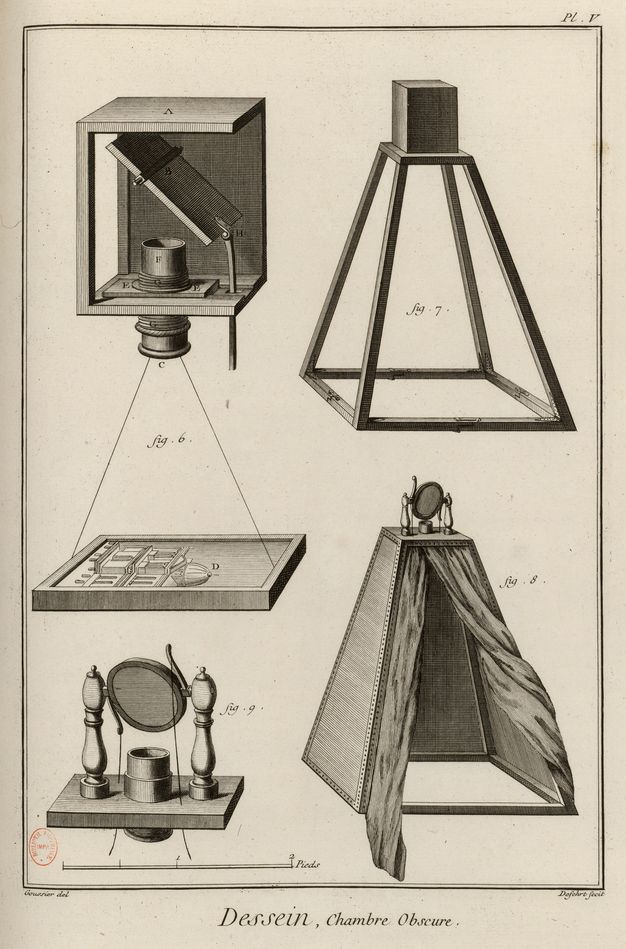
The camera obscura is not, it is true, generally associated with the French school and with traditions of academic art. Rather, art historians have researched the origins of its use as an instrument for perfecting the exact imitation of nature in Renaissance Italy and seventeenth-century Holland.4 It is no surprise to learn from the abbé Gougenot’s Life of Jean-Baptiste Oudry, an artist whose work was profoundly informed by northern practices of painting, that this still-life and landscape painter used a camera obscura.5 By contrast, Parrocel’s ownership of one poses a dilemma. The camera is not mentioned in any other contemporary source on Parrocel. His biographers unite, in fact, in characterizing his talent in terms of imagination, invention, and genius, skills that notionally render the resources of the camera obsolete.6 How do we explain this omission and make sense of the camera’s presence in Parrocel’s studio? Is the inborn secretiveness of artists about their methods to blame, as David Hockney alleges?7 Did Parrocel use it only exceptionally, for specific works? Or was the utility of the camera obscura not what we think it was, that is, not just a machine for copying? Answers to these questions in the context of things inevitably directs us to focus less on the newness of the technology and more on its significance in relation to alternatives embodied in the old tools of the early modern workshop.8
Estate inventories cannot tell us when things were acquired, but they do tell us where they were kept, from which we can infer use and significance. Parrocel’s studio was at the Gobelins on the outskirts of Paris.9 It was off the inner courtyard of the tapestry manufactory and looked out onto the gardens of the art collector and textile manufacturer Jean de Julienne.10 Above the studio, his living space was distributed in six rooms, including a “room” serving as a cabinet that was north facing, like the studio.11 Parrocel’s tools were itemized in both his domestic and his work spaces, suggesting that he divided his time between the two: his drawing implements (, , and geometry set) were listed in a walnut cupboard in the cabinet, while the record of the studio stuff (easels and other working surfaces, , and props) indicates that it was equipped for painting.12 Classified as “for drawing” yet located in the painting workshop, the camera obscura was seemingly an instrument operating between zones: between drawing and painting and also between indoor and outdoor. (Listed immediately after the camera was a tent of cotton drill and assorted tent pegs.)
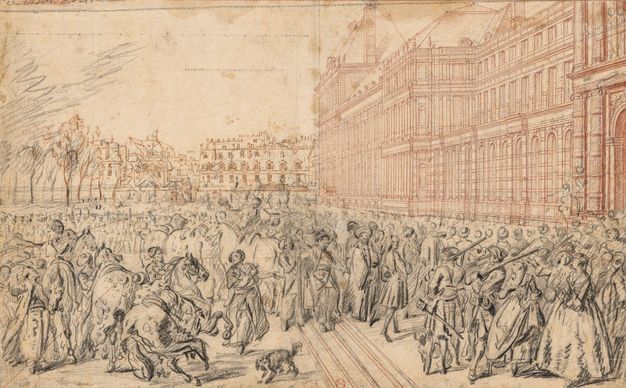
A preparatory drawing for the Reception of the Turkish Ambassadors at the Tuileries (fig. 22), a work commissioned from Parrocel by the crown in 1727, exhibits the technique of perspectival construction using the conventional tools of geometry (compass, ruler, and setsquare).13 The drawing is divided by color into black-chalk figures and sanguine setting. The disjunction between the even and exactly measured red space, mapped from a point of central perspective by a compass and ruler, and the mottled and mobile impression of events unfolding in that gridded locale under the differential pressure of black chalk’s painterly point, could not be more apparent. The perspective and the figures belong to different worlds. It appears, moreover, that the Turkish envoys and the Parisian crowds were drawn first, in space minimally ordered by a vanishing point, on which perspective’s rigid order was later imposed (red over black, in the lines of the steps) and into which the sharply foreshortened architecture was inserted, very possibly by another hand. That Parrocel struggled with the perspective is evident in the corrected positioning of the vanishing point: the eye from which black orthogonals tentatively radiate was removed by the red hand to a lower position.14 The clash between the propositional statements of geometry about space in the abstract, and the gestural marks provoked by concrete things—the sheen of a skirt, the curved rump of a horse, the assorted pitches of rifles on shoulders and swords on hips—are irreconcilable, and pull the image in opposite directions, breaking it apart.15
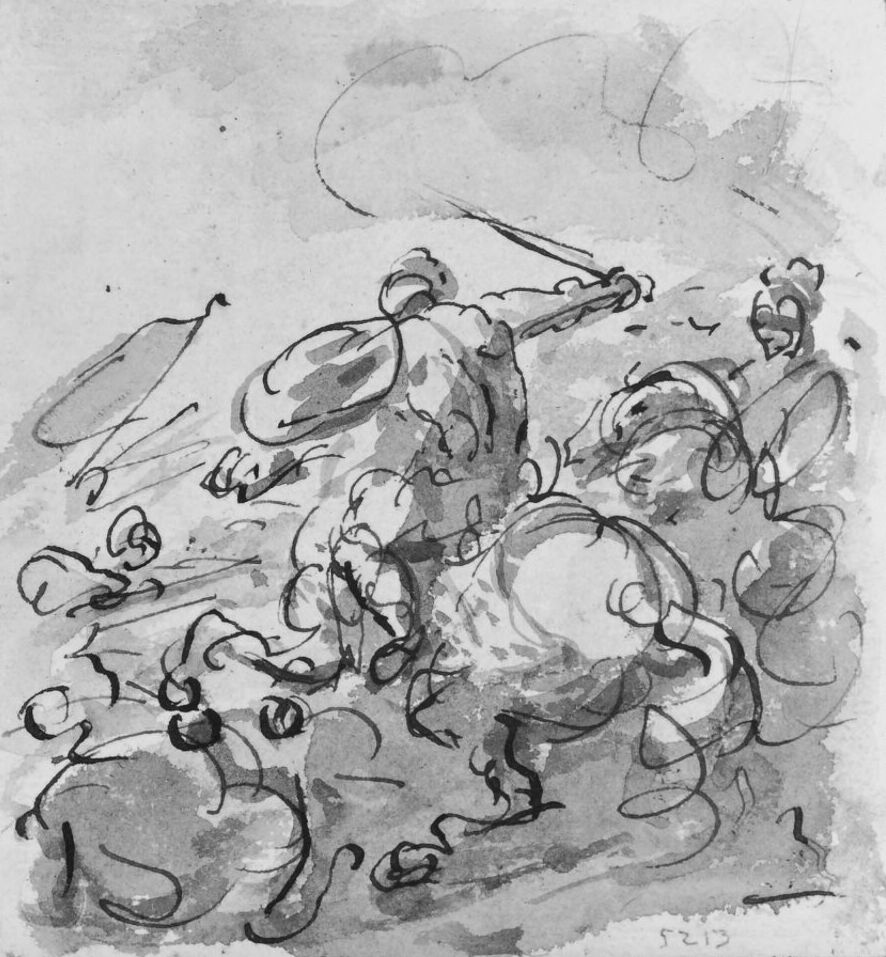
The projection of the camera obscura healed that rift. It enabled the artist to transpose the relative position and size of objects in a scene, freehand, onto the two-dimensional surface.16 The locus of scientific knowledge shifted from paper work to camera work; focused projection relied on exact calculation of the optimum distance between the lens and its objects, and on the informed choice of aperture in relation to light conditions.17 On the page, meanwhile, figure and ground, objects and space were created in a single gestural practice, paradoxically closer to the sketch than the mechanical copy. In Cavalry Engagement, for instance, a pen-and-brown-ink drawing with brown and gray wash (fig. 23), the energetic, almost continuous flow of Parrocel’s inky line feels its way with squiggles and accents toward the “real” of a scene of conflict, working with wash to create space both on the material surface of the drawing and in the picture plane. A camera obscura was obviously not used to make this drawing; rather, the drawing helps us see how the camera afforded a new experiential understanding of perception, one that enabled artists to work in practice back and forth across drawing and painting, or disegno and colore, domains that academic art theory had enshrined in the seventeenth century as cognitively distinct.
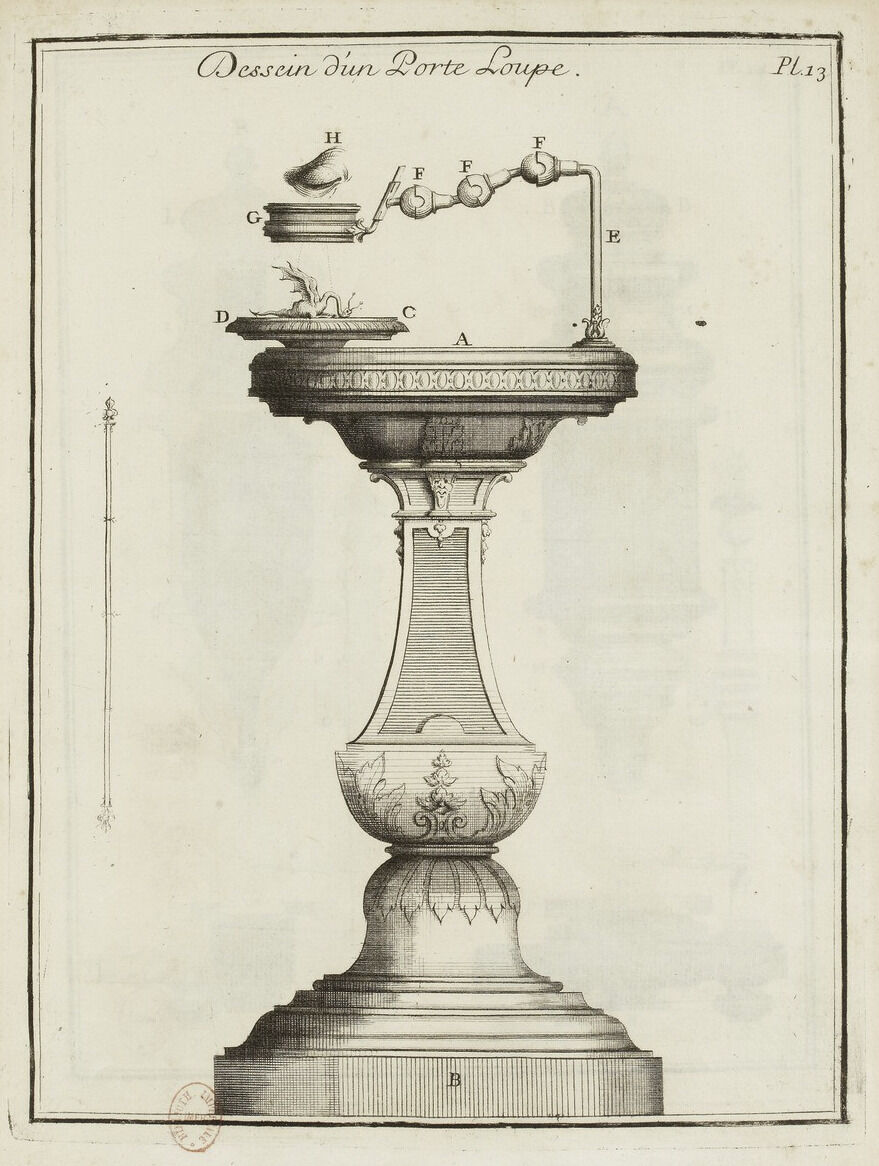
The Académie in 1700 was not, however, the same institution it had been at the height of Charles Le Brun’s influence, when a rationalist order of painting, based in line and narrative, was dominant. Camilla Pietrabissa has shown that, by the turn of the century, a more empirical approach was developing at the Académie school. Louis Joblot, the professor of perspective, introduced the camera obscura to teaching.18 Students, of which Parrocel was almost certainly one, were given a comprehensive course in optics, starting with the anatomy of the eye, followed by lessons in the science of light and color, and ending with instruction on how to build basic optical instruments.19 But, though Joblot encouraged students to take the camera obscura into the countryside to draw, there is no evidence that he promoted it as a means to achieve a heightened form of naturalism. A tiny ornamental dragon (fig. 24) is the object of the eye’s attention in his design for a magnifying glass published in 1718 in his book on microscopy.20
In the years Joblot was teaching, the art theorist Roger de Piles was giving lectures on art theory, published in 1708. In his Cours, de Piles advocated use of optical instruments, specifically mirrors, not in the context of imitation but as an aid to composition—in relation, that is, to invention. He argued that by looking in a convex mirror, which increases the force of central focus, the painter can understand better how to order his or her composition to achieve the “unity of effect” that is, he argues, crucial to satisfying the eye at a single glance, and thus to fulfilling the primary purpose of painting: the illusion of perception.21 The camera obscura is no different. Its lens only brings into view that which is directly in its line of sight and upon which it is focused; that which is not is registered is seen, if at all, with the progressively diminishing sharpness of peripheral vision. Unless the camera is refocused for each object in a scene, it will impose, like the history painter, an order on the world by the honor of its attention, and by consigning lesser things to the indistinctness of the edge.22 Joblot’s innovative teaching with the camera obscura did not of itself revolutionize the paradigms of pictorial representation at the Académie. Indeed, so natural seeming was ideal nature that the camera’s projections appeared artificial to some. Fifty years later, in Méthode pour apprendre le dessein, Charles-Antoine Jombert criticized as unnatural and exaggerated the contrast of light and shadow and the brightness of color projected by the camera.23 He cautioned restraint in the imitation of its “piquant” illusions and advised artists to check them against the “real” of unaided vision.
In light of this review of early eighteenth-century academic theory and pedagogy, the presence of a camera obscura in Parrocel’s studio appears less odd, less contradictory. Optical instruments were not reserved for imitation, they were also tools of invention and imagination. A reading, thus contextualized, of the Lives of Charles Parrocel for what they say about his art in relation to the tradition of battle painting and to the manner of his masters—his father the battle painter Joseph Parrocel, and the history painters Charles de La Fosse and Bon de Boullogne—may now indicate some material impacts of the technology on his practice.
Charles-Nicolas Cochin emphasized the bold liveliness of his friend Parrocel’s battle scenes by comparison to the small, detailed precision of the figures and settings in the work of the celebrated Adam Frans Van der Meulen, Louis XIV’s official war artist.24 He explained the forcefulness of their illusion of presence by reference to Parrocel’s lifelong study of the physiognomy and movement of the horse. Though he notes the importance of memory to the process, his characterization of Parrocel’s habitual manner of drawing as “square” and “flat” (see fig. 23), by which he meant that Parrocel privileged a single plane, parallel to the picture surface, invokes a haptic process of making in which the horse is introduced into the studio as an object for examination and manipulation, like a specimen on paper, though the gestures of representation remain open and sketchlike.25 Of Parrocel’s color, Cochin notes that it was compared unfavorably by some with that of his father and the generation of La Fosse. Antoine-Joseph Dézallier d’Argenville, for one, lamented its blueish, silvered tone, compared to the hot, red of the earlier colorists.26 In the difference introduced by Parrocel fils to Parrocel père’s pictorial heritage, Cochin saw, by contrast, a willingness to recognize the faults of the venerated father, whose works surrounded Parrocel in the studio, and to revise “convention” in the light of nature, a “piquant” nature—the adjective also used to describe the effects of the camera obscura.27
We can infer from the Lives that the camera obscura did graft a new mode of perception onto Parrocel’s body, one that via the technical actions of a lens enabled him to imagine and execute a bold and vivid representation of man and the natural world. This fits with the weak thesis of the impact of optical instruments on early modern Western art, according to which naturalism was stimulated by the look of objects and scenarios reflected in mirrors or projected through a lens, not manufactured with specific projections and reflections. It does not, however, rule out the stronger, instrumentalist argument. At the time of his death Parrocel was working on a set of battle paintings depicting Louis XV’s campaigns in Flanders (1744–48) during the War of the Austrian Succession in preparation for which he was despatched in the spring of 1746 to “reconnoitre” the environs of Ypres, Tournai, and Fontenay, very likely taking his tent and his camera with him.28 What both strong and weak theses register is the contribution made by the camera to the interiorization of practice brilliantly analyzed by Svetlana Alpers: to its becoming, as she puts it, the place “where the world as it gets into painting is experienced.”29
Light was a precondition of that experience, of which the camera, by the difference of its optical values to the steady, diffuse, ideal light of the north-facing studio, made the artist more acutely aware. They were consequently encouraged to control and manipulate those conditions, with optical instruments and with furniture: there was a green curtain on the window in Parrocel’s studio and a mirror on the wall.30 Interiorization led also to a re-visioning of the subjects of representation, reframing and refocusing history thematically, with the means of portraiture and still life.31 Parrocel was famed for his speed of execution and for his depiction of movement, qualities contrary, no doubt, to the slow-worked stillness of the descriptive genres generally favored by the camera obscura. However, for the Choisy commission, Parrocel was certainly concerned with the quiddity of things, and not just their narrative potential. He wrote to the directeur des bâtiments du roi, Le Normand de Tournehem, for loan of the king’s and the dauphin’s clothes at the Battle of Fontenay, hats and gloves included, which he described at length.32 Models of the horse and of ordnance, and examples of weaponry filled his studio.33 The studio, not the battlefield, was for Parrocel the place of encounter between history and painting.
One of the problems created by this shift to the interior was, as Alpers notes, the isolation of the artist.34 Parrocel’s natural melancholy was, according to Cochin, exacerbated by his distance from the center of Paris and his friends at the Louvre.35 Of course, melancholy had been a literary trope in the discourse on the artist since Vasari at least.36 In Cochin’s “Vie de Charles Parrocel,” however, it is not a sign of genius but a symptom of psychosis. What he describes as melancholy we term paranoia. Believing that the superiority of his talent was insufficiently recognized, Parrocel felt persecuted; imagined hostile motives in the behavior of brother academicians; became progressively self-absorbed, secretive, and aloof. Relevant here is that neither the privilege of a royal studio nor access to modern optical instruments appear to have given Parrocel a sense of agency; on the contrary, he believed himself to be the victim of forces beyond his control. The painter Nicolas Lancret was, apparently, the embodiment of those forces.37 Parrocel experienced Lancret’s commercial and popular success with domestic genre, with subjects native to the studio as interior, as a humiliating injustice. We catch a glimpse here of the dark side of the Enlightenment and the progress of commercial culture, or the distorted images that mirrors and lenses can produce.38 §
-
Charles Parrocel, “Inventaire après décès,” 3 June 1752, AN, MC/ET/CXXII/684. ↩︎
-
Plate V, “Dessein,” Encyclopédie, https://encyclopedie.uchicago.edu/, 22:7. ↩︎
-
On the use of the camera obscura in science and art, see Wolfgang Lefèvre, ed., Inside the Camera Obscura: Optics and Art under the Spell of the Projected Image (Berlin: Max-Planck-Institut für Wissenschaftsgeschichte, 2007). ↩︎
-
See Martin Kemp, The Science of Art (London: Yale University Press 1990), chapter 4. ↩︎
-
Louis Gougenot, “Vie de Jean-Baptiste Oudry,” in Mémoires inédits, 2:377–78. ↩︎
-
Charles-Nicolas Cochin, “Vie de Charles Parrocel,” Mémoires inédits, 404–27; Antoine-Joseph Dézallier d’Argenville, Abrégé de la vie des plus fameux peintres (Paris: De Bure, 1762), 4:429–34; and Pierre-Jean Mariette, Abecedario de P.-J. Mariette, ed. Philippe de Chennevières and Anatole de Montaiglon (Paris: J. B. Dumoulin, 1853–62), 4:82–83. ↩︎
-
David Hockney, Secret Knowledge: Rediscovering the Lost Techniques of the Old Masters (Harmonsworth: Thames and Hudson, 2001). ↩︎
-
David Egerton, The Shock of the Old: Technology and Global History since 1900 (London: Profile, 2006). ↩︎
-
Parrocel moved to the Gobelins in 1728. See Hannah Williams and Chris Sparks, Artists in Paris: Mapping the 18th-Century Art World, www.artistsinparis.org. ↩︎
-
Parrocel’s inventaire does not support the studio on Jacques-François Blondel’s ground plan in Architecture françoise (Paris: Jombert, 1752–54), 3: plate 19. ↩︎
-
The room is called a “salle” in the inventaire. ↩︎
-
AN, MC/ET/CXXII/684, 3 June 1752. ↩︎
-
Only two of the three commissioned works recorded in Charles-Nicolas Cochin’s biography of Parrocel were executed. This scene did not progress beyond the preparatory stage. See Cochin, “Vie de Charles Parrocel,” 409. On record of the commission in the Bâtiments’s accounts, see Fernand Engerand, Inventaire des tableaux commendés et achetés par la direction des bâtiments du roi (1709–1792) (Paris: E. Leroux, 1900), 381–82. ↩︎
-
The first vanishing point is represented as an eye; the second vanishing point in red chalk is a point. ↩︎
-
On these modes of drawing, see Tim Ingold, Making: Anthropology, Archaeology, Art and Architecture (Abington, Routledge, 2013), 125–41. ↩︎
-
For such tracings in the case of landscape, see Christoph Löthy, “Hockney’s Secret Knowledge: Vanvitelli’s Camera Obscura,” Early Science and Medicine 10, no. 2 (2009): 315–39. ↩︎
-
See Willem Jacob ’s Gravesande, Essai sur la perspective: Usage de la chambre obscure pour le dessein (The Hague: Troyel, 1711), 1–35. ↩︎
-
See Camilla Pietrabissa, “From Perspective to Place: The Landscape Tableau in Paris, c. 1680–c. 1750,” PhD diss., Courtauld Institute of Art (London, 2018), 22–26. ↩︎
-
According to Dézallier d’Argenville, Parrocel won several student prizes at the Académie. See Abrégé de la vie, 4:429. ↩︎
-
Parrocel owned two magnifying glasses. ↩︎
-
Roger de Piles, Cours de peinture par principes (1708; reprint, Paris: Gallimard, 1989), 65–68. ↩︎
-
’s Gravesande, Essai sur la perspective, 5–24. ↩︎
-
Charles-Antoine Jombert, Méthode pour apprendre le dessein (Paris: Jombert, 1759), 139. ↩︎
-
Cochin, “Vie de Charles Parrocel,” 408, 423. ↩︎
-
Cochin, “Vie de Charles Parrocel,” 421–22. ↩︎
-
Dézallier d’Argenville, Abrégé sur la vie, 432. ↩︎
-
Cochin, “Vie de Charles Parrocel,” 420–21. ↩︎
-
Engerand, Inventaire des tableaux, 383. ↩︎
-
Svetlana Alpers, “The Studio, the Laboratory and the Vexations of Art,” in Picturing Science, Producing Art, ed. Caroline A. Jones and Peter Galison (New York: Routledge, 1998), 401–17. ↩︎
-
AN, MC/ET/CXXII/684, 3 June 1752. ↩︎
-
Alpers, “The Studio,” 410. ↩︎
-
Engerand, Inventaire des tableaux, 384–85, ft. 5. ↩︎
-
AN, MC/ET/CXXII/684, 3 June 1752. ↩︎
-
Alpers, “The Studio,” 411. ↩︎
-
Cochin, “Vie de Charles Parrocel,” 423–24. Mariette attributes Parrocel’s ills to idleness and alcoholism. Mariette, Abecedario, 4:83. See . ↩︎
-
See the classic account in Margot and Rudolf Wittkower, Born under Saturn: The Character and Conduct of Artists (New York: Random House, 1963), 98–132. ↩︎
-
Cochin, “Vie de Charles Parrocel,” 417. ↩︎
-
On paranoia as a modern ill, see John Farrell, Paranoia and Modernity: Cervantes to Rousseau (Ithaca, NY: Cornell University Press, 2006). ↩︎