Mannequin
- Jean-Baptiste Le Prince (1734–81)
Four lifeless figures once stood in Jean-Baptiste Le Prince’s studio. One was a life-size model of an adult man; the other three (one male, two female) were of a smaller scale but still stood at three feet, or around the height of a small child.1 These four anthropomorphic objects served the painter as mannequins, mechanical devices to aid the artist in the representation of the human form. Made and deployed in idiosyncratic ways in European artistic practice from at least the Renaissance, the mannequin became, during the eighteenth century, a more standardized machine with distinctly formulated functions.2 Establishing themselves firmly as familiar denizens of the atelier, these lifelike bodies were a valuable if uncanny presence that both facilitated and threatened art’s relationship with the natural and the artificial.
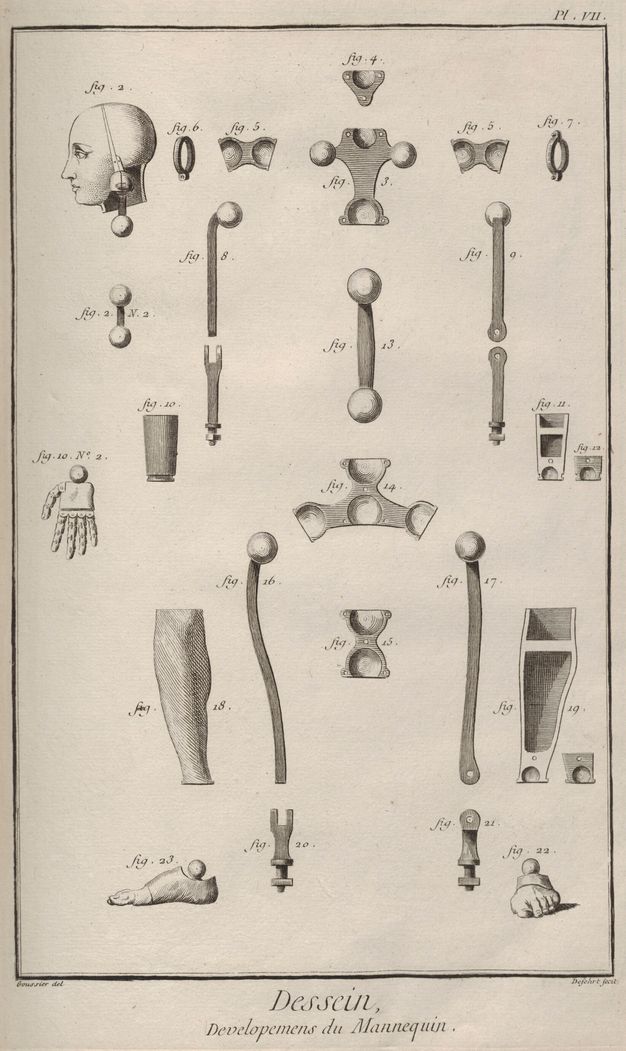
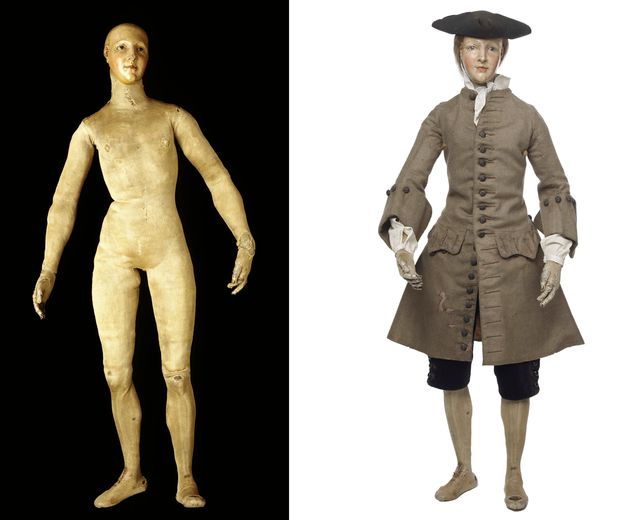
Signaling its status as part of the artist’s habitual apparatus, the mannequin features several times in the Encyclopédie’s suite of plates for “Drawing.” Plate VII provides a schematic breakdown of the constituent parts of the mannequin’s internal mechanics (fig. 98): a metal structure (referred to as the “carcass”) whose individual pieces tended to derive their names from osteological terminology (“shoulder blade,” “clavicle,” “spine,” “humerus,” “femur”).3 The mannequin’s debt to biology also extended to its mode of assembly, borrowing the skeleton’s efficient ball-and-socket joints to enable the multidirectional movement and rotation of its generally copper or iron members. With the exception of a carved wooden head, the flesh of the mannequin would consist of a filler substance (like cork or hair), which was molded over the metal carcass and covered with a skin, usually of chamois leather or silk stockings cut and stitched to size.4 A notable example of this kind of mannequin survives in the Museum of London in an item once owned by the London-based French sculptor Louis-François Roubiliac (fig. 99). Made of a copper-alloy skeleton, fleshed out with cork and horsehair, and covered in silk stockinette, it was topped with a delicately carved and painted wooden head, which, as Jane Munro suggests, was likely the work of the sculptor himself.5 Like Le Prince’s smaller mannequins, Roubiliac’s was a scaled-down model (measuring only 68 centimeters in height), but unlike Le Prince’s gendered mannequins (itemized as “men” and “women” in the sale of his estate), Roubiliac’s was androgynous and still has its range of doll-like clothing and that allowed the figure to appear male or female as required.
Neither in the case of Le Prince nor Roubiliac is it known where these artists acquired their studio companions, but Paris was certainly the major production center for mannequins during the eighteenth century. By the end of this period, mannequin making had begun to develop as a specialized trade, but at midcentury many of the best-known suppliers were in fact artists (usually members of the guild rather than the Académie) with a commercial sideline in producing mannequins, among them the sculptor Jean-Jacques Perrot, the pastel portraitist Nicolas Anseaume, and the pastellist and flower painter Michel Rabillon.6 Later in the century, more specialist makers emerged, like Paul Huot, whose mannequins became sought after across Europe.7 Another was François-Pierre Guillois, a mechanical engineer who made it his mission to improve mobility in mannequin design, creating machines that could mimic the body’s specific actions, like the pronation and supination of the hand and forearm: the more human its movements, the more proficiently the mannequin could fulfil its role as stand-in for the human body.8
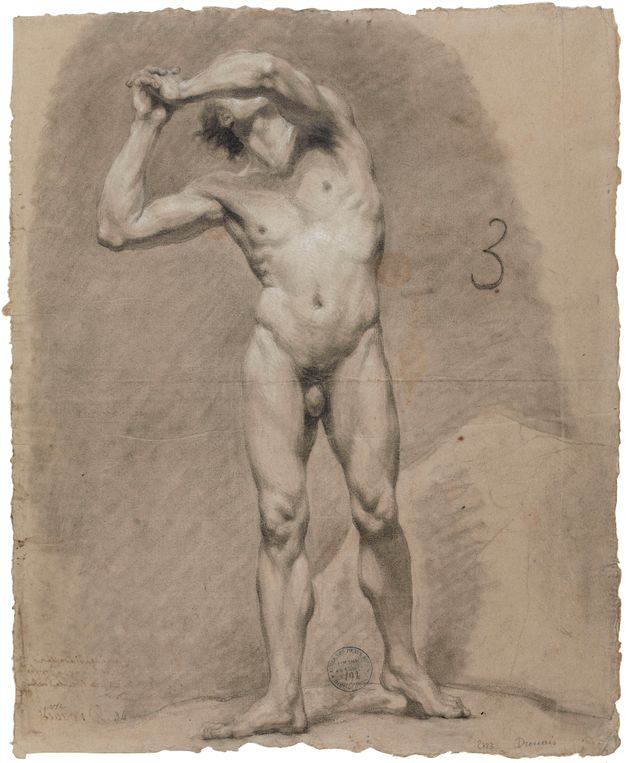
Mannequins were just one of several kinds of inanimate object called to perform this role of stand-in for actual people, sometimes proving better adapted for the task than the original. Drawing from living models in the Académie’s école du modèle (life drawing classes) was the pinnacle of the eighteenth-century curriculum, training artists to understand and represent the corporeality of the male nude in the production of académies (see fig. 34). (Women’s bodies could also serve as models, but only in the relative privacy of the studio.)9 The vitality of those living bodies, however, posed their own challenges (not least, the need to move), which made artificial replacements indispensable tools in certain circumstances. For the beginner, plaster casts of body parts provided students with immobile transitional objects to study before graduating to the trickier mobile versions; while for the expert, provided a privileged pedagogic insight into the underlying anatomy that a living model’s skin otherwise denied. Mannequins, meanwhile, were perhaps the furthest of all these objects from the corporeality of the human body, for despite the biological language and structures deployed in their assembly, their job was to stand in not for flesh but for form.
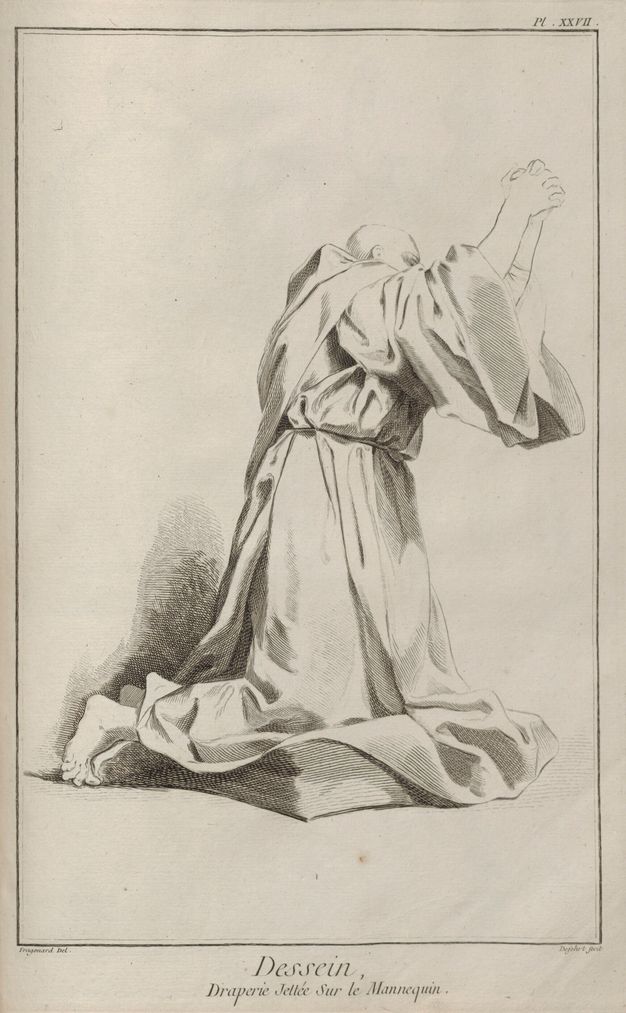
As a studio tool, the mannequin was a compositional device. According to eighteenth-century handbooks, it performed two principal services, both of which are modeled in another of the Encyclopédie’s “Drawing” plates showing the object in use (fig. 100).10 First, it was a vehicle for drapery. Thanks to the mannequin’s anthropomorphic shape, fabrics fell over it as they would over a person—folding, gathering, hitching, floating, or hanging—allowing artists to observe the behavior of textiles across the body’s various parts and to capture their distinctive formal qualities. The art of “throwing and styling” drapery to look naturalistic was so associated with the object that it later adopted its name—mannequiner (to mannequinize)—and was an important technique to master to avoid rigid-looking folds and overly labored effects.11 Second, the mannequin was a posable structure (unlike the static ) that could stay in formation for any length of time (unlike a live model). This made it an invaluable instrument for modeling all kinds of postures, but particularly those actions that the human body found challenging (posing with arms raised overhead) or even impossible (flying through the air).12 To assist with the assemblage of such figural compositions, an artist’s studio might be equipped with all manner of paraphernalia, from ropes and pulleys to raise items overhead, to grills and boards upon which to stage a mannequin at the required angles, elevations, and perspectives.13
Le Prince was certainly among the artists who made liberal use of such props and mechanics. In both the inventory of his Louvre apartments and the catalog of his estate sale, his mannequins were part of a plethora of studio equipment.14 Along with the numerous tools a painter and engraver might use for representing a subject (easels, a , a , a pair of compasses, and a ), Le Prince also owned a profusion of things for staging those subjects. This studio collection included, for instance, an extensive range of apparel, comprising both a large number of garments made especially for his mannequins, and a substantial assortment of foreign clothing, including sets of Chinese, Russian, Circassian, and “primitive” garments, and even the complete costume of a Mandarin. Some of these were no doubt souvenirs acquired on Le Prince’s European travels (he spent several years in Russia and eastern Europe, visiting Saint Petersburg, Moscow, the Kamchatka Peninsula, Livonia, Finland, and Siberia), but others were presumably imported, as he never traveled as far as China.15 Kept in a large armoire (a far larger receptacle than Watteau’s ), Le Prince’s studio wardrobe also extended to a collection of armor and weaponry: helmets, a shield, a sabre, a pike, a halberd, a dagger, a , pipes, a club, a bow, arrows, and a quiver. Finally, Le Prince also possessed several items that could be used to orchestrate all his mannequins, props, and costumed models into scenes. Among these staging instruments he had a “table for the model,” a set of stairs, two large wooden columns painted in faux marble, a Chinese table, and a model Russian carriage.
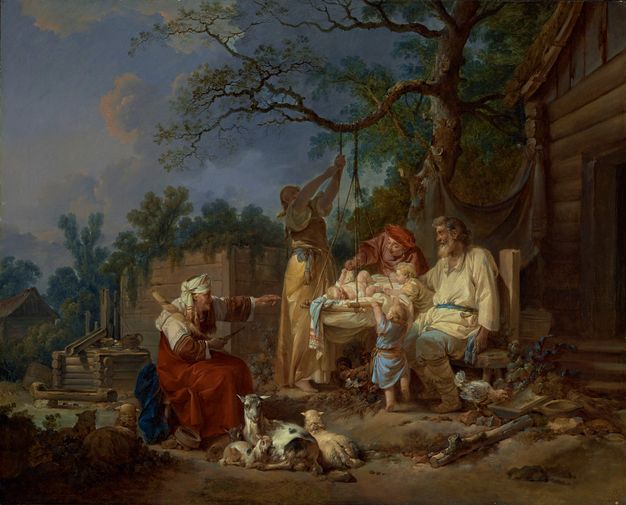
For an artist who made his name painting foreign genre scenes—where “exotically” attired figures engaged in everyday yet curiously othered activities—Le Prince’s studio collections were, like David’s , things that existed between the real and the fictional: functional items (clothing and weapons) that operated as theatrical agents (costumes and props). The crucial role that these performative inanimate objects played in Le Prince’s practice is evident in a work like The Russian Cradle (fig. 101). Having once encountered the material trappings of his studio, it is difficult not to envisage Le Prince’s painting as a staged tableau of “things.” The slumped physique of the old man on the right recalls the lifeless noncorporeality of a stuffed mannequin; the old woman on the left wears the costume of a Russian peasant but seems incongruously overdressed, as though festival apparel was the only option; the woman pulling the rope to raise the cradle occupies precisely the pose at which a mannequin would excel; and the cloth hanging incongruously between tree and hut starts to look like a length of studio drapery. Almost a still-life genre scene, Le Prince’s painting comes close to exposing the artifice that exists behind any figural composition, which, for the period’s art theorists, was often decried as the mannequin’s greatest risk.
Though the object’s use was sanctioned thanks to its deployment by the old masters (Tintoretto, Veronese, Poussin), there were constant warnings about the dangers of dependence or overuse.16 De Piles cautioned that a mannequin should never be a replacement for nature, only called upon “like a witness” for confirmation.17 Claude-Henri Watelet, meanwhile, was more wary, seeing mannequins as “traps” for the painter, with their “ridiculous forms” threatening to “slip imperceptibly into the painting” and render it “incorrect, cold, or inanimate.”18 This may indeed have been the root of Denis Diderot’s concerns with The Russian Cradle and several other paintings that Le Prince exhibited at his first Salon appearance in 1765. For while Diderot appreciated Le Prince’s skill with drapery, he criticized the painter for his “cold compositions” enlivened only by “picturesque clothing,” and for the troubling “amphibology” of The Russian Cradle in particular, with its ambiguously disjunctive elements.19 Yet given Le Prince’s artistic engagement with the human body, it is difficult to say whether this was error or intention. Though he had trained in François Boucher’s studio, presumably with aspirations of history painting, when Le Prince was eventually admitted to the Académie it was in the genre of “views and landscapes adorned with figures.”20 Thus for Le Prince, technically a landscapist, the human body was not the anatomical corporeal presence it was for the history painter, but instead figural staffage: a shape to structure the composition and ornament the scene. That was a role the mannequin was born to play. ‡
-
Notice des principaux articles de tableaux, dessins, estampes, terres cuites, plâtres, planches gravées, habillemens étrangers, armes curieuses, manequins, & autres objets, provenans de la succession de feu M. Le Prince, peintre du Roi (Paris: n.p., 1781), 19. ↩︎
-
The most comprehensive history of the mannequin’s form and use is to be found in Jane Munro, Silent Partners: Artist and Mannequin from Function to Fetish, exh. cat. (Cambridge: Fitzwilliam Museum, 2014). ↩︎
-
Description of Plate VII, “Développements du Mannequin,” Encyclopédie, https://encyclopedie.uchicago.edu/, 20:21:8. ↩︎
-
Description of Plate VI, “Le Mannequin,” Encyclopédie, https://encyclopedie.uchicago.edu/, 20:21:7–8. ↩︎
-
Munro, Silent Partners, 43. ↩︎
-
On mannequin makers in Paris, see E. J. J. Barillet, Sur le mannequin (Paris: Annales du Musée, 1809), 14–18; and Munro, Silent Partners, 43–51. ↩︎
-
Jane Munro, “Perfected Thing: A Lay Figure by Paul Huot,” in The Material Cultures of Enlightenment Arts and Sciences, ed. Adriana Craciun and Simon Schaffer (London: Palgrave Macmillan, 2016), 165–67. ↩︎
-
Barillet, Sur le mannequin, 16. ↩︎
-
On drawing from female models, see Candace Clements, “The Academy and the Other: Les Grâces and Le Genre Galant,” ECS 25, no. 4 (Summer 1992), especially 472–82. ↩︎
-
Antoine-Joseph Pernéty, Dictionnaire portatif de peinture, sculpture et gravure (Paris: Bauche, 1757), 403–4; and Jacques Lacombe, Dictionnaire portatif des beaux-arts (Paris: La Veuve Estienne & Fils, 1752), 384–85. ↩︎
-
Entry for “Mannequin,” Encyclopédie, https://encyclopedie.uchicago.edu/, 10:17; and Lacombe, Dictionnaire, 385. On “mannequinizing,” see Munro, Silent Partners, 28–29. ↩︎
-
Live models could pose with arms raised—as Germain Drouais’s académie demonstrates (see fig. 34)—but usually only where ceiling ropes had been installed for the model to hold. ↩︎
-
Roger de Piles discusses this use of the mannequin in his remarks in Charles-Alphonse Dufresnoy, L’art de peinture (Paris: Nicolas L’Anglois, 1668), 109–11. ↩︎
-
The following items are mentioned in Notice des principaux articles (1781), 19–20; and in Le Prince’s estate inventory (10 October 1781), transcribed in Jules Hédou, Jean Le Prince et son oeuvre (Paris: Baur, 1879), 250–51. ↩︎
-
On Le Prince’s travels, see Hédou, Jean Le Prince, 22–24. ↩︎
-
De Piles in Dufresnoy, L’art de peinture, 109–10; Pernéty, Dictionnaire, 403; “Dessein,” Encyclopédie, https://encyclopedie.uchicago.edu/, 4:890; and Claude-Henri Watelet, Encyclopédie méthodique: Beaux-Arts, 2 vols. (Paris: Pancoucke, 1788), 1:203. ↩︎
-
De Piles in Dufresnoy, L’art de peinture, 110. ↩︎
-
Watelet, Encyclopédie méthodique, 1:203. ↩︎
-
Denis Diderot, “Salon de 1765,” Oeuvres de Denis Diderot: Salons (Paris: Brière, 1821), 1:293, 302–3. ↩︎
-
Le Prince was received in 1765; his genre was described during his agrément in 1764: PV, 7:243. ↩︎