Material
Dressing-Up Box
- Jean-Antoine Watteau (1684–1721)
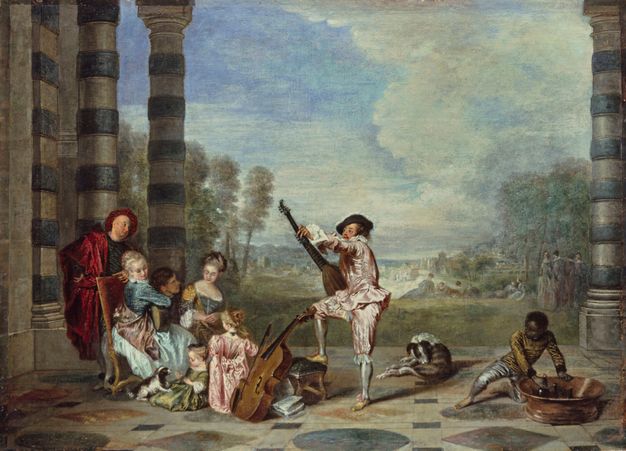
Antoine Watteau was celebrated in his own day as the inventor of a new genre of subject painting, the fête galante (fig. 45), a defining feature of which is the mix of costume—theatrical and actual, fashionable, dated, and everyday—in which the figures populating his landscapes are dressed. According to the comte de Caylus, a longtime friend of the painter and author of one of the Lives of the artist, Watteau owned a collection of clothes specific to that purpose.1 Watteau scholars have followed Caylus in linking it to the prominence of dress in the fêtes.2 Can this book’s focus on things add anything to the considerable knowledge we already have of Watteau’s passion for the theater, dressing up, and fashion? To account historically for the costumes, rather than the images that index them, foregrounds the when, where, and why of Watteau’s collecting, and the how of his use of them.
Neither costumes nor container has survived. In none of the other Lives of Watteau is the costume collection mentioned. Description of the painter’s goods and chattels in the documents concerning his estate is so limited that it adds little to our knowledge of his things, not even confirmation that the costumes were still in his possession at the time of his death.3 In short, direct evidence about the collection is in limited supply.
Guillaume Glorieux has suggested that Watteau sought out commedia dell’arte and other theatrical dress to borrow, hire, or purchase at the shop of theatrical costumier Michel-Joseph Ducreux, on the Pont Notre-Dame, the bridge whose merchants gave Watteau his first job as a copyist when he arrived in Paris from his native Valenciennes as a teenager around 1702.4 Three years later Watteau had moved on to the studio of the painter Claude Gillot, an aficionado of the capital’s theaters, for some of which he worked as a costume and set designer.5 As an artist Gillot made something of a speciality also from painting genre scenes inspired by the fair companies and their plays. Scholars agree that Watteau’s interest in the theater dates from this time.6 Did he, perhaps, begin acquiring costumes and other dress items when he set up independently, circa 1710, and no longer had immediate access to the resources of the Pont Notre-Dame and Gillot’s studio? All Watteau’s biographers underscore working “after nature” as Watteau’s only practice—practice, that is, supported by the presence of things, not memory and imagination.
That Caylus thought to make note of Watteau’s costume collection—though he, like Watteau’s other biographers, made a point of remarking the painter’s contempt for things in general—is explained by the purpose of his biography.7 Written as a lecture for the Académie and its students, Caylus believed it incumbent on him “to connect” the events of Watteau’s Life to “reflections” on the painter’s “manner” and “faire,” that is, to his artistic practice.8 Reference to the costume box occurs toward the end of the life in the wake of Caylus’s description of Watteau’s drawing habits, ones that involved working not only after life but with no objective in mind.9 Earlier in the biography Caylus offered a critique of Watteau’s artistic process that, he argued, had been produced negatively: by lack of that precious academic training that anchored and shaped his audience’s artistic experience. Caylus related both that Watteau had had little exposure to the life class and that he did not use a . That is to say, the nude was an unfamiliar practice to him, and the dressed body was a study in observation after nature, and not for him a contrived event using studio equipment.10 Reference to the and model derived its significance from the “operational sequence” of academic practice and its staging of costume at a particular point in that sequence.11
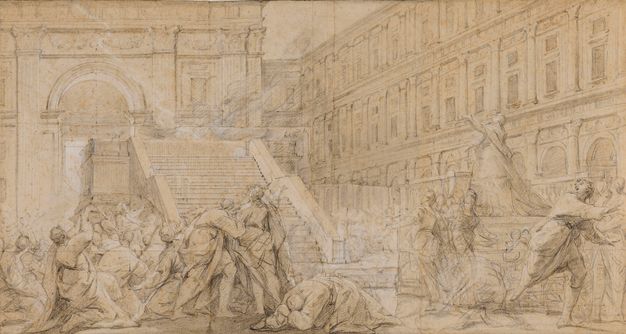
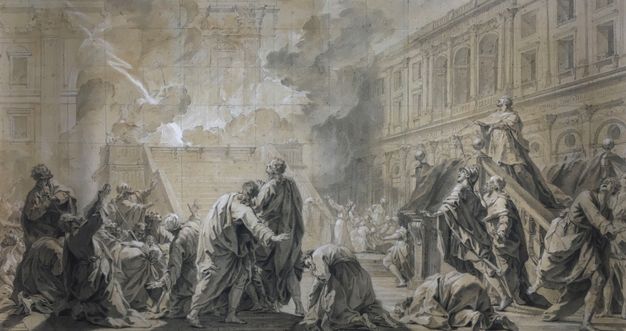
The history painter worked with a project in mind in a five-stage sequence. A rough and inspired “première pensée” (initial idea) was followed in stage two by, on the one hand, its careful elaboration as a coherent composition and by, on the other, detailed studies of its parts (single figures and figure groups). Stage three was that of the finished drawing, all the problems relating to the arrangement, pose, gesture, and dress of the figures having been resolved. This drawing was then scaled and prepared for transfer in stage four, and in stage five the transferred design was realized with brush, medium, and pigments on a canvas. Jean Restout’s Dedication of the Temple of Solomon (1743, Paris, Musée du Louvre) for the Abbey of Chaalis was produced in this manner.12 A drawing at Rouen (fig. 46) records the painter’s evolving solutions to the complexities of multiple-figure arrangement to the right of the temple steps in designs redrawn on successive flaps of paper pasted onto that side of the composition.13 To help him, Restout very likely used small-scale to model the groups of draped figures.14 A clean, finished drawing—with drapery rendered in finest detail, squared for transfer, and now in the Musée des Beaux-Arts at Orléans (fig. 47)—marks the end of the preparatory stages.15
Watteau’s practice, according to Caylus, was by comparison compressed and inverted. As a general rule, Watteau drew only studies—studies that, having no end or purpose, were therefore not intentionally part of operational sequences in the production of pictures.16 His process began, rather, with painting; according to Caylus, with rubbing the canvas surface all over with oil, so it would be ready in stage two to receive the flow of figures and figure groups randomly culled and transposed from his and recycled from earlier paintings.17 Composition was not for him a sequenced and reasoned formation, stage by stage or point to point, but rather a looser process of essaying and improvisation.18 It comprised not just painting but repainting, moving forward and doubling back. The chaos of it was replicated in the mess of his .19 The X-ray of, for example, Les charmes de la vie (see fig. 45) reveals that work had begun on the foundation of Watteau’s earlier composition The Concert (ca. 1717–18, Charlottenburg Palace, Berlin).20 The distribution of the three principal elements—theorbo player, foreground group left, and background group right—were copied onto the new canvas and then reworked.21 A nest of figures, middle distance right, in The Concert becomes in Les charmes a looser horizontal line of distant, almost ghostly human forms. A woman in yellow standing on the left facing right is repainted, following a drawing, to represent a man in red facing forward, leaning over the guitar player.
Watteau’s painting process—(1) covering, (2) transposing, (3) repainting—not only condensed the production method advocated at the Académie; by putting painting before drawing, it also muddled media as operational tools. With the removal of drawing from the preparatory to the executive stage, the study of costume becomes difficult to locate. For the history painter it belonged without doubt to stage two, and to drawing. Selected for specific narrative purpose, according to social norms of decorum and literary rules of verisimilitude, costume was modeled on the or copied from visual sources.22 In Watteau’s case the figure is always already dressed. Several biographers recorded that Watteau drew people while out walking—as found objects, you could say.23 Caylus recollected that visitors to Watteau’s studio were encouraged to use the dressing-up box and improvise poses and identities for the painter to draw.24 Hats and cloaks are, arguably, the things most versatile for the quick and easy transformation of selves.25 The man in red in Les charmes de la vie has been identified as the painter Nicolas Vleughels, with whom Watteau was sharing a studio around the time he painted the picture.26 A drawing by Watteau at Frankfurt (fig. 48) shows Vleughels in a cloak and a beret. The way these items are worn, not residing on the body but rather the cloak draped over one shoulder, the hat perched on the back of the head, seem to register the impromptu, momentary nature of the posing sessions. Was the sketch drawn before the painting or after the painting had begun, with no view in mind or in train with Les charmes?
We have no way of telling. What we do know is that Watteau’s process was open, both in the sense that it had no fixed beginning or end, and because he invited the creative participation of others in the choice and modeling of dress. Staging the composition of the fêtes independently of the dressing-up sessions, and transposing sketched figures on the basis of pose as much as costume, may account for the absence of unity in the fêtes’ costuming, a heterogeneity of dressing that surprised and delighted Watteau’s contemporaries.27 Caylus did not, of course, read Watteau’s practice this way. He saw in it the groping of an artist handicapped by lack of that academic schooling on which depended the mastery of art as a sequence of discrete operational techniques combined with a body of rational knowledge. That Watteau produced masterpieces in spite of his disadvantages was precisely the point revealed by Caylus’s biography.28
The methodology of “operational sequences” (chaînes opératoires) has the considerable advantage of enabling close comparison of technical practices (as above). However, defining technology exclusively as sets of operations in the transformation of “matter” by “human beings,” to paraphrase Pierre Lemonnier, separates object and subject categorically.29 It allows “matter,” in this case cloth, no agency, thus limiting our understanding of cloth’s uses to painting. When Caylus praised Watteau’s imitation of material, he remarked that Watteau “seldom painted stuff other than silk, which always tends to produce small folds.”30 Silk folds. It is self-altering—delicately so, in Caylus’s manner of speaking. His observation raises the following question for us: was Watteau transformed in his practice by the surface “operations” of the stuffs in his collection?
Contemporary sources described Watteau’s manner of painting in terms of touch, a gesture uniquely oriented to the surface.31 According to Caylus, he first “rubbed” his blank canvases all over “haphazardly” with oil, before, according to the amateur Antoine-Joseph Dézallier d’Argenville, applying “a flowing brush and the finest and lightest touch” to paint them.32 “Rubbing” and “flowing” denote the contact of one surface with another under different degrees of pressure. “Haphazardly” and “light” suggests free and untargeted movements of the hand and arm that cover the surface without necessarily delineating or circumscribing it. This is to suggest that Watteau responded to the affordances of canvas and rag paper as infinitely extendable surfaces, rather than viewing them as objects, or “windows,” defined by their edges. In Les charmes de la vie (see fig. 45) he painted, to be sure, an elaborate architectural frame for the musical fête, the polychrome marble squares of the terrace serving as a checkerboard on which to locate his foreground figures in space, in a manner consistent, at first glance, with the boxlike perspective that Jean Restout later constructed for Dedication of the Temple of Solomon (see fig. 46). On closer inspection, the lines of recession in the terrace and the landscape do not align exactly. The narrow strip of empty middle distance appears to bank upward. Afar is confused with above. Space becomes backdrop.
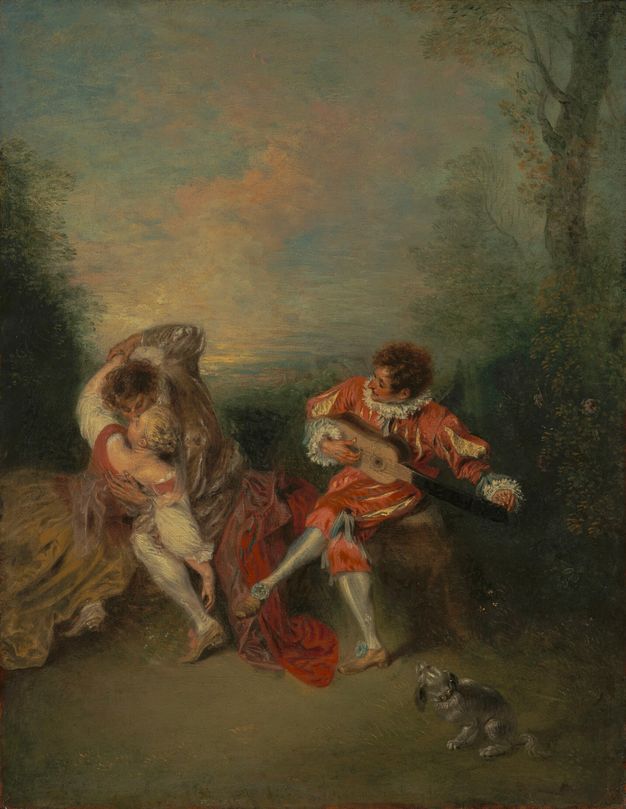
Directly transposing figure and figure groups from sketchbook to canvas and working them into scenes by painting around them tended to produce spatial ambiguities of this kind in complex, multifigure compositions. The treatment of the empty space below and above the guitarist and the embracing couple in another work, the smaller and simpler La surprise (fig. 49), suggests, however, that flatness was actively sought by Watteau; it was not simply an accident of method. Light touches of paint in the areas of foreground, foliage, and sky of La surprise describe edges of grass, leaf, and cloud without obscuring the continuous and amorphous colored surface they accent.33 Moreover, by combining fine and precise signifying brush marks with fluid passages of indistinctness—for example, the blending of landscape and figures in the background of Les charmes and the blurring of built forms on the horizon of La surprise—Watteau’s handling disrupts illusion and allows such qualities as smoothness and evenness to surface—qualities of touch, that is, not sight.
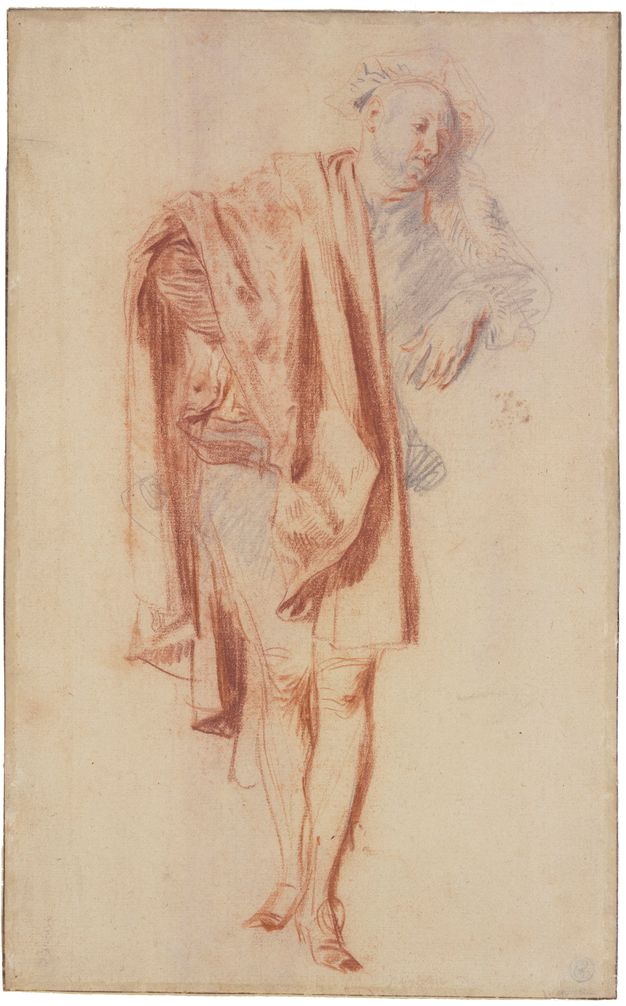
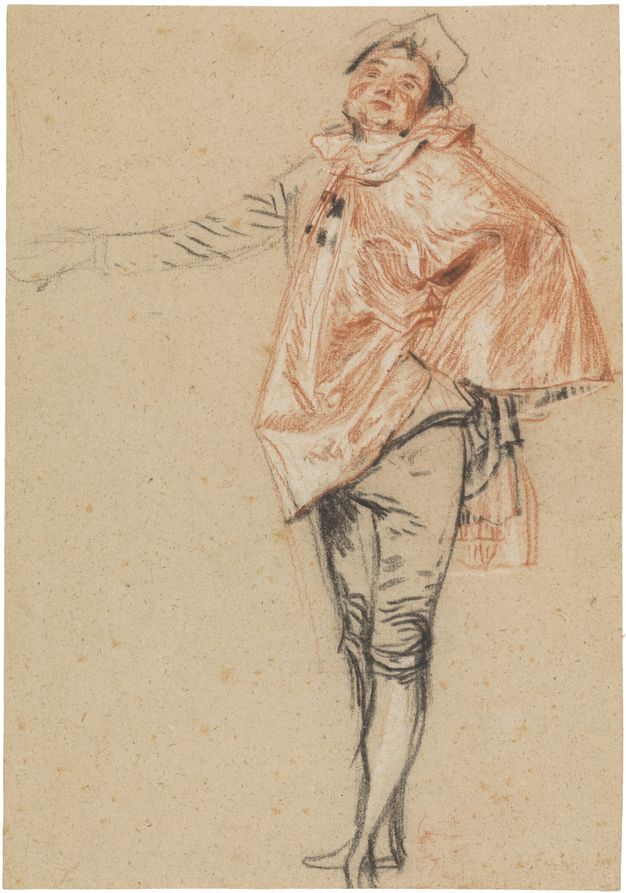
Meanwhile, what of the behaviors of cloth, the folding noticed by Caylus? Watteau was, his works suggest, fascinated by the myriad creases, crumples, wrinkles, rumples, tucks, pleats, and gathers “expressed” by cloth, his attention trapped by the curious, often complex shapes it folded and wrapped.34 An unexplained rumple in Vleughels’s cloak (see fig. 48) creates a puzzling trapezoid shape across the lower body. The cloak–rifle–man assemblage sketched on a sheet of studies of a soldier (Courtauld Institute of Art, London), configures, through the cloak’s wrapping action, a strange polygonal shape comprised of two unequal triangles, the bases of which sit and hang on the diagonal of the gun.35 A later study of a man in a cape (fig. 50), likewise withholds information about the body beneath the wrap and gather of silk. It tells, rather, of the folds the silk itself knots, folds that, like the damp patches on walls, invite imaginative projection: here, the features perhaps of a grotesque face.36
This focus on the collection of apparel, a collection that Watteau began to assemble at the beginning of his career and very likely kept to the end, has revealed when, where, and how it oriented his artistic practice, how it anchored his knowledge of the dressed body (like the grounded knowledge of the nude), and how it stimulated his imagination. License so to reconstruct the collection’s functions is given by the sources, the works, and also recent scholarship that emphasizes the lack of conventional fit between the costumes and the social identities of the persons wearing them in the fêtes galantes. What was so transgressive about Watteau’s portrayal of the dressed figure is that, whatever the figure is wearing—haute couture, yesterday’s fashions, theatrical dress, rustic rags—they appear to be no one other than themselves, though themselves dressed up almost to the point of disguise. Identity, by this account, was constructed on the surface, through artifice, and not conferred by blood, birth, or sensibility. According to Caylus, Watteau was once bewitched by a . Brought to his studio by a barber client, Watteau was enchanted by its perfect “imitation of nature.”37 Apparel was to him, apparently, no less natural than the body. §
-
Anne-Claude-Philippe de Tubières, comte de Caylus, “La vie d’Antoine Watteau,” in Pierre Rosenberg, ed., Vies anciennes de Watteau (Paris: Honoré Champion, 1984), 78. ↩︎
-
See especially François Moureau, “Theatre Costumes in the Work of Watteau,” in Antoine Watteau (1684–1721): The Painter, His Time and the Legend, ed. Margaret Morgan Grasselli and Pierre Rosenberg, exh. cat. (Washington: National Gallery of Art, 1987); and Suzanne Pucci, “Watteau and the Theatre: Movable Fêtes,” in Antoine Watteau: Perspectives on the Artist and the Culture of His Time, ed. Mary Sheriff (Newark: Universtity of Delaware Press, 2006), 106–22. ↩︎
-
See François Mandaret, “Jean-Antoine Watteau: The First Documents,” BM 153, no. 1298 (2011): 312–13. ↩︎
-
Guillaume Glorieux, “Michel-Joseph Ducreux (1665–1715), marchand de masques de théâtre et d’habits de carnaval au temps de Watteau,” BSHAF 2006 (2007): 119–29; and Glorieux, “Les débuts de Watteau à Paris: Le Pont Notre-Dame en 1702,” GBA 139 (2002): 251–62. ↩︎
-
See Jennifer Tonkovitch, “Claude Gillot’s Costume Designs for the Paris Opera: Some New Sources,” BM 147, no. 1225 (2005): 248–52; and Tonkovitch, “A New Album of Theatre Drawings by Claude Gillot,” Master Drawings 44, no. 4 (2006): 464–86. ↩︎
-
Donald Posner, Antoine Watteau (London: Weidenfeld & Nicholson, 1984), 47–58; Marianne Roland Michel, Watteau: An Artist of the Eighteenth Century (New York: Trefoil, 1984), 17–22; and Julie Anne Plax, Watteau and the Cultural Politics of Eighteenth-Century France (Cambridge, England: Cambridge University Press, 2000), 7–52. ↩︎
-
Edmé Gersaint, “Abrégé de la vie de Watteau,” in Rosenberg, Vies, 29–40 at 36; and Caylus, “Vie,” in Rosenberg, Vies, 67. ↩︎
-
Caylus, “Vie,” in Rosenberg, Vies, 55. ↩︎
-
Caylus, “Vie,” in Rosenberg, Vies, 78. ↩︎
-
Caylus, “Vie,” in Rosenberg, Vies, 70–72. Some scholars, such as Roland Michel, have disputed Caylus’s claims. She argues that Watteau drew the nude regularly if infrequently; see Watteau, 135. ↩︎
-
The notion of “operational sequences” is a descriptive tool developed in the anthropology and archaeology of technology. See Pierre Lemonnier, Elements of an Anthropology of Technology (Ann Arbor: University of Michigan Press, 1992). ↩︎
-
See Christine Gouzi, Jean Restout (1692–1768): Peintre d’histoire à Paris (Paris: Arthena, 2000), P115. ↩︎
-
Gouzi, Restout, D79 and 141–49. ↩︎
-
were listed among Restout’s studio paraphernalia in 1753. See AN, O1/1671/133–35. ↩︎
-
Gouzi, Restout, D81. ↩︎
-
On Watteau’s studies, see Roland Michel, Watteau, 93–111; and JoLynn Edwards, “Watteau Drawings: Artful and Natural,” in Sheriff, Antoine Watteau: Perspectives, 41–62, esp. 43–50. See also Alan Wintermute, Watteau and His World: French Drawings from 1700 to 1750, exh. cat., The Frick Collection, New York (London: Merrell Holberton, 2000). ↩︎
-
Caylus, “Vie,” in Rosenberg, Vies, 76. See Élizabeth Martin and Claudia Sindaco-Domas, “Le Technique picturale des peintres de fêtes galantes dans le contexte du XVIIIe siècle,” Technè 30–31 (2009–10): 25–36. ↩︎
-
See Tim Ingold, Lines: A Brief History (London: Routledge, 2007) on different modalities of mark making, esp. 39–71. ↩︎
-
Caylus, “Vie,” in Rosenberg, Vies, 77. ↩︎
-
See John Ingamells, Wallace Collection: Catalogue of Pictures, vol. 3: French before 1815 (London: Wallace Collection, 1999), P410. ↩︎
-
See Christoph Vogtherr, “Fêtes Galantes in London and Potsdam: Different Versions of the Same Theme in Watteau’s Work,” Technè 30–31 (2009–10): 179–84. ↩︎
-
As an example of the mannequins used by history painters, see Charles-Antoine Coypel, Catalogue des tableaux, desseins, marbres, bronzes, modèles, estampes (Paris: n.p., 1753), lot 492 (miniature armor), lot 493 (mannequins), lots 494–96 (miniature theaters for staging scenes). ↩︎
-
See Jean de Julienne, “Abrégé de la vie d’Antoine Watteau,” in Rosenberg, Vies, 17; and Antoine-Joseph Dézallier d’Argenville, “Abrégé de la vie d’Antoine Watteau,” in Rosenberg, Vies, 49. ↩︎
-
Caylus, “Vie,” in Rosenberg, Vies, 78. ↩︎
-
Certain models recur in Watteau’s drawings—for instance, a man with heavy brows, an aquiline nose, and dimples. Watteau draws him alternatively in a cap, beret, tricorn, and straw hat, and essaying a range of corresponding metropolitan and pastoral identities. See Pierre Rosenberg and Louis-Antoine Prat, Antoine Watteau (1684–1721): Catalogue raisonné des dessins, 3 vols. (Milan: Arte, 1996), no. 56. Cloaks conferred on models the cast of the soldier, the hurdy-gurdy player, the friar, or the Italian comedian (the Doctor). ↩︎
-
See Ingamells, French before 1815, P410. ↩︎
-
See Antoine de La Roque in Rosenberg, Vies, 5; and Dézallier d’Argenville, “Abrégé,” in Rosenberg, Vies, 50. ↩︎
-
See Caylus’s statement of purpose, “Vie,” in Rosenberg, Vies, 55. ↩︎
-
Lemonnier, Elements, 26. ↩︎
-
Caylus, “Vie,” in Rosenberg, Vies, 72. ↩︎
-
The discussion below is indebted to Tim Ingold, “Surface Visions,” Theory, Culture, and Society 34, nos. 7–8 (2017): 99–108. ↩︎
-
Caylus, “Vie,” in Rosenberg, Vies, 76; and Dézallier d’Argenville, “Abrégé,” in Rosenberg, Vies, 50. ↩︎
-
On what Étienne Jollet calls the “peu visible” in Watteau, see Jollet, “Analyse technique et poétique de l’oeuvre: le cas des ‘fêtes galantes’ d’Antoine Watteau,” Technè 30–31 (2009): 229–36. ↩︎
-
Caylus uses the word express rather than depict for Watteau’s representation of cloth. See Caylus, “Vie,” in Rosenberg, Vies, 72. ↩︎
-
See Rosenberg and Prat, Watteau: Catalogue raisonné, 1:cat 59. ↩︎
-
See Roger de Piles’s endorsement of Leonardo’s commendation of the damp wall in L’idée du peintre parfait (Paris: Gallimard, 1993), 30–31. ↩︎
-
Caylus, “Vie,” in Rosenberg, Vies, 67–68. ↩︎