Theme
Gaming Set
- Jean-Étienne Liotard (1702–89)
Jean-Étienne Liotard’s gaming set is an exquisite Chinese box, by origin and operation: an exotic luxury object that entices at every layer of its unboxing (fig. 60).1 Kept in storage in the Musée d’Art et d’Histoire in Liotard’s hometown of Geneva, the set still resides in its original traveling box, made to measure from rough wooden boards, painted black on the outside, with the artist’s initials, JEL, still legible on a handwritten label in the corner. Protected inside is the set’s principal container: a sumptuous black and gold lacquer box, decorated all over with botanical designs and Liotard’s initials again, this time more formally painted in a cartouche on the lid. Opening that lid, the unpacker is greeted by five smaller lacquer boxes nestled perfectly within, decorated in a similar fashion to the main box, complete with initialed cartouches, but each one slightly individualized by the form or placement of a leaf or stem. With the final layer of boxes reached, the next mystery is their contents. Two of the small boxes are empty, presumably left so in order to accommodate two decks of cards, which would fit comfortably in their confines. The other three together contain the ultimate treasure trove: 140 mother-of-pearl counters—20 oval, 40 round, and 80 shuttle-shaped—each incised with more decorative designs, and every single one bearing the artist’s initials in the center (fig. 61).
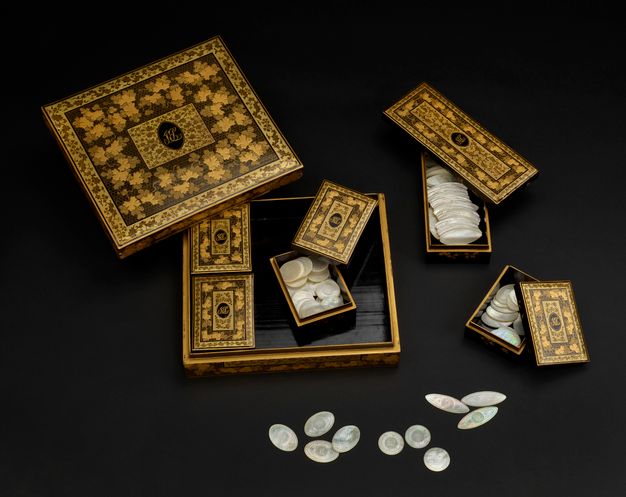
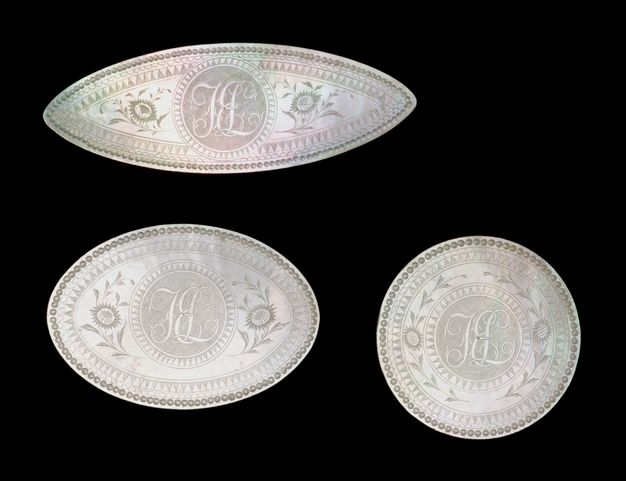
Accepting this object’s ineluctable invitation to open, touch, and admire, a close encounter with its materiality reveals much about the gaming set’s function but somewhat less about its actual use, because its pristine condition points more to inactivity than vigorous play—a gaming set that did not see much gaming. Yet it is perhaps more accurate to think of this as an object whose history of use merely differed from its intended function, for even unused things are functional in other ways. And Liotard’s gaming set certainly served many purposes in its far-from-sedentary life, as an item of international trade, a munificent gift, and a luxurious thing of beauty.
Liotard’s gaming box may not suffer the telltale scuffs and chips of a well-worn set, but it definitely bears traces of playful interaction. Sets like this were not games in their own right (like chess or backgammon sets), but rather counters that facilitated a variety of card games. Card playing took off dramatically in the eighteenth century at every social level, from the bawdy gambling spaces of taverns and fairs to the decadent salons and soirées of the aristocracy, where games of whist, piquet, réversis, or quadrille could bring hours of amusement. Liotard’s set belonged to the latter world, even if Liotard himself did not. Tucked into the box, there are two additional items that bear witness to the set’s ludic activities. One is a hemmed square of silk—red on one side, blue on the other—large enough to be thrown over a table to ready it instantly for gaming purposes, providing a soft, silky surface to lay cards and toss counters. The other is a scoring card for a game called Boston russe (fig. 62).
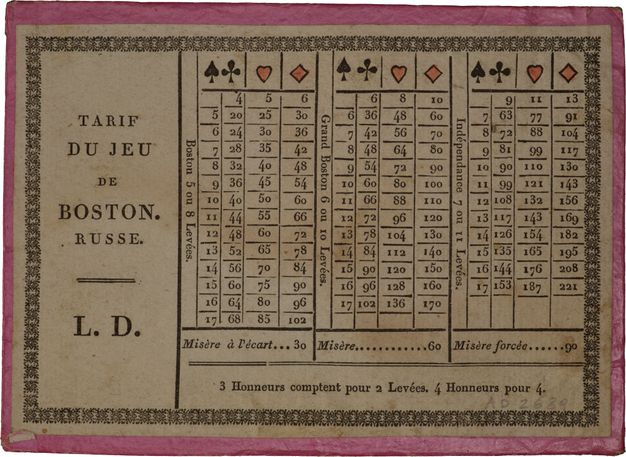
Devised in France in the 1770s, Boston was a trick-taking game (similar to whist or quadrille) in which players placed bids for the number of tricks they could win. The highest bidder then sought to achieve their tally, either alone or in a pair, while the others thwarted the mission.2 Named after the American Revolutionary War (1775–83), Boston had a specific terminology inspired by transatlantic events, like bids known as a “Philadélphie” or an “Indépendence.” Boston russe (Russian Boston) was not a Russian version but rather a variant in which diamonds were the top suit (as opposed to the usual hearts), and it had its own quite complicated scoring system, detailed in the two tables pasted to either side of Liotard’s scoring card. Upon successful fulfillment of a bid, this card would be used to determine the player’s reward, to be then paid out in those mother-of-pearl counters, each shape representing a different amount. Boston may have been Liotard’s game of choice or merely a new fad that passed his way, but the presence of the card suggests it was certainly a game enjoyed at some point by the artist, in a leisurely moment with friends or family.
Like most eighteenth-century artists, Liotard, the son of a tailor, was not born to the leisured classes.3 But painting was a profession that could grant its practitioners access to the most elite circles. As a portraitist active throughout the royal courts and high societies of Europe, Liotard had a wide experience of these social worlds, their luxurious materials, and their entertainments.4 Indeed, while the precise origins of Liotard’s gaming set are somewhat obscure, tradition has it that the box was a gift from none other than Maria Theresa, Hapsburg empress and mother of the French queen Marie-Antoinette.5 Liotard developed a certain professional intimacy with Maria Theresa over many years, visiting Vienna several times (1743–45, 1762, and 1777–78), becoming an acquaintance of the court, and painting numerous, sometimes quite informal portraits of the empress and her family. When his second daughter was born in 1763, he named her Marie-Thérèse and asked the empress to be her godmother.6 If the gaming set was a gift from his most powerful patron (eminently plausible given the significant cost of such an object, and given the empress’s penchant for lacquer), it was probably made in 1778.7 When Liotard was leaving the court at the end of that visit, Maria Theresa is known to have presented him with a boxed porcelain coffee service (fig. 63) as a gift for his wife.8 Given the formal synergies of these two boxed luxuries, it is certainly tempting to envisage the porcelain service and the gaming set as an elegant (and readily transportable) pair of gifts—for husband and wife—in recognition of Liotard’s artistic services to the court.
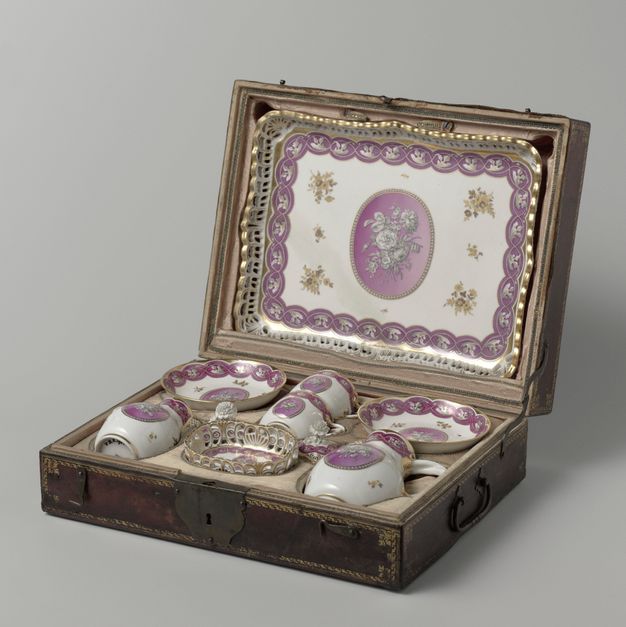
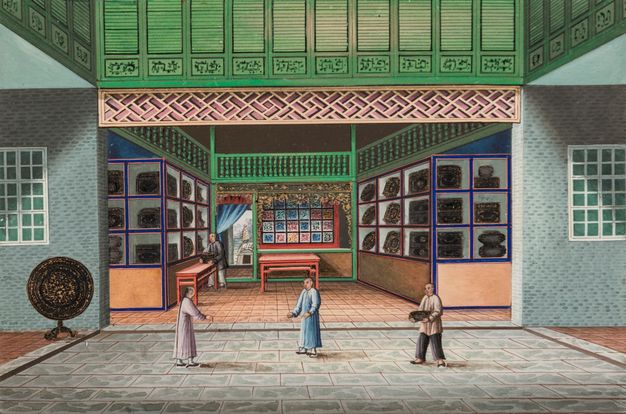
While the coffee service was a local production, made in Vienna’s Kaiserliche Porzellanmanufaktur, the Chinese gaming set had more global origins.9 Of all the things in this book, Liotard’s lacquer box is among those that traveled the farthest to reach the European home it would come to inhabit, though some of Boucher’s Pacific and Nattier’s Japanese porcelain also vie for that accolade. Liotard’s gaming set found its way to Geneva, via Vienna, from the city of Canton (now Guangzhou), which from 1757 was the only Chinese port permitted by the Qing court to trade with Europeans.10 Like most things traded in Canton, the set would have been produced expressly for the export market and procured by a European trader from one of the many shops on Old or New China Street selling lacquerware, porcelain, silk, paintings, carved ivory, tortoiseshell, and mother-of-pearl.11 A watercolor depicting a lacquerware shop in Canton (fig. 64) that is showing numerous lacquer boxes displayed on open shelves suggests that many of the wares sold here were made speculatively for immediate sale. But Liotard’s set would have been custom ordered, with a lacquerware maker and a mother-of-pearl carver employed to paint and incise the artist’s initials—JEL—on every element of the set. Creating personalized objects with initials or crests was a common practice in Canton, with empty cartouches waiting to be filled when traders arrived, but it added to the cost and required more time to prepare the commission.12 Liotard’s gaming set was thus not only an expensive gift but one planned well in advance.
As a Chinese product imported into Europe via international trade routes, given to a Swiss-born artist by an Austrian empress, and used to play a French game called Boston russe, named after an American war, this was a thoroughly global object connecting three continents materially and conceptually. It is strangely appropriate, and probably not coincidental, that a thing with such global reach should have been owned by the eighteenth century’s most notoriously cosmopolitan artist. Across his peripatetic career, Liotard lived in cities throughout Europe and its Asian borders, spending his working life (in descending order of duration) in Geneva, Paris, Vienna, Amsterdam, London, Constantinople, Rome, Florence, and Iaşi in Moldavia, plus visiting many others, but rarely staying anywhere longer than a few years. After he returned from Constantinople in the 1740s, he famously styled himself the “Turkish painter” and dressed accordingly, promoting his orientalist art through that intentionally exoticized persona.13 Though his days of cultural cross-dressing were over by the 1770s, when he acquired the gaming set, his exotic reputation remained, no doubt making Far Eastern lacquerware seem like an ideal gift for the most adventurous artist-traveler of the day.
Though created to fulfil a specific leisurely purpose, Liotard’s Chinese lacquer box was never a practical container in the vein of Fragonard’s or the Académie’s . That evident disjunction between its intended function (a gaming set to be played with) and its actual use (a beautiful thing to be given and admired) was always inherent in its materiality. Lacquer, gold, and mother-of-pearl made the set a luxury, an exotic commodity, a worthy gift from a powerful monarch, but they also made this thing’s functionality secondary to all its aesthetic charms. ‡
-
Thanks to Bénédicte De Donker, Noémie Étienne, and David Pullins for discussions about this object. ↩︎
-
Règles raisonnées du jeu de Boston (Paris: Defrelle, 1808). ↩︎
-
On Liotard’s biography, see Neil Jeffares, Dictionary of Pastellists before 1800, www.pastellists.com/Articles/LIOTARD.pdf. ↩︎
-
William Hauptman, “British Royal and Society Portraits” and “Continental Royal and Society Portraits,” in Jean-Étienne Liotard, 1702–1789, exh. cat. (Royal Académie of Arts, London; Scottish National Gallery, Edinburgh: 2015–16), 91–101, 127–33. ↩︎
-
This legend of the imperial gift is recorded as the probable provenance by the Musée d’Art et d’Histoire. ↩︎
-
Marcel Roethlisberger and Renée Loche, Liotard: Catalogue, sources, et correspondence, 2 vols. (Doornspijk: Davaco, 2008), 1:45. ↩︎
-
On the empress’s interest in lacquer, see Michael Yonan, “Veneers of Authority: Chinese Lacquers in Maria Theresa’s Vienna,” ECS 37, no. 4 (2004): 652–72. ↩︎
-
This timing corresponds both with the dating of the object and the period in which Boston was first being played. On the gift of the coffee service, see Jean-Étienne Liotard to his son, Jean-Étienne Liotard, 27 May 1783, in Roethlisberger and Loche, Liotard, 2:767. ↩︎
-
Maria Theresa also had interests in local production of lacquer (see Yonan, “Veneers of Authority”), but Liotard’s gaming set has been firmly attributed as a product of China by curators at Geneva’s Musée d’Art et d’Histoire. ↩︎
-
Paul A. Van Dyke, Merchants of Canton and Macao: Success and Failure in Eighteenth-Century Chinese Trade (Hong Kong: Hong Kong University Press, 2016), 2. ↩︎
-
On Canton’s shopping streets, see Patrick Conner, The Hongs of Canton: Western Merchants in South China 1700–1900 (London: English Art Books, 2009), 75–88. ↩︎
-
On lacquerware and mother-of-pearl exports, see Carl L. Crossman, The Decorative Arts of the China Trade: Paintings, Furnishings and Exotic Curiosities (Woodbridge: Antique Collectors’ Club, 1991), 263–88, 289–96. ↩︎
-
On the “peintre turc,” see Mary D. Sheriff, “The Dislocations of Jean-Étienne Liotard, Called the Turkish Painter,” in Cultural Contact and the Making of European Art since the Age of Exploration (Chapel Hill: University of North Carolina Press, 2010), 97–121. ↩︎