Type of Object
Theme
Type of Object
Theme
Prompted to consider carriages and artists in the eighteenth century, we think perhaps first of specialist trades, those of the coach painter and the ornamental carver.1 Or, in the context of metaphors of modernity, we think of the image of the extravagantly decorated coach used by critics and satirists to figure the rise of luxury consumption and the corresponding degradation of art.2 We do not, generally, think of carriages as things owned and used by artists. The fine art sculptor and academician Jean-Baptiste Pigalle, who lived at the end of his life on the outskirts of Paris in the semirural district of Montmartre, compels us to think again. Parked at the stable of his house, 12 Rue de La Rochefoucault, in 1785 were a cart and a carriage and a cabriolet. In the stable were a pair of bays to drive the carriage and a black mare for the cabriolet.3 Pigalle’s vehicles contributed to the enormous increase in the number of carriages on the streets of the capital, which had risen from 310 in 1658 to over 15,000 by 1750.4 Growth in vehicular transport occurred in tandem with the gradual improvement of the country’s roads.5 The combination transformed travel, multiplying and speeding up connections between people and places, technological progress regarded as crucial to the modernization of the western world, according to historians.
Was this simultaneous opening up of geographical space and collapse of distance in the seventeenth century experienced professionally, socially, and culturally by artists like Pigalle? Was it reason enough to keep a carriage? Answering these questions begins with knowing more about Pigalle’s vehicles. None survive, but the words used by the notaries to denote them in his postmortem inventory are telling. Of the three types, the cart and the cabriolet mark extremes: of slowness in the case of the cart, a heavy, unsprung, and open vehicle used to transport goods, and of speed and maneuverability in the case of the cabriolet, a light two-seater with a collapsible hood, for expeditions locally. Between the two stands the carriage, specifically a Berline, a four-wheel enclosed vehicle with suspension, for both short- and long-distance travel. Pigalle probably used his cart to ferry materials to and from his studio, and the cabriolet for the short trip to the center of town. The only reference to Pigalle’s travel choices in a contemporary source describes the sculptor leaving the Louvre after a difficult meeting of the Académie’s membership in September 1768; according to Charles-Nicolas Cochin, the Académie’s secretary, Pigalle got into a “chaise,” a cabriolet-style vehicle, and amid heckling from students, made his escape.6 The larger, sturdier, and less nimble Berline was, meanwhile, very possibly his choice for the journeys he made to Reims, Ferney, and Strasbourg in relation to his commissions, respectively, in 1765 for the monument to Louis XV, in 1770 for Voltaire nu, and in 1776 for the mausoleum of the maréchal de Saxe, always assuming he did not opt for public transport.
Although, as Nicolas Clément has noted, Pigalle’s journeys all date from the latter part of his career, they don’t coincide neatly with his purchase of a house with a stable.7 When the monument to Louis XV took him to Reims, and the Voltaire commission to Ferney on the Swiss border, he was living at the Louvre. What were his alternatives? Pigalle’s exact contemporary, the pastel painter Jean-Baptiste Perronneau, traveled by diligence, or public stagecoach, as he crisscrossed France in pursuit of commissions for portraits in the 1760s and 1770s.8 Stagecoaches for Reims left Paris from the Rue Saint-Martin every Saturday at 4 o’clock in the morning, and for Lyon—the first stage of the route to Ferney—at dawn every three days from Quai des Célestins.9 The Almanac royal would have provided Pigalle with all the necessary information to plan his journeys and calculate the cost. Alternatively, he might have borrowed a carriage. In 1767 Cochin borrowed one from the wealthy art publisher Charles-Antoine Jombert to make his regular summer visit to the marquis de Marigny at his country house, Ménars.10 It is possible that Pigalle’s generous friend the abbé Gougenot made one available to him.11
Perronneau and Cochin, though they were using different kinds of transport—public and private, scheduled and unscheduled—both traveled in an open-ended manner, one that Tim Ingold calls “going along.”12 As they drove or were driven, both were alert, it seems, to the opportunities of the road, living it as they moved along. Perronneau, as Francesca Whitlum-Cooper has shown, scanned the markets at Lyon, Bordeaux, and Orléans for openings to paint, matching his movements to the economics of his environment, and Cochin, at leisure, looked for occasions to renew acquaintances and to visit places of interest.13 Pigalle’s journeys, whether undertaken by diligence or in his own carriage, were, by contrast, almost always determined in advance.14 They were oriented toward a precise destination in fulfillment of a specific goal; with few exceptions, immediate return followed.
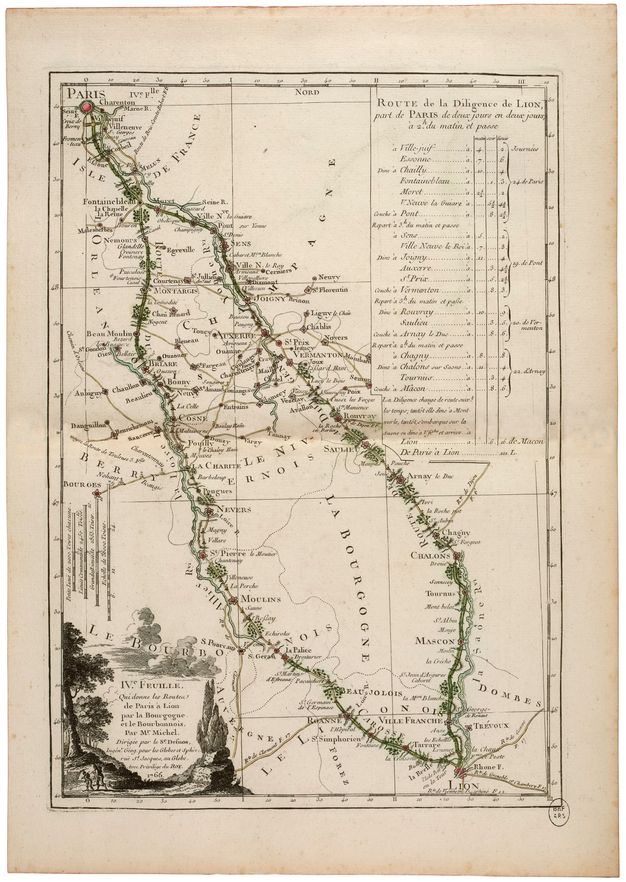
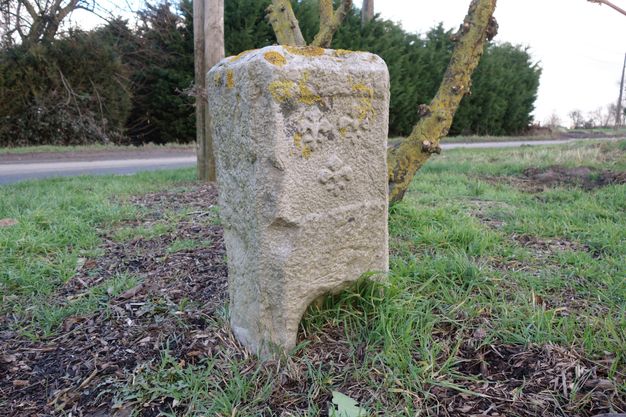
Travel for Pigalle was a matter of itinerary, not geography. An itinerary is a list of points or places through which to pass in order to reach your destination.15 By the mid-eighteenth century, such itineraries could be bought as single sheets for a few sous from book and map sellers. Some were no more than a sequence of place names in geographical sequence, but by the mid-eighteenth century the cartographers Claude Sidone Michel and Louis-Charles Denos were publishing L’Indicateur fidèle, strip maps that outlined itineraries along a single route.16 Sheet number 4, the route from Paris to Lyon (fig. 25), depicts two roads, the older, slower road for goods and local traffic along the Loire, and the new, fast, metaled “Route de la Diligence,” for quick transit across the Île-de-France and the Nivernais to the Burgundy capital. The topography of the wider landscape is reduced to a minimum—just enough for the traveler “to see all the places through which he must pass.”17 It represents, in a sense, the view from the carriage window.18 Such was the speed of traveling by post, according to Arthur Young in 1787–89, that one saw “nothing”19—nothing, that is, but the “milestones,” or rather the toise-stones that, with a fleur-de-lis, punctuated the distance traveled from Paris in units of a thousand toises (fig. 26). Carriage and itinerary isolated travelers perceptually and socially from the environment: it enabled them, as Michel and Denos proudly noted, to journey from point to point without having to scan the horizon for landmarks or stop and ask the way,20 just follow their map with a finger.
Both carriage and map were agents of speed and mobility. Speed is also a leitmotif of contemporary accounts of Pigalle’s journey to Ferney. According to baron Grimm, the sculptor promised to leave for the environs of Geneva “immediately” after the famous dinner chez Mme Necker in April 1770, at which the specifics of the Voltaire monument were decided, and the Swiss artist Jean Huber described with astonishment the speed with which the sculptor modeled Voltaire’s likeness and then left, according to Grimm, without stopping to say goodbye.21 Such accounts not only gloss over the practical difficulties that Pigalle must have faced on this trip, especially on the last leg from Lyon to Ferney, off the grands chemins, they also imply that the time of travel between points was dead time. Only destination mattered.
Can we conclude that Pigalle embraced a modern mode of travel, one structured by ends and made efficient by the routes royales built by the king’s engineers at the Ponts et Chaussées, and by carriages designed for speed and long distance? In the case of Voltaire nu, such a conclusion would align developments in infrastructure with the expansion of the public sphere through the increased circulation of people, objects, and enlightened ideas.22 However, the history of the maréchal de Saxe monument tells a different story. Commissioned in 1753 by the king, it was ready for installation by 1771. Saxe, the hero of Fontenay and victor of Louis XV’s campaigns in Flanders during the War of the Austrian Succession (1744–48), was Protestant and could not be interred in a Catholic church, and therefore not in Paris. The mausoleum was destined for the church of Saint-Thomas at Strasbourg, part of the Alsatian lands conquered by France at the end of the seventeenth century and still predominantly Lutheran. The logistics of the tomb’s transfer from Paris to Strasbourg were hugely complex. From the sources published by Jules Guiffrey in 1891 emerges a picture of energetic, efficient administration headed by the directeur des bâtiments du roi, the comte d’Angiviller, who between March 1775 and July 1776 secured the preparation of the site and the safe delivery and installation of the mausoleum.23 He contracted hauliers for the medium-weight packing cases,24 commissioned the design of special wagons for the heaviest from the king’s mechanic, Antoine-Joseph Loriot,25 organized passports for the convoys to exempt their loads from entry duties as they crossed into Alsace,26 and generally coordinated the arrival of information, works, and personnel in good order and at the right time.27 In d’Angiviller’s bureaucratic imagination, space was abstract extension, and executive power radiated from its nodal point, Paris, along geometric lines to its destination.
Pigalle’s centrism was quite different from both Enlightenment circulation and the lines of royal rule. In 1771 and again in 1774 he had attempted to overturn the decision to send the mausoleum to Strasbourg and to keep it instead in Paris.28 For him, Paris was not a capital node at the center of a power grid but a locality, a place in itself, home of the arts, and, therefore, where the mausoleum properly belonged. He was unable to envisage Strasbourg as having any cultural resources. He sent a wooden hoist and other equipment in the packing cases, as if, the outraged préteur royal, baron d’Antigny, remarked, wood was in short supply at Strasbourg and the city had no carpenters.29 His eagerness to travel to Ferney for the sake of a sitting, the better to execute a commission for Paris, turned to reluctance when the work was to be alienated: he visited Strasbourg for the first time in July 1776, arriving with the last of the dispatches from his studio.30 The itinerary was for him less an invitation to travel—Michel’s and Denos’s L’indicateur fidèle is prefaced with a map of Paris in the form of a patte d’oie enticingly labeled with final destinations—than it was security for a rapid and safe homecoming.
If Pigalle did make use of his carriage for work extra-muros, he more likely actively enjoyed it, we can suppose, for excursions intra-muros. Public transport was again available, in the form of the fiacre, or taxicab; there were ranks in Pigalle’s neighborhood at Montmartre du Mail and Porte Saint-Denis.31 But, as Perronneau discovered to his cost when returning from petite Charône, a village in the northeast of Paris, a fiacre was not always on hand when you wanted one.32 According to the Dictionnaire de l’Académie française, carriages were by definition things of convenience.33 They were also, of course, always much more: a thing as well as means. From the moment the carriage was introduced to France in the early seventeenth century it was regarded as a luxury and was subject to sumptuary law.34 In the early eighteenth century, the rule of ownership and of the decoration of vehicles was still a matter for the courts. Though enforcement lapsed in the 1720s, carriages continued to signify illegitimate and scandalous fortune in the luxury debate.35 Thus, in the physical, social, and moral space of the eighteenth century, the carriage, as Daniel Vaillancourt has noted, polarized distinctions between the entitled and the not, between those forced to walk or hire, like Perronneau, and those able to drive.36 In the second half of the eighteenth century, the boulevards in the west and northwest of Paris attracted those who wanted to be seen in their cars, transforming the road into a space of spectacle. Pigalle had been decorated with the Order of Saint Michel in 1769, reward for the Reims monument. According to Louis Réau, his escutcheon, by its choice of tools for charges—gold modeling tool and riffler rasp on an azure field—confirms Pigalle’s natural modesty, though a nobleman.37 Did his carriages, perhaps, say differently?
Pigalle’s carriage was valued at 800 livres, his cabriolet at 300 livres, the harness and horses at 72 and 1,000 livres, respectively—valuations that exceeded most other things he owned, except his own sculpture.38 The vehicles were well kept. The carriage had metal springs, a technological novelty, and the cabriolet was elegantly decorated: blue and white Utrecht velvet upholstery on the inside and green coachwork on the outside, the color of fashion in the 1770s, according to the vernisseur Jean-Félix Watin.39 For a final flash of brilliance: silver buckles and ornaments decorated the harness.
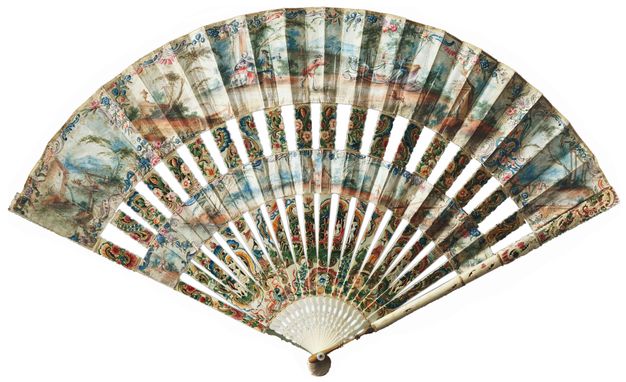
In contrast to fiction and satire, which in the eighteenth century often featured carriages, sometimes prominently as engines of narrative and foci of scorn, the carriage is largely inconspicuous in the pictorial record of the city. We grasp its ubiquity, luxury, and fashion only indirectly, from its regular appearance as a motif on luxury goods. On a so-called cabriolet fan in the Royal Collection (fig. 27), the cabriolet appears twice: in the scene of accident on the upper fan leaf and across the carved ivory sticks at the bottom. A pair of mandarins with parasols frame the carved cabriolet and its occupants. They, and the materials from which the fan is made—ivory, tortoiseshell, and mother-of-pearl—represented and embodied luxury in motifs and stuffs arriving in Paris from outside France: from China, India, the Caribbean, and the South Seas. What is remarkable about Pigalle’s domestic luxe is, by contrast, the almost complete absence of the exotic: the Utrecht velvet of the cabriolet was produced at Amiens; Mme Pigalle’s porcelain were Sèvres, not Chinese; Pigalle did not collect and minerals; and his furniture was not made of bois des Indes but solid oak, walnut, and pine, and, moreover, it was upholstered in wool moquette, not silk.40 His luxury was local, sometimes literally as well as metaphorically so. The house on Rue de La Rochefoucault was wallpapered throughout. In 1779 the firm Arthur and Grenard had established their wallpaper factory on the corner of Boulevard des Capucines and Rue Louis-le-Grand, a stone’s throw south of Pigalle’s dwelling. §
See, for example, Carl Nordenfalk, “The Stockholm Watteaus and Their Secret,” Nationalmuseum Bulletin Stockholm 3, no. 3 (1979): 105–39; and Georg J. Kugler, The Golden Carriage of Prince Joseph Wenzel von Liechtenstein (New York: Metropolitan Museum of Art, 1985). ↩︎
See Étienne La Font de Saint-Yenne, Réflexions sur quelques causes de l’état présent de la peinture en France (The Hague: Neaulme, 1747), 17–18; and Jean-Jacques Rousseau, “Discours sur les sciences et les arts,” trans. Lowell Blair, in The Essential Rousseau (New York: New American Library, 1974), 220. ↩︎
Nicolas Clément, Sculpter au XVIIIe siècle: Jean-Baptiste Pigalle (1714–1785) (Paris: Honoré Champion, 2014), 328. ↩︎
“Carrosse,” Encyclopédie, https://encyclopedie.uchicago.edu/, 2:705. ↩︎
Guy Arbellot, “La grande mutation des routes de France au XVIIIe siècle,” Annales economies, sociétés, civilisations 3 (1973): 765–91. ↩︎
See “Correspondance de M. de Marigny avec Coypel, Lépicié et Cochin,” ed. Marc Furcy-Raynaud, NAAF, 1904, 155–56. ↩︎
Clément, Sculpter, 24–25. ↩︎
See Francesca Whitlum-Cooper, “Itinerant Pastellists: Circuits of Movement in Eighteenth-Century Europe,” PhD diss., Courtauld Institute of Art (London, 2015), 197–231. ↩︎
See Almanach royal (Paris: Breton, 1764), 486 (Reims); and Almanach royal (Paris: Le Breton, 1770), 514 (Lyon). ↩︎
See Paul Ratouis de Limay, Un amateur orléanais au XVIIIe siècle: Aignan-Thomas Desfriches (Paris: Champion 1907), 66–70. ↩︎
On abbé Gougenot, see Hélène Guicharriaud, “Un collectionneur parisien, ami de Greuze et de Pigalle, l’abbé Gougenot, 1724–1767,” GBA 134 (1999): 1–74. ↩︎
Tim Ingold, Lines: A Brief History (London: Routledge, 2007), 72–103. ↩︎
Whitlum-Cooper, “Itinerant Pastellists,” 197–231. ↩︎
See Samuel Rocheblave, Jean-Baptiste Pigalle (Paris: Lévy, 1919), 112–23. ↩︎
On the itinerary see, Catherine Delano-Smith, “Milieus of Mobility: Itineraries, Route Maps, and Road Maps,” in Cartographies of Travel and Navigation, ed. James Ackerman (Chicago: University of Chicago Press, 2006), 16–68. ↩︎
L’Indicateur fidèle, ou guide des voyageurs (Paris: n.p., 1767). The sheets were regularly updated and reissued. ↩︎
L’indicateur fidèle, “Prospectus du guide des voyageurs,” unpaginated. ↩︎
On the enclosure of carriages and the introduction of windows necessitating flat doors to lower them, see André-Jacob Roubo, L’art du menuisier, 4 parts in 5 vols. (Paris: Delatour, 1769–75), 3:496–509. ↩︎
Patrick Marchand, Le Maître de poste et le messager: Les transport publiques en France au temps des chevaux (Paris: Belin, 2006), 87. ↩︎
L’indicateur fidèle, “Prospectus.” ↩︎
See Louis Réau, J-B Pigalle (Paris: Tisne, 1950), 61–63. ↩︎
See Dena Goodman, “Pigalle’s Voltaire nu: The Republic of Letters Represents Itself to the World,” Representations 16 (1986): 86–109. ↩︎
See Jules Guiffrey, “Le Tombeau du maréchal de Saxe par Jean-Baptiste Pigalle: Correspondance relative à ce monument (1752–1783),” Revue de l’art ancien et moderne 7 (1891): 161–234. See also Clément, Sculpter, 154. ↩︎
Guiffrey, “Le Tombeau,” 204. See also AN, O1/1905/2:125, an invoice for transportation submitted by the hauler Bricard, representing twenty-two days out and eighteen days return with the loss of three horses, total cost 7,200 livres. ↩︎
Guiffrey, “Le Tombeau,” 203, 213, 218. ↩︎
Guiffrey, “Le Tombeau,” 206–7. See also AN, O1/1905/2:113, “Passavant en exemption des droits,” 13/04/1775; and AN, O1/1905/2:132, Memorandum by the Fermiers générals in defense of their rights to levy dues, 12 November 1776. ↩︎
Guiffrey, “Le Tombeau.” ↩︎
Guiffrey, “Le Tombeau,” 174–76, 184–87. ↩︎
Guiffrey, “Le Tombeau,” 215, 217. ↩︎
Guiffrey, “Le Tombeau,” 224. ↩︎
See Bernard Causse, Les Fiacres de Paris au XVIIIe siècle (Paris: Presses Universitaires de France, 1972): map of the fiacre ranks in Paris. ↩︎
Whitlum-Cooper, “Itinerant Pastellists,” 220. ↩︎
Dictionnaire de l’Académie française, 4th ed. (Paris: Brunet 1762), 1: s.v. “Carrosse.” ↩︎
See Edit du roy pour le retranchement du luxe, March 1700, in Nicolas De La Mare, Traité de police, 4 vols. (Paris: Brunet 1705–38), 1:419–23. ↩︎
See Antoine Hatzenberger, “Luxe d’ostentation et luxe de mollesse: La critique rousseauiste des carosses,” in Architecture, Cultural History, Autobiography, ed. Jonathan Mallinson, SVEC (Oxford: Voltaire Foundation, 2008): 227–42. ↩︎
Daniel Vaillancourt, “Faire rouler la carosse, ou comment le XVIIIe siècle ne marche pas,” in Classical Unities: Place, Time, Action, Acts of the 32nd Annual Congress of the North American Society for Seventeenth-Century French Literature, Tulane University, 13–15 April 2000, ed. Erec Koch, Biblio 17 (Tübingen: Narr, 2001), 45–55. ↩︎
Réau, J-B Pigalle, 23. ↩︎
AN, MC/ET/LVII/574, Jean-Baptiste Pigalle, “Inventaire après décès,” 29 August 1785. ↩︎
Jean-Félix Watin, L’art du peintre, doreur, vernisseur [1773], ed. Thierry Verdier (Montpellier: Pulm, 2005), 101–2. ↩︎
Jean-Baptiste Pigalle, “Inventaire après décès,” 29 August 1785, AN, MC/ET/LVII/574. ↩︎
| words