Sketchbook
- Jean-Michel Moreau the Younger (1741–1814)
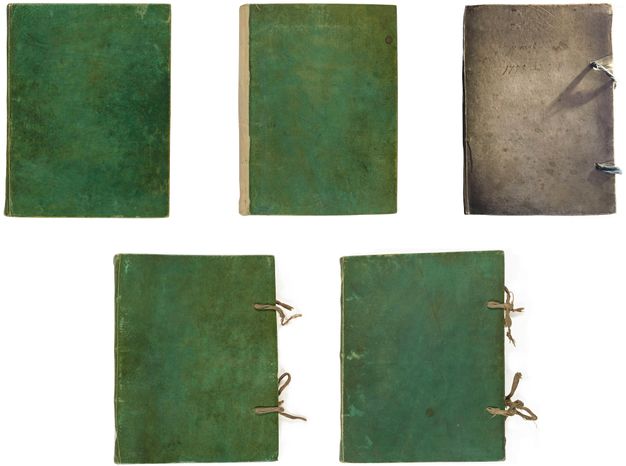
Jean-Michel Moreau’s sketchbook does not really look like a sketchbook (fig. 148).1 A small, leather-bound, hard-covered volume, with decorative tooling and gilding, and even its own title—“ETU/DES” (studies)—inscribed in a panel on the spine, Moreau’s sketchbook appears far more like a that might be at home on a shelf amid plays, poetry, treatises, and histories. More commonly in the eighteenth century, artists’ sketchbooks took the form of carnets, a kind of notebook (not unlike Johann Georg Wille’s (see fig. 86), though with different paper) with fairly workaday binding that could be purchased from stationers’ shops or suppliers of artists’ materials. Jacques-Louis David, for instance, tended to shop for his sketchbooks near the Louvre, buying at least one from a color merchant on Rue du Coq Saint-Honoré and another from a paper merchant on Rue des Prêtres Saint-Germain-l’Auxerrois.2 By contrast, Moreau’s sketchbook was an object that seemed to owe its materiality to the largely Left Bank world of bookbinders and booksellers, in which Moreau had been immersed since 1765, when he married the niece of a bookseller and printer.3 From the outside, Moreau’s sketchbook thus pulls us into the public spaces of the Paris book trade. But on the inside, its drawings evoke a far more private sphere of personal encounters and intimate sociability. Made in a period when the lines between professional and domestic were less distinctly drawn, this was a thing that embodied and navigated those mutable boundaries.
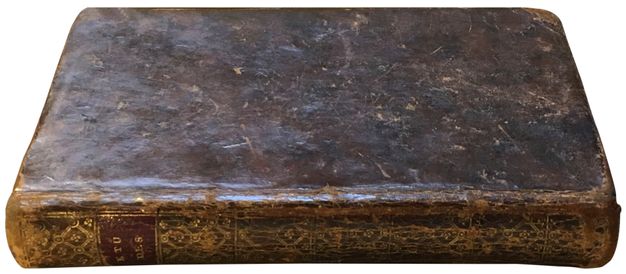
Moreau’s choice of word for the contents of his book, reiterated again in handwriting on the flyleaf (“Etudes de M. Moreau”), is also different from that selected by David or Hubert Robert, who used croquis (quick sketches) to describe the contents of their sketchbooks.4 One such carnet, kept by Robert in Rome, contains page after page of monuments, architectural spaces, antiquities, and figures—some hasty, some partial, some crammed together on shared sheets. Perhaps exactly what we might imagine an artist’s sketchbook to resemble, Robert’s carnet served as something between an album, storing images for reuse in future artworks (like the bound books of figure studies kept by Antoine Watteau to populate his fêtes galantes), and a travelogue, recording the encounters and experiences of his European voyage.5 Moreau’s sketchbook, meanwhile, contained a record of more local travels through the homes and spaces he frequented in Paris—salons, sitting rooms, parlors, studios, workshops, churches, and very occasionally a street or park. The drawings he made in these spaces were not sketches of sites but carefully composed studies of people, far more consistent in their form and subject matter than Robert’s random croquis, but far more ambiguous in their purpose than Watteau’s albums.
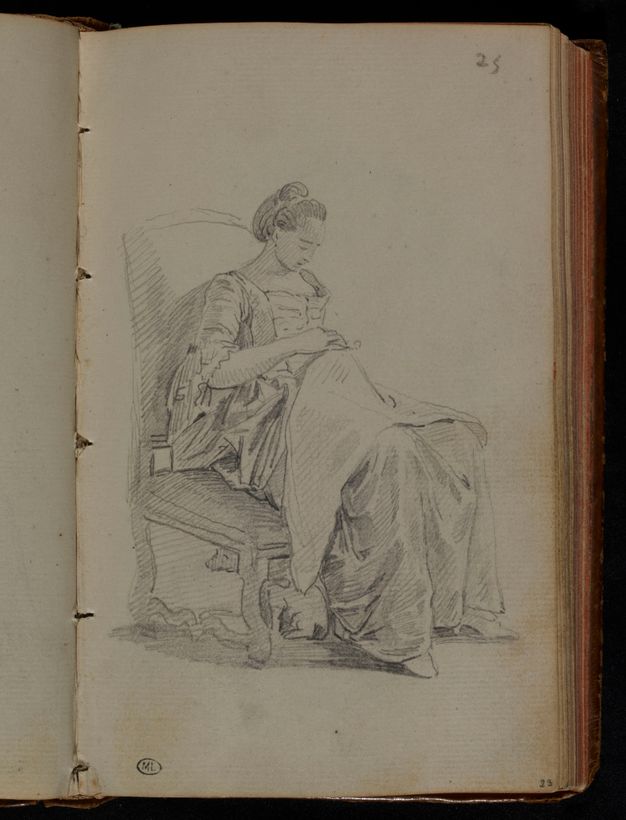
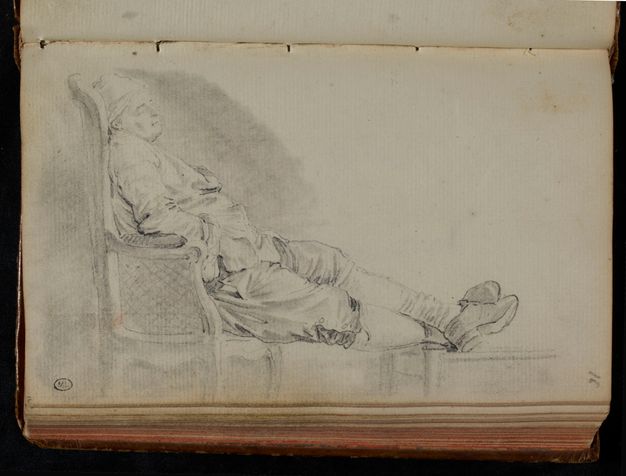
With only a handful of exceptions, every drawing in the book records an encounter with a person. Each figure, sketched invariably in pencil or black , fits a loose set of criteria: they nearly always appear on their own; they are usually absorbed in a moment of domestic or sociable activity; and they seldom acknowledge the draftsman’s gaze, indeed they often seem thoroughly unaware of it.6 Moreau evidently chose his opportunities deliberately, preferring subjects whose attention was protractedly caught elsewhere—reading, chatting, sewing, playing guitar, looking the other way, or even fast asleep. One young woman, for instance, is entirely focused on her needlework (fig. 149), looking down at her hands and concentrating on her stitches, while even the under her chair stares calmly off in the other direction. Another figure is completely beyond consciousness, having fallen asleep in his (fig. 150). Named on the back of the page as Moreau’s colleague Étienne Jeaurat, he is captured in a state of utter ease, dressed casually in shirtsleeves and cap with no , his legs comfortably outstretched on a stool, as though having drifted off during a casual visit or a session in the studio.7 Despite the consistency of Moreau’s interests in these drawings, it is difficult to pin down his motivations. Was he employing sketching as a diversion in these moments, occupying himself while those around him were otherwise engaged? Or was he taking advantage of his companions’ stillness, using the extended time it afforded to linger over each observation? Whatever the case, “study” is certainly the most apt word for these drawings. Less rough and more composed than Robert’s croquis, Moreau’s études are efforts to consider, analyze, and contemplate each person in that moment.
Turning the pages of Moreau’s sketchbook often feels like an intrusion into a private world. Whether or not his subjects were cognizant of their capturing, the images give the impression of covert glances and domestic informality. Taken together they are an intimate record of friends, family, and chance encounters, a collection seemingly made more for personal interest than professional purpose. But, as ever in the eighteenth century, that was an ambiguous distinction. Professionally, Moreau was a draftsman and engraver whose highest accolade was his appointment as dessinateur du cabinet du roi in 1775 (a title he used on the sketchbook’s flyleaf). But from the 1770s onward, much of his practice was devoted to book illustration. According to his obituary from 1814, Moreau produced over 2,400 drawings destined to become engraved prints in books, including editions of ancient texts by Homer, Virgil, Ovid, and Thucydides; modern classics by Racine, Molière, Corneille, and La Fontaine; and contemporary works by Montesquieu, Crébillon, Marmontel, Rousseau, and Voltaire.8 Creating images to complement and enhance the printed words of such diverse books, Moreau’s subject matter was necessarily varied and quite different from his sketchbook drawings, from mythological stories and ancient histories to theatrical scenes and pastoral vignettes.
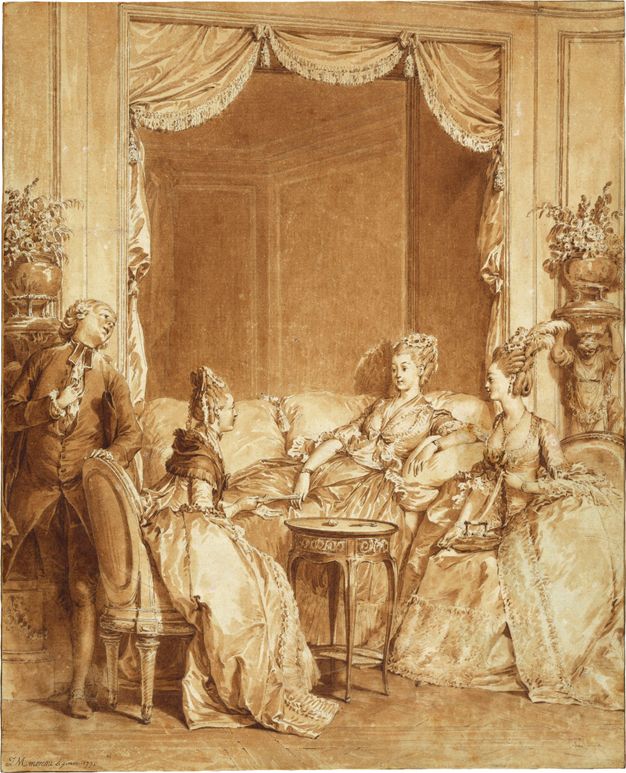
Yet for much of the contemporary literature, Moreau’s studies of domestic encounters may have been as informative to his professional practice as Robert’s buildings and monuments were to the landscapist. Among Moreau’s most celebrated scenes of everyday life were, for instance, the illustrations he produced in the 1770s for a publishing project initiated by his uncle-in-law, Laurent Prault, which later became the Monument du costume (1789).9 Relating quotidian events and contemporary tastes, the series included drawings like Have No Fear, My Good Friend (fig. 151), in which a woman pregnant with her first child lies in a daybed, conversing for reassurance with friends and a visiting priest. As they depict figures occupied with ordinary activities in the home, there is certainly something reminiscent of Moreau’s sketchbook encounters, and yet their animation and theatricality could not be further from the sketchbook’s moments of quiet absorption.10 If Moreau’s book illustrations were the staged performance of everyday life, then his sketchbook drawings were like the private view, the real observations that would be edited later into fictionalized worlds.
As a material thing and a used thing, Moreau’s sketchbook sits somewhere in between the categories of objects in this book. In some ways, it fits most neatly with tools, things that artists used to enable the practical and technical aspects of their work. Alongside , , chalk holders, , brushes, and , Moreau’s sketchbook formed part of the arsenal of studio equipment that the draftsman-engraver needed to make and create—a tool for recording ideas, practicing techniques, or seeking inspiration. In other ways, however, as an artwork in its own right, the sketchbook might align more closely with things like Largillière’s or Drevet’s : art objects that were called upon to serve functional as well as aesthetic purposes. But in quite different ways, the sketchbook might have more in common with the written books that artists kept to manage their affairs—things like and . With these, the sketchbook shared not only their physical form of bound pages but also that particular quality of their contents, where professional matters became inextricably entwined with domestic life. Despite the near total absence of words, the sketchbook certainly reads like a diary of mingled recollections: a sleepy afternoon in the workshop, when a student dozed off against the wall mid-sketch; a lighthearted episode playing with the dog on the floor; a time when his former master, Jacques-Philippe Le Bas, pontificated from a chair with cane in hand; a moment witnessing two gossiping ladies in church; or the numerous occasions (twice at least) when Jeaurat nodded off for a nap.11 With his working world embodied in its binding, and the private sociability navigated through its pages, Moreau’s sketchbook was surely the most personal of all the books he illustrated. ‡
-
Album Moreau Jean-Michel, Musée du Louvre, RF1656. Thanks to David Pullins for discussions about this object. ↩︎
-
Sellers labels appear inside the covers of Album David Jacques-Louis 2, Musée du Louvre D.A.G., RF6071; and Album David Jacques-Louis 3, Musée du Louvre D.A.G., RF9136. ↩︎
-
Moreau’s wife was Françoise Pineau, daughter of the sculptor François Pineau and Jeanne-Marie Prault, whose brother was Laurent Prault, the libraire-imprimeur. On Moreau’s biography and family, see Adrien Moureau, Les Moreau (Paris: G. Pierson, 1893). ↩︎
-
The word croquis is written on the title page, cover, or flyleaf of numerous sketchbooks including: Hubert Robert Roman Sketchbook (1760), The Morgan Library & Museum, New York, inv. 1958.5; Album Robert Hubert 2, Musée du Louvre D.A.G., RF55311; and Album David Jacques-Louis 3, Musée du Louvre D.A.G., RF9136. ↩︎
-
Hubert Robert Roman Sketchbook (1760), The Morgan Library & Museum, New York, inv. 1958.5. On the nomenclature of different kinds of bound repositories for drawings and their uses, see David Pullins, “Albums and Sketchbooks,” Drawing: The Invention of a Medium, exh. cat. (Cambridge: Harvard Art Museums, 2017), 135–43; and Christian Michel, “Le goût pour le dessin en France aux XVIIe et XVIIIe siècles: De l’utilisation à l’étude désintéressé,” Revue de l’art 143 (2004): 27–34. On Watteau’s drawings and albums, see Alan Wintermute, ed., Watteau and His World: French Drawing from 1700 to 1750, exh. cat. (New York: American Federation of Arts, 2000). ↩︎
-
Of the fifty-eight drawings in the book, only five are not figure studies. ↩︎
-
Moreau almost never named his sketchbook figures or annotated the drawings in any way. Only three include names, all of them depicting artists (two of Jeaurat and one of Jacques-Philippe Le Bas). ↩︎
-
“Notice sur M. Moreau” (excerpt from Moniteur, no. 355, 1814, [2–3]. See also Linda Gil, “Les illustrations des Contes et Satires de Voltaire par Moreau le Jeune, pour la première édition des Oeuvres complètes de Voltaire (1784–1789),” Féeries 11 (2014): 221–43. ↩︎
-
Moreau’s drawings first appeared in the Seconde suite d’estampes pour servir à l’histoire des moeurs et du costume française dans le dix-huitième siècle (1777). They were re-published in the Monument du costume (1789). On this publication, see Colette Bertrand, “Le ‘Monument du costume’ de Rétif de la Bretonne,” Dix-huitième siècle 15 (1983): 389–406. ↩︎
-
This is to invoke Michael Fried’s theory of the contrasting dynamics of theatrical and absorptive relations to the beholder in eighteenth-century French art. Michael Fried, Absorption and Theatricality: Painting and Beholder in the Age of Diderot (Chicago: University of Chicago Press, 1980). ↩︎
-
The drawings referred to are on folios 14, 16, 24, 28, 35, and 39 of Album Moreau Jean-Michel, Musée du Louvre, RF1656. ↩︎