Type of Object
Theme
Type of Object
Theme
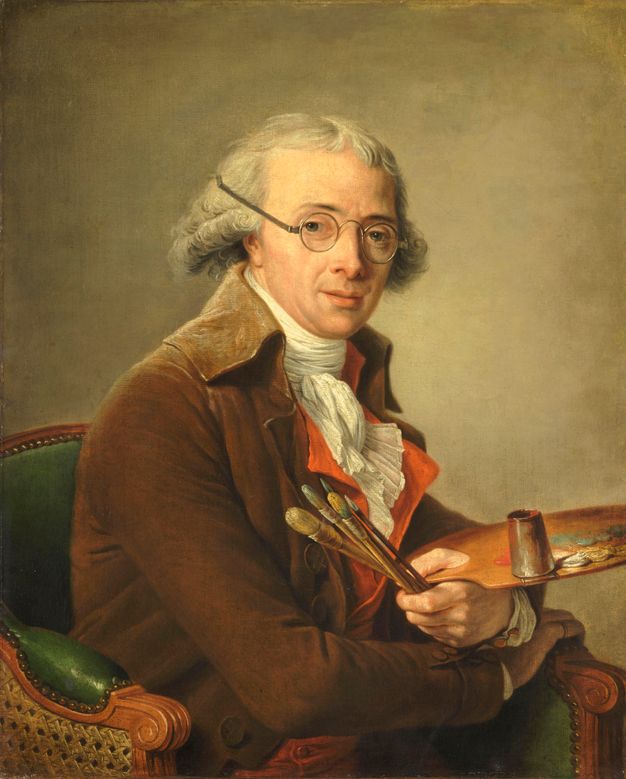
In the 1790s, Jean-Honoré Fragonard stopped painting. By this point in his life, he had enjoyed a long and successful career as an artist spanning three decades, scores of clients, and hundreds of artworks (paintings and drawings), and he had established a name with his distinctively bravura take on the rococo mode. Indeed, the only thing he had not achieved was admission to the Académie.1 But at the age of sixty, he made a career change and became a bureaucrat.2
Fragonard’s professional pivot from painter to arts administrator kept him in the same cultural sector—working for the Commission du Muséum Central to establish France’s first national museums—but involved a dramatic change in daily activities: from the tasks of the studio (grinding pigments, preparing canvases, sketching compositions, charging and cleaning , creating works of art); to the tasks of the cabinet (reading and writing, and more reading and writing). As human activity exists in an inextricable relationship with things, Fragonard’s career change also necessitated a shift in his material environs: a redelineation of his space, a demotion (perhaps even discarding) of previously essential tools, acquisition of new items to enable new activities, and a changing relationship with the old. Among the many things in Fragonard’s possession involved in this moment of transition was his armchair (fig. 4).3
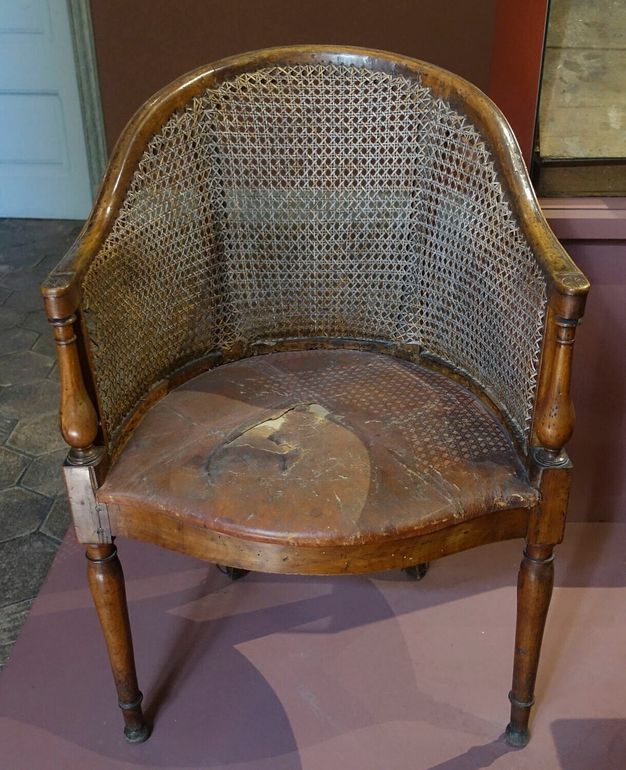
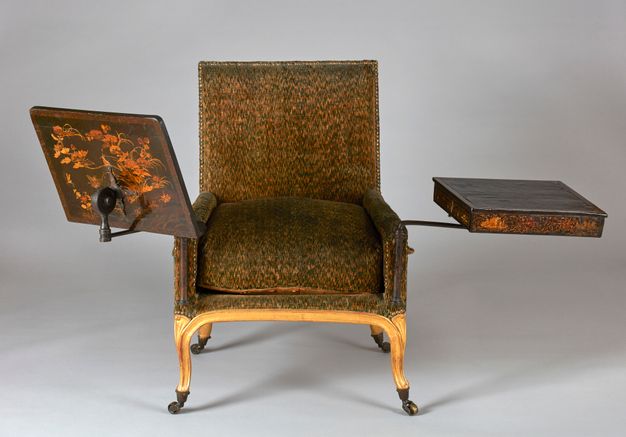
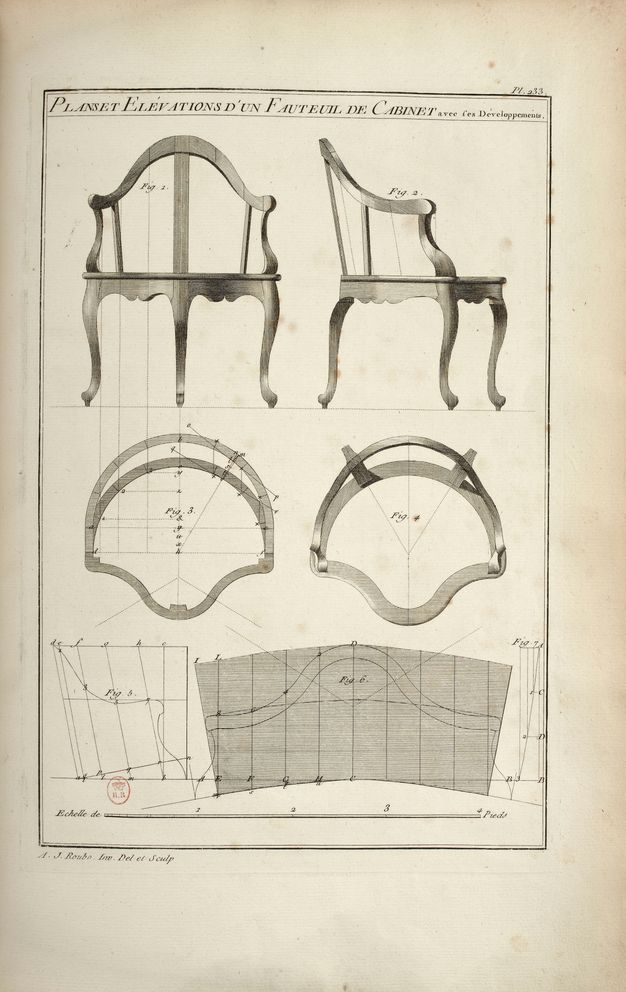
A cane fauteuil with a continuous back and armrests and an upholstered leather seat, Fragonard’s armchair has certain decorative details (like its turned front legs), but other aspects suggest a privileging of functionality over aesthetics (like the single cane layer that makes it somewhat less elegant from behind). In an effort to define chairs, Denis Diderot described them rather self-evidently as “an article of furniture upon which one sits,” but the furniture makers of eighteenth-century Paris assured far more specification of use and activity within this generic category of object.4 There exists, as Mimi Hellman has articulated, a mutually defining relationship between bodies and furniture.5 Every chair allows its user to sit, but each chair accommodates that operation differently, ensuring a particular corporeal position, subtly directing comportment and behavior, and physically delimiting a range of actions and gestures. Any given chair will facilitate some activities, but in turn make others more challenging. In the increasingly literate world of Enlightenment Paris, furniture designed specifically for reading and writing became an important business. Chairs could be optimized for the physical actions of intellectual labor, like, at the more customized end of the spectrum, the fauteuil designed for Voltaire by the menuisier Charles-François Normand (fig. 5): on one side, an adjustable stand for books or papers to read; on the other, a flat surface for writing (if left-handed) that doubled as a container for storage; and casters on the feet so the chair could be wheeled at whim to a more amenable position.6 For other readers and writers, who unlike Voltaire were less averse to stationary deskwork, the chair of choice might be a fauteuil de cabinet (fig. 6), with its central leg at the front and its rounded seat cut away at the sides to ease pressure on the thighs. According to the menuisier André-Jacob Roubo, this assured a commodious experience for those required to sit for long periods leaning forward, “as all those who write do.”7 As a desk-dwelling administrator, Fragonard would have shared such requirements, but his armchair was not designed with quite the same degree of specification.
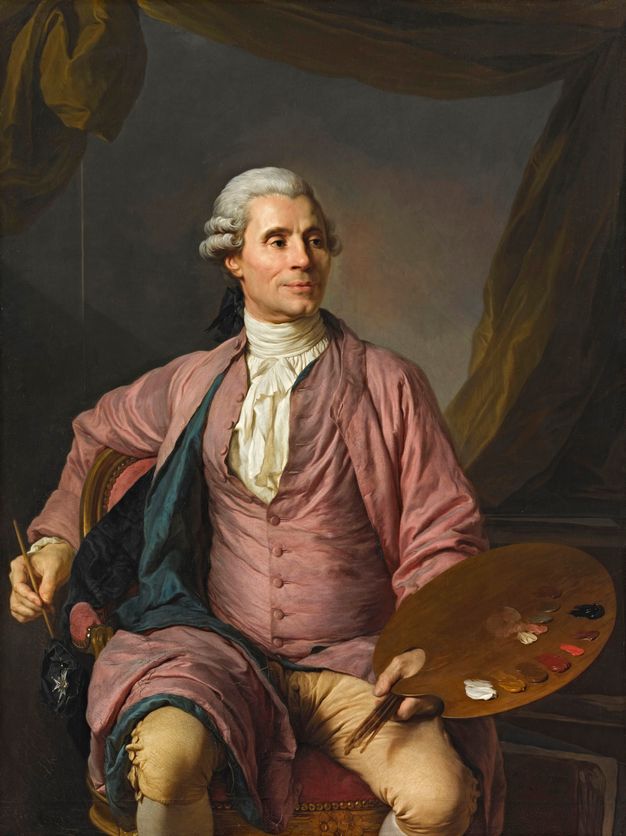
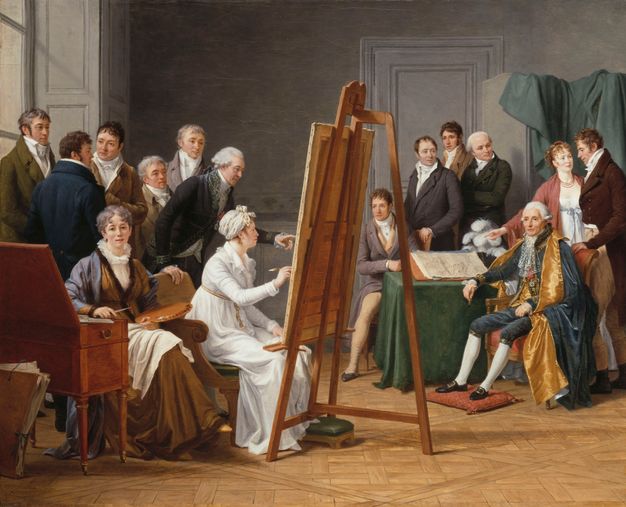
Nevertheless, its features would have qualified it well for the role of a bureaucrat’s desk chair. Its seat height would elevate the user to the appropriate level for writing, while allowing the feet to remain ergonomically on the floor; the curved front edge of the seat would alleviate some pressure on the legs; and the height of the armrests would offer support to the elbow of the writing hand. While amenable to the deskwork required in his new administrative life, Fragonard’s chair was not so specialized in its design as to preclude alternative uses or to imply that it was acquired expressly for this purpose. Its style and materials certainly suggest it was made in the last quarter of the century, so it may well have been bought new by Fragonard in the 1790s to mark his career change, but it could also have been a slightly older purchase re-appropriated for new service.8 Indeed, it is not impossible that it had already served as a work chair in a different space, in the studio of the erstwhile painter. Though the bodily comportment and gestures of deskwork and easel work are completely different, it seems, from the evidence of artists’ portraits, that fauteuils were also frequently the chairs of choice for painting (see, for instance, figs. 36, 38, and 65). With the artist’s active brush hand raised to the canvas, the armrests of an armchair were not an impediment to painterly action and, for the palette hand, they would provide welcome relief for a tired arm.
Fragonard’s armchair, with its amenable versatility and potential for re-appropriation, thus invites an alternative way of thinking about the painter’s late career change. The timing of Fragonard’s decision has always made it ripe for dramatic speculation, even while his exact reasons remain unknown. In many ways, with the events of the French Revolution, this was a moment of collective transformation. From the civil unrest of 1789 to the increasing violence and disruptions of the 1790s, life in France changed significantly in a few short years. Yet in other ways, normal life continued through it all, not least in the form of the relentless litany of loss and ill health that besets every family. For Fragonard, indeed, this extraordinary moment of French history was marked by some very ordinary tragedies, which themselves have been seen as climactic points in his narrative of transition. In 1788 his beloved daughter Rosalie died when only eighteen and, not long afterward, Fragonard himself became seriously ill with a gastrointestinal condition known as cholera morbus.9 In 1790 he traveled to his native Grasse in the south of France to recuperate over the following year, and it was after this, upon his return to Paris, that Fragonard gave up painting. Whether correlation or causation, Fragonard’s trip and the events around it have come to stand as a watershed. His career change looks tantalizingly like a decision provoked by poor health or grief (like that rupture marked in Wille’s after his wife’s death) or like a reaction to the tumultuous events of the day (a new job for this new world). But what if this choice was, like Fragonard’s chair selection, less dramatic change than pragmatic readjustment, less a renunciation of his former life than a reconfiguration of it?
When considered from the perspective of his armchair, there was certainly as much continuity as change in this shift. From the vantage of its leather seat, Fragonard would be working in the same professional field, in the same building, with the same colleagues, albeit performing quite different tasks. Along with several other artists, including, at different times, Jacques-Louis David, François-André Vincent, Augustin Pajou, and Hubert Robert, Fragonard’s role on the Commission du Muséum Central was to oversee the Louvre’s transformation into France’s first public museum. When the monarchy fell on 10 August 1792, the Louvre and its collections transitioned from royal to national property, and the existing plan to establish a museum was adopted by the new regime, as Andrew McClellan has shown, as a matter of political urgency.10 Delivering this crucial goal would be an enormous administrative feat, from the loftiest acts of selecting and curating artworks for display to the more mundane tasks of managing wages and arranging the transport of objects.11 Fragonard’s work in this endeavor was simplified by living onsite, for, like so many of the artists and objects in this book, Fragonard and his chair were residents of the Louvre, despite this being a privilege usually only accorded to academicians, that title Fragonard had never achieved.12 But in this respect, his new role actually proved a valuable opportunity for closure. Not only did this key administrative post bring him an institutional legitimation that had always been lacking, it also resolved an unsettled relationship with the Louvre itself. For Fragonard’s failure to become an academician stemmed from his failure to paint the reception piece requested of him: a ceiling painting to complete the decoration of the Louvre’s Apollo Gallery.13 Joining the commission was then a chance to tie off the loose threads still left from his artistic career. David certainly saw it as a natural progression—a way for Fragonard to devote “his old age to preserving the masterpieces whose numbers, in his youth, he succeeded in increasing”—but perhaps in that moment, it was actually the masterpiece he had failed to complete that proved more decisive.14 Whatever the case, from his desk chair, Fragonard was certainly able to make a mark on Paris’s art-world institutions—and on the Louvre—that he had never quite managed with his brush. ‡
Fragonard was agréé in 1766 but never completed the admission process. ↩︎
On Fragonard’s career change, see Pierre Rosenberg, “Fragonard: Functionnaire at the Louvre,” in Fragonard, exh. cat. (New York: Metropolitan Museum of Art, 1987), 581–82. ↩︎
Part of the Louvre’s collection, the chair is now at the Villa-Musée Fragonard, Grasse. Curators have traced its provenance back to Fragonard’s apartments in the Louvre; see Jean-Honoré Fragonard, peintre de Grasse, exh. cat. (Grasse: Villa-Musée Fragonard, 2006), 13. ↩︎
“Chaise,” Encyclopédie, https://encyclopedie.uchicago.edu/, 3:13. ↩︎
Mimi Hellman, “Furniture, Sociability, and the Work of Leisure in Eighteenth-Century France,” ECS 32, no. 4 (1999): 415–45. ↩︎
Anne Forray-Carlier, Le mobilier du Musée Carnavalet (Dijon: Faton, 2000), 300. ↩︎
André-Jacob Roubo, L’art du menuisier en meubles, part 3, section 2 (Paris: Saillant & Nyon, 1772), 643. ↩︎
With thanks to Mia Jackson and Ulrich Leben for the dating of this chair. ↩︎
Pierre Rosenberg, ed., Fragonard, exh. cat. (New York: Metropolitan Museum of Art, 1987), 417–19. ↩︎
Andrew McClellan, Inventing the Louvre: Art, Politics, and the Origins of the Modern Museum in Eighteenth-Century Paris (Berkeley: University of California Press, 1999), 91. ↩︎
McClellan, Inventing the Louvre, 91–123; and Rosenberg, “Fragonard,” 581–82. ↩︎
Fragonard seems to have been living in the Louvre before he left for Grasse, as his name is included in a description from 1790: “État des logemens,” transcribed in Jules Guiffrey, NAAF, 1873, 147. He then remained in the Louvre until the general eviction of all artists in 1805. ↩︎
The request of a ceiling painting for the Apollo Gallery was made following Fragonard’s agrément in 1766 (PV, 7:330–31). Ten years later, Fragonard wrote to the Académie seeking to be relieved of the obligation, and it was agreed that he could submit an ordinary easel painting instead (PV, 8:242), but Fragonard never did that either. ↩︎
Jacques-Louis David, Rapport sur la suppression de la commission du Muséum (Paris: Imprimerie Nationale, 1973), 5. ↩︎
| words