Shell
- François Boucher (1703–70)
The name and reputation of the painter and academician François Boucher is, for many, synonymous with the shell. The he wore for his portrait by the Swedish artist Gustaf Lundberg (Paris, Musée du Louvre), painted in 1741, at the time he had started to collect, falls down his back in a cascade of curls that against the background of blue look almost like ropes of white and silver scallops. Shells were not, however, the only things that Boucher collected. Neither were they things greatest in number or highest in value in Boucher’s cabinet sold at his death in 1770. A handwritten note at the back of a copy of the painter’s sale catalog gives a breakdown of the sums raised by the different kinds of thing in order of sale.1 Rearranging the subtotals by value puts shells sixth: first among the categories of natural history, certainly, but significantly below the records fetched by painting, drawing, furniture, and porcelain.2 Yet “shell” was and is often promoted as the synecdoche for Boucher’s art and collection, both by reason of novelty—he was one of a few artists in his taste for natural history3—and because the shell, a signature motif of the rococo, came to signify the excess, the luxe, of that style’s reign, a style of which Boucher’s work is a defining instance.4 That said, recent discussions of Boucher’s shells have mostly ignored the awe and fear spelled by the temptation of his shells;5 they have focused less on obvious questions of consumption and critique, appetite and idiom, and have opted instead to interrogate the “science” of his conchyliology.6 Collection, as opposed to accumulation, puts things under cover of the charge of luxury because it consecrates the value of collected things as real, innate, not simply determined by exchange.
What happens if we address Boucher’s things as goods, not ideas? First, we refuse to treat shells as found, discovered, or given, and acknowledge that they entered the collection having been traded like any other thing. Second, we reject naturalizing the relationship between Boucher and his collection, that is, we stop treating his taste as idiosyncratic and self-explanatory. Third, while acknowledging the vestigial part still played by the discourse of curiosity in the reception of the collection, we note the ascendency of the language of taste and fashion.7
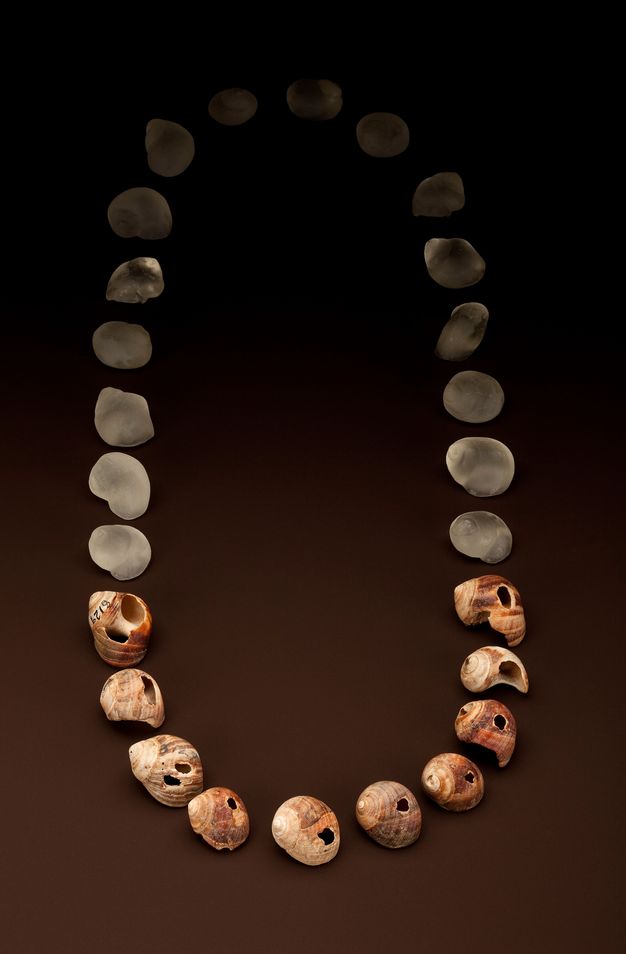
The market for shells was emergent in the eighteenth century. According to Krzysztof Pomian, natural history rose as the market for medals fell:8 a symptom not of changing taste among the privileged, apparently, but rather evidence of a structural transformation of that elite—of its penetration by money. Pomian’s argument is one to which we will return, so conspicuously does it address the ethical problem of consumption, of luxury, but first let us consider Boucher’s specimens in the moment of exchange and at the places it occurred in order to advance their historical candidacy as commodities. In not being made, the minerals, corals, and shells were obviously not exactly like other luxury goods: , , , lacquer, furniture, and so forth. In fact, in a process that exactly reversed the mounting of Chinese and Japanese ceramic in gilt bronze, the better to fit it for European consumption,9 shells imported from the West Indies were stripped of useful fastenings; holes remained where craft had once made nature into “primitive” jewelry (fig. 142).10 Specimens of agate, jaspe, and other hard stone that had been sized, shaped, polished, and fitted for were likewise uncaged.11 For nature to appear natural often required creative labor;12 the distinction between natural history and luxury goods was not as distinct as we sometimes suppose.
More a “phase” than a property of things, commodity or exchange value was, according to the dealer Pierre Rémy, most conspicuous at auction.13 To quote from the catalog of his first natural history sale in 1757, “more reliable knowledge about the rarity and value of shells is to be got at an auction than by looking at [par la vue] collections,” because the collector is invariably in the habit “of boasting about his belongings, and of valuing the preciousness of a thing, either by what he paid for it, or by the price his fantasy has set on it,” whereas auctions do not lie.14 Boucher certainly attended such sales: in 1745 he bought two drawers of shells and several individual specimens for 108 livres at Antoine de La Roque’s sale15 (he paid 100 livres for twenty-three drawings from Charles-Antoine Coypel’s sale in 1753), and in 1766, at the important natural history sale of Mme Dubois-Jourdain, he bid on more than two hundred lots, spending a total of 1,254 livres,16 or more than twice the annual rent for his apartment on Rue de Richelieu.17
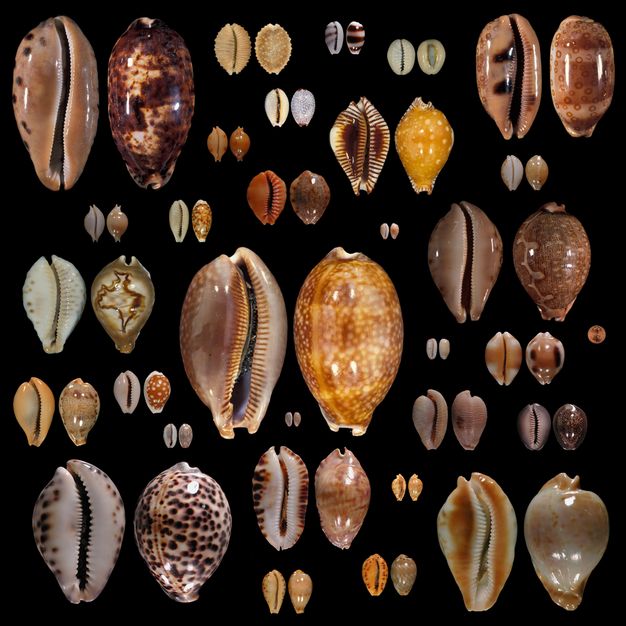
Like Rémy, modern scholars contrast the auction and the cabinet, identifying the first with the commodity and the second with the gift. One of Boucher’s pupils recorded the pleasure and excitement his master experienced on receipt of a “gift” of minerals.18 Boucher “was delighted like a child,” apparently. That pleasure was, however, more calculating than the simile allows. Boucher reserved only two items from the consignment for his own collection; he set the rest aside as swaps. Auctions accentuated the commodity dimension of objects but it was by no means absent from shells in the cabinet. Boucher’s swaps functioned not unlike shells in the so-called cowrie zone of West Africa (fig. 143), a medium of exchange in the eighteenth-century slave trade, or wampum beads (made from the quahog clam shell) in North America, used in the same period by European coastal settlers to trade with the Iroquois, that is to say, they functioned like money, but as a limited, not a generalized, medium of exchange.19 To argue thus that Boucher sometimes mobilized the abstract exchange value of his natural things as the means of acquiring others is not to imply that he was insensible to their concrete form. Boucher’s thirty-five cowries (porcelaines) were, according to Rémy, each unique in size (“very big” to “small”), shape (“egg-shaped,” “shuttle-like,” “hump-backed,” etc.), color (“olive,” “mole,” “mouse gray,” “snow white,” etc.), and surface pattern (“tiger-skin,” “mottled,” etc.), each individual therefore capable of accumulating histories of where it had been, to whom it had belonged, to what purpose it had served. Each was the material object of Boucher’s desire.20 However, in the catalog, taxonomy serves to index value in lieu of history and provenance. Just one of Boucher’s cowries is credited with an origin: “from Panama.” Stripped in the discourse and practices of collecting and trade of their cultural fastenings, of traces of the social relations that constituted them as valuables or commodities, and often even of geographical knowledge, the shell’s exterior sign of visuality becomes generic glitter.21 Far from the cabinet having been a haven from trade, it was a place of greater market risk.
After his death, Boucher’s collection was sold at auction. The sum raised, 70 percent of the value of his estate, represented the bulk of the inheritance later divided among Boucher’s heirs.22 There had been no inventory, a remarkable omission considering the value of the estate and the number of parts into which it was to be divided. That omission is perhaps explained by the fact that Boucher had no landed property, no rentes, no securities, only meubles (movable property, things), the estimation and realization of the value of which required an expert and a dealer, but not a notary. That he should have sought to protect his fortune by collecting, rather than investing, suggests that although scientifically the shells, corals, and minerals were, as Pomian notes, comparatively “young”—had yet to earn themselves settled names and secure taxonomic classification—they were commercially mature in the sense that their exchange-value was known and relatively stable. In general, the arc of Boucher’s collecting, from modest beginnings in the early 1740s to important purchases in 1760s, mirrors the steady upward trajectory in shell values.23 To be more precise, the prices fetched indicate a marked correlation between size and price. His many spiny bivalves fetched sums between 9 and 18 livres, with a concentration at 12 to 15 livres.24 Notwithstanding Rémy’s prefatory claim that the painter was willful and impulsive, unable to deny himself the least thing beautiful, Boucher was not reckless. He calculated carefully and shrewdly.25 The 120,000 livres realized by his sale left his widow and children comfortable.
The importance of the Boucher sale warranted the expense of a frontispiece.26 Two putti hold attributes of Painting and Glory, two others trumpet the painter’s fame. The , brushes, portfolio, and loose drawings, like the putti, direct the viewer to the artist’s studio; ironically, no reference is made to the cabinet. Boucher’s sale, like that of other artists, included work, tools, and studio equipment, but these accounted for no more than 34 out of the sale’s total 1,865 lots. Rémy establishes no causal connection between Boucher the painter and Boucher the collector, but he does promote for praise formal parallels between the fecundity of the artist’s imagination and the immense size and richness of his collection, between the amiability of the owner and the attraction of his possessions. Others were not so approving. Bret de Dijon found that the painter had compromised his talents for the sake of his collection, not as the seventeenth-century art theorist Alphonse Dufresnoy had supposed it possible, by painting too fast, but by accepting tasks beneath a true artist’s calling.27 Lempereur too discovered that Boucher had been led by profit to corrupt his talent, though in condemning the painter he spared the collection.28
Such contemporary response to Boucher’s collection dates from the period after he had taken up lodgings at the Louvre, and more especially after he became premier peintre. Following the death of Charles-Antoine Coypel, Boucher was given the latter’s grand set of rooms on the first floor of the north wing, overlooking the Rue Saint-Honoré. His immediate neighbors were not other artists but courtiers and members of the king’s household. At the end of the century, Sébastien Mercier would mock the culture of favor that had had the elite, or would-be elite, compete for and traffic in such lodgings, notwithstanding the gross discomfort occasioned by their lack of proper amenities.29 In such an elite social setting it is perhaps not surprising that the architect Jacques-François Blondel should have chosen to draw attention to Boucher’s cabinet—“very beautiful”—rather than his adjacent studio.30 Boucher had spent over 9,000 livres, a significant sum of money, on improvements necessitated, it is generally supposed, by the installation of his collection.31 Two visitors recorded their impressions. In 1766 Horace Walpole was struck by the “quantities of shells, mosses, ores, Japan, China, vases, Indian arms and music etc.”32 A year later, those same quantities impressed the Polish tourist count André Mniszech not at all. He mocked Boucher’s cabinet as “a vast curiosity shop,”33 sly allusion, perhaps, to the trade card the painter had once designed for Gersaint in which, coincidentally, the very assortment of things Walpole listed is depicted.
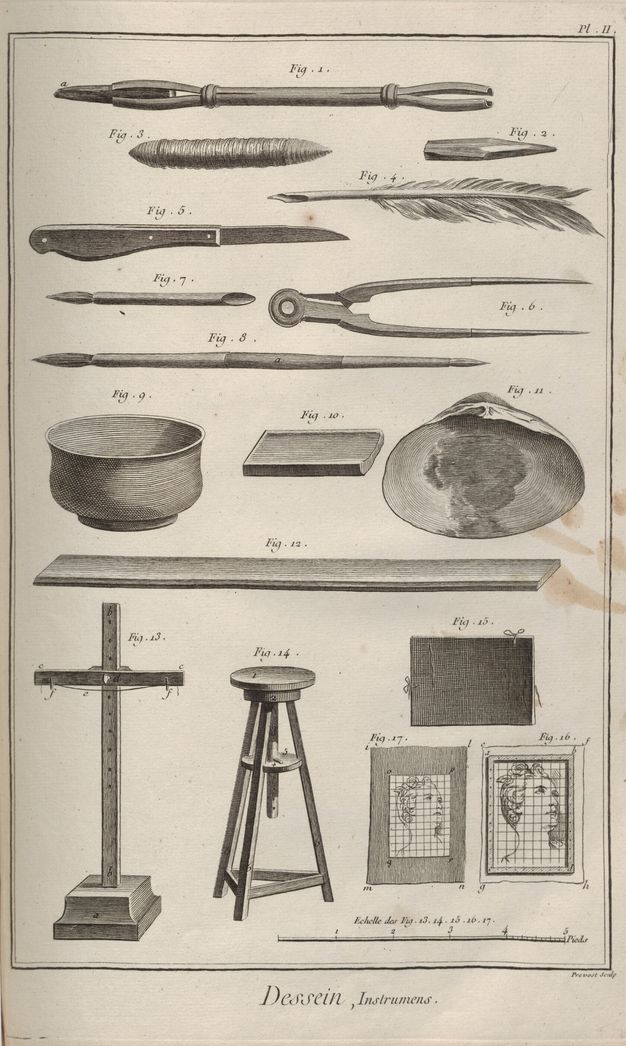
Bret and Mniszech faulted Boucher’s collecting not because they detected in it conspicuous imitation of signs of noble rank but because they thought they recognized simple consumerism: a gross bourgeois accumulation of stuff like so much stock or a commodity of natural history objects. Visitors were offered neither a narrative of God’s creation nor a lesson in nature’s wondrous order, just the mundane store of Boucher’s possessions, all show and no tell. Collecting was traditionally justified in the case of artists by use. And for collecting to serve art it must precede and inspire creation, not succeed it and reward artistic labor. In a very literal sense, shells provided that support to genius (fig. 144). They were his everyday objects of the studio, his tools for holding water-based paints, their white, nacreous interiors, allowing the painter to anticipate the effect of the pigment on paper.34
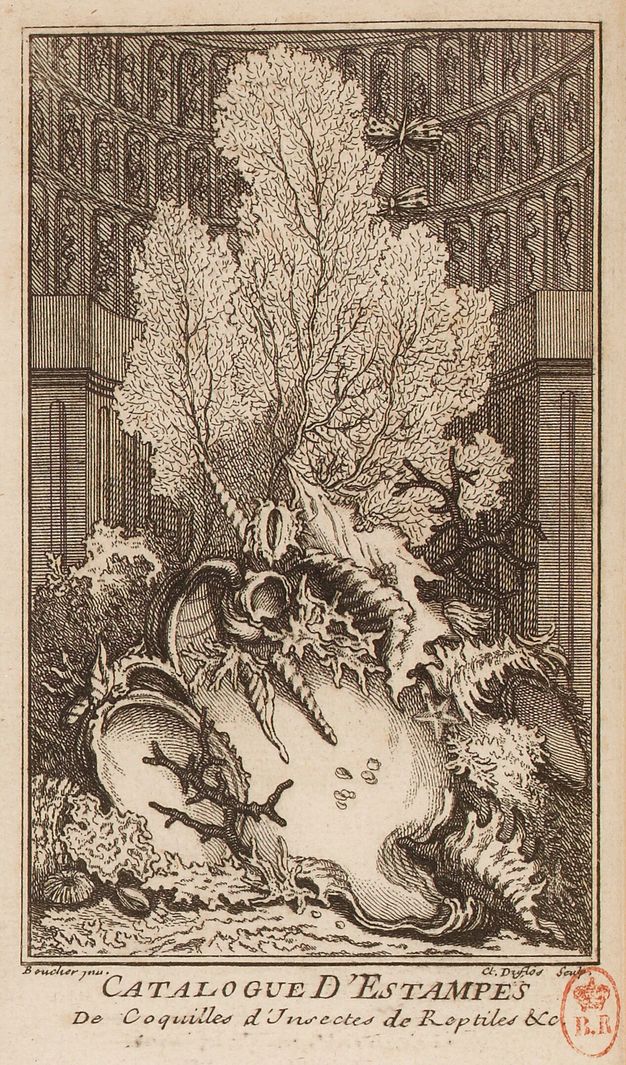
In criticizing Boucher, Lempereur remarked the contrast in the lives and manners of Boucher and Bouchardon.35 According to François Basan, Bouchardon’s collection was a spur to emulation.36 The sculptor had bought pictures, drawings, books, and prints in order to succeed better in the greatness of his art. Boucher bought only for pleasure. Bouchardon’s virtue and Boucher’s vice is not explained by subject matter; the difference lies, rather, in ordering and arrangement. Certainly Bouchardon’s collection consisted predominantly in items directly connected to sculpture (see ), but the sculptor also owned shells: there were four on the marble chimneypiece in his salon, along with a garniture of porcelain.37 In the studio, he had copies of the entomologist Maria Sibylla Marian’s publications, vellums by botanist Nicolas Robert, and a copy of the 1711 edition of Rumphius’s Ambonese Curiosity Cabinet.38 Bouchardon’s objects did not form a collection as such, insofar as they were not displayed for or visited by others. Boucher’s, on the other hand, were conspicuously staged. Sixteen glass-topped tables housed some of the shells; others were sheltered in a coquiller made by the ébéniste François Oeben and the bronzier Philippe Caffieri, and yet more were displayed under glass bells.39 Jessica Priebe has suggested that in Boucher’s frontispiece for Edmé Gersaint’s 1736 natural history sale we see something of the effect later created at the Louvre (fig. 145).40 The “mélanges,” or lots of mixed specimens in Boucher’s sale, were disposed, she argues, to form exactly this kind of confection of shells, corals, and sponges loosely piled around a vertical axis.
However, the interlacing of amateur and professional natural history, of luxury and learning, of the aesthetic and the scientific that such displays secured and celebrated in the 1740s was beginning to come undone by the 1760s. “Mixture” in Rémy’s catalog of Savalette de Buchelay’s collection qualifies not the display but denotes instead the relation of the mineral specimens to the jars of chemical preparations arising from them.41 Thus color, the distinguishing effect of Boucher’s cabinet by grace of scope and visual surprise,42 was the utility of Savalette’s: copper produced copper acetate or verdigris, iron generated the hydrated oxides red and yellow ochre, ferrous ferro-cyanide salts precipitated Prussian blue, from lead came the compound lead carbonate or flake white, and from mercury, apparently, orpiment—red, yellow, and orange.43 Meanwhile, in the case of shells, long before Rémy sharpened his to describe Boucher’s cabinet in the terms in which it had been formed, those of exterior appearance—shape, color, pattern, and surface texture—other amateurs, such as Gabriel Bernard des Rieux, had begun to acknowledge the importance of the animal inside. Des Rieux had acquired anatomical preparations of shellfish by the scientist and academician Jean Méry to exhibit alongside his shells, and it was these, Dézallier d’Argenville admitted, that constituted proof that shells were not entirely “without purpose” (“inutiles”).44
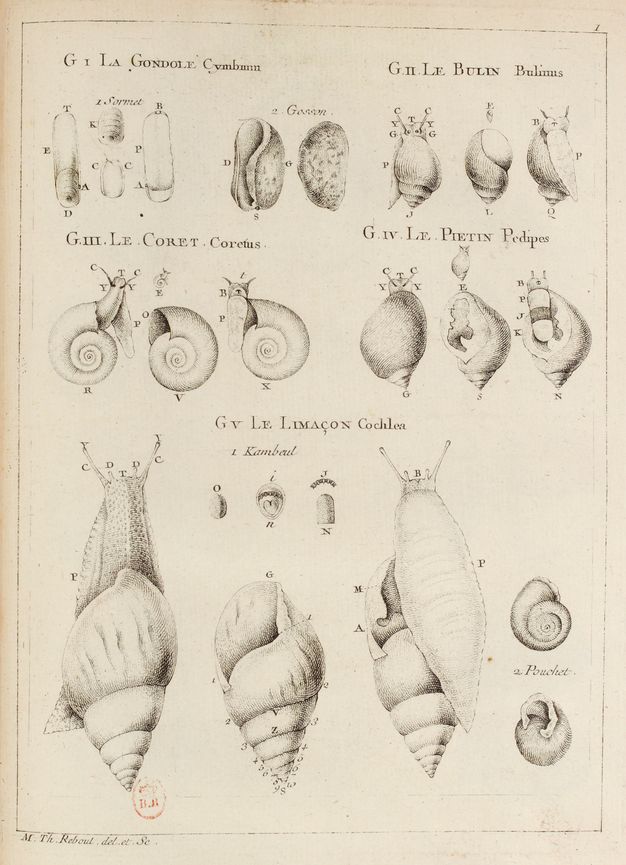
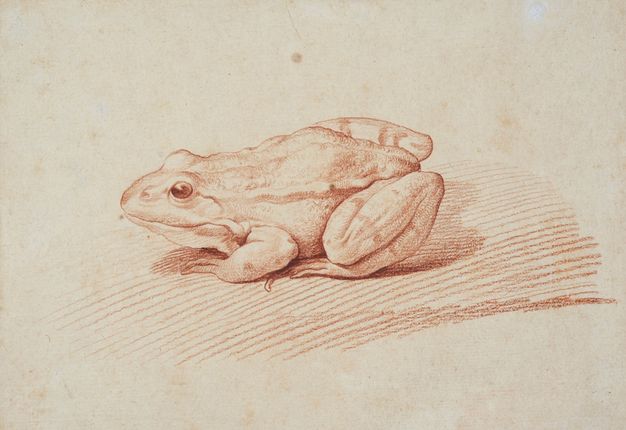
In 1757 Michel Adanson published a powerful critique of the aesthetic that informed contemporary collection and display of shells: “this very beauty,” he wrote, “which attracts the eye to shells, has become a huge obstacle to the progress of science. . . . Up until now, molluscs have only been appreciated for their dress, their exterior envelope, the shell, and not the creatures that live inside them.”45 The result was a profound misunderstanding of the order of this branch of nature, which Adanson proposed to rectify with the help of illustration by the academician Marie-Thérèse Reboul-Vien (fig. 146). Drawing could enter the shell by section, could reinstate the lost animal. Bouchardon’s preference for illustrated books over specimens, and his own practice of drawing animals from life (fig. 147), bore witness to the kind of productive—and not consumerist—engagement with knowledge that was deemed proper to the artist.46
Boucher’s shells may or may not have informed his artistic practice. Generic and specific shelly objects certainly feature in many of his designs for fountains, urns, and other decorative objects in the 1730s and 1740s, but their forms owe at least as much to ornament as to nature. Moreover, on the evidence of Boucher’s sale, the style denoted by shells, the rocaille, was not conspicuously present at his Louvre interior. The keynote there was struck by minerals, not shells: the gilt bronze of Caffieri’s “antique” lights, the marble tops of classic cabinets and consoles. It was, perhaps, the disconnection between Boucher’s art and his things that led Mniszech to describe his cabinet as a shop, as if, that is, the objects had no reason for permanent residence. They were “arranged only to catch the eye” and offered “no further thought,” for either the visitor or the artist.47 The themes of superfluity, appearance, and disorder encountered in the critique of amateur conchology were ones also present in the luxury debate at the midcentury.48 §
-
Pierre Rémy, Catalogue raisonné des tableaux, desseins, estampes, . . . minéraux, cristallisations, mandrepores, coquilles & autres curiositées, qui composent le cabinet de feu M. Boucher, premier Peintre du Roi (Paris: Musier, 1771); annotated copy at the INHA library, Paris. ↩︎
-
“Tableaux: 41,965”; “Dessins: 16,047”; “Meubles: 15,003”; “Porcelaines: 14,557”; “Coquilles/polipines: 10,838”; “Minéraux/pierres: 9,856”; “Bronzes/lacques: 9,701”; “Estampes: 2,873.” ↩︎
-
René-Antoine Houasse and Jean-Baptiste Slodtz are among the very few other painters known to have bought shells in the 1730s. See Jessica S. Priebe, “Conchyliologie and Conchyliomanie: The Cabinet of François Boucher, 1703–1770,” PhD diss., University of Sydney, 2011, 113. ↩︎
-
See most recently Jamie Mulheron, “François Boucher and the Art of Conchology,” BM 158 (2016): 254–63. ↩︎
-
See Françoise Joulie’s fuller discussion of Charles-Antoine Jombert’s comments in Joulie, “La collection de François Boucher,” in L’artiste collectionneur de dessins, ed. Catherine Monbeig-Gognel and Cordelia Hattori (Milan: 5 Continents, 2006), 129–219. See also Ewa Lajer-Burcharth, The Painter’s Touch (Princeton: Princeton University Press, 2018), 73–80. ↩︎
-
Bettina Dietz and Thomas Nutz, “Collections Curieuses: The Aesthetics of Curiosity and Elite Life in Eighteenth-Century Paris,” ECL 29, no. 3 (2005): 44–75. ↩︎
-
Fashion was a significant point of reference in specimen description (e.g., fanlike, lacelike, cufflike, pleated, découpé, fringed). ↩︎
-
Krzysztof Pomian, “Médailles/coquilles = erudition/philosophie,” Transactions of the IVth International Congress on the Enlightenment, SVEC 4 (1976): 1677–1703. ↩︎
-
See Kristel Smentek, Rococo Exotic: French Mounted Porcelains and the Allure of the East, exh. cat., The Frick Collection (New York: Antique Collectors’ Club, 2007); and Smentek, “Objects of Encounter: Mounting Asian Porcelain in Eighteenth-Century France,” in The Challenge of the Object, ed. Ulrich Grossmann and Petra Krutish (Nuremberg: Germanischen Nationalmuseums, 2014). ↩︎
-
For instances of such use or possible use in Boucher’s collection, see Rémy, Catalogue Boucher, lots 1608, 1610. See also Antoine-Joseph Dézallier d’Argenville, L’Histoire naturelle éclaircie (Paris: De Bure, 1742), 95–96. ↩︎
-
Rémy, Catalogue Boucher, lots 1350, 1354, 1359, 1363, 1369, and 1375. ↩︎
-
On cleaning and polishing shells for display, see Dézallier d’Argenville, L’histoire naturelle, 98–101. ↩︎
-
The notion that commodity is a phase in the biography of a thing is Igor Kopytoff’s. See Kopytoff, “The Cultural Biography of Things: Commoditization as Process,” in The Social Life of Things: Commodities in Cultural Perspective, ed. Arjun Appadurai (Cambridge, England: Cambridge University Press, 1986), 64–91. ↩︎
-
Pierre Charles Alexandre Helle and Pierre Rémy, Catalogue raisonné d’une collection considérable de coquilles rares et choisies du Cabinet de M Le *** (Paris: Didot, 1757), vii. ↩︎
-
See Guillaume Glorieux, À l’enseigne de Gersaint (Seyssel: Champ Vallon, 2002), 562–76. ↩︎
-
See Priebe, Conchyliologie, 123–25. ↩︎
-
See Colin B. Bailey, “Marie-Jeanne Buzeau, Madame Boucher (1716–96),” BM 1047 (2005): 224–34. ↩︎
-
Johann Christian von Mannlich, Histoire de ma vie (Trier: Spee, 1989), 2:156; Jo Hedley, François Boucher: Seductive Visions (London: Wallace Collection, 2004), 53–54; and Priebe, Conchyliologie, 131–40. ↩︎
-
The definition of “peak,” or wampum, and “Porcelaine,” or cowrie, in Encyclopédie, http://encyclopedie.uchicago.edu/, 12:214; 13:106 indicates awareness that shells were currency in West Africa and the Americas. See also Marc Shell, Wampum and the Origin of American Money (Champaign: University of Illinois Press, 2013); and Toby Green, A Fistful of Shells: West Africa from the Rise of the Slave Trade to the Age of Revolution (London: Penguin, 2020). ↩︎
-
Rémy, Catalogue Boucher, 235: lots 1695–97. ↩︎
-
On the role of visuality in theories of value, see David Graeber, “Beads and Money: Notes towards a Theory of Wealth and Power,” American Ethnologist 23, no. 1 (1996): 4–24. ↩︎
-
See Georges Brunel, Boucher (London: Trefoil, 1986), 36; and Bailey, “Mme Boucher,” 233. ↩︎
-
On the market value of shells, see Bettina Dietz, “Mobile Objects: The Space of Shells in Eighteenth-Century France,” BJHS 39, no. 3 (2006): 363–82. ↩︎
-
See Rémy, Catalogue Boucher, lots 1698–1738. ↩︎
-
Rémy, Catalogue Boucher, “Avant-propos.” ↩︎
-
See Rémy, Catalogue Boucher, frontispiece. ↩︎
-
Antoine Bret de Dijon, “Nécrologe,” reprinted in Alexandre Ananoff and Daniel Wildenstein, François Boucher (Lausanne: Bibliothèque des Arts, 1983), 1:136. ↩︎
-
J. B. D. Lempereur, Dictionnaire des artistes . . . (1795), reprinted in Ananoff and Wildenstein, Boucher, 1:147–48. ↩︎
-
Louis-Sébastien Mercier, Tableau de Paris (Amsterdam, 1781–88), 6:208–9. ↩︎
-
Jacques-François Blondel, L’architecture françoise (Paris: Jombert, 1754–56), 4:36, and note (d). ↩︎
-
Brunel, Boucher, 51–52; Hedley, Boucher, 54; Bailey, “Mme Boucher,” 226; and Priebe, Conchyliologie, 145–76. ↩︎
-
Bailey, “Mme Boucher,” 227. ↩︎
-
Bailey, “Mme Boucher,” 227. ↩︎
-
See Henri Gautier, L’art de laver (Lyon: Amaulry, 1687), 66–67; and “Dessein,” Encyclopédie, Recueil, https://encyclopedie.uchicago.edu/, 2: plate II. ↩︎
-
Lempereur, Dictionnaire, 147. ↩︎
-
François Basan, Catalogue des tableaux, desseins, estampes, livres d’histoire, sciences & arts de Bouchardon (Paris: de Lormel, 1762), 3–8. ↩︎
-
François Boucher, “Inventaire après décès,” AN, MC/ET/LXXVI/384, 18 August 1762. ↩︎
-
AN, MC/ET/LXXXVI/384, 18 August 1762; and Basan, Catalogue . . . Bouchardon, lots 163–64, 169, 171. ↩︎
-
See Rosemarie Stratmann-Dohler, Jean-François Oeben, 1721–1763 (Paris: Amateur, 2002), 38, 134. For specimens under glass, see Rémy, Catalogue Boucher, lots 1716, 1785. ↩︎
-
Priebe, Conchyliologie, 174–75. ↩︎
-
See Pierre Rémy, Catalogue raisonné . . . de la succession M. de Savalette de Buchelay (Paris: Didot, 1764). ↩︎
-
Rémy, Catalogue Boucher, “Avant-propos.” ↩︎
-
Rémy, Catalogue… de Savalette de Buchelay, 14, 16–17, 21–22, and 25. ↩︎
-
Antoine-Joseph Dézallier d’Argenville, Conchyliologie (Paris: De Bure, 1780), 1:231. ↩︎
-
Michel Adanson, Histoire naturelle du Sénégal: Coquillages (Paris: Bauche, 1757), vi. Adanson’s collection was given by his heirs to the Musée National d’Histoire Naturelle in 1939. See E. Fisher-Piette, “Les mollusques d’Adanson,” Journal de Conchyliologie 85, nos. 2–4 (1942): 101–377. ↩︎
-
This is obviously not to say that Boucher did not draw animals, but it is to note that he did not, like Bouchardon, adopt the conventions of depiction particular to natural history. ↩︎
-
André Mniszech, “Un gentilhomme polonais à Paris en 1767: Notes de voyage,” Revue rétrospective 61 (1887): 108. Mniszech praised Mme la présidente de Bandeville’s collection instead, noting that she knew her collection and showed it to visitors with “intelligence.” ↩︎
-
See, for example, Victor de Riquetti, marquis de Mirabeau, L’ami des hommes (Paris: Guillaumin, 1883), 275–315. ↩︎