Theme
Color Box
- Jean-Honoré Fragonard (1732–1806)
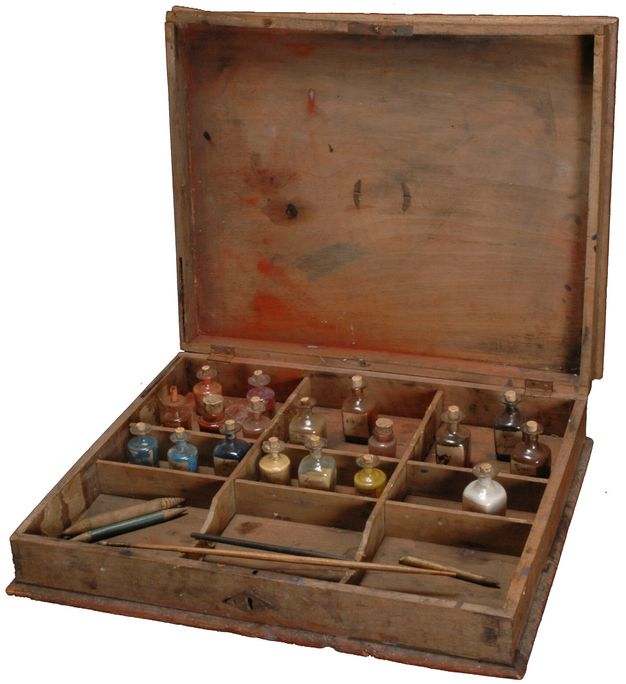
Upstairs in the Villa-Musée Fragonard, in the southern French town of Grasse, where Jean-Honoré Fragonard was born, there is a shallow wooden box (fig. 28). Inside, its colorful contents immediately convey its function. Divided into nine compartments, the box is home to eighteen cork-stoppered glass bottles, slightly varied in shape, each filled with a different ground pigment and labeled by hand: Prussian blue, burnt sienna, carmine, etc. Along with the colors, the three compartments at the front are designed to house tools, with central dividers carved to a curve, so utensils can rest without rolling away. The bits and pieces left include an ebony stick, some well-worn blending stumps, and a fine brush darkened at the tip. Covered in marks and stains, this unassuming box is thought to have belonged to one of the best- and least-known painters of eighteenth-century France.1 Celebrated for the distinctive painterly canvases that have secured his place in the canon of European art, Fragonard is nevertheless still surprisingly enigmatic as a person.2 The color box thus presents a compelling material trace, promising a personal connection otherwise limited by archival sources. Now residing in a museum installed in the house of Fragonard’s cousin, where the painter lived for a year in the 1790s, the color box offers vivid insights into the practicalities and economics of eighteenth-century art making and an alternative view of the materiality of Fragonard’s painterly practice.
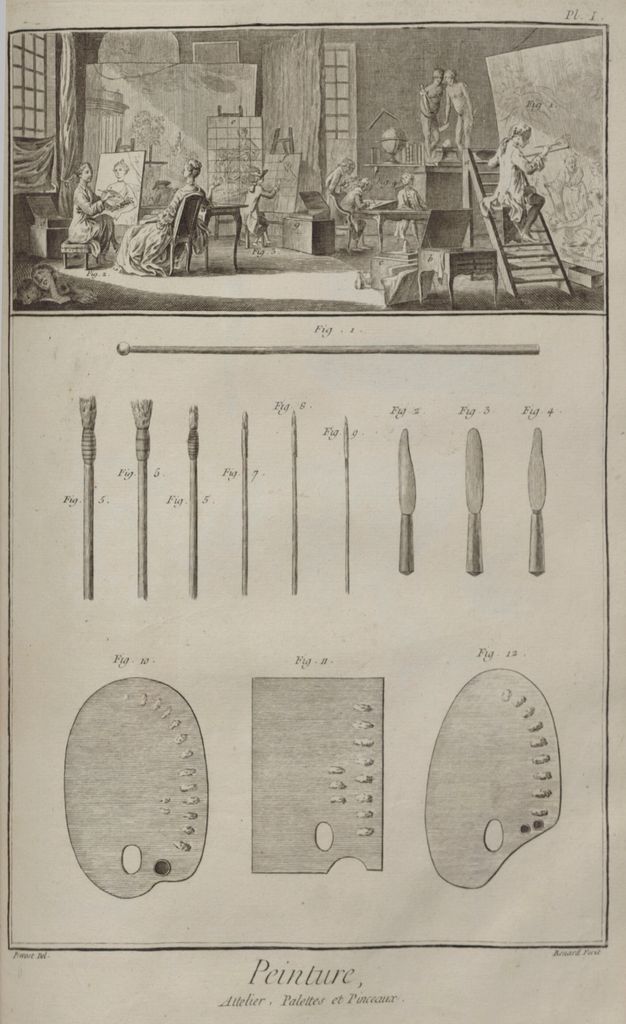
Of all the painter’s tools, the might be the most symbolically recognizable, but color boxes were just as ubiquitous amid the paraphernalia of the eighteenth-century studio. In the imagined composite studio offered as initial vignette to the Encyclopédie’s plates on “Painting” (fig. 29), color boxes indeed become a defining feature of the space. Most evident is the grande boîte à couleurs in the foreground near the history painter’s steps. More elaborate than a mere container, this genre of color box was a piece of furniture, with additional drawers for storage, and legs that made it a commodious height for use in the studio (handy for placing a brush or hanging a ). Fragonard’s box, meanwhile, was a simpler kit, closer in form to that on the far left beside the portraitist, or that in the center beside the copyist scaling down a canvas. Without legs or drawers, this type was less furniture than storage case, not as capacious but eminently more transportable than its cumbersome legged relative. The Encyclopédie’s vignette suggests a taxonomy of color boxes in which size was related to specialization, as though painters of lesser genres required lesser tools. But the form of the box was actually more related to specification, that is, the context of its use. As a history painter Fragonard likely kept a grande boîte à couleurs in his studio, but this smaller version was a tool customized for use outside that space.
The eighteenth century was not yet the era of plein-air painting, but it was a period when artists traveled. Whether on the short cross-town trip of a portraitist visiting an important client for a sitting, or longer journeys for out-of-town commissions or a European grand tour, artists often needed to transport their tools. From the physical evidence of use, Fragonard’s box certainly did not lead a life confined to the studio. Punched through the lid are two metal clips or fasteners that once attached a leather handle (now perished) so it could be carried without upsetting the contents. Nevertheless, traces of bright-red pigment indelibly staining the wood inside the lid betray a mishap, perhaps a jostled explosion of vermilion. Another accident of transit is recalled in the splintered wood and detached joint at one corner of the lid, while chips and scratches all over the exterior bear witness to a peripatetic life.
During his career, Fragonard undertook two substantial periods of travel.3 His first journey began in 1756, when at the age of twenty-four he was sent to Italy as a pensionnaire to finish his training at the Académie’s school in Rome.4 It is even possible that this was when Fragonard acquired his color box. According to regulations issued later under Joseph-Marie Vien’s directorship (which were quite possibly ratifications of already established customs), all new pensionnaires were supplied upon arrival with a color box and two palettes.5 As they were encouraged to travel as part of their artistic formation, it is likely that this institutional color box was of the transportable variety. Fragonard returned to France in 1761 and then made his second grand tour between 1773 and 1774, this time under the patronage of Pierre-Jacques-Onésyme Bergeret de Grancourt, an associé libre of the Académie. Bergeret’s journal records the extent of the trip’s itinerary and its numerous participants: Bergeret, his son, a cook, two coachmen, and other servants, along with Fragonard and his wife, traveled from Paris, through France’s Massif Central, along the Mediterranean coast into Italy, then north through Slovenia, followed by Vienna and Prague, and finally into Germany before heading home via Strasbourg.6 The majority of works that survive from these trips, particularly the second, are drawings, but despite his focus on chalk and ink during the journeys, it is unlikely that Fragonard would have been without his colors for such a long period, making a traveling color box an essential piece of equipment.
If the box as container indicates the mobility in Fragonard’s artistic practice, the contents attest to its persistent economies and labors, both to the complex commercial ecosystem of eighteenth-century colors and to the artist’s physical activities in the studio. Color making in this period involved specialized materials, techniques, and supply chains, some of which stretched to a truly global scale. Inside the bottles in Fragonard’s box, there are substances from at least three continents. From Europe, burnt sienna, Italian terra, and Naples yellow all came from Italy; from Africa, mummy brown was made from the ground remains of Egyptian mummies; and from Central America, carmine was made from cochineal beetles imported from Mexico or Honduras.7 Other pigments were known as regional specialties: Prussian blue was derived from a chemical synthesis invented around 1706 in Berlin, where it was produced exclusively until the 1720s, when the secret of the recipe was published; lead white, meanwhile, was the product of an industrial process that was mastered particularly effectively by English manufacturers.8 Interactions between artists, scientists, and entrepreneurs were crucial to the color industry’s development. This is evident in Joseph-Siffred Duplessis’s collaborations with chemists to perfect his , but also in the regular occurrences in the Académie’s minutes of new pigments being eagerly presented by their discoverers. In 1771 new ochers found on the estate of Baron de La Lézardière were tested by a group of academicians including Vien, Jean-Baptiste-Marie Pierre, Alexander Roslin, Jean-Siméon Chardin, and Joseph Vernet (notably a heterogenous sample of history, portrait, still-life, and landscape painters). Proving successful, the new ochers were certified by the Académie, but not all were so fortunate.9 In 1781 the chemist Louis-Bernard Guyton de Morveau proposed a new zinc white as a safer alternative to lead white (which smelled foul and caused serious health problems with long-term exposure).10 Despite its benefits, the academicians who tested the zinc alternative reported a litany of faults: it was difficult to grind finely and so less tractable on the brush; it was too transparent; it took a long time to dry and stayed tacky on the fingers; and the resulting color was “sad.”11 No surprise, then, that the white of choice in Fragonard’s box remained “blanc de plomb” (lead white).
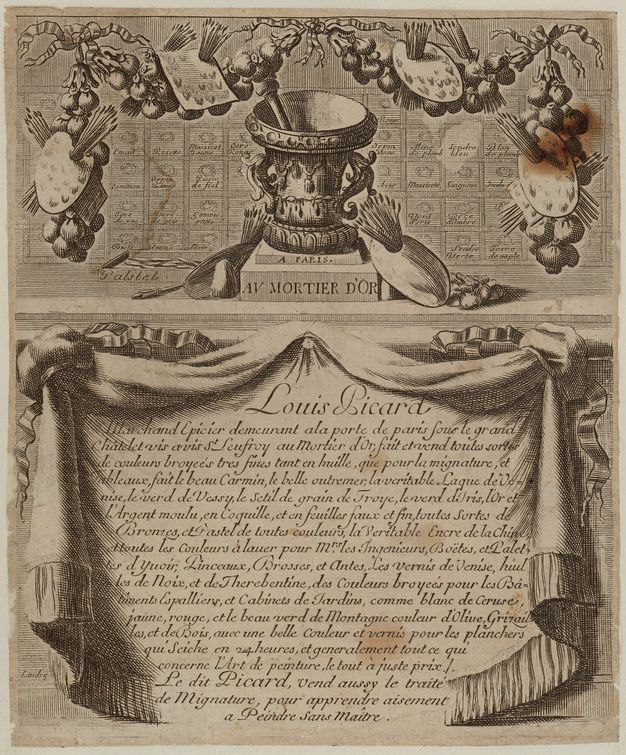
When it comes to the question of procurement, we do not know where exactly Fragonard bought his colors. But eighteenth-century Paris had no shortage of suppliers from which to choose. This was the period when the specialized trade of marchands de couleurs (color merchants) began to develop, emerging on one side through the épicier (grocery) trade and on the other through guild artists, who were more able than academicians to supplement their incomes through commercial ventures. One grocer-cum-color merchant from the beginning of the century, Louis Picard, referred to himself generically as a marchand épicier, but his trade card shows that his shop—Au Mortier d’Or (At the Golden Mortar)—specialized in artists’ supplies (fig. 30). The trade card evokes a shop counter adorned with a garland of palettes, brushes, and pig-bladder pouches (used for preserving premixed paints) hung over the eponymous golden mortar in which the pigments were ground. Behind are dozens of drawers where the raw pigments were stored, many with legible labels familiar from Fragonard’s box (“blanc de plomb,” “cendre bleu,” etc.). Located near the Châtelet, Picard’s shop was in one of the areas of Paris’s Right Bank that became something of a color quarter. Along with numerous shops on or around Rue Saint-Denis—including À la Momie (named after the Egyptian brown pigment), Le Bon Broyeur (The Good Grinder), and Le Gros Mailletz (The Big Mallet)—this area extended up to the Porte Saint-Martin, a part of the city dense with both guild artists and color merchants (who were sometimes both).12
Expansion of the color trade offered artists a greater range of materials, and also a change in the practicalities of their own profession. A price list published by Jean-Félix Watin, a color merchant in the 1770s, suggests the choices between labor and economy now open to painters.13 Take yellow, Fragonard’s signature color: stil de grain was 2 livres per pound if bought “en pierre” (as stones or fragments), but double if bought finely preground; a cheaper option was yellow ocher, which was only 2 sols per pound “en pierre,” and 4 sols when ground. Some pigments could even be bought already suspended in a binder, prepared for different uses: “blanc de céruse” mixed for laying undercoats, or “blanc de plomb” mixed for finishing. Many artists still preferred to grind and mix their own pigments, giving them more control over quality. But the process was labor intensive. To prepare the pigments found in Fragonard’s color box, the basic tools required were a molette (muller) and a marble or porphyry slab (both visible in the Encyclopédie vignette near the grande boîte à couleur, see fig. 29). Raw materials had to be ground on the slab using the molette with small amounts of solvent (water, oil, or turpentine) to limit the dust. Once ground, the residue was left to dry on paper while all the equipment was thoroughly cleaned before the next color to avoid contamination.14 Dried pigments could be stored in airtight containers, like Fragonard’s cork-stoppered bottles, until needed, when they would be mixed with oil (usually linseed or walnut). But mixed pigments had a limited life, so all these operations were being performed constantly, sometimes with the aid of apprentices or assistants. As each pigment had its own properties and peculiarities, this required a complex body of tacit knowledge, secret recipes, and jealously guarded procedures, passed from master to student in that alternative pedagogic space of the studio. Fragonard’s training with François Boucher is frequently acknowledged, but we seldom envisage that relationship in terms of a transfer of practical know-how, instead focusing on a more creative lineage of style and subject matter, as though the two were not inherently linked.
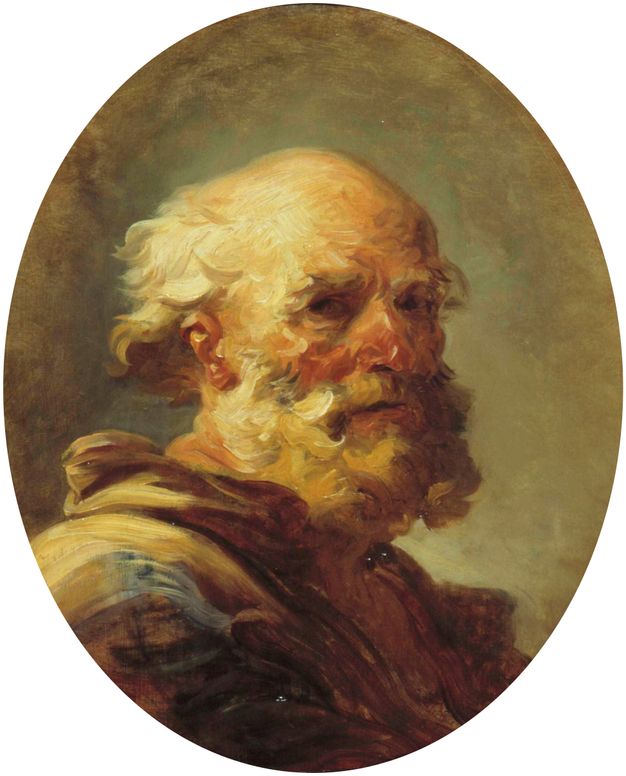
Oily stains inside the lid of Fragonard’s box draw attention to this less abstract, more applied side of eighteenth-century color. Upon encountering this material object, familiar art-theoretical debates seem to fade; discourses about color and line, harmony and resemblance give way to the practicalities of messy, volatile substances that required scientific knowledge to produce, money to buy, and labor to prepare.15 For an artist who, more than any of his contemporaries, produced an oeuvre defined by the rich materiality of paint, such a realization is arresting. In the textured surface of a work like Head of an Old Man (fig. 31), paint is treated almost sculpturally, as the viscous liquid is modeled into forms (the scroll of an ear; the curl of a moustache). Fragonard does not delineate features and fill them with color, nor does he imitate hair and skin by layering wispy strokes over smooth; instead, he builds the man’s face with paint, forming his features through gestures of the brush. Scholars have interpreted Fragonard’s approach (especially in his so-called fantasy portraits) through a history of ideas that explains them alternatively via cultural traditions of the imaginary, Enlightenment “sensationist” philosophy, or art-theoretical adaptations of courtly aesthetics.16 For Mary Sheriff, those paintings are an artistic encapsulation of sprezzatura—that nonchalance that makes effort appear effortlessness.17 But Fragonard’s color box is a reminder of precisely the opposite. Like a before and after, the pigments in those little bottles recall the hours of physical labor required to transform raw materials into usable colors, not to mention the cost of procuring them. In that light, Fragonard’s heavily laden canvases take on a sense of artistic generosity, a material trace of his investment of time, labor, and expense, as though each artwork places us in the presence of a munificent host.
On the outside of the box, across its lid, there is a final trace of ownership in a curious inscription, just visible amid the scratches and stains. Rather than a description of the box’s contents or the name of its owner, someone at some point instead wrote the word L’amour (Love), a floating signifier claiming some affective relationship to something. Now at the Villa Fragonard, the box’s inscription calls attention to the erstwhile presence there of Fragonard’s most famous commission—Les progrès de l’amour (The Progress of Love, The Frick Collection, New York)—which, in an unexpected way, leads to the end of Fragonard’s career and a possible explanation for the box’s survival. In 1790, amid the events of the Revolution and the death of his daughter, Fragonard fell ill and left Paris for the warmer climes of Grasse, bringing his wife, his sister-in-law (the painter Marguerite Gérard), and his young son (the future artist Alexandre-Évariste).18 For some reason, he also brought the four rolled canvases of The Progress of Love, a series notoriously rejected by Madame du Barry in the 1770s.19 In Grasse, Fragonard sold them to Alexandre Maubert, his first cousin once removed, from whom he was renting the villa, and they were installed in the salon on the ground floor until they were sold a hundred years later by Maubert’s descendants.20 Like the paintings, the color box also ended up in Maubert’s possession, perhaps left behind after Fragonard returned to Paris the following year. As the story of his relates, Fragonard stopped painting around this time. But his color box bears evidence of continued use, one of its bottles containing chrome yellow, a pigment derived from chromium, which was not discovered until 1797.21 Far from being preserved as a relic of Fragonard’s practice, the box was evidently adopted by another (possibly Gérard or Alexandre-Évariste), who gave this useful thing at least a few more years of valuable service. ‡
-
Attribution rests on its provenance through Fragonard’s family and chemical analysis of the contents. François Delamarre and Bernard Guineau, “La boîte de couleurs dite ‘de Fragonard’: Analyse du contenu des flacons,” in Jean-Honoré Fragonard, peintre de Grasse, exh. cat. (Grasse: Villa-Musée Fragonard, 2006), 25–31. ↩︎
-
Fragonard, exh. cat. (New York: Metropolitan Museum of Art, 1987), 15. ↩︎
-
Fragonard, 61–71, 361–70. ↩︎
-
Fragonard was awarded the Académie’s grand prix in 1752, then entered the École des Élèves Protégés from 1753 to prepare for Rome. On the Académie de France in Rome during this period, see Reed Benhamou, Charles Natoire and the Académie de France à Rome: A Re-evaluation (Oxford: Voltaire Foundation, 2015). ↩︎
-
Vien was director in Rome from 1775 to 1781. Article IV, “Règlemens qui doivent être observés par les pensionnaires de l’Académie de France à Rome,” in CDR, 13:159. ↩︎
-
Bergeret et Fragonard: Journal inédit d’un voyage en Italie, 1773–1774 (Paris: May et Motteroz, 1895). See also Pierre de Nolhac, “Fragonard en Italie d’après le journal de Bergeret de Grancourt,” Revue des deux mondes 41 (1917): 613–29. ↩︎
-
For the colors in Fragonard’s box, see Delamarre and Guineau, “La boîte de couleurs,” 27–28. On the composition of eighteenth-century colors, see Le Pileur d’Apligny, Traité des couleurs matérielles, et de la manière de colorer, relativement aux différens arts et métiers (Paris: Saugain & Lamy, 1779). ↩︎
-
Alexander Kraft, “On the Discovery and History of Prussian Blue,” Bulletin of the History of Chemistry 33, no. 2 (2008): 61–67; and R. D. Harley, Artists’ Pigments c. 1600–1835: A Study in English Documentary Sources, 2nd ed. (London: Butterworth, 1982), 70–74, 166–72. ↩︎
-
23 August 1771, PV, 8:82. ↩︎
-
29 September 1781, PV, 9:80. In 1783, the Royal Society of Arts in London offered a prize for a harmless method of preparing lead white, without much success. Harley, Artists’ Pigments, 168–69. ↩︎
-
22 June 1782, PV, 9:114; and 6 July 1782, PV, 9:116. ↩︎
-
Martine Jaoul et al., Des teintes et des couleurs (Paris: RMN, 1988), 52–53; and Hannah Williams, “Artists and the City: Mapping the Art Worlds of Eighteenth-Century Paris,” Urban History 46, no. 1 (2019): 106–31. ↩︎
-
Jean-Félix Watin, L’art du peintre, doreur, vernisseur, 2nd ed. (Paris: Grangé, 1773), n.p. ↩︎
-
Watin, L’art du peintre, 58–60. ↩︎
-
On color in art theory, see Jacqueline Lichtenstein, The Eloquence of Color: Rhetoric and Painting in the French Classical Age, trans. Emily McVarish (Berkeley: University of California Press, 1993). ↩︎
-
See Mary D. Sheriff, Fragonard: Art and Eroticism (Chicago: Chicago University Press, 1990); and Melissa Percival, Fragonard and the Fantasy Figure: Painting the Imagination (Farnham: Ashgate, 2012). ↩︎
-
Sheriff, Fragonard, 120–23. ↩︎
-
Pierre Cuzin, “Fragonard, un Grassois à Paris,” in Jean-Honoré Fragonard, peintre de Grasse, exh. cat. (Grasse: Villa-Musée Jean-Honoré Fragonard, 2006), 19. ↩︎
-
Colin B. Bailey, Fragonard’s Progress of Love at the Frick Collection (London: D Giles, 2011). ↩︎
-
Cuzin, “Fragonard,” 20. ↩︎
-
Robert L. Feller, ed., Artists’ Pigments: A Handbook of their History and Characteristics (Washington: National Gallery of Art, 1986), 1:187–217. ↩︎