Type of Object
Pastels
- Marie-Suzanne Giroust (1734–72)
Clutching a tray of vibrantly colored pastel sticks, Suzanne Giroust appears to have been searching for the right one (fig. 128). Seated before her easel, in the company of her husband, she is painting a pastel portrait of a family friend.1 Her is open beside her, a white lies at the ready to wipe the constant chalky dust from her hands, and a knife rests nearby to sharpen a stick should finer lines be required. From her cluttered assortment of colors, Giroust has made her selection—a deep blue—now held lightly in her fingers and about to be deployed. But first she looks up, casting a final glance at her sitter to confirm her choice by scrutinizing his garment once more. As a representation of the studio setting, this portrait of Giroust by her husband, Alexander Roslin, offers some sense of the processes and substances of pastel painting: from the equipment and media required, to the patterns and activities of their employment. But there is a pervasive incongruity in this encounter. As a material experience, the art of pastel is presented to us here not actually in pastel, but in Roslin’s own preferred medium of oil.2 We find ourselves thus witness to an awkward moment of artistic tension, invited (ostensibly) to marvel at a celebration of pastel but instead facing an implicit declaration of oil’s superiority. While it plays out here in the domestic context of Roslin and Giroust’s relationship, pastel was a medium that, in the artistic hierarchies of eighteenth-century France, was quite habituated to underestimation, latent or otherwise.
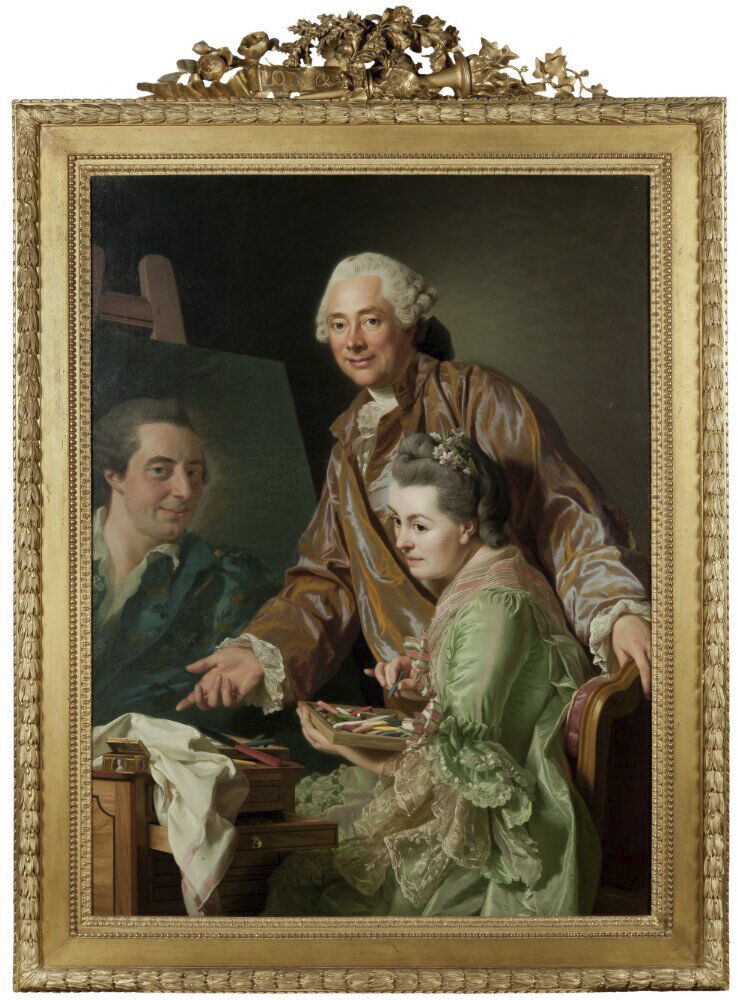
Pastel’s ambiguous position as a medium may have been due in part to the odd disjunction between its form and function; it looked like one thing but performed the artistic activities of another. As physical objects, pastels appear so similar to (chalks) that one might wonder why this book needs an entry on the thingness of Giroust’s pastels when it already has one on Huët’s crayons. But in use, gesture, and even materiality, pastel was something else entirely. While crayon was the Académie’s medium of choice for drawing, pastel was a medium for painting, categorized and defined as such by Roger de Piles: a method by which “visible objects are rendered through color on a flat surface” (our italics).3 As Roslin’s portrait of Giroust suggests, this also made the actions and processes of pastel quite different from crayon. Rather than used horizontally on a drawing board, pastels were used upright at an easel, borrowing the apparatus of oil painting, and even to an extent simulating its support, as the paper was often pasted onto fabric stretched over a wooden strainer, making it easier to frame and glaze afterward.4 In general, however, the studio paraphernalia of a pastellist like Giroust was less extensive than for many of her painter colleagues, because as “things,” pastels were both medium and tool—an all-in-one device requiring no mechanical holder or applicator. Pastellists eschewed the draftsman’s , with all its promises of linear control, and had no use for the oil painter’s brush and , because pastel colors could not be mixed in advance, their tonal nuances being achieved only in situ. Instead, pastel sticks were held directly in the hand, and fingers—embedded with dust—became an extension for blending color on the paper’s surface. While practical (if messy), a pastel’s very thingness thus made it something of a renegade. With its dependence on manual engagement and its emphasis on the representational force of color, pastel posed an inherent challenge to those entrenched academic hierarchies that privileged line over color and mind over hand.
Sharing the physical form of crayon but the functionality of paint, pastels also found themselves as neither-nor when it came to their materiality. While there was little consistency in the composition of pastels—and different colors required different ingredients and recipes—each stick was essentially a combination of three substances: a pigment to give it a specific color; a white extender (chalk, gypsum, talc, starch, tobacco pipe clay, alabaster) to give that color bulk and opacity; and a binder (natural resins, gum tragacanth, drying oils, egg, whey) to hold everything together.5 Perfecting the balance was key, according to Robert Dossie’s handbook on artists’ materials: too much binder and the pastels would not cast; but too little and they would not adhere to the paper.6 Pastel was thus very much a manufactured substance, a contrast to the usually natural materials of crayons—charcoal, quarried chalk, etc. (notwithstanding Nadaux’s improvements)—and actually had much in common materially with oil paint. Despite their vastly different forms, the colors of pastels and oils were derived from the same organic and inorganic pigments (like yellow ocher, stil de grain, vermillion, or umber).7 But the different binders of pastel and oil paint meant that sometimes the most successful colors in one were trickier in the other. Dossie, for instance, advised caution with and Prussian blue, which in pastel were “apt to turn pale, and sometimes entirely lose their hue,” unless prepared in exactly the right manner.8 Given the complexity of knowledge and know-how required for their production, it is not surprising that, by the time Giroust was practicing, most pastellists tended to procure their sticks from commercial manufacturers rather than routinely making their own in the studio.9
Giroust’s preferred pastel-maker is not known, but she would have had many options with Paris’s emergent specialist trade in artists’ materials. Commercial production of pastels had been limited in the seventeenth century, but as Majorie Shelley notes, the trade in ready-made pastels proliferated considerably in the eighteenth century.10 One of the Parisian suppliers with connections to Académie circles was Jean-Nicolas Vernezobre, a guild painter who worked principally as a pastel merchant (a professional combination of art making and art supplies that was not uncommon for artists outside the Académie). Vernezobre was directly connected with Giroust’s teacher, Maurice-Quentin de La Tour, who painted Vernezobre’s portrait in the 1760s (Musée Antoine Lécuyer, Saint-Quentin), and he certainly supplied Alexis Loir, whose name appears in a list of outstanding debts (he owed 6 livres, 19 sols, 6 deniers) in an inventory taken after the death of Vernezobre’s wife in 1760.11 That same document also recorded the extent of Vernezobre’s stock, including 6,534 pastel sticks of various colors, which were valued at a total of 330 livres, 14 sols, suggesting that on average each stick cost just over 1 sol. A box of pastels supplied by Vernezobre remarkably survives in a private collection (fig. 129), offering an extremely rare encounter with this eighteenth-century artistic medium. Some sticks are still at their original size; others are worn with use or broken to stumps, perhaps for use on their side. All of them are arranged in compartments to form a loose chromatic spectrum of color families—blues, pinks, browns, yellows, and so on—which both optimized the artist’s selection process and protected each stick from the taint of differently colored neighbors.12 The drawers of Giroust’s presumably functioned in a similar way (see fig. 128), storing like colors together, while the small tray in her hand is instead a practical improvization for work in progress—like a palette—not for mixing colors, but for gathering those currently in use.13
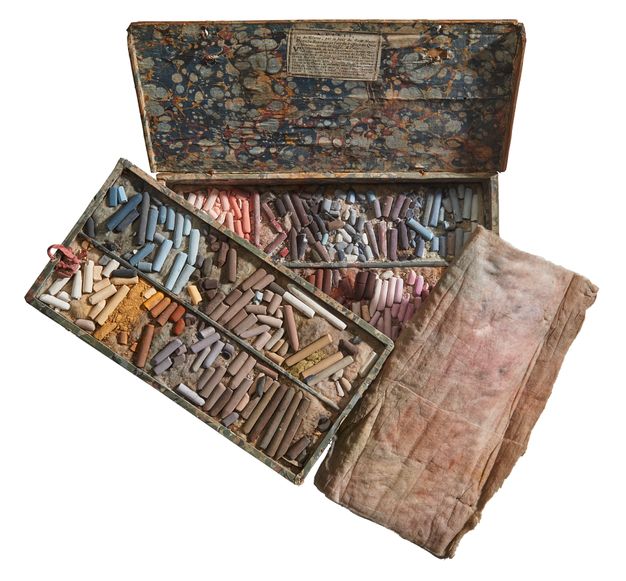
Another quality of pastel’s thingness, evident in the thick, dusty residue lining every compartment of the Vernezobre box, was its extreme friability. Created from ground pigments and extenders, pastels were essentially powder, bound together but constantly threatening to revert to their powdery origins. As soon as the rolled stick was used or handled, it began to disintegrate with every stroke, some of it transferring to the paper’s surface, but much of it becoming particles of chalky waste. Aside from the incessant dust, the most pressing problem arising from this fragility was that the artworks themselves were as volatile as the sticks. The images formed through that colored layer left on the paper were so vulnerable that, as Paul-Romain Chaperon noted in his treatise on pastel, with “the least jolt” or “the lightest rub” the whole thing could be gone for good.14 Efforts to overcome this volatility inspired technological innovation with chemical fixatives (like isinglass or fish glue), which the Académie became keen to support as pastel’s wider popularity progressively established the medium in the institutional consciousness.15 In 1753 the inventor Antoine-Joseph Loriot presented his “secret” for fixing pastel without ruining the work’s finish or marring the brilliance of its colors.16 Though it was acclaimed, Loriot did not publish his secret and in 1772 (two years after Giroust’s admission to the Académie) a new method was proposed by a Sardinian painter, Joseph Saint-Michel, which was supposed to make pastels “as solid and as durable as oil paintings.”17 Giroust’s husband, Roslin, was one of the academicians given the task of testing Saint-Michel’s method for the Académie, and it is difficult to imagine that Giroust (the more proficient pastellist of the couple) was not involved—or at least invested—in that testing process.18
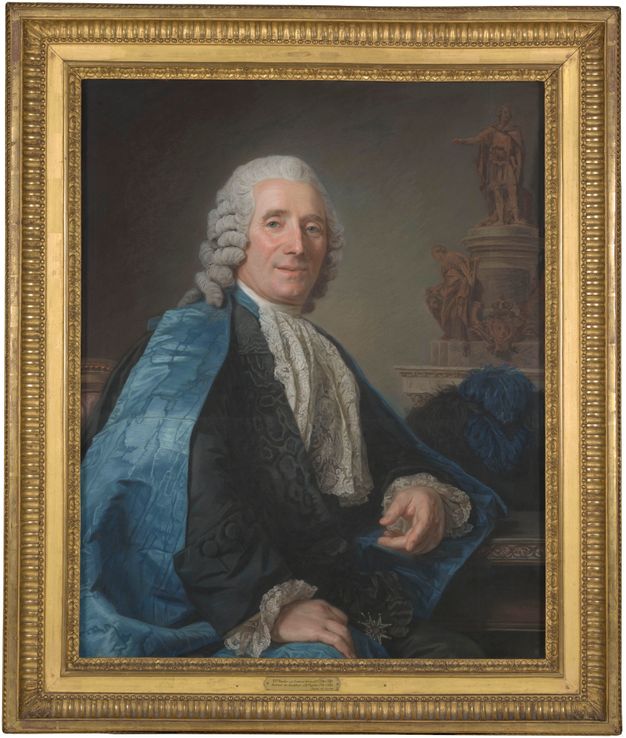
Despite inventive fixing technologies, pastel’s fragile materiality did restrict its artistic reach, both in terms of who used it and how. According to Chaperon, the “great” painters tended to avoid it, preferring oil to ensure their works were preserved for “posterity.”19 Rarely deployed for the Académie’s prized genre of history painting, pastel instead found its raison d’être in portraiture, the genre in which Giroust excelled.20 Her stunning portrayal of her sculptor colleague Jean-Baptiste Pigalle (fig. 130) exemplifies the qualities of pastel that Antoine-Joseph Pernéty found so felicitous for portraiture, especially the “velvetiness” created by its powdery dust, which in his opinion made it the best medium for capturing the softness and liveliness of skin and the texture of fabrics.21 In Giroust’s exceptional handling, we encounter those representational possibilities in the lifelike articulation of Pigalle’s face, with his pronounced stubble, the glowing capillaries in his cheeks, and the sweaty shine on his forehead contrasting almost viscerally with the dryness of his powdered . Beyond the fleshtones of his face, Giroust deftly mobilized a limited chromatic range of blues, blacks, whites, and earth tones to differentiate an exquisite array of textures and materials, from the hard bronze of the sculpture behind, to the delicate patterns of his lace cuffs and jabot, and the dazzling shimmer of the blue watered silk robe and the tantalizing floaty tactility of his feathered hat. Giroust’s exemplary portrait, submitted as her reception piece at the Académie, not only showcases the representational potential of pastel but also reveals the payoff to its material vulnerability. Pastel paintings may be dust held perilously on the paper’s surface, but the counter to the medium’s fragility was its chromatic longevity. Pigments suspended in oil and covered in layers of varnish could be prone to discolor, fade, or darken over time, but in pastel those same pigments maintained a vibrancy and “éclat” that would pique the envy of any oil painter.22 ‡
-
On the sitters, see Magnus Olausson, “Roslin’s Self-Portrait with His Wife Marie Suzanne Giroust Painting a Portrait of Henrik Wilhem Peill,” Art Bulletin of Nationalmuseum Stockholm 20 (2013): 17–18. An in-depth study of Giroust is being undertaken by Melissa Hyde and is forthcoming under the title Painted by Herself: Marie-Suzanne Giroust, the Forgotten Académicienne. ↩︎
-
Roslin did practice in pastel but was better known for his oils. For both artists’ work in pastel, see Neil Jeffares, Dictionary of Pastellists before 1800, http://www.pastellists.com/Articles/RoslinMS.pdf and http://www.pastellists.com/Articles/RoslinA.pdf. ↩︎
-
Along with pastel, he included oil, fresco, distemper, miniature, enamel, and mosaic. Roger de Piles, Cours de peinture par principes (Paris: Jacques Estienne, 1708), 313–14. ↩︎
-
On pastel supports see Majorie Shelley, “Pastelists at Work: Two Portraits at the Metropolitan Museum by Maurice-Quentin de La Tour and Jean-Baptiste Perronneau,” Metropolitan Museum Journal 40 (2005): 105. ↩︎
-
Joyce H. Townsend, “Analysis of Pastel and Chalk Materials,” The Paper Conservator 22, no. 1 (1998): 21; and Marjorie Shelley, “Joseph Wright’s Pastel Portrait of a Woman: Part III: Technique and Aesthetics,” Metropolitan Museum Journal 44 (2009): 113. ↩︎
-
Robert Dossie, The Handmaid to the Arts (London: J. Nourse, 1758), 181–82. ↩︎
-
On common pigments in pastel making, see Paul-Romain Chaperon, Traité de la peinture au pastel (Paris: Defer de Maisonneuve, 1788), 28–29. ↩︎
-
Dossie, The Handmaid to the Arts, 183–84. ↩︎
-
By contrast, in the 1710s and 1720s, Rosalba Carriera did both. Her correspondence indicates efforts to procure commercial pastels as well as approaches to making her own, including using tailor’s chalk and ground . See the entry on Rosalba in Jeffares, Dictionary, http://www.pastellists.com/Articles/Carriera.pdf. ↩︎
-
Majorie Shelley, “Painting in the Dry Manner: The Flourishing of Pastel in 18th-Century Europe,” Metropolitan Museum of Art Bulletin 68, no. 4 (Spring 2011): 5–8. ↩︎
-
Françoise-Marguerite Desbois (wife of Jean-Nicolas Vernezobre), “Inventaire après décès,” 11 March 1760, AN, MC/ET/CXXII/711. ↩︎
-
On storing pastels, see Chaperon, Traité, 26. ↩︎
-
Another instance of a pastellist using a “tray-palette” can be found in Georg-Anton Urlaub’s Self-Portrait (1735, Würzburg, Lower Franconian Museum). ↩︎
-
Chaperon, Traité, 10. ↩︎
-
On fixing methods and substances, see Chaperon, Traité, 307–29. ↩︎
-
Entry for 6 October 1753, PV, 6:367. ↩︎
-
Charles-Nicolas Cochin, “Arts utiles et agréables,” Journal encyclopédique 6, no. 2 (September 1772): 476. ↩︎
-
Jean-Jacques Bachelier was the other tester: 6 June 1772, PV, 8:101. Giroust would die prematurely of breast cancer only a few months later on 31 August 1772. ↩︎
-
Chaperon, Traité, 10–11. ↩︎
-
Some attempts (often unsuccessful) were made to use pastel for history subjects, such as Jean-Étienne Liotard’s Apollo and Daphne, 1736 (Rijksmuseum, Amsterdam). ↩︎
-
Antoine-Joseph Pernéty, Dictionnaire portatif de peinture, sculpture et gravure (Paris: Bauche, 1757), cxxviii. ↩︎
-
This dichotomy of fragility and “éclat” is observed in Claude-Henri Watelet, L’art de peindre (Paris: Guérin & Delatour, 1760), 52. ↩︎