Type of Object
Decoration
- Joseph-Marie Vien (1716–1809)
It is not often that we know the exact moment an artist acquired a possession. At the end of January 1776, three months after Joseph-Marie Vien moved to Rome to become director of the Académie de France, a courier arrived from Paris bearing a package.1 Inside was an item that Vien had been anticipating for months—his official regalia as a chevalier in the Order of Saint Michel—an honor he had been granted before he left for Italy. Proudly displayed in his portrait by Duplessis painted a decade later (fig. 36), the decoration that Vien received in that package consisted of the usual two parts: a black riband to be worn as a sash across the body and, hanging from it, a gold badge with the insignia of the order. The insignia’s design dated from the 1660s, when this late medieval chivalric order had been revived by Louis XIV, and consisted of a Maltese cross outlined in white enamel, with four gold fleurs-de-lis at the angles, and a central gold oval with a partially enameled relief of Saint Michel, or the Archangel Michael (fig. 37).2
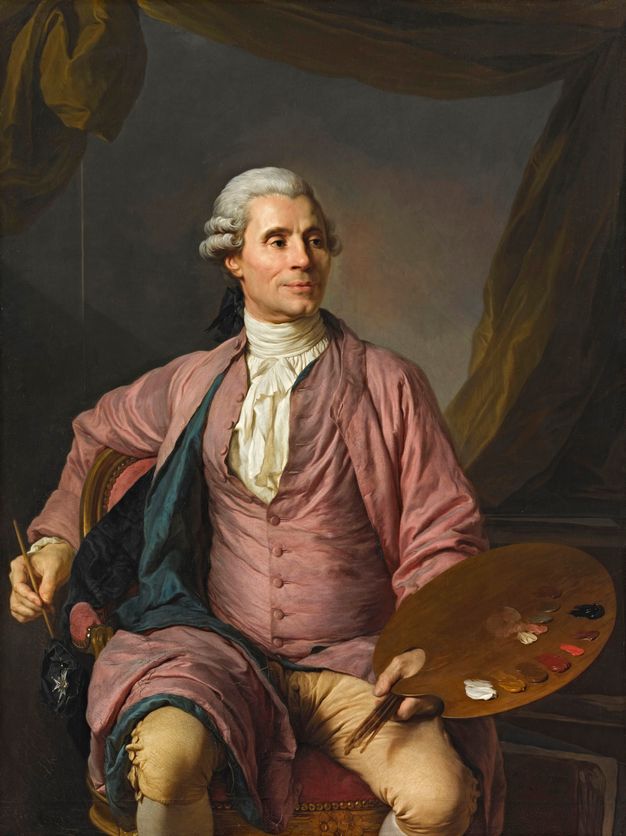
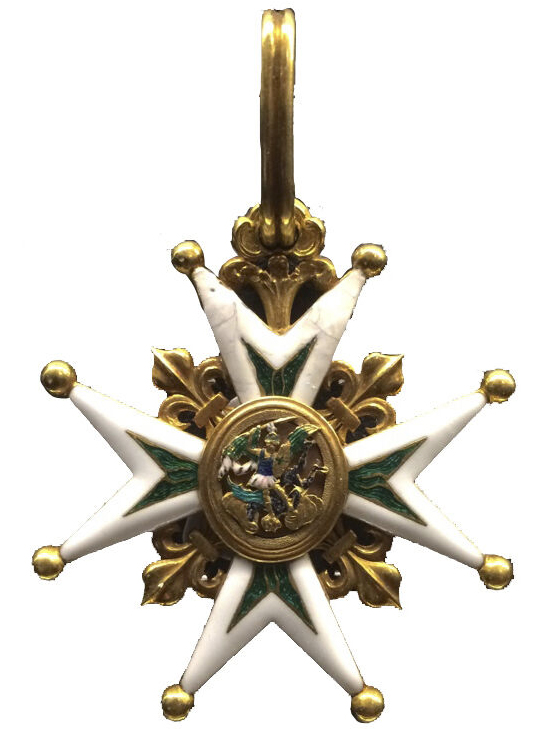
In a book filled with tools and other active objects busily working, enabling, and creating, Vien’s chivalric decoration might seem like a thing that did very little. Even as an item of clothing, it was more accessory than garment, an auxiliary addition that performed no protective or practical service and was, perhaps not surprisingly, usually categorized as an item of bijoux (jewelry) in estate inventories.3 But for some things, purpose lies more in meaning than action. And it would be difficult to find in these pages a more semantically charged item than this wearable insignia, whose principal function was, after all, significance itself.
The semantic operations of Vien’s decoration reside in its very name. Décoration was a word that, as Katie Scott has argued, carried two distinct but entwined meanings in eighteenth-century France: a “mark of honor” indicating rank or title, and an “embellishment [or] ornament” that enhanced a space or, in this case, a person.4 As a mark of honor, Vien’s decoration conveyed his specific chivalric title through the insignia’s symbolic details, from the fleur-de-lis of the House of Bourbon to the iconography of Michael slaying Satan in the form of a dragon. But when worn on the person as an embellishing accessory, this decoration served as a marker of elite status long before such specific detail could be appreciated. Its functionality in this regard stemmed precisely from its lack of function. As an ornamental addition, it was an item of apparel designed for a socially restricted sartorial circuit, where superfluity was both affordable and necessary. In other words, only someone with a status to convey required an item whose sole purpose was to convey status.
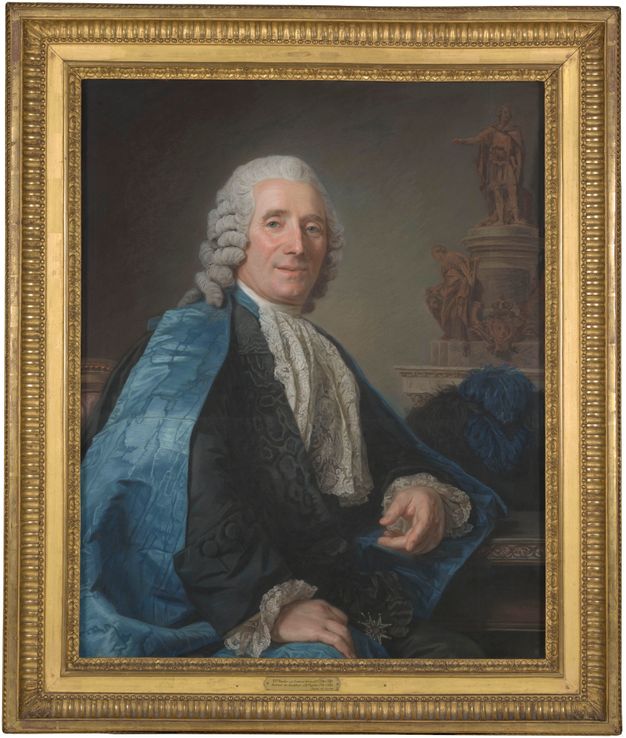
While a decoration’s raison d’être was to signify, exactly what Vien’s own decoration signified was ironically somewhat ambiguous, partly because of what the Order of Saint Michel had become, and partly because of Vien’s specific position within it. In 1665, when Louis XIV revived the order, the decoration had been an irrefutable sign of noble status. According to the original statutes, the requirements for becoming a chevalier were (along with being Catholic and over thirty) hereditary nobility through at least two branches, and ten years’ service in the military or law, the two spheres represented by the nobility of the “” and of the “robe.”5 But by the time Vien received his, things had shifted. Nobility was still a requirement, but according to Benoît de Fauconpret’s demographic analysis of membership, 69 percent overall were actually anoblis—individuals granted noble status, usually specifically so they could be admitted to the order—while only 11 percent were hereditary nobles.6 Moreover, from 1701, very few traditional members of the nobility were admitted at all, with chevaliers instead being drawn from the professions, among them doctors, merchants, manufacturers, architects, and, of course, artists.7 Along with Vien, other painters who received this ennobling honor included Hyacinthe Rigaud, Carle and Louis-Michel Van Loo, Jean-François de Troy, Charles-Joseph Natoire, Noël Hallé, and Jean-Baptiste Pigalle (who wears his decoration in Giroust’s portrait, see fig. 130).8 Thus, while the decoration continued to signify membership of a chivalric order, the order itself had subtly but surely evolved: from one honoring hereditary noble status to one lauding professional merit. Indeed, when the comte d’Angiviller wrote to Vien confirming his title, he described it as “a reward for your talents” and “an object of emulation for everyone pursuing the same career as you.”9 Given its steady evolution into an award for professional achievement, the Order of Saint Michel is now even perceived as a forerunner to Napoleon’s Légion d’honneur, the imperial order of merit that replaced the old orders of chivalry.10
The decoration delivered to Vien in 1776 was thus potentially an empty signifier, floating without a clear referent, and certainly no longer meaning what it had a century earlier. But for Vien, this was no concern whatsoever. However it might have shifted, the Order of Saint Michel was still the preeminent honor an artist could attain, a highly sought and much cherished sign of success. More urgently still, in Vien’s new role as director of the Académie de France in Rome, the decoration was also to serve as a crucial accoutrement for navigating the Italian city’s appearance-conscious society, in which, as d’Angiviller described it, a hefty weight was placed on “external marks” of status.11 By the 1770s, following the long directorships of de Troy and Natoire, both of whom were admitted as chevaliers during their tenure, the decoration had essentially become part of the Rome package. As soon as Vien was appointed, d’Angiviller immediately set about acquiring the chivalric order for his new director, as though it were simply part of the administrative process.12 Yet in this context, as the decoration edged from sign of nobility to professional award, and then seemingly to requisite tool of office, the distance between signifier and signified slipped even further. This was particularly so in the case of Vien. For at the moment the courier arrived with his decoration—that ostensible marker of noble status and membership of the Order of Saint Michel—Vien was in fact technically neither.
Though Vien’s admission to the order had been approved in September 1775, he had to leave for Rome before the next stages of the process could occur.13 Unable to attend a chapter meeting in Paris for the official ritual of reception, Vien was left in the liminal state of admis et non reçu (admitted but not received) and not yet entitled to wear the order’s regalia.14 Indeed, it was not until seven years later, after Vien had returned to Paris, that he would eventually be ennobled by Louis XVI (via the patent issued on 13 March 1782) and soon after officially received as a chevalier of Saint Michel.15 For Vien’s mission to Rome, d’Angiviller had to solicit special permission from the king authorizing the painter to wear the order’s sash and cross before he had the right to do so, a process of administrative negotiation that took some time, which is why the decoration had to be sent by courier months after Vien’s departure.16
With so much semantic ambiguity in every direction, one might imagine some reticence on Vien’s part when it came to his status as a chevalier, at least during his time in Rome before the honor had been fully conferred. But that would be to underestimate the power of the object. For while Vien was certainly quick to ratify his status upon returning to Paris, it seems that, for the painter, the real moment of achieving that status occurred seven years earlier, when the courier arrived with his parcel. From the letter that Vien wrote to d’Angiviller immediately afterward, it is evident that this was the day he felt he became a chevalier. With the decoration finally in his possession, he offered heartfelt thanks to the minister for “the honor, which you obtained for me and which I have just received,” as though the medal itself had just conferred his new title.17 This is not to suggest that Vien was superficially privileging appearance over substance, valuing the external marker of status more highly than the status itself, but rather that the two were inseparable from each other: to acquire the decoration was to become the thing it represented. Such an understanding was perhaps even more persistent for someone like Vien, the son of a locksmith, who was made noble rather born it, who achieved his title through success rather than blood. After all, for the anoblis, nobility could only ever be legitimated by a “thing” (whether a chivalric decoration or letters patent), an object whose materiality could manifest the very substance they lacked.
Whatever Vien lacked in noble blood, he certainly made up for in the eighteenth-century’s emergent metric of success, and given the political events to come soon after his ennoblement, success would certainly prove the more valuable currency. It would actually be difficult to imagine a more successful artistic career than Vien’s, with his ascent to the top steadily passing every rank and role in the art world. Admitted by the Académie in 1754, he was elected adjoint à professeur only three months later and then professeur in 1759, thus reaching career grade by the age of forty-three.18 After that he began climbing his way through prestigious administrative posts, first securing the directorship of the Académie’s École des Élèves Protégés (1771) and then the directorship of the Académie de France in Rome (1775).19 Even from Italy, he managed to continue his promotion in absentia through the Académie’s internal ranks, being elected Adjoint à recteur (1778) and then recteur (1781) so that upon his return from Rome he was poised to make his final ascent.20 Named chancelier of the Académie in 1785, he eventually reached the peak in 1789, when he was elected directeur of the Académie and made premier peintre (first painter) to the king.21
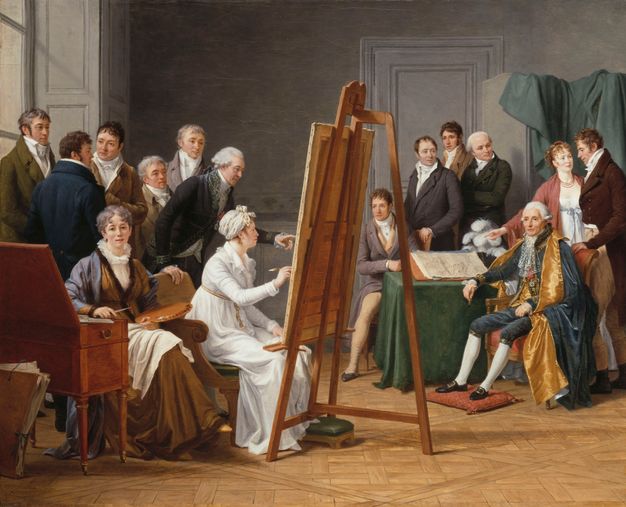
Vien’s was undoubtedly a superlative career, but timing could have been his downfall, for he claimed the summit of those institutional structures right as they were about to crumble, only two months, in fact, before the storming of the Bastille. Yet though Vien remained the king’s man, leading the Académie Royale until its final demise in 1793, the Revolution did not mark the end of Vien’s success.22 Indeed, Vien’s greatest skill of all perhaps was his ability to work a system, and once a system was reestablished in Napoleon’s First Empire, Vien found himself redecorated in the regalia of a new regime. Like the counterpoint to Duplessis’s portrait of 1785 (see fig. 36), Gabrielle Capet’s group portrait of 1808 shows Vien in this fresh guise (fig. 38), dressed as a member of France’s new order of nobility—an imperial count—and on his chest, where he once wore his Order of Saint Michel, a flash of red ribbon draws the eye to his new decoration: commandeur in Napoleon’s Légion d’honneur.23 What is perhaps most interesting in this coda is not that Vien survived the rupture, but rather that—as these decorations suggest—rupture is not always the best way to understand this moment of French history. After all, the Order of Saint Michel had become an order of merit long before the Légion d’honneur, and despite the different systems they represented, an ancien régime chevalier and an imperial commandeur might have more in common than their accessories. ‡
-
Joseph-Marie Vien to comte d’Angiviller, 31 January 1776. CDR, 13:188. Vien recounts the moment in his memoirs, but he misremembers it happening only a fortnight after his arrival: Thomas Gaehtgens and Jacques Lugand, Joseph-Marie Vien: Peintre du roi, 1716–1809 (Paris: Arthena, 1988), 313. ↩︎
-
Founded in 1469 by Louis XI, the Order of Saint Michel was the oldest (though not the most senior) of the French chivalric orders. The insignia is described in the 1665 statutes: Statuts de l’Ordre de Saint Michel: Ordonnances et règlements rendus en conséquence (Paris: Imprimerie Royale, 1728), 11. ↩︎
-
For example, Louis-Michel Van Loo, “Inventaire après décès,” 22 April 1771, AN, MC/ET/LVI/166. ↩︎
-
“Décoration,” Dictonnaire de l’Académie française, fourth edition (1762). The importance of this relationship in architecture is elaborated in part two of Katie Scott, The Rococo Interior: Decoration and Social Spaces in Early Eighteenth-Century Paris (London and New Haven: Yale University Press, 1995). ↩︎
-
Article IV, Statuts de l’Ordre (1728), 8. ↩︎
-
These are percentages for all members from 1660 to 1790 with traceable biographies. Benoît de Fauconpret, Les chevaliers de Saint-Michel, 1665–1790: Le premier ordre de mérite civil (Paris: P. du Puy, 2007), 47. ↩︎
-
Fauconpret, Les chevaliers, 91. ↩︎
-
On artists who were made chevaliers of the order, see [Jules Guiffrey], Lettres de noblesse accordées aux artistes français (XVIIe et XVIIIe siècles) (Paris: Dumoulin, 1873), 40–44. On artists who were ennobled, see Louis de Grandmaison, “Essai d’armorial des artistes français,” Réunion des sociétés des Beaux-Arts des départements, part 1 (Paris: Plon-Nourrit, 1903), 296–403; part 2 (Paris: Plon-Nourrit, 1904), 589–687. ↩︎
-
D’Angiviller to Vien, 26 September 1775. CDR, 13:135. ↩︎
-
Fauconpret, Les chevaliers, 97–100. ↩︎
-
D’Angiviller to Charles de Vergennes, 18 September 1775. CDR, 13:131. ↩︎
-
Beginning with his letter to Vergennes, 18 September 1775. CDR, 13:131. ↩︎
-
Vien’s admission was approved in Vergennes to d’Angiviller, 23 September 1775. CDR, 13:134. ↩︎
-
Natoire experienced the same state of limbo and actually remained in it because he did not return to Paris between his admission to the order in 1756 and his death in 1777. ↩︎
-
On Vien’s ennoblement and reception into the order, see Grandmaison, “Essai d’armorial” (1904), 660–62; and [Guiffrey], Lettres de noblesse, 38–39. ↩︎
-
D’Angiviller to Vergennes, 4 December 1775. CDR, 13:169. ↩︎
-
Vien to d’Angiviller, 31 January 1776. CDR, 13:188. ↩︎
-
PV, 6:383, 391; and PV, 7:95. ↩︎
-
PV, 8:70, 200. ↩︎
-
PV, 8:341; and PV, 9:69. ↩︎
-
PV, 9:255; and PV, 10:12. ↩︎
-
On Vien’s role in the revolutionary politics of the Académie, see Nicolas Mirzoeff, “Revolution, Representation, Equality: Gender, Genre, and Emulation in the Académie Royale de Peinture et de Sculpture, 1785–1793,” ECS 31, no. 2 (1997–98): 153–69. ↩︎
-
On Vien’s post-revolutionary career, see François Aubert, “Joseph-Marie Vien (sixième article),” GBA 23 (November 1867): 475–82. ↩︎