Type of Object
Red Lake
- Joseph-Siffred Duplessis (1725–1802)
On 2 December 1786, a four-page memorandum on red lake written by the portraitist Joseph-Siffred Duplessis was read to members of the Académie by the secretary, Antoine Renou.1 The designation mémoire, or memorandum, indicates that the discourse had not been solicited by the Académie, unlike a conférence, which was a public lecture on art that an academician was invited to give.2 Mémoires were, rather, projects submitted by individuals soliciting the Académie’s approval and imprimatur. Rare in the first half of the eighteenth century, the number of such memoranda by artists, inventors, and amateurs rose significantly after 1750, in spite of the fact that the Académie as professional body and as school did not formally concern itself with the materiality and craft of art. Thus, when “couleur” was discussed in the conférences, it was in the context-specific sense of “coloris,” that is, in relation to its aesthetic value and with regard to questions of color distribution and pictorial harmony.3 The making, mixture, and manipulation of colors were the know-how, or secrets, of the studio transmitted by apprenticeship, not discourse. Duplessis tipped his hat at the distinction and readily admitted that pigments do not, of themselves, make good pictures. But he argued that much of a picture’s “freshness,” “brilliance,” and therefore beauty depended on them, and as such the Académie had, he implied, a very proper though as yet formally unacknowledged interest in them. By his memorandum he sought to break with the tradition of artisanal secrecy and overcome academic hauteur. He offered his stock of personal and private knowledge of red, acquired through lengthy research and experimentation, as a gift to his fellow academicians, opening up a public road between studio and Académie.
His subject was red lake.4 Not a mineral pigment like vermillion or ultramarine, ground from cinnabar and lapis lazuli, red lake is an organic pigment precipitated from a dye such as madder or cochineal by means of an inert binder, in this case alum.5 It is translucent and strongly colored and was often used as a glaze over other paint layers, notably in the depiction of drapery and dress.6 It was not new. On the contrary, it was an old and established artist’s pigment: Rubia tinctorum, or madder, was brought to Europe from Asia in the fourteenth century and widely grown as a crop thereafter, especially in Zealand in the Netherlands, but also in France; cochineal was imported from Mexico, beginning in the sixteenth century. A Spanish monopoly, it reached France via the port of Cadiz.7 Although historians argue that red was declining sharply in importance in the eighteenth century, eclipsed by blue, red lake was, with other reds, an important component, with other reds, of Duplessis’s —perhaps even, of his artistic identity.8 In 1781 he had exhibited a portrait of himself in a red coat (fig. 138). Tradition has it that he wore it during regular visits to the Salon so that Salon goers might compare the original and the copy.9 Hanging thereafter at his lodgings at the Louvre, it is possible that the gradually fading color of the depicted satin spurred him to review his materials and processes. The fugitive nature of red lake was, he assumed, a modern ill and the inevitable hazard of commercially produced pigments.10 As he relates in his memorandum, he decided to fix the problem by making his own lake.
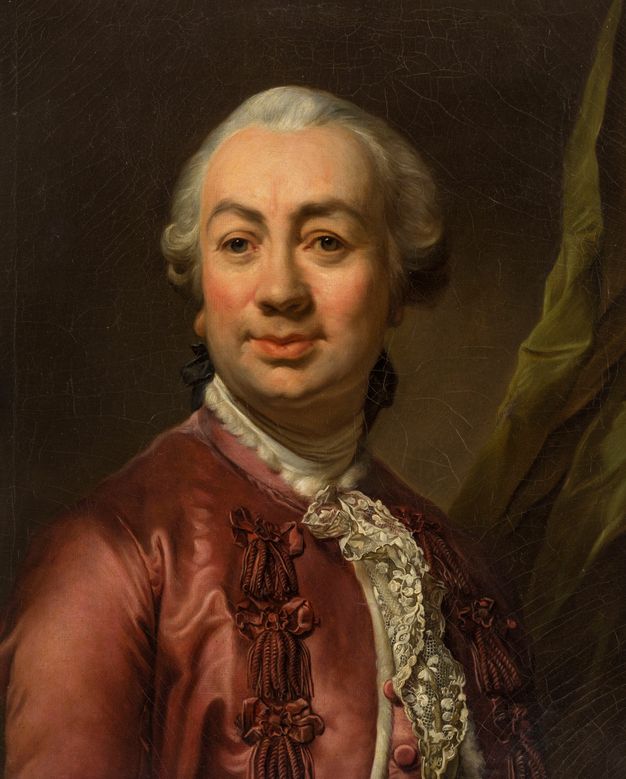
On the surface, Duplessis’s insourcing of color production to the studio looks like a return to early modern craft practices in which the making as well as the application of pigments was conducted in-house. It implies purchase of the cochineal virtually unprocessed, or of ground madder in one of the three grades (from expensive, fine, and light, to cheap, coarse, and dark). And it implies that, once in the studio, the stuffs were dispersed in water (hot for cochineal, cold for madder) and mixed with the binder before the water was evaporated off and the residue ground to a fine powder ready to make into paint. The memorandum contradicts such an interpretation, however. Having experimented with a “pure” and “solid” carmine lake of his own manufacture that proved no more enduring than those he had bought ready-made, Duplessis looked for enlightenment outside the studio, to the most recent and relevant published sources and to chemists. He proceeded, moreover, by formulating clear and distinct hypotheses rather than operating blindly by the chance of trial and error.11 First he conjectured that animal colorants are intrinsically superior in brightness and solidity to vegetal ones; second, he theorized from a passage in the abbé Raynal’s Histoire des deux Indes (1780) (which described indigenous practices of extracting colorant from gastropods in the gulf of Guayaquil) that obtaining such a bright and solid purple red was a question of method not matter;12 and third, he hypothesized that the solidity of pigments was determined by their adhesiveness. In short, he took a quotidian pigment of the studio, a real red, and constructed it anew as a “scientific object,” to use Lorraine Daston’s terminology, an object of intellectual inquiry, and target also of his cognitive experimentations.13
To confirm and prosecute his theories he contacted the chemist Jean Darcet, recently appointed to succeed Pierre-Joseph Macquer at the Jardin des plantes and advisor at the Gobelins and at Sèvres.14 Darcet challenged Duplessis’s ideas and persuaded him to experiment instead with madder, the growing of which the government had been working to encourage with tax breaks since the 1750s, and which had been the subject of the Mignot de Montigny prize in applied chemistry at the Académie Royale des Sciences in 1783–85.15 Duplessis was very likely familiar with the plant because it was an important crop for Carpentras (Duplessis’s place of birth) and the surrounding region.16 Darcet referred Duplessis to the recent trials on madder published by the Berlin chemist Andreas Margraff in the Journal Polytipe and also described in the article “Garance” in the Encyclopédie méthodique (1784).17 Having agreed on the hue they wanted to create—at the purple rather than the orange end of the red spectrum—Duplessis and Darcet separately produced madder lakes, achieving comparable, and therefore valid, results. Duplessis then exposed samples of his new madder lake and his original carmine lake to the weather and to sunlight. Within a short time, the cochineal in the carmine lake sample had “evaporated”; the madder sample was, meanwhile, unchanged.18 Against expectations, madder outperformed cochineal in relation to solidity: the dyestuff, not the technology of pigment generation, confounded both Duplessis’s first and his second premises. His ideal red was vegetable. Use of the verb “to evaporate” indicates that in relation to method, Duplessis was led, under Darcet’s tutelage, to abandon his earlier “mechanical” theory of colorfastness and replace it with an organic one. The coloring properties of his red were reimagined or invented as chemical.19
Thus far our account of Duplessis’s memorandum has stressed the scientific nature of its discourse and of the painter’s thinking and experimenting: his division of natural objects into animal, vegetal, and, by implication, mineral realms; his problematization of the “goodness” of pigments in terms of common variables (brightness and solidity); and his recourse to repeat trials to establish chemical “facts.” However, this recipe for red lake, his gift to the Académie, was traditionally wrapped. Duplessis framed his “discovery” of a conceptually stable and enduring red lake by reference to the ancient dyestuff murex, source of the prestigious Tyrian purple praised by Pliny.20 He did not subscribe to the chevalier de Jaucourt’s contentions that the imperial purple of the ancient world had been no more beautiful that its modern manifestation, and that murex had ceased to be used simply because cheaper and better alternatives (cochineal and Brazil wood) had been sourced in the New World; rather he thus accepted the importance of history in determining the value and meaning of color.21 “Pourpre” was, according to Duplessis, a lost art, a holy grail, toward whose recovery all his spare energies were bent.22 The objectivity with which he seemingly treated the “facts” about colorants from Europe and the Americas may have stripped red of the local knowledge and meaning that it had for farmers in Zealand, or peasants in Oaxaca, but in doing so it also enabled the better translation and embedding of red lake into the semiotics of European art.23 Duplessis, as portrait painter to the king and the court, was acutely aware of the symbolic value of pigments and hues: the silky shimmer of purple for aristocrats, dull woolen scarlet for the untitled.24 It is surely significant that his only other intervention on matters of color should have concerned ultramarine, an old pigment, first imported from Afghanistan and at times worth more than its weight in gold.25 Though “Prussian” blue had generally been accepted as a cheaper synthetic alternative of equal stability and strength, Duplessis lobbied the directeur des bâtiments du roi to pursue measures at an international and diplomatic level to secure a readier supply and consequently a fall in price.26 Duplessis’s sympathies were thus entirely with the Académie, whose secretary, harassed apparently by the increasing number of new art products submitted by inventors to the Académie for examination, argued that what was needed was not new pigments but a better understanding of the old ones. In this the Académie was sometimes at odds with the Bâtiments. While the comte d’Angiviller made concerted efforts to secure ultramarine for the king’s artists from Turkey and Russia through diplomatic channels, he chided academicians as reactionary, resistant to progress, specifically to the introduction of new, commercially invented alternatives to traditional compounds.27 §
-
PV, 9:300. ↩︎
-
See Christian Michel and Jacqueline Lichtenstein, eds., Lectures on Art: Selected Conférences from the Académie Royale de Peinture et de Sculpture, 1667–1772, trans. Chris Miller (Los Angeles: Getty Research Institute, 2020). ↩︎
-
The distinction between couleur and coloris was one made by Roger de Piles in Dialogue sur la couleur (Paris: Langlois, 1673). See also his “Termes de peinture” at the end of Conversation sur la connoissance de la peinture (Paris: Langlois, 1677). Thomas Puttfarken, Roger de Piles’s Theory of Art (New Haven: Yale University Press, 1985), 59–63. ↩︎
-
ENSBA, Ms. 237.15, fol. 4. ↩︎
-
See Jo Kirby and Raymond White, “Identification of Red Lake Pigment Dyestuffs and a Discussion of Their Use,” National Gallery Technical Bulletin 17 (1996): 56–80; and Jo Kirby, Marika Spring, and Catherine Higgit, “The Technology of Eighteenth- and Nineteenth-Century Red Lake Pigments,” National Gallery Technical Bulletin 28 (2007): 69–81. ↩︎
-
It seems to have been used only sparingly in the representation of flesh, mostly to enrich shadows. ↩︎
-
See Georges Roque, La Cochenille, de la teinture à la peinture: Une histoire matérielle de la couleur (Paris: Gallimard, 2021), 52, 126. See also A Red Like No Other: How Cochineal Colored the World: An Epic Story of Art, Culture, Science and Trade, ed. Carmelle Padilla and Barbara Anderson (New York: Skira-Rizzoli, 2015). ↩︎
-
See Michel Pastoureau, Red: The History of a Color, trans. Jody Glading (Princeton: Princeton University Press, 2016), 142–93. ↩︎
-
Jules Belleudy, Joseph-Siffred Duplessis (1725–1802) (Chartres: Durand, 1913), 95. What is being suggested here is that Duplessis was more concerned with registering his abilities as a colorist and painter of stuffs than his skill at capturing a likeness, which did not depend on the clothes he was wearing. ↩︎
-
We know little about colormen in eighteenth-century Paris. See, as precursor to the nineteenth-century trade, Séverine Sofio, “Colourmen in the Nineteenth Century, Artisans or Experts (Paris, Tours),” Ethnologie française 165, no. 1 (2017): 75–86. ↩︎
-
Prussian blue was a chance product of attempts to make cochineal red lake. See Jo Kirby and David Saunders, “Fading and Colour Change of Prussian Blue: Methods of Manufacture and the Influence of Extender,” National Gallery Technical Bulletin 25 (2004): 73. ↩︎
-
In 1768 the chemist Pierre-Joseph Macquer had demonstrated similarly that a change in the sequence of operations used to dye wool with cochineal resulted in the successful dyeing of silk with the same dyestuff. See Macquer, “Sur un nouveau moyen de teindre la soie en un rouge vif de cochenille,” Mémoires de l’Académie royale des science (1768): 82–90. ↩︎
-
See Lorraine Daston, ed., Biographies of Scientific Objects (Chicago: University of Chicago Press, 2000). ↩︎
-
On Darcet, see Michel Jean Jérôme Dizé, Précis historique sur la vie et les travaux de Jean d’Arcet (Paris: Gillé, 1802); and Jaime Wisniak, “Jean Darcet,” Revista CENIC 35, no. 2 (2004): 105–10. Concurrently, or possibly prompted by Duplessis’s investigations, Darcet conducted experiments on cochineal. ↩︎
-
For the Arrêt du Conseil d’État, 24 February 1757, see Henri-Louis Duhamel de Monceau, Mémoire sur la garance et sa culture (Paris: Imprimerie royale, 1757), written specifically for farmers in order to promote madder as a crop, 78–79. The Montigny prize was not awarded because the single project submitted was judged insufficiently original by the Académie. See Christine Lehman, “L’art de la teinture à l’Académie royale des sciences au XVIIIe siècle,” Methodos: Savoirs et textes 12 (2012). ↩︎
-
Robert Chencier, Madder Red: A History of Luxury and Trade (London: Routledge, 2000), 10, 202–51. ↩︎
-
Encyclopédie méthodique, ou par ordre de matières, 3 (Medicine) (Paris: 1784): s.v. “Garance.” See also Kirby, “The Technology,” 76. ↩︎
-
In his memorandum Duplessis offered to bring the samples to the Académie for academicians to see for themselves. ↩︎
-
On mechanical and chemical models of dye process, see Alan E. Shapiro, Fits, Passions and Paroxysms (Cambridge, England: Cambridge University Press, 1993), 242–67. ↩︎
-
Pliny the Elder, Natural History, trans. W. H. S. Jones, Loeb Classical Library 10 (Cambridge: Harvard University Press, 1951), 6:296–97. ↩︎
-
“Pourpre,” Encyclopédie, https://encyclopedie.uchicago.edu/, 13:245. ↩︎
-
ENSBA, Ms. 237.15, fol. 3–4. ↩︎
-
On the discourse of science in France as “objective” or “neutral,” see Camille Frémontier-Murphy, “La construction monarchique d’un lieu neutre: L’Académie royale des sciences au palais du Louvre,” in Règlements, usage et science dans la France de l’absolutisme, ed. Christiane Demeulenaere-Douyère and Éric Brion (Paris: Tec & Doc, 2002), 170–203. ↩︎
-
Compare Duplessis’s Portrait of comte d’Angiviller, 1778, Musée et Château de Versailles, with his Portrait of Benjamin Franklin, 1778, New York, Metropolitan Museum of Art. ↩︎
-
In Charles Parrocel’s Inventaire après décès, 3 June 1752, lapis lazuli, or ultramarine in solid form, was itemized with the painter’s “jewels,” not his studio equipment. See AN, MC/ET/CXXII/684. ↩︎
-
See AN, O1/1918/237. ↩︎
-
On d’Angiviller’s efforts in 1786 to obtain ultramarine from Turkey and Russia through the intermediary of Auguste de Choiseul Gouffier, ambassador to Constantinople, see AN, O1/1918/ 313, 316; and O1/1919/99, 107, 146. D’Angiviller’s frustration boiled over in the case of zinc white, proposed by the chemist De Morveau in 1781 as an alternative to the carcinogenic lead white traditionally used by painters. See d’Angiviller to Jean-Baptiste-Marie Pierre, 19 January 1783 (AN, O1/1916/123). ↩︎