Type of Object
Burin
- Renée-Elisabeth Marlié (1714–73)
“A burin is a steel instrument for engraving on metal.”1 The best kind, according to this anonymous writer of the entry “Burin” in volume 2 of Diderot and d’Alembert’s Encyclopédie, were those made from German or British steel: “its virtue is its fine grain and its ash gray color.”2 We have no way of knowing whether Renée-Elisabeth Marlié was fortunate enough to have a German burin, but we do learn from her “life,” briefly told by the collector and connoisseur Pierre-Jean Mariette, that a burin of some kind was “put in her hand” by the engraver and royal academician François-Bernard Lépicié, whom she married in 1731 at the age of sixteen.3
Burins consist of a square shaft that tapers toward a diamond- or lozenge-shaped cutting face (fig. 18). They were supplied in a variety of sizes by the capital’s master needlemakers and were later fitted with wooden handles furnished by its master turners.4 These were not generic tools. Rather, they were made to the engraver’s specification, in relation to hand size and with regard to habits of practice. Some engravers favored long burins, others short, some diamond-tipped, others lozenge.5 Of whatever kind, a burin did not become a tool, properly speaking, however, until it had been remade in the printmaker’s workshop.6 The handle was cut away and flattened in a line perpendicular to the cutting face, and the point was further shaped, sharpened, and refined on an oil stone. The burin was therefore a highly individualized thing that belonged to its owner not only as property but as an extension of the body (hand and lower arm) and of thought: it prefigured the character of the line—bold, fine, etc.—that she envisaged and intended to cut.7
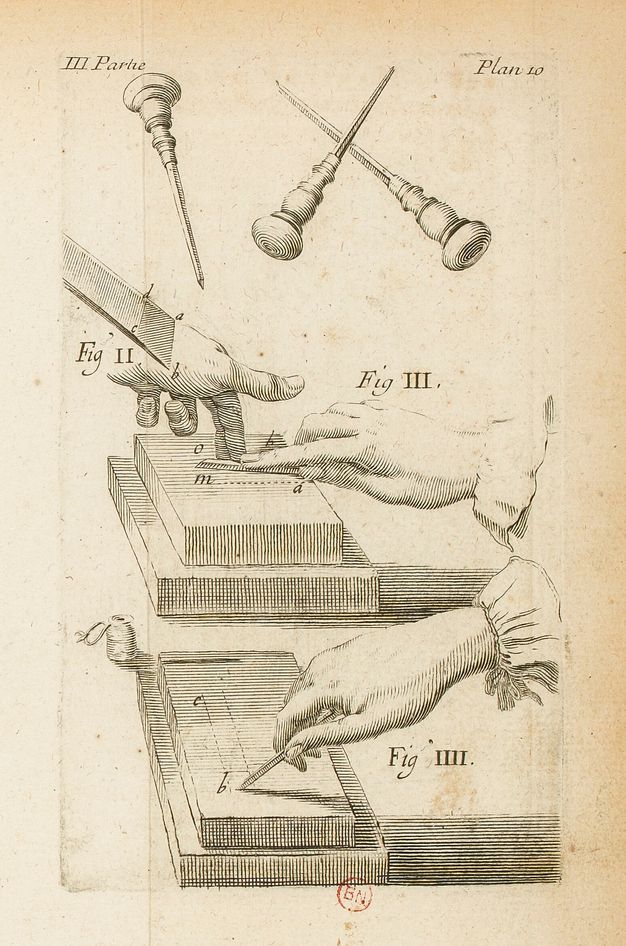
The burin was put to work on a copper plate bought ready-made from a master coppersmith.8 Figures 1 and 2 of plate 11 of Charles-Nicolas Cochin’s 1745 revised edition of De la manière de graver à l’eau-forte et au burin (see fig. 18) depicts how to hold the burin and put it to the plate: not grasped like a or , but rather with thumb and forefinger on the belly of the tool to guide the point, and the other fingers tucked up so that none come between the burin and the cutting surface. Cochin admitted that plates and description were not alone sufficient to understand fully the techniques of engraving, such was the range of pressure and the manifold subtleties in manipulation of the angle of the point to produce a flowing line to the desired width and depth.9 A tacit form of knowledge, engraving was only fully revealed in the workshop.10 Learned by doing, that is, by watching the master work and replicating his efforts in the presence of his example, engraving was a skill acquired slowly, through practice over time.11
Marlié’s entitlement to such training and to exercise her burin professionally was secured by the Edict of Saint-Jean-de-Luz, signed by Louis XIV in May 1660, which confirmed intaglio printmaking as a liberal art.12 There was no formal requirement of apprenticeship, journeymanship, and trial by masterpiece for printmaking, and no formal prohibition of women’s participation, in contrast to needlemaking, turning, and coppersmithing, the trades that supplied the engraver’s tools and medium, whose regulations proscribed access by women other than the widows of masters.13 In law, printmaking was thus gender neutral. Women like Marlié could and did pick up the tools of printmaking in increasing numbers in the eighteenth century.14 In addition to a professional tool, the burin, therefore, was potentially an agent and sign of independence.
The image we inherit of women in the eighteenth-century print trade is personified not by Marlié, that is, a printmaker, however, but by Elisabeth Duret, Mme Le Bas, a workshop manager. In the portrait that Charles Joullain fils draws of her in his life and oeuvre of Jacques-Philippe Le Bas, her womanly work is portrayed as the perfect counterpart to her husband’s art and industry.15 She kept the books, and by her thrift safeguarded the success of his business. She compensated Le Bas’s students and assistants for his exacting demands by her loving kindness and solicitude in hard times, ensuring the smooth and efficient running of his shop. Marlié’s burin tells a different story, not of bourgeois feminine virtue and companionate marriage but of the starker economic conditions of women’s work.
Her husband, Lépicié, was not a publisher and printseller with a large commercial enterprise like Le Bas. He had trained as a reproductive engraver, and by the late 1720s or early 1730s was making his reputation as the interpreter of modern French masters, first Charles-Antoine Coypel and later, in the 1740s, Jean-Siméon Chardin. He envisaged marriage, arguably, not as a partnership in which the moral, social, and economic assets each invested in the marriage’s joint stock (communauté de biens) are shared and distinct,16 but as an opportunity to recruit free labor and mitigate some of the economic risks of small-scale art reproduction. The lack of examples of Marlié’s work before her marriage suggest that Mariette’s quip that Lépicié put the burin in his bride’s hand was actually a statement of fact and not the figure of speech it appears on the page. The , from this perspective, looks not a little like an apprenticeship agreement: Lépicié to provide trade know-how and board, lodging, and laundry, Marlié to contribute dowry and labor. The known dates of Marlié’s prints indicate that her training lasted five to six years,17 the average, in fact, for engravers on metal.18
Her first commercial efforts in the mid-1730s were portraits for the printseller Michel Odieuvre’s down-market series Les portraits des personnes illustres (1735). Next, she published with her husband’s publisher, Louis Surugue, engravings of Sight (fig. 19), Taste, and Smell for a set of The Five Senses (ca. 1741), which resemble more-or-less formal demonstrations of skill—chefs-d’oeuvre in the guild sense. Her prints, produced alongside those of Touch and Hearing by her exact contemporary Pierre-Louis Surugue fils, are literal copies of Jan Saenredam’s engravings after Henrick Goltzius (ca. 1595), and sought to rival the originals in that beauty and softness for which Goltzius’s burin was renowned.19 Three years later, in 1744, she replicated her husband’s engraving after Chardin’s Le Bénédicité (1740), the work that sealed Lépicié’s reputation as an engraver, matching it faithfully line for line.20 Surugue fils had meanwhile been made an agréé (provisional member) of the Académie in 1742, where he exhibited another print after Goltzius at the Salon. In 1744 he also engraved a Chardin: The Card Game, after the original painting (now lost), however, not another’s print. In 1747 he was elected a full academician. Marlié’s talent brought her no comparable independent public recognition. In 1737 Lépicié had been appointed the secretary of the Académie. His elevation can only have deepened her burdens as helpmeet in the studio.
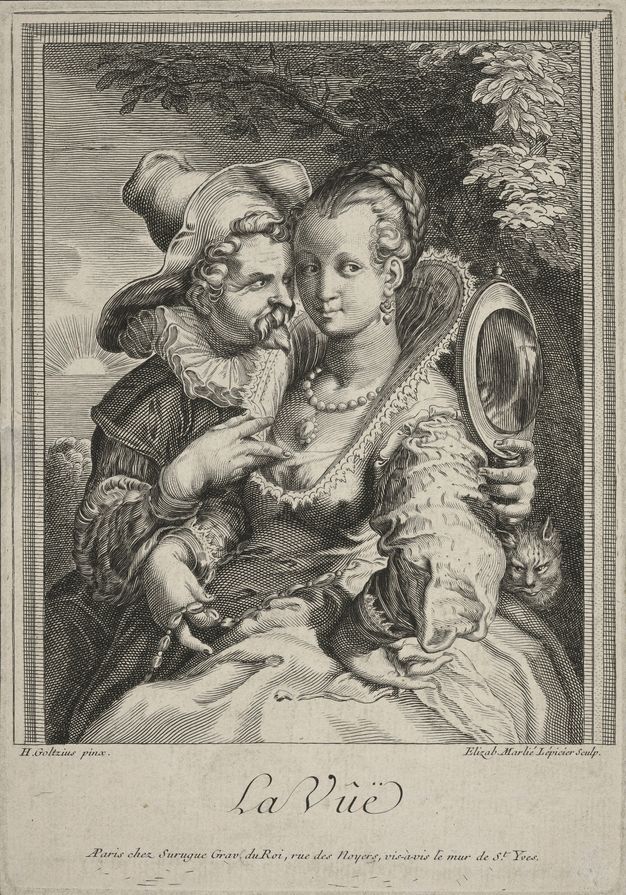
Her comparative invisibility as an engraver-wife, compared to Surugue’s prominence as fils of a lineage of engravers, is partly explained by cultural notions of appropriate womanly work. The burin’s line was associated with masculine values of strength, precision, and boldness.21 The resistance of the tool on the plate, metal to metal, required that the lines, swelling with the push, and tapering with the release of controlled and skillfully directed muscle power, were laid in systematically and evenly, creating a “net of rationality” not, it was generally thought, afforded by womanly work.22 Contra such prejudice, in Sight (see fig. 19) Marlié reproduces the almost geometric precision of Saenredam’s lines: the faces of the protagonists are rendered in swinging parallel arcs (the woman’s cheek) and in contrary motions of curves and counter-curves (the man’s jaw and brow) whose flat abstraction is relieved just enough with dots and cross-hatching to render the effect representational. In praising Saenredam’s engraving for its “softness,” François Basan applauded not his feminine sensibility but his virtuosic mastery of the manual challenges presented by the burin and the hard obduracy of the engraver’s medium.23 Though the amateur Claude-Henri Watelet acknowledged that engraving was not as physically demanding as received wisdom supposed, his account did nothing to overturn the general presumption that engraving is an art unfit for a woman.24 Women like Marlié challenged the idea of the burin and the category of woman; the meaning of one or the other had to change when she picked up her tool and engraved a line.
By the end of the seventeenth century the status of engraving was under assault. According to the publisher Charles-Antoine Jombert, the engraved line expressed, in the eyes of the modern viewer, not strength but “rigidity,” not clarity but “coldness.”25 Cochin alleged that engravers like Goltzius had turned virtuoso performance with the burin into an end in itself. Such self-reflexive displays of facility, he argued, undermined the proper purpose of engraving: to imitate the expressiveness, chiaroscuro, and coloris of drawings and paintings.26 For reproduction he promoted the more flexible technique of etching. Cochin’s criticism could well have been leveled at Marlié’s 1756 engraving after Carle Van Loo’s The Marriage Contract (1736) (fig. 20), a painting in Ange-Laurent de La Live de Jully’s collection, and described in the collection’s catalog as “in the taste of Rembrandt,” a “pastiche” of the Dutchman’s art.27 Only the really attentive viewer appreciates Marlié’s efforts to find with her burin a cut to correspond to the loose, broken paintwork of Van Loo’s brush and the rich tenebrism of his glazes. Even so, “Rembrandesque,” it is not. For such failings Cochin downgraded engraving to the secondary role of reinforcing etching’s finer line work, of adding mere accent and finish. Arduousness, in the sense of drudgery and routine, was the salient feature of engraving in this redefined role, a value that the woman might embody, but without artistic credit.
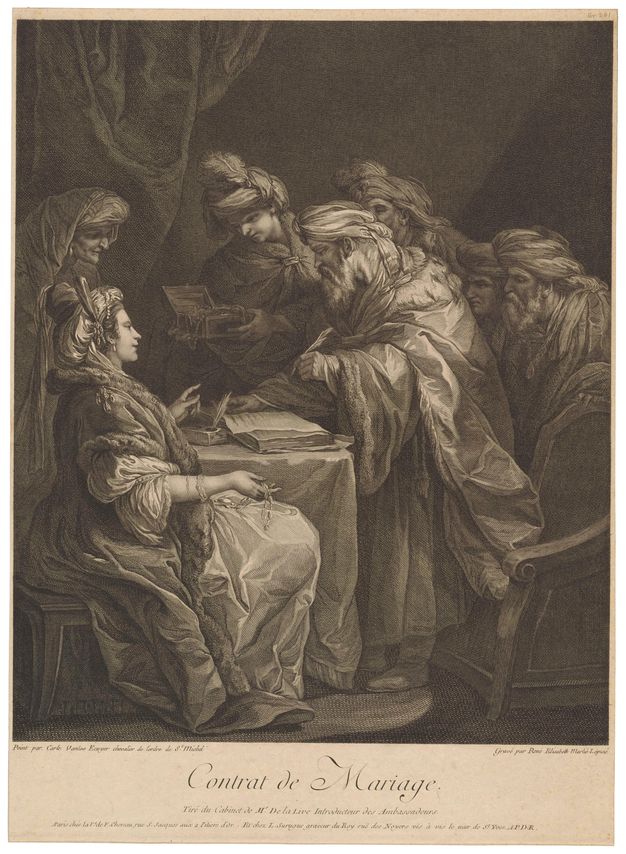
Marlié’s print was advertised in the Mercure de France in November 1756.28 Having praised the print in generic terms for capturing the “beauties” of Van Loo’s “Drawing” and the “vigor” of his “coloris,” the writer of the ad concluded by saying that the print “pays tribute also to M. L’Epicié, deceased, who knew how to leave us a second self . . . by resurrecting his talents” in his wife. The compliment was backhanded. It implied that although Marlié signed her work in her own name, nevertheless, under Lépicié’s training, she had not developed an independent artistic voice.29 Not a compliment, it was, in Lépicié’s case, also not a figure of speech. His purpose had indeed been to create a second, indistinguishable self, to share the labor of printmaking by “finishing” his work to preserve by her burin his etched disegno from the wear and tear of printing, thus increasing the size of the edition that could be pulled from the workshop’s copper plates and consequently the profitability of the business. In an invoice in the form of a poetic writ, addressed by Lépicié to the Fermiers généraux in June 1738, the engraver observed that the print they had commissioned from him after Hyacinthe Rigaud’s Portrait of Philibert Orry, had taken two years of “painful and continuous labor,” during which “Patience” had been his soul’s only condition and “Migraine” his only companion.30 Marlié was that patience personified. So close is her technique to his that connoisseurs find it impossible to untangle their work.
The Marriage Contract is Marlié’s last known engraving. Shortly after Lépicié’s death in 1755 she put her burin down. Released from a contract of drudgery and artistic nonentity, she retired at his lodging at the Louvre. §
-
“Burin” in Encyclopedie, 2:465, https://encyclopedie.uchicago.edu/. ↩︎
-
Johann Georg Wille sourced his steel burins from London—four dozen in 1763. See Mémoires et journal de J. G. Wille, ed. Georges Duplessis (Paris: Veuve Jules Renouard, 1857), 1:238. ↩︎
-
Pierre-Jean Mariette, Abecedario de P. J. Mariette, ed. Philippe de Chennevières and Anatole de Montaiglon (Paris: J. B. Dumoulin, 1853–62), 3:192. For Lépicié and Marlié’s marriage contract, see Mireille Rambaud, Documents du Minutier Central concernant l’histoire de l’art (1700–1750), 2 vols. (Paris: Imprimerie Nationale, 1964–71), 1:188–89. ↩︎
-
See Jacques de Savary des Bruslons, Dictonnaire universel du commerce (Paris: Estienne, 1723–30), 1: s.v. “Aiguillers,” 3: s.v. “Tour.” ↩︎
-
Charles-Nicolas Cochin refused to discuss the physical properties of burins in detail in De la manière de graver à l’eau-forte et au burin (Paris: Jombert, 1745), 100, because each engraver choses what suits them best. See also Claude-Henri Watelet’s article “Gravure” in Encyclopédie, 7:888. ↩︎
-
See Cochin, De la manière, 100–101. After Gérard Edelinck’s death in 1707 students fought over his burins in the hope that his art was his tool. See Cousin de Constamine, “Vie d’Edelinck,” in Mémoires inédits, 2:58; and Antony Griffiths, Print before Photography (New Haven: Yale University Press, 2016), 471. ↩︎
-
Watelet noted that the hilt of the burin sits in the palm of the hand such that its blade aligns directly with the bones of the forearm. See Watelet, “Gravure” in Encyclopédie, 7:888. ↩︎
-
Savary des Bruslons, Dictionnaire universel, 2: s.v. “Chaudronnier.” ↩︎
-
Cochin, De la manière, 104. ↩︎
-
On tacit knowledge, see Michael Polanyi, The Tacit Dimension (1966; reprint, Chicago: University of Chicago Press, 2009). ↩︎
-
See Abraham Bosse’s “preface” (1645), republished in Cochin, De la manière, xvii. See also Cousin de Constamine, “Vie d’Edelinck,” in Mémoires inédits, 2:57, on Edelinck as a teacher: “son trait ne fut ni précédé, ni suivit d’aucun discours”; cf. Jean-Gérard Castex, “Réduire la gravure en art et en principes: Lecture et réception du Traité des manières de graver à l’eau-forte d’Abraham Bosse,” in Réduire en art: La technologie de la Renaissance aux Lumières, ed. Pascal Dubourg and Hélène Vérin (Paris: Maison des sciences de l’homme, 2014), 235–48. ↩︎
-
See Marianne Grivel, Le commerce de l’estampe à Paris au XVIIe siècle (Geneva: Droz, 1987), 96–99. ↩︎
-
On gender and the guilds, see Clare Crowston, “Women, Gender, and Guilds in Early Modern Europe: An Overview of Recent Research,” International Review of Social History 53 (2008): 19–44. ↩︎
-
See Delia Gaze, ed., Dictionary of Women Artists (London: Routledge, 1997), 1:62. ↩︎
-
See Charles Joullain fils, Oeuvre de Jacques-Philippe Le Bas, 5 vols. (BnF, Ee11–Ee11d fol), 1. ↩︎
-
On the marriage contract in the ancien régime, see Claude-Joseph de Ferrière, La science parfaite des notaires, updated by François-Benoît Visme (Paris: Saugrain, 1752), 1, pt. 4, esp. 256–63. ↩︎
-
She started producing portrait engraving for Michel Odieuvre’s series Portraits des Grands Hommes et Personnes Illustres. Four were advertised in the Mercure de France in 1736 (June, July, September, and October), including the portrait of the engraver Claude Mellan. ↩︎
-
The apprenticeship documents for engravers on metal shows that the average training contract was six years. See Rambaud, Documents du Minutier Central, 1: xliv–xlvi. ↩︎
-
François Basan, Dictionnaire des graveurs (Paris: Prault, 1789), 2:147. The Saenredam originals almost certainly belonged to the publisher of the copies, Louis Surugue the Elder, in whose collection Goltzius’s work was prominent both in the original and reproduced by Saenredam, among others. See François Basan, Catalogue d’estampes des plus grands maîtres italiens, flamands et françois du cabinet de feu Louis de Surugue (Paris: Pierres, 1769), lots 47, 134, 195, 315, 387, 434, 435–36, and 500. ↩︎
-
Close comparison of their prints reveals that Marlié did simplify her husband’s work, reducing the number of lines especially in the rendering of the ground. ↩︎
-
See Cochin, De la manière, xxiii; Encyclopédie, 7:284 (“Franchise de pinceau ou de burin”). ↩︎
-
The phrase is from William M. Ivins Jr. See Ivins, Prints and Visual Communication (Cambridge: MIT Press, 1969), 70, 73. ↩︎
-
Basan, Dictionnaire, 2:147–48. ↩︎
-
Encyclopédie, 7:887. ↩︎
-
Charles-Antoine Jombert, “Préface de l’éditeur,” in Cochin, De la manière, xix. ↩︎
-
Cochin, De la manière, 106. ↩︎
-
See Catalogue historique du Cabinet de peinture et de sculpture françoise de M. de La Live (Paris: Le Prieur, 1764), 79. ↩︎
-
Mercure de France, November 1756, 169–70. ↩︎
-
She signed, seemingly at random, Marlier, Lépicié, and Marlié-Lépicier. To contrast Marlié’s situation with Marguerite Gérard’s relationship with Jean-Honoré Fragonard at the end of the century, see Rena M. Hoisington and Perrin Stein, “‘Sous les yeux de Fragonard’: The prints of Marguerite Gérard,” Print Quarterly 29, no. 2 (2012): 142–62. ↩︎
-
See Placet à Messieurs les Fermiers généraux sur le portrait de Monseigneur le Contrôleur général gravé par ordre de la Compagnie (n.p., 1738), 2. ↩︎