Type of Object
Material
Type of Object
Material
The court portrait painter Jean-Marc Nattier owned multiple teacups. To be exact, five sets in all: a set of six Japanese porcelain cups and saucers with a sugar bowl, a pair of “old Japan” covered cups mounted in ormolu, a set of six Meissen cups and saucers, and two sets of uncertain origin, one “Asian” and consisting of twelve cups and saucers, a teapot, and a sugar bowl, and the remaining four cups and saucers described merely as of “red and white” china.1 Most, and perhaps even all, of these cups were marked by travel. Having survived undamaged over sometimes vast distances and always against considerable odds, they partook of the marvelous and exotic.
Description of the items in the catalog of Nattier’s sale in 1763 is so summary that we can only imagine what they may have looked like: possibly Kakiemon-style (fig. 167), since it was these white-bodied Japanese wares, typically decorated with vegetal ornament in bright enamel colors, that were most admired by Western consumers and were widely copied in Europe, especially by Meissen. They were sold with the rest of Nattier’s collection, which included Oriental vases, urns, jars, potpourris, and figurines, begs the question: What were the teacups for? Did a passion for porcelain lead Nattier to collect them for themselves, or did a taste for tea entail purchase of a tea set? To put it another way, was Nattier oriented toward his teacups as a functional part of his everyday life, or as an aesthetic diversion from it? How does the answer to this question inform, moreover, our understanding of Nattier’s encounter with cultures different from his own? Finally, how might the answer also explain the conspicuous lack of visual reference to porcelain in his paintings?
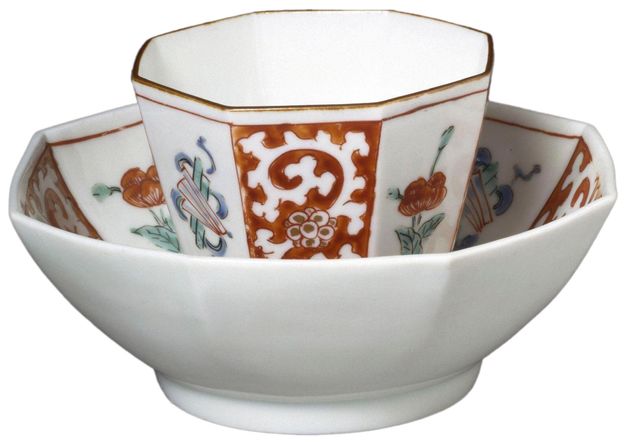
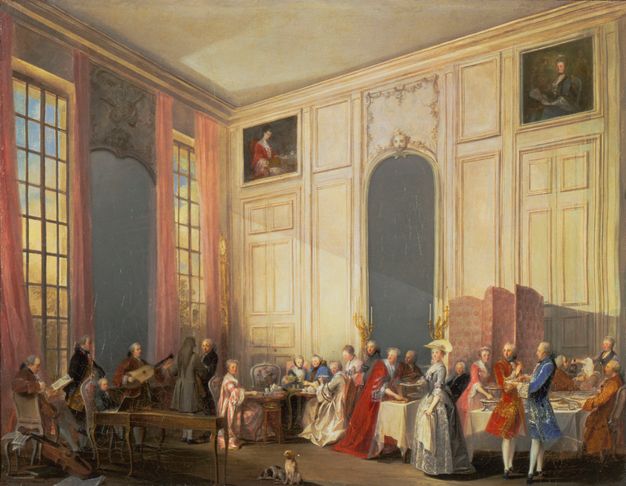
By the beginning of the eighteenth century, Chinese and Japanese porcelain was being imported to France in quantity. It was retailed in Paris by luxury-goods merchants (marchands merciers) and was sold at auction.2 Nattier’s first purchases were made in the early 1720s. Sometime before 1722, he bought a garniture of Japanese porcelain for one of the chimneypieces at his lodgings, on Rue de Hasard.3 He was admiring and acquiring Asian porcelain, we can thus note, long before his contemporary François Boucher, with whom it is today more famously connected.4 If the name “Nattier,” inscribed in 1756 against lot 1043—a pair of ewers with blue painted flowers—in a copy of the catalog of the duc de Tallard’s sale, refers to Jean-Marc, he was, moreover, still augmenting his collection more than thirty years later.5 Between these dates, the painter was appointed artist in residence to the Grand Prieur of the Order of Malta and in 1735 moved into a suite of rooms at the Temple, an enclave of houses, workshops, and shops clustered around the Grand Prieur’s palace in Paris.6 It was there that Nattier assembled his collection and also, perhaps, there that he was introduced to the rituals of tea. The prince de Conti, who acceded to the office of Grand Prieur in 1748, and his mistress, the salonnière Marie-Charlotte, comtesse de Boufflers, were renowned for their tea parties, depicted by Michel-Barthélemy Ollivier (fig. 168), though not in sufficient detail to be absolutely certain whether the teacups are Asian or European.
Nattier’s encounter with Japan and China via cups and tea was mediated by institutions of trade and sociability. In the literature of the sales rooms, “Japanese” denoted not an object’s place of origin but its excellence.7 “Japanese” teacups were of high quality, “old Japanese” teacups of the highest. When dealers like Pierre Rémy, who cataloged the Tallard sale, or François Joullain, who auctioned Nattier’s cabinet, qualified Japanese porcelain as “old,” they were unaware that porcelain was actually a modern art in Japan, introduced from China in the seventeenth century. Age for them was a synonym of rare—rare sometimes to the point of rendering an object virtually unique.8 “Old Japan” was thus a name, not a narrative. No scholarly discourse on porcelain equivalent to that on the history and theory of Western art and antiquities existed outside the trade. No Pierre-Jean Mariette wrote for porcelain the like of his treatise on engraved gems (see ). History in the case of the porcelain object only began when it arrived in Europe and acquired a biography in the form of provenance.9
The temporal shift that occurred through the recontextualization of the object as it moved from East to West and was removed from its original context of use to begin a new, shelf life in a cabinet stripped it of its pre-collection histories. According to Rémy, porcelain was not a collector’s item as such; rather, it ornamented the nobleman’s collection proper by providing a light counterpoint to his European bronzes and a fragile foil to his antique vases.10 As ornament and counterpoint, oriental porcelain was, in the discourse of collecting, always after, later than, an addition or supplement to the real (classic and classical) objects of curiosity, its own antiquity and cultural autonomy disavowed by European taste and epistemology.
We can’t know whether Nattier’s porcelain was a decorative supplement to his sculptures, whether novelty cups introduced accent by offsetting his sanctioned art works—small bronzes of The Gladiator, Venus and Cupid, Louis XIV on Horseback—because Nattier sold his collection in 1763, shortly before retiring from the Temple to live with his youngest daughter.11 Without an inventory, there is no way to tell whether his things were gathered and arranged together, or whether the “cabinet” sold by Joullain comprised possessions scattered throughout his rooms, the tea sets perhaps stored in a cupboard until needed. That Nattier’s teacups were arranged in sets does not of itself indicate use; Rémy described one of Tallard’s tea sets as a mini collection within the ducal cabinet, carefully assembled from disparate things, set on a tray, and circumscribed by it.12 European collectors were compelled by circumstance so to act—to act Japanese, in fact, partly because the matching tea set was unknown, foreign to Japan. Tea bowls were unique, individually precious, often named, and chosen by the tea master for each performance of the tea ceremony (茶道) according to the particular occasion and specific guests.13 In France, by contrast, the sameness of sets was a visual metaphor of the social whole and of the nonhierarchical ideal of politeness that characterized salon sociability chez Mme Boufflers and her sisters (see fig. 168).14 French users of teacups—of which, given the number of his sets, Nattier was probably one—bought, therefore, against the grain of Japanese culture and also that of European supply: they bought to match, in order to make sets out of single cups.
Tea was introduced to France in the early seventeenth century and was taken initially as a medicinal remedy, but by the eighteenth century it had become an elite recreational drink.15 We could perhaps imagine that using a teacup and drinking tea afforded Nattier the illusion of a more intimate experience of Japan than merely admiring his china; that the experience and objectives of collecting and using could and did coincide for him. However, according to Anne Eatwell, the fashion for tea at midcentury and notably at the Temple was mediated by anglomania and a desire not for contact with Japan but with England. To drink tea was to ape English manners and to consume porcelain was, arguably, to poach its tea things—Japan in translation, so to speak.16 Thus the cultural dichotomies of East and West that structured the discourse on collecting were present also in the discourse and language of use. According to the dictionary of the Académie française, tasse (cup) is related to goblet (beaker), by implication an earlier word for an older vessel.17 Goblets were made of silver or gold. Cups could be of porcelain, faience, or glass. The height of the beaker was reduced in the cup, but the rim of the cup expanded the perimeter of the beaker to expose a larger surface of liquid for cooling. Cups, unlike beakers, were synonymous with their exotic contents (teacups, coffee cups, chocolate cups), thus doubly different. To use a teacup, in sum, was to handle something familiar and different, something translated: both like a beaker and like no other cup, in substance, form, and purpose.
Porcelain resembled French earthenware but exceeded it in refinement, producing notably thinner vessels of finer, whiter ceramic, lighter in the hand, more brilliant and lively to the eye (see fig. 167).18 From the beginning of the century, attempts were made across Europe to rival imported porcelain, but it was not until the 1770s that the royal manufactory at Sèvres succeeded in reproducing “true,” or hard-paste porcelain, chemically identical to that of China.19 In Nattier’s lifetime, porcelain was a mystery still. Although in 1712 the Jesuit missionary François Xavier d’Entrecolles chose the cup as a simple, familiar, model object to illustrate the production process at Jingdezhen, porcelain teacups nevertheless remained unknown to French consumers;20 they were experienced rather in metonymic relation to what they resembled in form (beakers), and what they bettered in stuff (everyday faience). Was the painter’s pleasure in his intensely material cups made uncanny by this mix of the familiar and the strange and by the animation of porcelain’s uniquely high-gloss surface, described by another French Jesuit, Louis Le Comte,21 as alive with the infolded reflection of things around it? Nattier’s mixed feelings about his collection are certainly on record. At the end of his life, he confessed to his eldest daughter that, in the balance sheet of his worldly achievements, he counted his cabinet among his regrets.22
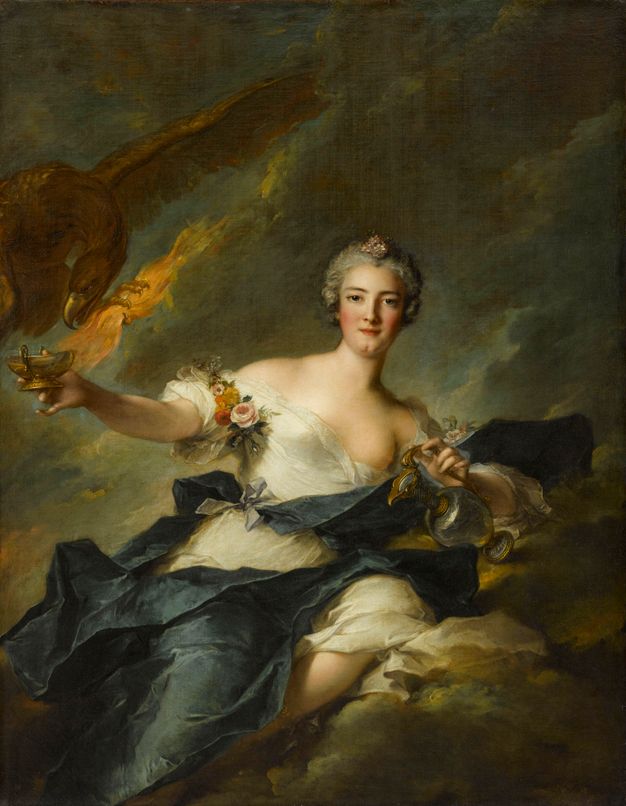
Were we able to attribute Nattier’s ambivalence specifically to his porcelain, would it explain his decision not to incorporate porcelain in his work? The duchesse de Chaulnes, in Nattier’s portrait of her serving Jupiter with elixir (fig. 169), does so from a cup of gold and silver, not a porcelain one, notwithstanding the fact that both Chaulnes’s brother, Joseph Bonnier de la Mosson, and her husband, Michel-Ferdinand d’Albert d’Ailly, were keen collectors of china.23 It would, of course, have been anachronistic to have depicted the Hebed duchesse holding an exotic modern thing, but even in Nattier’s portraits of sitters in contemporary dress, porcelain is absent, in contrast to the bourgeois portraits by his contemporary Jacques-André-Joseph Aved.24 The obvious explanation is not, however, in patterns of class consumption, since according to Daniel Roche, it was the nobility, not the bourgeoisie, who drove the boom in porcelain vending.25 It was they who rushed to supplement, update, or replace their silverware with china tea and dinner services, while the bourgeoisie cautiously accumulated silver, teaspoon by teaspoon, hallmarked things of guaranteed value that served as both ornament and safeguard, because easily converted back into specie when circumstance necessitated. Nattier conforms to this pattern: he had silver, to a value nearly four times that of his china.26
Roche argues that in its passion for porcelain, the nobility sought to express its intellectual curiosity and appetite for cultural risk. That sitters had Nattier portray them with silver indicates, however, the limited semantic resonance of the china object in the public discourse on distinction, perhaps because in representation its materiality is overshadowed by form. We can note that the ewer and cup depicted in Mme de Caumartin’s hands in Nattier’s portrait of her (1753, Washington, National Gallery of Art) are decorated with graceful and flowing patterns of elegant figures, precisely the human motifs that Europeans scorned as grotesque and ill-proportioned “magots” in Chinese painting and ornament.27 Orientalism is not, however, completely repressed. It returns in gesture: Chaulnes holds her golden kylix (see fig. 169) as if it were a Japanese tea bowl; she ignores the handles, and delicately balances the cup between finger and thumb as tea etiquette demanded, according to the king’s physician Nicolas de Blegny.28
If we have come to know Nattier’s teacups better by this microhistory of their “lives” it has been not by the dictionary’s function to define but by history’s tracking of their movement across geographical, epistemological, social, and aesthetic spaces. For Nattier, entanglement with these and other things was, as for his patrons, both exciting and disturbing. That he returned his teacups to the market in 1763 suggests that, in the end, he failed to make them truly his own. §
[Nattier], Catalogue des desseins, tableaux, estampes, bronzes, porcelaines et livres du cabinet de M. D*** [Nattier] (Paris: Joullain & Prault, 1763), 14–15. ↩︎
See Carolyn Sargentson, Merchants and Luxury Markets (London: V&A, 1996); and Stéphane Castelluccio, “Le goût pour l’Asie: Le commerce des objets chinois et japonais à Paris dans la première moitié du XVIIIe siècle,” in Une des provinces du rococo: La Chine rêvée de François Boucher, exh. cat. (Besançon: Musée des Beaux-Arts et d’Archéologie, 2019), 26–39. ↩︎
Philippe Renard, Jean-Marc Nattier (1685–1766) (Saint-Rémy-en l’Eau: Hayot, 1999), 186–87. ↩︎
See Yohan Rimaud, “Les couleurs célèstes de la terre: La collection d’objets orientaux de François Boucher,” in Une des provinces du rococo, 62–75. ↩︎
Pierre Rémy and Jean-Baptiste Glomy, Catalogue raisonné des tableaux, sculptures . . . desseins et estampes, porcelains anciennes . . .qui composent le cabinet de feu M. le duc de Tallard (Paris: Didot, 1756) (copy at INHA, Paris), lot 1043. There was a copy of the sale catalog in Nattier’s library, see [Nattier], Catalogue, 22: lot 44. ↩︎
Renard, Nattier, 58. ↩︎
Stéphane Castelluccio, Collecting Chinese and Japanese Porcelain in Pre-Revolutionary Paris (Los Angeles: J. Paul Getty Museum, 2013), 114–81, esp. 136. ↩︎
Rémy and Glomy, Catalogue Tallard, lot 1050. ↩︎
See Rémy and Glomy, Catalogue Tallard, 257–58, on the grand dauphin as the origin of collecting porcelain. ↩︎
Rémy and Glomy, Catalogue Tallard, 256–57. ↩︎
On Nattier’s sculpture, see [Nattier], Catalogue, 9. ↩︎
Rémy and Glomy, Catalogue Tallard, lot 1089. Tea sets were not produced in Japan because the Japanese tea ceremony entailed selecting utensils specific to the occasion and the particular guests. ↩︎
See Sadako Ohki and Takeshi Watanabe, Tea Culture of Japan, exh. cat. (New Haven: Yale University Art Gallery, 2009). ↩︎
On self-same sets for decoration, not use, see Mimi Hellman, “The Joy of Sets: The Uses of Seriality in the French Interior,” in Furnishing France, ed. Dena Goodman and Kathryn Norberg (London: Routledge, 2006), 129–53. ↩︎
According to Antoine Furetière, by the end of the seventeenth century coffee had prevailed over tea as the everyday drink of choice. Furetière, Dictionnaire universel (The Hague: Husson, Johnson & Swart, 1727), 2: s.v. “thé.” ↩︎
Anne Eatwell, “Tea à la Mode: The Fashion for Tea and Tea Equipage in London and Paris,” in Boucher and Chardin: Masters of Modern Manners, exh. cat. (London: Wallace Collection, 2008), 50–76. ↩︎
Dictionnaire de l’Académie française, 3rd ed. (Paris: Coignard, 1740), 1: s.v. “gobelet,” 2: s.v. “tasse.” Edmé Gersaint used gobelet (beaker) to denote the cups in the Bonnier de la Mosson sale. See Gersaint, Catalogue d’une collection considérable de diverses curiosités . . . contenües dans les cabinets de feu Monsieur Bonnier de la Mosson (Paris: Barois & Simon, 1744), lots 907, 908, 912, 916, 917. ↩︎
In Oudry’s Still Life with Grapes, Celery, and Porcelain (1725), porcelain is juxtaposed with celery, the blanching, or whitening, of celery perhaps a metaphor for the whitening of earthenware in porcelain. ↩︎
Antoine d’Albis, The Creation of Hard-Paste Porcelain at Sèvres (London: French Porcelain Society, 1998). ↩︎
François Xavier d’Entrecolles, Lettres édifiantes et curieuses sur l’état présent de la Chine, ed. Louis Aimé-Martin (Paris: Société du Panthéon Littéraires, 1843), “Lettre de père d’Entrecolles au père Orry, sur la fabrication de la porcelain,” 12 September 1712, 3:473–74. ↩︎
Louis Le Comte, Nouveaux mémoires sur l’état present de la Chine (Paris, 1697), 1:258–59. ↩︎
See Marie-Catherine Pauline Tocqué, “Vie de Jean-Marc Nattier,” in Jacqueline Lichtenstein and Christian Michel, Conférences de l’Académie royale de peinture et de sculpture (Paris: ENSBA, 2015), tome 6, vol. 2:919–33, at 932–33. Nattier was not alone in turning against his collection. According to Gougenot, Jean-Baptiste Oudry formed a collection “de vases, de figures, de porcelaines et de curiosités de la Chine,” but “il s’en dégoûta,” and he sold it for 9,000 livres. See Louis Gougenot, “Vie de M. Oudry,” Mémoires inédits, 2:371. ↩︎
On Nattier’s portrait, see Jean-Marc Nattier 1685–1766, exh. cat. (Paris: Musée National des Chateaux de Versailles et de Trianon, 1999–2000), no. 39. In the British Museum, see a famille rose teapot with the d’Ailly coat of arms (Franks 808+), Jingdezhen, which belonged to the duc de Chaulnes’s father. ↩︎
For example, see Aved’s portraits of Mme Crozat (1741, Musée Fabre) and Madame Brion, Seated, Taking Tea (1750, Seattle Art Museum). ↩︎
Daniel Roche, France in the Enlightenment (Cambridge: Harvard University Press, 2000), 632–34. ↩︎
Renard, Nattier, 159. ↩︎
On French scorn for Chinese “magots,” see Kate Tunstall, “Le Neveu de Rameau, règne des magots et des pagodes,” Diderot Studies 35 (2015): 329–48. ↩︎
Nicolas de Blegny, Le Bon usage du thé, du café et du chocolat (Lyon: Amaulry, 1687), 11. ↩︎
| words