Type of Object
Order Book
- Louis-Jean-François Lagrenée (1724–1805)
“This book was written by Lagrenée, History Painter, Director of the Académie in Rome” (fig. 117). Inscribed on the first page of a large notebook, roughly 23 by 17 centimeters, these handwritten words serve as the makeshift title page to Louis-Jean-François Lagrenée’s order book.1 Yet from page one, the order promised by this document is disrupted by the disorder in its making. For while Lagrenée served as director of the Académie de France in Rome from October 1781 until September 1787, the book’s contents suggest that he started keeping the record much earlier, about a decade before he could have styled himself with this particular institutional moniker.2 Like many other pages in this book, then, the title page was written out of order, either added in its entirety at a later date or updated with a new title when its author was too.
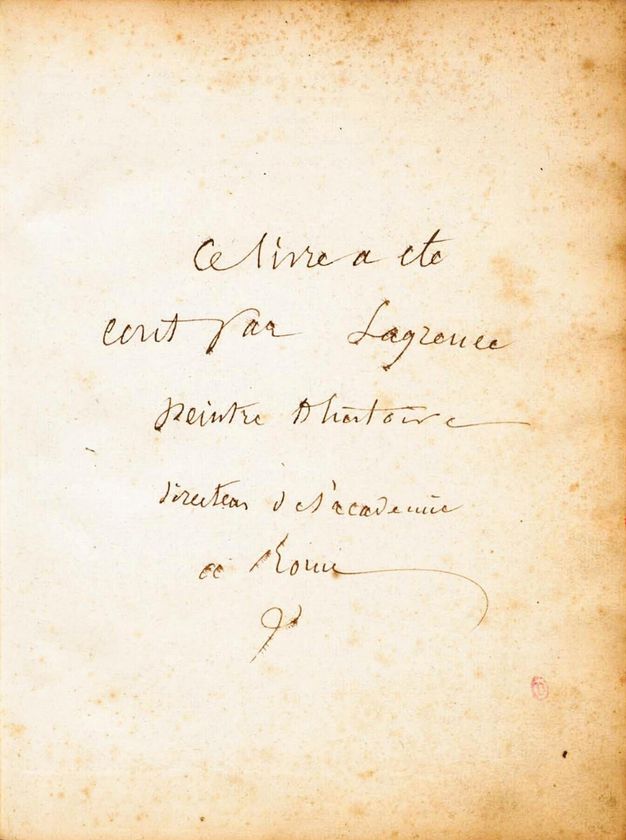
An order book was a common object in eighteenth-century France. A kind of register kept by every commercial agent, it was updated regularly to keep track of accounts and details of business. Despite their ubiquity, their organizational functions, and their often official status (merchants were required to keep them by statutory regulation), order books tended not to adhere to prescribed forms. Instead, like Lagrenée’s, they took shape with the idiosyncrasies of their makers.3 Indeed, according to the Encyclopédie, the principal job of the order book, or livre de raison, was to establish order for its owner out of their affairs (“il rend raison à celui qui le tient de toutes ses affaires”).4 How, then, did this book create order for Lagrenée? Which aspects of his business were rendered orderly in its pages? And what does the book’s internal order and disorder reveal about the life of the object and its owner?
Inside, the contents of Lagrenée’s 311-page book are composed of two main parts (fig. 118). The first is the more unexpected. Beginning on a recto numbered “1,” under the title “Recueil de sujets d’histoire” (Compendium of history subjects), Lagrenée neatly copied out over fifty stories to serve as potential themes for paintings, like the “Death of Cleopatra” or the “Battle of Alexander against Darius.” Separating his selections thematically—ancient history, Roman history, mythology, sacred subjects—Lagrenée also recorded his sources, for instance, his most frequent citation, Charles Rollin’s Histoire ancienne (1730–38), referenced impeccably with volume and page numbers. About two-thirds of the way through the book, on page 217, that compendium comes to an end, on a recto numbered 218 (he accidentally left out page 186, upsetting the numbers). A new title marks the beginning of the second part, more expected for an order book: “État des tableaux faits par Monsieur Lagrenée” (Register of paintings made by Monsieur Lagrenée).
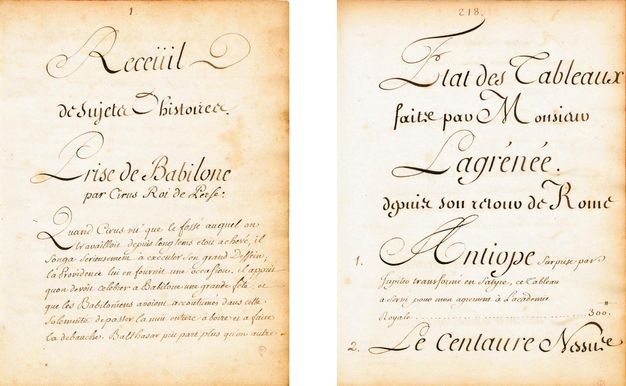
This register was a comprehensive record of the artist’s output. In a continuously numbered list, Lagrenée itemized every painting he produced: from no. 1, Antiope Surprised by Jupiter, the agrément piece he presented to the Académie in 1754; right up to no. 457, Bellona Dragging Mars from the Arms of Venus, painted toward the end of his life.5 With subheadings to structure the content, his productions were organized by time and place: first, “since his return from Rome,” meaning back in Paris after being a pensionnaire and joining the Académie (1754–60); next, “in Saint Petersburg,” where he served as imperial court painter (1760–62); then, “since my return from Saint Petersburg,” a long section that actually includes his directorate in Rome (1762–87); and finally, “Return from Rome,” which runs to the end (1787–1805). The register ends on page 298, with only a few pages left in the book, most of which are blank, apart from a four-page description of a “Subject of a Painting for the King,” and, on the final page, a small pencil outline of an antique urn—the only image in the entire book.
Lagrenée’s order book was a thing whose purpose was to reduce. To create order by making compact. Its two parts denote two distinct efforts in this vein: first, an attempt to scale down history; and second, a system to condense his own artistic practice. History, that vast textual discourse, was the stock-in-trade for any history painter, the raw material from which the artistic product was created. Thanks to Lagrenée’s meticulous scholarly citations, we know that the sources he was using were already compilations. Rollin’s histories offered summaries of stories drawn from a range of ancient texts, but clearly these multivolume editions with their lengthy accounts—like Histoire ancienne at thirteen volumes or Histoire romaine (1738–48) at seven volumes—were too much for Lagrenée and needed further paring down to suit his specific needs. Discarding the tedious or superfluous, Lagrenée created for himself a bespoke edited selection, extracting only the parts of stories he might want to paint, along with details to aid visualization (like the clothing worn by Persians, or the attributes of gods). From the calligraphic quality of his headings and writing, he clearly intended his abridged history to serve as a long-term reference—perhaps even a “traveler’s edition” for an artist planning to voyage—obviating the need for constant consultation of a large library.
With the order book’s transition from historical compendium to register, its functionality became multipurpose: from product guide to stock list and accounting system. Each page of Lagrenée’s register followed a methodical layout (fig. 119). At the left margin, an item number; in the middle, title of the work and salient details (short descriptions, commissioners, locations); and at the right margin, price. At the top of each page, Lagrenée noted the total of prices from all previous pages, and at the bottom he added those from the current page, thus keeping a running calculation of the value of his production to date. He stopped including prices toward the end (from page 282, soon after his return from Rome as directeur), at which point his career total stood at 283,120 livres. This systematic register molded Lagrenée’s studio output into a neat chronological and financial record, organizing his career into chapters and keeping track of his income along the way. Yet as its title page has already revealed, the book’s apparent order belies the disorder of its making, with temporal disjunctions, retrospective fabrications, and nonsequential interventions.
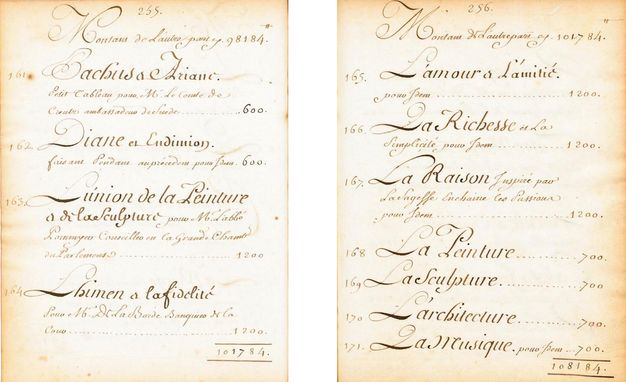
What, then, do the pages divulge about the book’s life as an object? Based on medium and facture, it appears to be the product of two stages of making, but, intriguingly, not ones that align with its two parts. The first stage—and the book’s creation—took place all at once, during which Lagrenée composed the historical compendium and over a third of the register. Covering pages 1 to 256, this stage is characterized by remarkable consistency in the book’s production, not least in the calligraphic headings/painting titles and stylized handwriting (see figs. 118, 119). Then, from page 257, the inconsistencies and variations begin: first an ink change from brown to black; then page totals start appearing in pencil rather than ink; then come small lapses in style, until eventually the calligraphic features are abandoned entirely and the writing becomes quicker and messier (fig. 120). Clearly, somewhere around this point the book entered a second and much longer stage of making, which, unlike the first (contained at a single moment, with the register reconstituted retrospectively), unfolded in real time over the rest of his career.
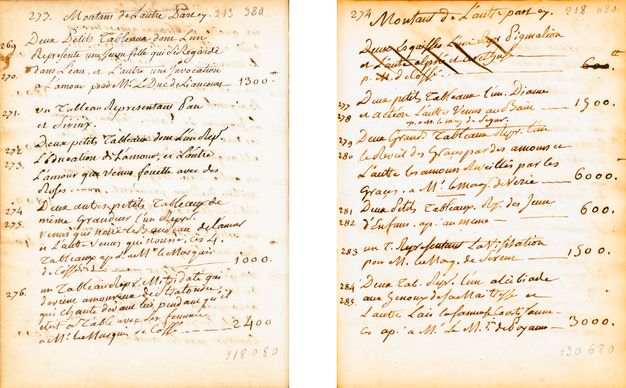
Once being formed in real time, the book also started to require corrections, from marks crossing out canceled items, to annotations noting changes and updates. On page 259, for instance, under the entry for Diana and Acteon, a succession of additional lines indicates the painting’s turbulent life: initially painted for the duc de Praslin, his exile prevented him from taking it; next, the work was sold to the comtesse du Barry for 720 livres, but she returned it; then, eventually, it went to Monsieur de la Borde. This sense of the book’s constant use and reuse is not limited to the register. Traces of revisits also punctuate the pages of the compendium, where Lagrenée would jot notes after painting the subjects described. On page 8, for instance, following the story of two widows vying to join their late husband on his funeral pyre (from a chapter on the successors of Alexander), Lagrenée noted, “I executed this subject in a drawing,” then later in a different ink and more tremulous hand “since as a large painting for the king in Rome in 1782.” The painting in question, Two Widows of an Indian Officer (1782, Dijon, Musée des Beaux-Arts), was exhibited at the Salon of 1783, and the explanatory text in the exhibition livret reads as though derived from the version in Lagrenée’s order book, suggesting yet another instance of reuse.6
The order of the book’s making invites speculation about Lagrenée’s motivations. Why start it, and why then? Based on the dates of the paintings itemized around the transitional point (pages 255–60), Lagrenée decided to create his book sometime between 1769 and 1771.7 Given the timing, it is tempting to imagine that the painter’s desire to order his affairs at this moment was prompted by the mundane practicalities of moving home. Lagrenée had been living for a few years on Rue de l’Arbre-Sec near the church of Saint-Germain-l’Auxerrois, having earlier lived at various other addresses in the neighborhood. But in May 1771, Lagrenée was finally granted a logement in the Louvre after years of trying to acquire that privilege, ever since his return from Saint Petersburg.8 Perhaps creating a new order book was an effort to consolidate disorderly papers before the move, or perhaps it was part of that desire (familiar to many) to want to start afresh after unpacking: to create a new order for a new life. Either way, Lagrenée’s order book looks like the product of that natural inclination, when faced with material excess or systematic chaos, to seek to reduce, condense, and simplify.
Lagrenée was certainly not alone among his colleagues in keeping an order book, but the considerable variations among the handful that still survive suggest they were often driven by different ends. Hyacinthe Rigaud’s order book was a list of portraits with prices, including sums paid to studio assistants, which indicates a prevailing concern with financial matters.9 Jean-Baptiste Oudry’s order book was also a record of portrait subjects, but this time in illustrated form, each entered into the book as a small sketch of the composition.10 This might suggest an inclination to catalog visually, or that the book served an additional purpose as a presentation album for clients. Meanwhile, Joseph Vernet’s order books were effectively chronicling nearly everything—from commissions received, to useful addresses, and household happenings and expenses—revealing the landscapist’s general proclivity to archive.11 By comparison with his colleagues, Lagrenée’s register of prices and patrons suggests, like Rigaud, an interest in commercial affairs (both economic and social). But his decision to combine that with a historical compendium draws an unusually direct connection between the business of history painting and the intellectual activities of his practice, not least in those numerous cross references between the book’s two parts. Despite the Académie’s privileging of scholarly pursuits and its conflicted relationship with commerce, Lagrenée’s order book makes it an easy cohabitation.
It seems fitting to end by returning to the beginning, back on Lagrenée’s title page, where, on its verso, we find the final annotation ever made in the book, and the most out of order of all. Made not by its original owner but by a subsequent one, the words were written by one of the Goncourt brothers, those celebrated nineteenth-century collectors and historians of the eighteenth-century art world. Having purchased the order book as an item of interest, the brothers accessioned it into their collection, getting it rebound with a monogrammed cover and inscribing it on the back of the title page with a cataloging description. Highlighting its historical significance, they described it as a “document without which it would be impossible to write the life of this likeable French painter.” Like the metal plaque added to Jacques-Louis David’s by his heirs, this inscription pulls the object into its future afterlife—recalling its passage from everyday item in an eighteenth-century studio, to documentary evidence in the historiographical narratives of French art—a trajectory that would surely have delighted the self-historicizing Lagrenée. ‡
-
The manuscript is now in the collection of the INHA in Paris. It has recently been digitized: https://bibliotheque-numerique.inha.fr/viewer/32482. ↩︎
-
Lagrenée’s appointment had been determined by 14 February 1781, so that seems the earliest possible moment for the inscription of the words “directeur de l’Académie à Rome.” Letter from comte d’Angiviller to Jean-Baptiste-Marie Pierre (14 February 1781), in CDR, 14:82. ↩︎
-
“Livres (commerce),” Encyclopédie, https://encyclopedie.uchicago.edu/, 9:613. On the legal role of the livre de raison, see Michel Cassan and Christine Nougaret, “Une typologie des écrits du for privé,” in Les Écrits du for privé en France de la fin du Moyen Âge à 1914, ed. Jean-Pierre Bardet and François-Joseph Ruggiu (Paris: Éditions de Comité des travaux historiques et scientifiques, 2014), 76–77. ↩︎
-
“Livre grand,” Encyclopédie, https://encyclopedie.uchicago.edu/, 9:613. ↩︎
-
Bellona is dated to ca. 1804 in Marc Sandoz, Les Lagrenée: I. Louis-Jean-François Lagrenée, 1725–1805 (Paris: Éditart-Les Quatre Chemins, 1983), 308. ↩︎
-
“Exposition de 1783,” Collection des livrets des anciennes expositions depuis 1673 jusqu’en 1800 (Paris: Liepmannssohn, 1870), 14–15. ↩︎
-
The dating of Lagrenée’s oeuvre here follows Marc Sandoz’s catalogue raisonnée. It is another fascinating sign of the potential disorder of Lagrenée’s inventory that Sandoz felt the need to reorder it in accordance with his own cataloging system. See Sandoz, Les Lagrenée, 359–73. ↩︎
-
Jules Guiffrey, “Brevet de logement dans la Galerie du Louvre,” NAAF (Paris: Charavay Frères, 1873), 95, 97. ↩︎
-
Rigaud’s livres de raison are held in the libraries of the Institut de France and ENSBA, Paris. The most comprehensive study is Joseph Roman, Le livre de raison du peintre Hyacinthe Rigaud (Paris: Laurens, 1919). ↩︎
-
Oudry’s albums are held in the Musée du Louvre. They were analyzed as “liber veritatis” in Hal Opperman, Jean-Baptiste Oudry (1686–1755), PhD diss., University of Chicago, 1972, 2 vols. (New York: Garland, 1977), 2:608–40. ↩︎
-
Vernet’s livres de raison are held in the Bibliothèque Municipale, Avignon; they were partially transcribed in Léon Lagrange, Joseph Vernet et le peinture au XVIIIe siècle (Paris: Didier, 1864). For a sensitive analysis of their contents and materiality, see Charlotte Guichard, “Les écritures ordinaires de Claude-Joseph Vernet: Commandes et sociabilité d’un peintre au XVIIIe siècle,” in Les Écrits du for privé, 231–44. ↩︎