Type of Object
Baptism Certificate
- Hubert Robert (1733–1808)
A small piece of paper, around the size of a postcard, contains enough information in its printed and handwritten lines to paint a rich picture of Hubert Robert’s earliest days (fig. 7). A baptism certificate is, indeed, a fairly meta thing about which to write an object biography, given that such documents are a conventional source of biographical facts, at least in the Catholic culture of eighteenth-century France, where an acte de baptême was a near universal marker of the beginning of a life. But as a thing with its own life, this piece of paper reveals far more than the factual information it contains about Robert’s origins, providing insights into religious customs and legal procedures, as well as a father-son relationship and some savvy financial dealings.
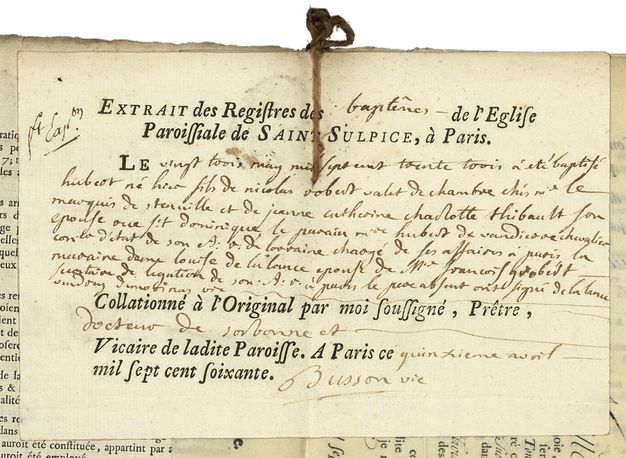
Recording details about his family, his social background, and the urban neighborhood in which he was born, Robert’s baptism certificate tells us, quite directly, who this artist was and where he came from before he became an artist. We discover that Robert was born on 22 May 1733 and was baptized the next day, following the convention of baptizing babies as soon as possible after birth (sometimes even later the same day), in order to reduce the likelihood of the infant dying without receiving the sacrament. We also meet Robert’s parents—his mother, Jeanne-Catherine-Charlotte Thibault, and his father Nicolas Robert—and learn that the latter was in the service of a noble household, as valet de chambre to François-Joseph de Choiseul, marquis de Stainville, a courtier to the dukes of Lorraine.1 This, we find, was the social milieu into which Robert was born, for both his godparents were in the service of the Paris household of the duke of Lorraine, François III (who would later become Holy Roman Emperor). Robert’s godfather, Hubert de Venvières, was chevalier conseiller d’État to the duke, and his godmother was Louise de La Lance, wife of François Gobert, the duke’s secrétaire de légation. Robert’s godparents thus offered an elite social network for their charge, but his godfather specifically had a more immediate role in shaping the infant’s identity. Robert was christened Hubert following the custom of naming the child after the godparent of the same gender (a custom that, for instance, saw the painter Hyacinthe Collin de Vermont named after his godfather and future colleague Hyacinthe Rigaud). Finally, we also encounter some of the urban spaces in which Robert began his life. The family address is recorded as Rue Saint-Dominique, a street running parallel to the Seine on Paris’s Left Bank, starting near the abbey of Saint-Germain-des-Prés and ending near Les Invalides. This street was located in the parish of Saint-Sulpice, which, as the certificate states, was the church in which Robert was baptized and where this telling piece of paper was produced.
Robert’s baptism certificate is thus a treasure trove of personal details for the biographer, but at the time, its significance lay more in its value as a material vestige of a religious rite and as an important legal document. Baptism is the first of the Catholic Church’s seven sacraments, those outward and visible signs of God’s grace that sanctify the faithful. According to the tenets of that faith, as elaborated in eighteenth-century catechisms, the rite of baptism served to wash away original sin, allowing for rebirth through Christ, and making the recipient a child of God and the Church.2 It was, in other words, the sacrament by which one was initiated into the Christian faith and without which one would be denied eternal salvation. An acte de baptême was proof that the sacrament had been received, a record that Robert had been held at the font by his godparents while a priest had enacted this solemn rite to make him a child of God. Yet as was often the case in ancien régime society, where lay laws and customs were structured around religious beliefs and practices, the sacrament of baptism also had a legal dimension. A baptism certificate might seem a fundamentally religious thing—a material trace of a sacrament, signed by a priest and issued by a parish church—but it was as much, if not more, or inextricably both, a legal document, serving to register the birth and record the existence of a new member of society.
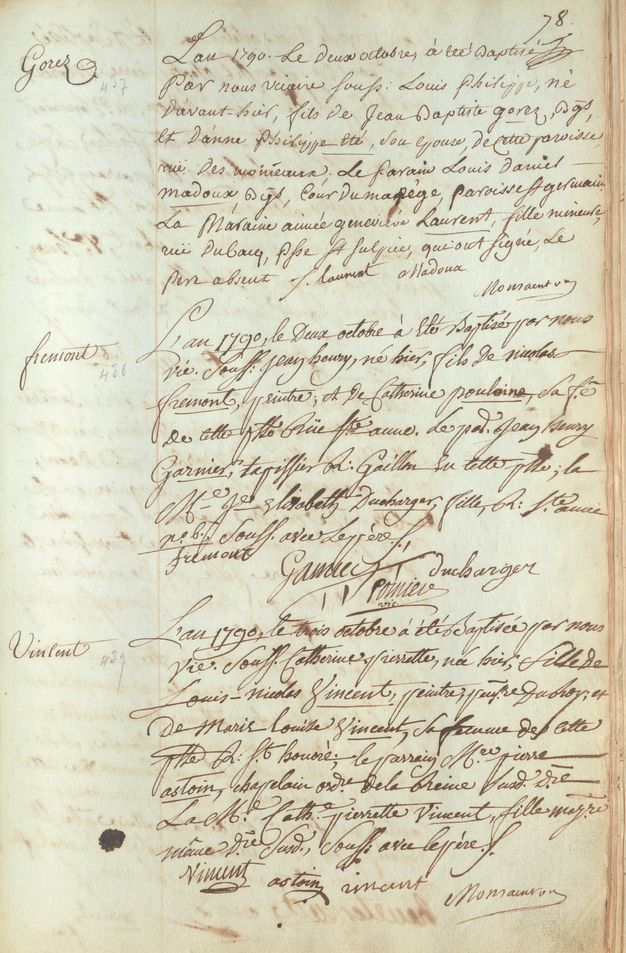
For the most part, this legal registering of baptisms actually took a different material form. Unlike Robert, most people did not own a certificate, but rather simply had the record of their baptism written into the baptismal register of their parish church. While the vast majority of Paris’s eighteenth-century parish registers were sadly destroyed in the nineteenth century, a rare volume remains from the church of Saint-Roch (fig. 8).3 Covering the year 1790, the ledger offers a sense of the materiality of these records, in which each baptism was entered by the priest who performed the rite—usually the curé (parish priest) or the vicaire (curate)—and signed beneath by the parents and godparents after the service. On page 78, for instance, we find three entries, two of them children of painters—Jean-Henry, son of Nicolas Frémont; and Catherine-Pierrette, daughter of Louis-Nicolas Vincent—their surnames written in the left margin for ease of retrieval.4 Such communal ledgers (listing all children, born of painters, nobles, and servants alike) were the standard material records of baptisms. But on occasion, proof was needed in a more mobile form. As Robert’s certificate states at the top, this was an “extrait des registres” (an extract from the registers) of Saint-Sulpice, that is, a transposition of Robert’s entry in the ledger to create a readily transportable individualized version. From the text printed on the certificate, it is also clear that it was an adaptable pro forma, allowing the vicaire to supply details from any of the parish’s registers (baptisms, marriages, or funerals) as and when required.
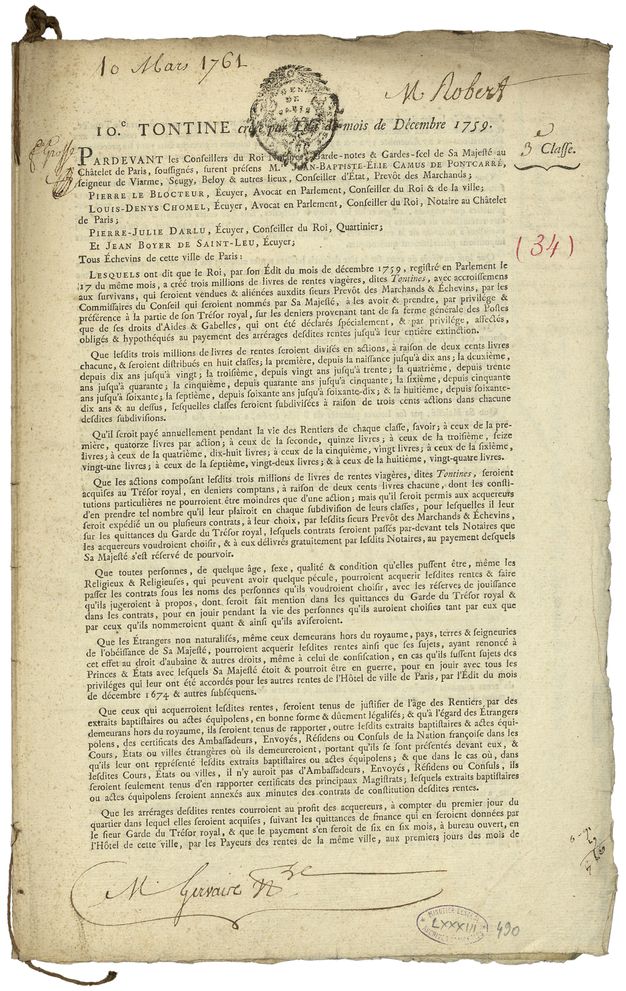
Robert’s requirements for a baptism certificate occurred, as the document reveals in its issue date, on 15 April 1760, about a month before his twenty-seventh birthday. As a material thing, Robert’s baptism certificate thus has little connection with his actual baptism. The document was produced nearly three decades after the sacrament was administered, by a priest who performed no role in the rite. Its current location (in the Archives Nationales) reveals why it was sought in the first place, for it is to be found attached with a piece of notary’s string to a contract outlining a tontine (fig. 9).5 This was an early modern speculative investment scheme in which subscribers would pay an initial amount and then receive a life income via an annuity. Participants in the tontine were divided into age groups, and over time, as others died, shares were redistributed to surviving members, leaving the last one standing as the recipient of a substantial fortune.6 Hubert Robert was a pensionnaire at the Académie de France in Rome when this tontine was drawn up, but his share was purchased by his father, Nicolas, who seems to have made this investment in his son’s favor as a paternal gesture to assure a financial income for the young painter.7 Nicolas paid 1,000 livres in order for Hubert to receive a rente viagère (life annuity) with a principal of 80 livres plus interest, which, for a twenty-six-year-old man with a normal life expectancy, would have looked like a secure and profitable investment. Given the importance of age to a tontine, baptism certificates were required to provide proof of a participant’s date of birth.8 Thus, on the final page of the contract, the notary confirmed that the extract from the baptismal register of Saint-Sulpice had been supplied; a note was added to the back of that certificate indicating that it had been “certifié véritable” (certified as true); and the small piece of paper was tied in perpetuity to this financial deal.
Through the baptism certificate’s passage from parish register to investment contract we not only encounter two distinct moments of Robert’s life—the infant of 1733 and the young artist of 1760—we also find a connection between the seemingly disparate spaces of religion and finance. Given the moral qualms about speculative financial ventures, especially for a scheme in which participants benefited from the deaths of others, one might envisage an uncomfortable discord between what this piece of paper represented and how it was used: that is, between the holy sacrament that turned Hubert Robert into a child of God, and the worldly business deal that brought him fiscal return. Yet this document proffers a material trace of the more symbiotic relationships between religion, law, and finance that existed in the lived experience of eighteenth-century France. ‡
-
Though not mentioned on the certificate, Robert’s mother was also in service in the marquis’s household as a femme de chambre. See Hubert Robert, 1733–1808: Un peintre visionnaire, exh. cat. (Paris: Musée du Louvre, 2016), 29. ↩︎
-
Catéchisme, ou exposition de la doctrine chrétienne (Soissons: Ponce Courtons, 1756), 197–203. ↩︎
-
Copies of Paris’s parish registers were kept in the Tuileries Palace and were destroyed in 1871, when the building was burned during the Paris Commune. ↩︎
-
Neither painter was ever admitted to the guild (which was disbanded in 1776) or the Académie, but Louis-Nicolas Vincent exhibited works at the Académie’s open Salon of 1791: Collection des livrets des anciennes expositions depuis 1673 jusqu’en 1800 (Paris: Liepmannssohn, 1870), 20, 32. ↩︎
-
AN, MC/ET/LXXXIII/490. ↩︎
-
John Dunkley, “Bourbons on the Rocks: Tontines and Early Public Lotteries in France,” ECS 30, no. 3 (2007): 311. See also David R. Weir, “Tontines, Public Finance, and Revolution in France and England, 1688–1789,” Journal of Economic History 49, no. 1 (1989): 95–124. ↩︎
-
Robert was in Rome from 1754 to 1765. ↩︎
-
Dunkley, “Bourbons,” 312. ↩︎