Écorché
- Jean-Antoine Houdon (1741–1828)
Houdon’s écorché is a thing with many stories, not least because the thing known as “Houdon’s écorché” is actually many things existing in many forms.1 This anatomical of a flayed human figure exists in two distinct versions: one with arm extended, one with arm raised. Both versions exist in life-size and reduced-scale formats. Each version and format were executed in different materials, mostly plaster or bronze, but also terracotta. And the dates of production extend from 1767 right into the nineteenth century, with Houdon producing numerous casts throughout his life, and copies continuing to be made after his death in 1828. In fact, versions of Houdon’s écorché are still being sold today, such is its enduring appeal as an aesthetic object and its value as an educational tool for artists: the two qualities for which it was prized from the very moment of its creation.2
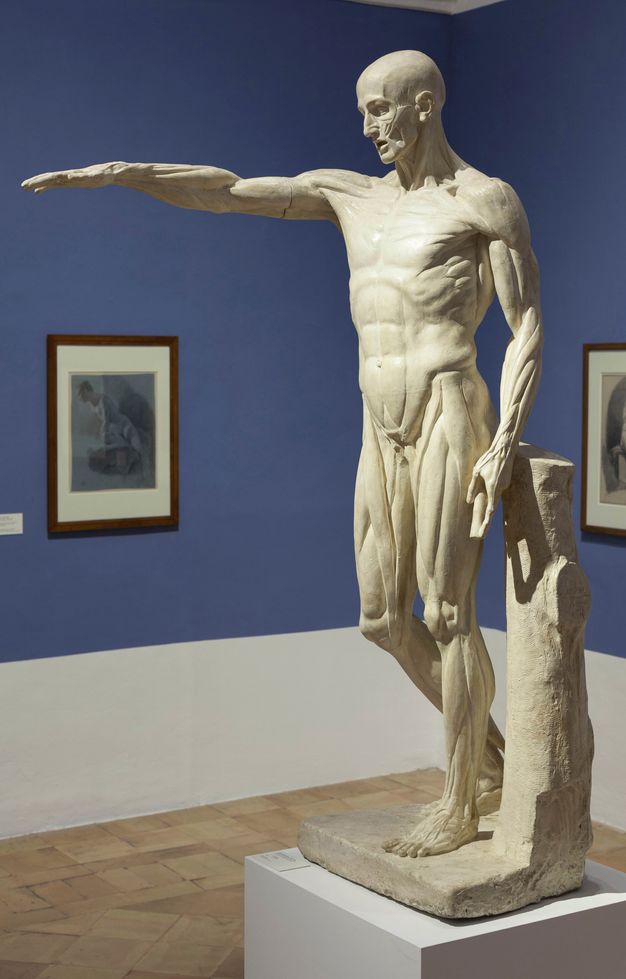
The écorché’s story begins in the 1760s in Rome, where it was created almost by accident. At the age of twenty-three, having won the Académie’s grand prix for sculpture, Houdon traveled to Italy to complete his training at the Rome branch of the institution (then in the Palazzo Mancini).3 Embarking on the life of a pensionnaire, Houdon spent his days attending drawing classes, copying great works of art, and creating his own. He was also one of only two students in his cohort who took anatomy classes, setting out at dawn with his colleague, Johann Christian von Mannlich, for the hospital of Saint-Louis-des-Français, where the professor of surgery, Monsieur Séguier, taught them human anatomy by dissecting fresh cadavers.4 It was amid these encounters with corpses that Houdon’s first écorché (fig. 51) began to take shape. At the time, he was working on a sculpture of Saint John the Baptist and, according to Mannlich, “had the idea to make the model in clay, first in the form of an écorché, and each day used our anatomy lessons . . . to make a thorough study of the muscular system.”5 The young sculptor’s experimental plan was to create a life-size model for his sculpture, building it up from the inside out, to produce an anatomically correct figure.6
Houdon’s teachers and fellow students in Rome were so struck by the model that they encouraged him to take a mold of the skinless body before making any further additions, and this incidental object became the first version of the écorché. Its extended-arm pose was thus not chosen for any scientific reason, but rather determined by the baptizing gesture of the saint. Charles Natoire, the Rome Académie’s director at the time, was so taken with Houdon’s anatomical model that he requested a plaster cast for the school, declaring that the squelette (skeleton) would be an invaluable tool for instructing students.7 Houdon obliged, and the cast remains at the Rome Académie today (now in the Villa Medici) (see fig. 51). Perhaps the most intriguing point to note from the écorché’s origins (other than the fact that Natoire clearly did not have a word for it, calling it a “skeleton” despite the complete absence of any bones) is that this object, which would go on to become such a fundamental tool in academic teaching, was made neither as a tool nor by a teacher. Rather, it was made by a student and began life as the experimental preparatory stage of an artwork. The écorché’s accidental making and enthusiastic reception also reveal a great deal about the role of anatomy in art education at this moment. Indeed, it is telling that when Houdon took his Roman anatomy classes, he was very much in the minority. But less than a decade later, anatomy had become a compulsory part of the pensionnaire curriculum, in part thanks to Houdon’s écorché. When Joseph-Marie Vien, as the new director, rewrote the school’s regulations in 1775, anatomy classes were fixed in the rules, and so too was their principal object of instruction: “Article 2: Among the studies that student painters and sculptors must follow in Rome are anatomy and perspective. . . . Anatomy will be taught using the écorché that M. Houdon made for the Académie.”8
Back in Paris, anatomy had been nominally part of the Académie’s curriculum since its founding in 1648, with a professor of anatomy employed especially for the purpose. Nearly always a surgeon (with the exception of the history painter Jacques-Antoine Friquet de Vauroze), these medical men were something of an incursion of science into the arts.9 This was evident in the things they used to teach, which included an actual human skeleton, casts of body parts taken from skinned cadavers, and medical treatises.10 While anatomical knowledge was generally accepted as an important skill for history painters and sculptors, science and art did not coexist without friction. There was a disconnect between the surgeons’ interest in the human body (a pathologized machine to be healed) and the artists’ interest in the human form (an aesthetic object to be represented). Houdon understood this disjunction implicitly, as he explained in a letter written in 1772, a few years after his return to Paris: “Surgeons, as skilled as they may be, are not draftsmen, and draftsmen are not surgeons. In my view, the skilled surgeon must study nature, as defective as one may find it, in order to be able to treat every infirmity. But we must study it differently. It is nature in all her nobility, her perfect state of health, that we are seeking.”11
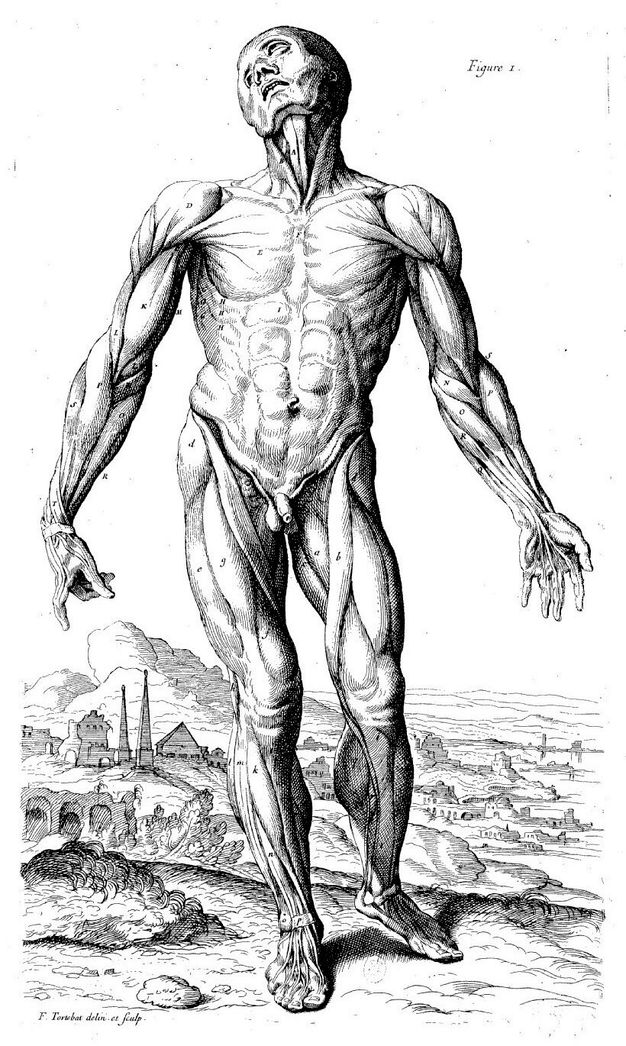
Houdon was not the first to articulate this problem, and his écorché was not the first attempt at a solution.12 Already a hundred years earlier, Roger de Piles and François Tortebat had produced their Abrégé d’anatomie accommodé aux arts de peinture et de sculpture (1667). Made in the tradition of Vesalius, this was a medical textbook for artists, complete with straightforward tables and illustrative engravings of skinless bodies set incongruously in Italianate landscapes (fig. 52).13 According to de Piles, its intention was to provide the detailed knowledge of the body required by artists, without the “infinity of useless things” that normally cluttered medical books.14 Yet despite such efforts to tailor anatomy for artists, there remained an ambivalence in the early eighteenth century.15 Scientific interests in observing the human body still seemed anathema to the aesthetic goals of perfecting the human form. In the second half of the century, however, anatomy made an academic comeback.
Soon after his return to Paris, in August 1769, Houdon presented himself at the Académie for his agrément (provisional admission).16 That he included the écorché in his portfolio of works for this ritual examination suggests the extent to which Houdon considered it an aesthetic achievement, given that artistic skill and quality were the key criteria for acceptance. But that a month later, the sculptor offered to donate a plaster cast of the écorché to the Académie, “as it might be of use to the students,” also suggests the educational value he attached to his model.17 For the Académie’s part, Houdon’s gift came at the right moment. After decades of dwindling interest and even resistance, anatomical study was having a resurgence under the new professor of anatomy, the surgeon Jean-Joseph Sue, who had devised a bespoke curriculum for his artistic students.18 Combined with the shifting stylistic approach to the human body emerging with the neoclassical revival in the 1760s, the climate of reception for Houdon’s écorché was ideal.19
This was entirely different from the lack of fanfare that had greeted an earlier écorché by Edme Bouchardon in 1741 (fig. 53), when the Académie had been at its most resistant to anatomical study. But Houdon’s success and Bouchardon’s lack of it were also due to the defining differences between these objects, whatever their superficial similarities. Bouchardon’s écorché was a cast taken directly from a cadaver. Houdon’s, meanwhile, was a cast taken from a clay model that was made by observing cadavers. The distinction was crucial. Both sculptors took actual human bodies as their source, but only Houdon had that vital artistic remove from nature, which allowed him to bridge the problematic divide between art and science. Houdon’s écorché was not an index of an imperfect real body (like Bouchardon’s), nor an artistic scientific diagram (like Tortebat’s), but rather an anatomical sculpture. This was not the natural anatomy of a single dead man, but an art-made muscular system, derived from numerous bodies to create a universally ideal form. Like the Doryphoros or the Apollo Belvedere, Houdon’s écorché was an invention of bodily perfection, just in this case, it was a perfection of the corporeality beneath the skin.
Simultaneously tool and artwork, the écorché’s distinctive scientific and artistic qualities gave it broad appeal. By the 1770s plaster copies had been acquired not only by the Paris and Rome academies, but also by those of Toulouse, Bordeaux, and Flanders. At the same time, it was beginning a life beyond institutional bounds, becoming a sought-after object of curiosity at foreign courts in Poland, Parma, Russia, and Gotha.20 Its appeal was so great that Houdon’s fellow academicians soon wanted copies for themselves. But a life-size sculpture is a difficult thing to accommodate in most domestic spaces, so Houdon was encouraged by his colleagues to create smaller copies that would be both “less expensive” and “more convenient” for individual ownership.21 In its new reduced format, Houdon’s écorché became an object for personal use, to be found standing on the desks of amateurs, residing on the shelves of collectors, and taking on practical roles in artists’ studios, as a tool to be used alongside live models and to guide the composition of human forms.22
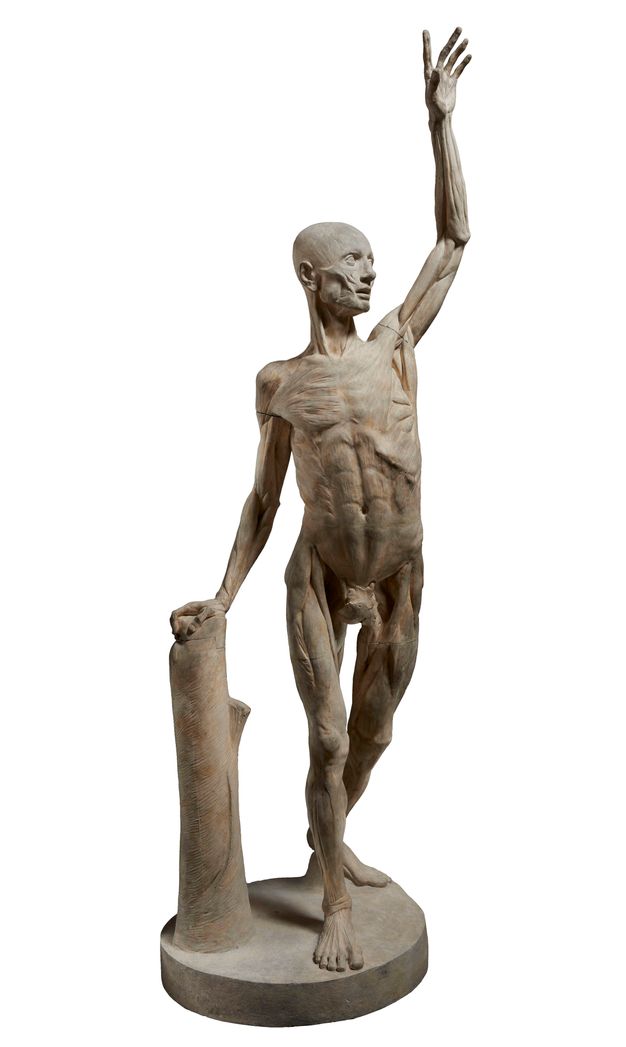
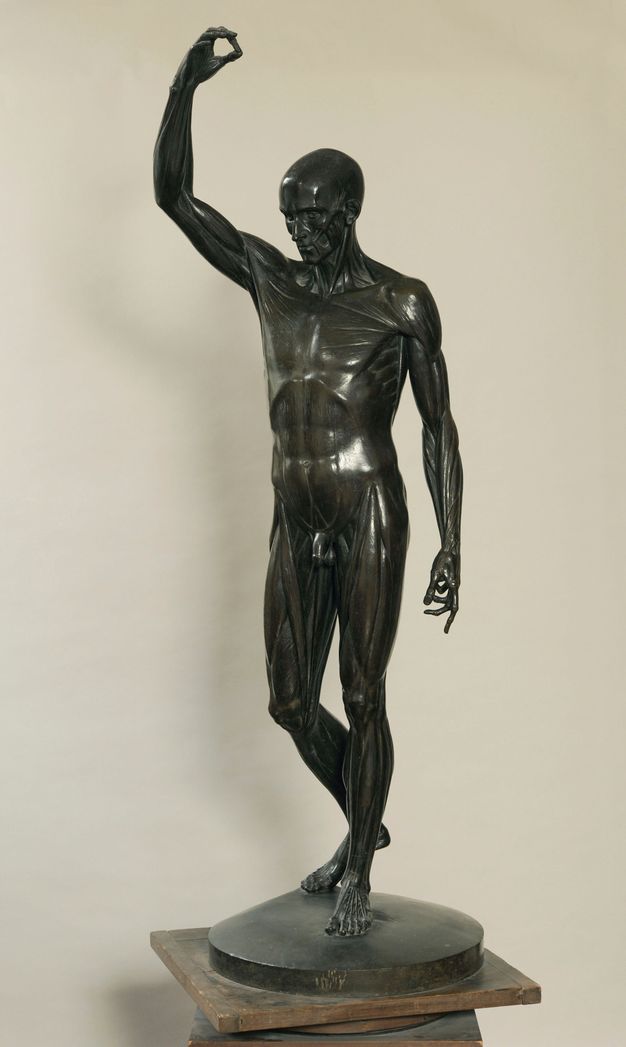
With increasing demand and expanding production in the 1770s, Houdon created his second version of the écorché: its right arm raised overhead, thumb and finger pressed together, and mouth closed (fig. 54). The sculptor never recorded a definitive explanation for the changed pose, but it was likely in pursuit of both scientific value and economic potential. Unlike the first version, originating as a study for a specific artwork, the second was an anatomical model from the outset. Free of compositional constraint, the new pose demonstrated a more complete range of muscle movement across the body, from fully flexed to entirely relaxed. On the practical front, it was also more compact and less vulnerable to accidental breakages, crucial for the friable plaster versions, and more straightforward to fire in bronze. As bronze casts could travel more easily, while also attracting a higher price, the second écorché thus greatly increased the potential for circulation and commercial revenue.
Over time, Houdon certainly found ingenious ways to profit from his écorché’s success. In 1790 he announced that he wanted to donate a new écorché to the Académie so the school could possess one in each pose.23 Casting a life-size version in bronze was a tricky business, so when the planning was complete, he decided to turn the firing into a promotional gathering. The event was by invitation only, with those lucky enough to receive billets (tickets) making their way on a Sunday evening out to Houdon’s studio and foundry at the Roule, on Rue du Faubourg Saint-Honoré.24 One attendee declared that the crowds were so intense that “truth be told, one could not see much of the founding at all,” but no matter, for there was other entertainment.25 Upon arrival, Paris’s high society was met with a vast room where Houdon had installed an exhibition of his sculptures, all lit strikingly from above. It seems this one-man showcase was the real purpose of the event, with the écorché merely serving as headline act to fill the house.
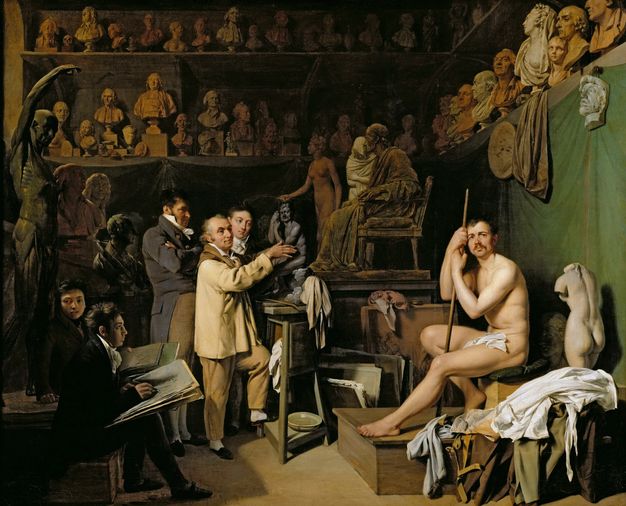
Houdon’s écorché survived its firing, and the sculptor eventually presented one to the Académie in 1792 (see fig. 54).26 It is this life-size bronze incarnation that is most associated with Houdon’s mature years, not least due to its appearances in Louis-Léopold Boilly’s well-known paintings of Houdon’s studio from the early 1800s (see fig. 113). Like the , the écorché becomes a ubiquitous resident of Houdon’s studio in these interiors. But unlike the modeling stand, which is resolutely used—a piece of furniture with utilitarian functionality (like Fragonard’s ), rather than aesthetic value (like David’s )—the écorché remains decisively both. As tool and artwork, it is as much part of the artist’s paraphernalia strewn about the studio (at home with the portfolios, rags, saucers of water, and modeling tools), as it is one of the many sculptures displayed around the room. For an object that gained its reputation precisely because of its ability to inhabit the roles of both tool and artwork, the sculptor’s studio was perhaps its most natural habitat. Notwithstanding all the places that Houdon’s écorchés ended up, this was where it deployed itself most authentically, just as it does in Boilly’s vision. Looming to the left, it bookends the scene, becoming the art-made instrument that oversees the sculptor’s work, its commanding gesture conducting the artistic endeavors undertaken in this space. ‡
-
For comprehensive examinations of the two versions and their associated works, see Anne L. Poulet’s entries in Jean-Antoine Houdon, Sculptor of the Enlightenment, exh. cat. (Washington: National Gallery of Art; Los Angeles: J. Paul Getty Museum; and Musée National du Château de Versailles, 2004), 63–71. ↩︎
-
An updated version of Houdon’s original écorché is, for instance, sold by the Eaton London sculpture studio. ↩︎
-
Houdon won the prize in 1761 but did not travel until 1764. PV, 7:175. ↩︎
-
Histoire de ma vie: Mémoires de Johann Christian von Mannlich (1741–1822), ed. Karl-Heinz Bender et Hermann Kleber, 2 vols. (Trier: Spee, 1989–93), 1:260, cited in Jean-Antoine Houdon, 63. ↩︎
-
Histoire de ma vie, 1:260, cited in Jean-Antoine Houdon, 63. ↩︎
-
On the écorché’s origins, see Louis Réau and Pierre Vallery-Radot, “Les deux écorchés de Houdon,” Æsculape 28, no. 1 (January 1938): 174–76. ↩︎
-
Charles Natoire to the marquis de Marigny, 18 February 1767, in CDR, 12:140. ↩︎
-
“Règlements qui doivent être observes par les pensionnaires de l’Académie de France à Rome” (1775), in CDR, 13:158. ↩︎
-
A contrast to the professor of perspective, who was usually an artist (e.g., Abraham Bosse, Michel-Ange Challe, Sébastien Leclerc, Pierre-Antoine Demachy). ↩︎
-
Anatole de Montaiglon, ed., Mémoires pour servir à l’histoire de l’Académie royale de peinture et de sculpture depuis 1648 jusqu’en 1664 (Paris: P. Jannet, 1853), 1:56; and Philippe Comar, “Une leçon d’anatomie à l’École des Beaux-Arts,” Une leçon d’anatomie: Figures du corps à l’École des Beaux-Arts, exh. cat. (Paris: ENSBA, 2008–9), 19. ↩︎
-
“État des choses renfermées dans les caisses envoyées à son Altesse Monseigneur le duc de Saxe-Gotha,” July 1772, cited in Jean-Antoine Houdon, 356. ↩︎
-
See Mechthild Fend, Fleshing Out Surfaces: Skin in French Art and Medicine, 1650–1850 (Manchester: Manchester University Press, 2017), especially 193–234. ↩︎
-
Andreas Vesalius, De humani corporis fabrica (n.p., 1555). ↩︎
-
Roger de Piles, “Préface,” Abrégé d’anatomie accommodé aux arts de peinture et de sculpture (Paris: Jombert, 1765), i. ↩︎
-
In 1737, the professorship in anatomy was actually defunded and made into a nominal post. Comar, “Une leçon,” 21. ↩︎
-
Houdon returned to Paris in 1768. He was agréé (provisionally admitted) at the Académie on 23 August 1769, in the same meeting as Jean-Baptiste Greuze’s infamous réception. PV, 8:19. ↩︎
-
30 September 1769. PV, 8:24. ↩︎
-
The Académie approved Sue’s classes, but set conditions for entry. Before enrolling, students had to pass a life drawing test. PV, 6:43–44. ↩︎
-
In 1764 the comte de Caylus even proposed a slightly bizarre new Osteology Prize, with students competing to draw the best skeleton in “an interesting attitude.” The prize did not really take off. PV, 7:249. ↩︎
-
Jean-Antoine Houdon, 13 February 1776. Bibliothèque Municipal de Versailles, F946, no. 229, cited in Jean-Antoine Houdon, 64. ↩︎
-
Houdon, 13 February 1776, cited in Jean-Antoine Houdon, 65. ↩︎
-
Reduced-scale versions of Houdon’s écorché can be seen in paintings like Guillaume Voiriot’s Portrait of Jean-Joseph Sue (1789, Châteaux de Versailles et de Trianon) and Louis-Léopold Boilly’s A Painter’s Studio (ca. 1800, Washington, National Gallery of Art). ↩︎
-
PV, 10:58, 187. ↩︎
-
Geneviève Bresc-Bautier, “Fonderie et ateliers du Roule,” La Rue du Faubourg Saint-Honoré (Paris: 1994), 373. ↩︎
-
Gerhard Anton Von Halem, Blicke auf einen Theil Deutschlands, der Schweiz und Frankreichs bey einer Reise vom Jahre 1790 (Hamburg: Carl Ernst Bohn: 1791), 1:84. ↩︎
-
PV, 10:187. ↩︎