Lantern
- Jean-Siméon Chardin (1699–1779)
- Charles-Nicolas Cochin (1715–90)
- Claude-François Desportes (1695–1774)
- Pierre-André Jacquemin (1720–73)
- Jean-Baptiste Lemoyne (1704–78)
- Jean-Baptiste Pigalle (1714–85)
- Claude-Joseph Vernet (1714–89)
- Joseph-Marie Vien (1716–1809)
The lantern is exceptional in this book. A utensil, to paraphrase the Dictionnaire de l’Académie française (1762), made of glass, horn, oilcloth, or other translucent material to protect the flame of an enclosed tallow or wax candle from the wind and rain, the lantern was generally thought to be a public utility for outdoor use in the eighteenth century, not a personal thing privately owned.1 These particular lanterns were ones used to light the public or semipublic passageways between artists’ logements (lodgings) at the Louvre. They belonged, insofar as the cost of fueling and maintaining them was borne collectively, to the group of artists granted rights of residency at the Louvre by royal patent (brevet) and listed above. The lanterns count as “artists’ things” because they served, on the one hand, to create an internal sense of community and personal belonging, distinguishing brevetaires from the master craftsmen of the town, and on the other, as an instrument of internal discipline.
Bought from glaziers and supplied with fuel by chandlers, lanterns generally fall below the threshold of notice in personal records and communication. Notaries did not itemize and value stocks of candles. Candles were classed for the purposes of probate with perishable goods like food, and not stores or supplies like wood or coal.2 Lanterns went largely unnoticed, too, in diaries and letters. They are, in short, difficult to connect historically to particular persons. Those at the Louvre become visible and knowable only because in November 1769 a number of unnamed artists at the palace threatened not to pay the dues collected annually at New Year to cover the cost of keeping the lanterns in good repair and supplied with the wicks and fuel needed to light them.3 This mini rebellion, which pitted the interests and concerns of the community of brevetaires against those of particular individuals, prompted the sculptor Jean-Baptiste Lemoyne to write to the directeur des bâtiments du roi, the marquis de Marigny, forwarding a petition signed by fellow sculptor Jean-Baptiste Pigalle; the painters Jean-Siméon Chardin, Claude-François Desportes, Joseph-Marie Vien, and Claude-Joseph Vernet; the draftsman and printmaker Charles-Nicolas Cochin; and the king’s jeweler, Pierre-André Jacquemin, and to ask him to intervene in the matter.4
The petitioners justified their case principally on grounds of custom. The public passages had, they said, always been lit at night. “Decency requires it, and the good of all is united in it.”5 The Louvre was a community as well as a legally protected enclave. The king’s artists living there were, by an act of Henri IV in 1608, distinguished from the city’s ordinary painters and sculptors by privileges that included the freedom to practice their arts without let or hindrance from the Paris guilds and by exemptions from certain municipal taxes and duties, including taxes levied to pay for the lighting and cleaning of the city’s streets.6 At one level the passageway lanterns represented a sign of exceptionalism: royal lighting, we might say, as opposed to city lights. At another level, and more importantly, the practice of lighting the passages played a part in fostering and sustaining a sense and style of community among the denizens of the Louvre.
Though not mentioned directly in the memorandum, the circumstances of the Desportes household was a likely factor in the affair. At the time of writing, Mme Desportes, wife of still-life painter Claude-François Desportes, was responsible for collecting the lantern dues.7 Lemoyne alludes to the desire to spare her humiliation. Claude-François was the son of the “great” Alexandre-François Desportes, painter of Louis XIV’s hunts. He had inherited his father’s logement in 1743 and continued to perpetuate the family business in animal and still-life painting as best he could but without his father’s flair.8 Claude-François was keen, it seems, to preserve his wife’s income from lantern tending. His warm commendation of his mother’s contribution in her time to the domestic economy—she had worked as a linen draper and lace seller to afford his father the leisure to perfect his studies after nature—suggests he actively approved his wife’s occupation.9
Care and supply of lanterns at the Louvre represented unofficially, one could say, an office, a poor relation of the governor of Versailles’s office to supply the grands appartements with beeswax candles or equivalent in the visual arts to the posts of keeper of the king’s cabinet and drawing master to the royal household; less distinguished and less remunerative certainly, but significant nevertheless to the modest artist’s income.10 That the community at the Louvre took action in part to support its more vulnerable members is strongly suggested by the fact that most of the signatories of the lantern petition, signed another in 1774 to second Nicolas Desportes’s begging request to Marigny to be allowed keep the family logement after his cousin Claude-François’s death.11 Nicolas Desportes had lived with and worked for, first, Alexandre-François, his uncle, and then Claude-François; the logement had been his only home and its free accommodation was crucial to his prospects of supporting himself independently by painting.12 “The good of all” highlighted in the lantern petition entailed safeguarding the little jobs, like the tending of lanterns, in order to keep modest artistic livelihoods afloat in precarious times, and the corps at the Louvre united.
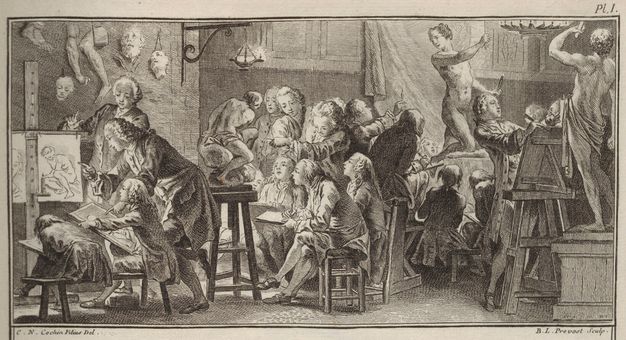
More obviously, of course, the lanterns lit the communal areas of the Louvre. The kind of lanterns used is not made clear in the memorandum. Not lanterns with wax candles certainly. Candles made of beeswax were prohibitively expensive.13 More likely, they would have been either oil lamps, that is, an enclosed ceiling version of the one depicted by Cochin at the Académie’s drawing school (fig. 93), the reservoir for oil plain to see, or lanterns supplied with tallow candles. Either could have provided, more or less unattended, a source of continuous light for between five and a half to twelve hours, or from dusk to dawn, according to the season.14
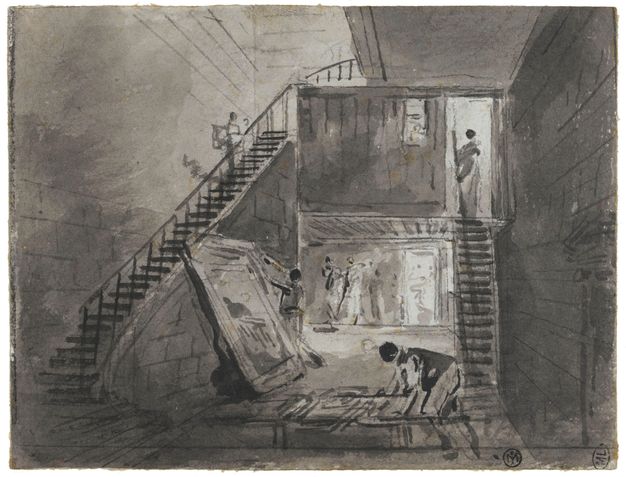
The light shed would not have been as intense as that afforded by wax candles, but it was sufficient to vouchsafe “decency” in what the petitioners called their “gallery,” the passage connecting the logements at mezzanine level. By “décence” they meant that “exterior” or public expression of polite bearing appropriate to spaces of prestige.15 By naming the mezzanine passageway the “small gallery,” they implicitly invited comparison of it to the celebrated Grande Galerie above, and invoked an interior space of habitation and belonging as well as of convenient transit.16 In this passage-cum-gallery, the private space of individual studios and the public space of the palace and the greater world beyond collided. Hubert Robert’s gray-washed black-chalk drawing of a corridor (fig. 94), once thought to represent the entrance to his studio, affords a vivid picture of the flows in and out of this transitional space: pictures being moved out from studios or stores, a woman poised on the threshold of the private, about to step in. In the depths, a group of loiterers take up residence. Light reaches the space from a distance, through contiguous spaces. Momentarily brightened by the opening of a door, its natural state is half shadow even in the daylight hours.
According to the Bâtiments’ archives, the propriety of the passages at the Louvre was regularly under threat. In December 1777, the cleanliness, rather than the lighting, of the passages led to the intervention of the comte d’Angiviller, Marigny’s successor as director, into the trivialities of the everyday.17 The now so-called corridors were supposed to be swept once every two weeks and sprinkled with water to settle the dust, but notwithstanding the conscientiousness of the cleaner, the place was, reported Jean-Baptiste-Marie Pierre, the king’s first painter, unacceptably filthy.18 D’Angiviller took up the matter with Barthouil, Inspecteur du Louvre, from whom he learned that art students habitually used the corridors as latrines and, moreover, that when Barthouil had instructed the Swiss guard to stop them defecating, he had been treated to a generous portion of their wastes on his doorstep in retaliation.19 Lighting was an important weapon in repressing such behavior. If it did not shame the student cohort, it did enable the identification of individual culprits.20
Tensions arose not only between young and old for definition of the culture of the public space at the Louvre—wild or civilized, dark or light—but also between bachelors and married academicians. D’Angiviller touched on the inconveniences caused by absent single artists, because there was no wife to open the door to receive messages, no one to answer for and to them.21 This suggests that bachelor households were potentially dangerous to order and decency too. Were bachelors perhaps the ones who threated not to pay the lantern charge? It is a point to note that the majority of the signatories of the petition were married men: Chardin, Desportes, Lemoyne, Pigalle, Vernet, and Vien. That the Louvre was no place for a woman is intimated by the case of Anne Vallayer-Coster, the only woman artist to have been granted a logement at the galerie du Louvre, a grace she appears to have hesitated in accepting.22 When in April 1779 she came for a site visit to inspect the rooms that d’Angiviller had assigned her and to establish whether she could in fact live there “honorably” and “comfortably,” she came “in the greatest . . . incognito” that a large “calèche bonnet” could afford, one so profound, according to the architect Maximilian Brébion, not a little impressed, that it “left the curious in some doubt as to whether the wearer possessed a face at all.”23 The passage-cum-gallery ideal that Lemoyne and company were bent upon preserving as a reality in 1769 was one in which riotous and sometimes rebellious masculinity was tamed by lantern light, and women like Mme Desportes and Vallayer-Coster were free to circulate and pursue their domestic and working lives without cover and without risking mockery and shame.
The later context of the Bâtiments’ role under d’Angiviller in disciplining behavior at the Louvre could suggest, reading back, that the lanterns of 1769 were in practice Marigny’s things, though they belonged to Lemoyne and his logement neighbors. Marigny’s regime was notably less oppressive that d’Angiviller’s. Even so, the petitioners’ concern for decency certainly suggests that the artists at the Louvre were subjects of what Michel Foucault has called “biopower,” unconsciously internalizing norms of behavior and self-control useful to the state and which, by use of lanterns, they themselves intended to perpetuate.24 Yet their attachment to the lanterns exceeded the merely instrumental. In calling the mezzanine corridor a “gallery” and by invoking custom, their petition indicates that they valued lantern light also for its symbolic meaning. It styled their manner of existence “privileged” in contrast to the artisanal neighborhoods of Paris, where lanterns oriented passage at night rather than illuminating it.25 Privilege lived entailed responsibilities as well as representation. The Louvre artists, the petition has suggested, were a community conscious of its interdependence. Defending the custom of lighting was also defending the right of the lesser artists to little jobs. It articulated a concern to mitigate the social and cultural differences within privilege between the haves and the have-nots, between students and elders, between men and women, between bachelors and married men, and ensure thereby the better security for all. If we would be mistaken in raising the coincidental connection here between lanterns, light, and social solidarity to the metaphorical level of Enlightenment it is, perhaps, no coincidence that the phalanstery imagined by Charles Fourier and other utopians in the nineteenth century was informed, as Roger Luckhurst has recently shown, by the “corridic” (his word) spaces of the Louvre and other royal palaces.26 The collectively owned lantern in the public corridor embodies a different strand of modernity’s myth of artistic genius, one rooted not in the isolated individual studio but in community, and manifest in such housing projects as La Ruche, the artist community established by the sculptor Alfred Boucher at Montparnasse in the wake of the Great Exhibition of 1900, and which is still home to around fifty artists today. §
-
Dictionnaire de l’Académie française 4th ed. (Paris: Brunet, 1762), 2: s.v. “Lanterne.” ↩︎
-
The point is more fully made by Stephane Castelluccio in L’Éclairage, le chauffage, et l’eau au XVIIe et XVIIIe siècles (Montreuil: Gourcuff gradenigo, 2016), 34. ↩︎
-
It is unclear whether Mme Desportes actually lit the lanterns or simply administered their use. The Swiss guard was responsible for the public spaces of the Louvre. ↩︎
-
Jean-Baptiste Lemoyne to the marquis de Marigny, 4 November 1769. AN, O1/1673/152. ↩︎
-
Jean-Siméon Chardin, Charles-Nicolas Cochin, Pierre-André Jacquemin, Jean-Baptiste Lemoyne, Jean-Baptise Pigalle, Claude-Joseph Vernet, and Joseph-Marie Vien, “Memorandum,” AN, O1/1673/153. ↩︎
-
For the letters patent of Henri IV (1608), confirmed and elaborated by Louis XIV (1673), see Jules-Joseph Guiffrey, “Logements d’artistes au Louvre,” NAAF, 1873, 40, 73. On the logements more generally, see Yvonne Singer-Lecocq, Un Louvre inconnu: Quand l’état logeait ses artistes, 1608–1806 (Paris: Perrin, 1986); and Elena Palacios Carral, “The Freelancer: The Individuation of the Artist’s Work in Paris, 1608–1805,” AA Files 77 (2020): 103–12. ↩︎
-
Mme Desportes is identified in Claude-Joseph Vernet’s accounts as the person in charge of the lanterns. See Léon Lagrange, Joseph Vernet et la peinture du XVIIIe siècle (Paris: Didier, 1864). ↩︎
-
Claude François had moved in with his father in 1739. ↩︎
-
See Claude-François Desportes, “Vie de M. Desportes, peintre d’animaux” (1748) in Mémoires inédits, 2: 101. ↩︎
-
On the supply of candles to the royal palaces, see Castelluccio, L’Éclairage, 63–76. ↩︎
-
AN, O1/1673/345: Resubmission of a placet originally tendered by Claude-François Desportes (AN, O1/1673/330) before his death. The resubmission is signed by Chardin, Vernet, Loriot, Bailly, Lagrenée, Restout, Roettiers, Duviver, Lemoyne, Vien, and La Tour among others. See also AN, O1/1673/329. ↩︎
-
Nicolas Desportes had lived at the family logement for forty-three years. An independent report on the matter (AN, O1/1673/344) by Bâtiments personnel noted that the Desportes “has for a long time been a loved and regarded family” (“est une famille aimée et considérée depuis longtemps dans les galleries.”) ↩︎
-
On prices of oil, tallow, and wax, see Castelluccio, L’Éclairage, 19–20, 32–33. Beeswax candles were roughly three times as expensive as tallow. ↩︎
-
Castelluccio, L’Éclairage, 40. ↩︎
-
See Dictionnaire de l’Académie française, 1: s.v. “Décence.” ↩︎
-
“Memorandum,” AN, O1/1673/153. On the early history of corridors, see Reed Benhamou, “Parallel Walls, Parallel Worlds: The Place of Masters and Servants in the ‘Maisons de Plaisance’ of Jacques-François Blondel,” Journal of Design History 7, no. 1 (1994): 1–11. ↩︎
-
See Marc Furcy-Raynaud, ed., “Correspondance de M. d’Angiviller avec Pierre,” NAAF, 1905, 152–54, Jean-Baptiste Marie Pierre to the comte d’Angiviller, 4 December 1777. ↩︎
-
On the “ballayeurs” resident in the palace, see Guiffrey, “Logements d’artistes au Louvre,” 150–51. ↩︎
-
See Furcy-Raynaud, “Correspondance,” 156–57, d’Angiviller to Pierre, 16 December 1777. Barthouil’s logement was on the first floor of the Cour Carré. See Guiffrey, “Logements d’artistes au Louvre,” 148. ↩︎
-
The students of the painters Hugues Taraval, Pierre-Antoine De Machy, Charles-Louis Clérisseau, and Louis Jean-Jacques Durameau were identified. ↩︎
-
Furcy-Raynaud, “Correspondance,” 157. ↩︎
-
See AN, O1/1673/571: d’Angiviller to Vallayer-Coster, 9 April 1779. ↩︎
-
AN, O1/1673/574: Brébion to d’Angiviller, 12 April 1779. ↩︎
-
Michel Foucault, A History of Sexuality: Volume 1, An Introduction (New York: Vintage, 1980), esp. 94, 139. ↩︎
-
See Wolfgang Schivelbusch, “The Policing of Street Lighting,” Yale French Studies 73 (1987): 61–74. ↩︎
-
Roger Luckhurst, Corridors: Passages of Modernity (London: Reaktion, 2019), 43–69. ↩︎