Porte-Crayon
- Jean-Baptiste Perronneau (ca. 1715–83)
On 9 April 1767, the following ad appeared in the French newspaper Annonces, affiches et avis divers: “Lost on the 25th March between the Stock Exchange and Château Trompette, an emerald shagreen-covered CASE [ÉTUI] containing a pair of compasses, a porte-crayon and a set-square in silver, on which is inscribed “by Butterfield.” The person who finds it is begged to return it to the hand of M. Perronneau, Peintre du Roi, Place du Marché Royal, at M. Lagarde’s. . . . [The finder] will receive a reward of 12 livres.”1 Never, arguably, had the porte-crayon (chalk holder) been more present to Perronneau than in its absence and more consciously tangible than in this moment of loss.2 Though translated above idiomatically as “to the hand of M. Perronneau,” literally, he begged for its return to “his grasp,” that he might hold it again. Perronneau, a Paris portrait painter in and in oil, was on a working tour to Bordeaux when his pencil case went missing. It was not his first trip to this thriving inland Atlantic city and port on the river Garonne in the southwestern province of Guyenne and Gascony. The port was second only to Nantes in the volume and importance of its trade in sugar, tobacco, and slaves with Saint-Domingue (present-day Haiti). The city had grown rapidly in the early eighteenth century, and the neighborhood between the medieval castle Trompette and Ange-Jacques Gabriel’s new Stock Exchange, where Perronneau lost his pencil case, was fashionable and home to the mansions of the city’s premier merchants. On the other side of the Exchange was the Place du Marché Royale, where Perronneau lodged; built in 1760, it was the focus of the similarly well-to-do quartier Saint-Pierre. The prosperity and salubriousness of the city notwithstanding, Perronneau was nevertheless perhaps more vulnerable to misadventure away from home, and certainly more sensitive to the pain of it.
Although highly conventionalized forms of writing, lost-property ads are nevertheless first-person narratives. In this sense, they resemble the personal avowals of possession found in letters, , and holograph , rather than public statements of ownership made by notaries and dealers in inventories and sale catalogs. However, in contrast to Charles-Nicolas Cochin’s invocation of the ideal in his letters to a friend, Perronneau’s description is d’après nature, an immediate, detailed account of the salient features of that which was and was already his. Unlike Jean-Baptiste Massé’s , it frames his thing in a narrative of dispossession rather than voluntary separation or giving. He tells where and when he lost it but reveals nothing of the object’s biography and how the porte-crayon came to be his. A paradoxical genre, the lost-property ad combines anguished expression of displaced ownership with objective description of surface appearance. To reconnect the two, we first need to know more about this thing before, in a second move, reconstructing its value via the text’s discourse of possession and the particular circumstances of Perronneau’s life.
According to Patrick Rocca and Françoise Launay, silver drawing instruments were relatively rare. They are recorded in only 1 to 5 percent of probate inventories in the period between 1680 and 1780, the golden age of silver drawing sets.3 Brass was standard for such things.4 The form of the porte-crayon, however, did not vary significantly with the material. It consisted of a hollow cylinder with two rings. The cylinder was slit at either end in order to render it sufficiently flexible to receive the sticks of chalk inserted into it. These were held tightly in place by the grip of the rings, once slid down over the cylinder and chalk.5 The only observable difference between silver and brass porte-crayons was that silver ones tend to be smaller and were generally fashioned to hold chalk at one end only.6 The precious metal added nothing to the functionality of the tool.7
Inherently valuable, Perronneau’s set was also expertly made. “Butterfield” was Michael Butterfield, an Englishman who had moved to Paris in the mid-1660s to become, according to Anthony Turner, one of the most important scientific instrument makers in Paris in the last quarter of the seventeenth century.8 Inventor of the so-called Butterfield dial (a pocket sun dial) and supplier of astronomical instruments to the Royal Observatory, drawing instruments were the bread-and-butter business of his workshop (fig. 134).9 Since Butterfield died in 1724, Perronneau must have acquired his instruments second-hand.10 By contrast, the case in which he kept them was very likely new. Shagreen, or fish leather, scraped and dyed to reveal its characteristically dotted dermal pattern, only became fashionable in the 1750s, when developed and marketed by the Paris glover Jean-Claude Galluchat.11 Shagreen was pretty but valued also for its practicality. Tougher than animal leather and waterproof, it provided an ideal outer skin for containers of all kinds. Perronneau’s green speckled case may have been stock, but it was more likely bespoke because his instruments were few and the set incomplete; even the smallest sets included a ruler.12 In sum, though drawing sets were standardized commodities by the end of the seventeenth century, there was little that was standard about Perronneau’s.
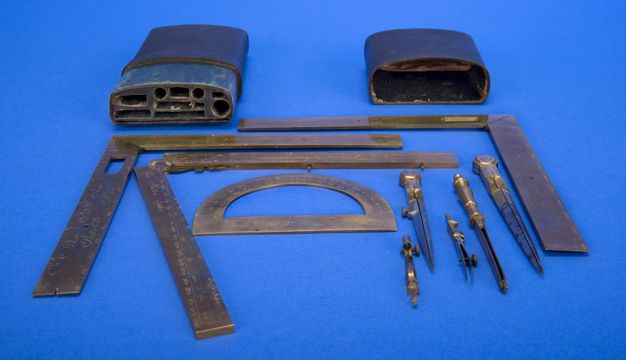
The painter put a price on its return. What did 12 livres represent? Not the cost of replacement, to judge by the silver drawing sets made and sold by the Paris instrument maker Jacques Canivet on the Quai de l’École. The stock inventoried at his death in 1773 included sets of silver drawing instruments valued at half the price of Perronneau’s reward.13 Not its exchange value either, since used goods generally sold for less than new.14 What 12 livres represented had less to do with the market than with the material form of the currency. Rewards were paid in cash, and values were therefore determined by the denominations of coin. Twelve livres represented the account value of a demi-louis, the smallest of the gold coins in circulation in the eighteenth century. According to the Affiches, it potentially bought back pocketbooks, seals, walking sticks, and handbags.15 If the reward appears roughly commensurate with the value of things lost, it is, however, an illusion because, as Jonathan Lamb points out, “reward” is by definition excessive.16 Loss does not alienate property, and buying it back is a legal and commercial nonsense since ownership is not transferred. The value of the reward Perronneau promised the one who returned his pencil case thus indexed not its exchange value but the feelings he had for his drawing instruments, their sentimental value, and the desire he had for their restoration that he might enjoy holding them once again.
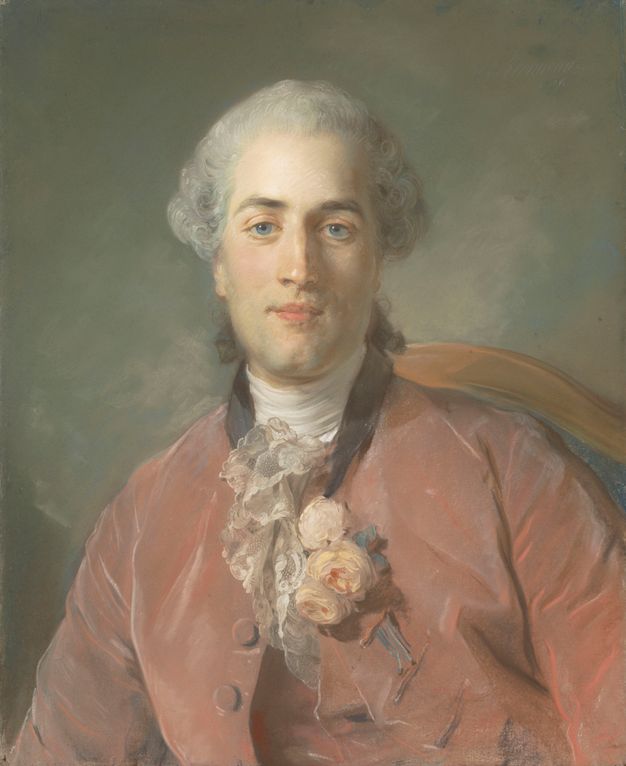
That Perronneau treasured his porte-crayon might seem surprising. He was not an artist reputed as a draftsman. Few autonomous drawings by his hand survive, and unlike his rival, Maurice-Quentin de La Tour, he does not appear routinely to have made preparatory drawings for his portraits.17 Rather, he did the preliminary line work for his pastels directly on the support. Sketched lines mapping the relative positions of Olivier Journu’s temple, hairline, and chin are just discernible under infrared light in the 1756 portrait (fig. 135) of this sugar and slave trader, which Perronneau had painted on an earlier visit to Bordeaux.18 Merchant families in the sugar business feature prominently in Perronneau’s patronage circle, the Journu among others.19 The painter may have used his porte-crayon on Journu, but the lines of underdrawing are broad, their application seemingly rapid and sweeping, consistent with chalk gripped, like sticks of , directly between the fingers rather than mediated by a holder.
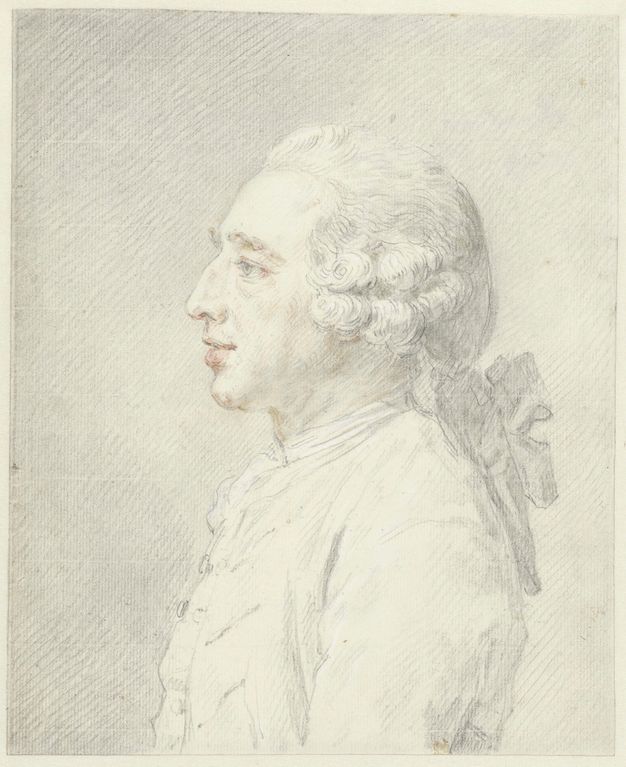
The pencil case and loss of it in the street suggest that the porte-crayon was for drawing en pleine société (to adapt the phrase en plein air), not in the studio. It was, in this sense, part of the paraphernalia of sociability and social representation that made up the bulk of the lost property that owners sought to entice home by reward: medals, pocket , fancy bags, and .20 A rare portrait drawing by Perronneau of the Dutch collector Louis Metayer Phzn (fig. 136), dated circa 1767–68, at the time the painter visited Amsterdam, represents the kind of refined and detailed portrait drawing that Charles-Nicolas Cochin had made fashionable as a social pastime among friends at Mme Geoffrin’s salon in the 1750s.21 The control and refinement of the lines indicate that the porte-crayon has been active. Attentiveness and delicacy, attributes of Perronneau’s graphic gesture, found their correlates in polite social intercourse, thereby commending drawing as a polite art.
Where does that leave the porte-crayon? Answer: as only indirectly the subject of this inquiry? Its thingly claims to our attention having been drowned out by the voice of the subject? Reducing the porte-crayon to the status of object sign of Perronneau’s artistic ego does not, however, account fully for the painter’s distress at losing it. Steven Fowles has noted that things obtrude in consciousness not only when they break or malfunction but also when they disappear.22 Lost things prey on our minds. They have material effects, leaving painful holes in our selves.23 The announcement to the world in the newspaper of the depleted subject, self minus thing, was a cry for restoration of not only lost property but also the unity of self. If Perronneau selected chalk only occasionally as a medium for his art, he more regularly seems to have signed his pastels using graphite, very possibly manipulated into elegant cursive lines by his silver porte-crayon.24 The artist Perronneau minus porte-crayon was, in his mind, and perhaps in the opinion of others, not just an artist with an incomplete tool set but, simply and more significantly, not quite an artist at all.25 §
-
Annonces, affiches et avis divers, 9 April 1767, 58. Quoted from Francesca Whitlum-Cooper, “Itinerant Pastellists: Circuits of Movement in Eighteenth-Century Europe,” PhD diss., Courtauld Institute of Art (London, 2015), 230. ↩︎
-
On the paradoxical dependence of immateriality on materiality for its expression, see Daniel Miller, “Materiality: An Introduction,” in Materiality, ed. Daniel Miller (Durham, NC: Duke University Press, 2005), 20–29. ↩︎
-
Patrick Rocca and Françoise Launay, “La dynastie Langlois-Lordelle-Canivet-Lennel, ‘fabricateurs’ d’instruments de mathématiques à Paris au XVIIIe siècle,” Artefact: Techniques, histoire et sciences sociales 7 (2018): 151–86. See also Patrick Rocca, “French Silver Drawing Instruments,” Bulletin of the Scientific Instrument Society 114 (2012): 30–38. ↩︎
-
See “Porte-crayon,” Encyclopédie, http://encyclopedie.uchicago.edu/, 13:139. ↩︎
-
Plate I, fig. 1, “Dessein,” Encyclopédie, http://encyclopedie.uchicago.edu/, 20:21:1, see fig. 93, above. In Perronneau’s portraits of artists holding porte-crayons, for example, his portraits of Laurent Cars (1759, Paris, Musée du Louvre), and Charles-Nicolas Cochin (1759, Louisville, KY, Speed Art Museum), the chalk holders are invariably brass ones, although Cochin certainly also owned a silver one. ↩︎
-
“Porte-crayon,” Encyclopédie, http://encyclopedie.uchicago.edu/, 13:139. ↩︎
-
Alain Manesson noted that in the case of a ruler, silver was a positive disadvantage because it tarnished and marked the paper on which one was drawing a line. Manesson, La géométrie pratique, divisée en quatre livres (Paris: Anisson, 1702), 1:152. ↩︎
-
Anthony Turner, “Mathematical Instrument-Making in Early Modern Paris,” in Luxury Trades and Consumerism in Ancien Régime Paris, ed. Robert Fox and Anthony Turner (London: Routledge, 1998), 79. ↩︎
-
See Mike Cowhan, “The Butterfield Dial,” Bulletin of the Scientific Instrument Society, 113 (2017): 25–28. The sculptor Edme Bouchardon owned a Butterfield dial in a shagreen case. ↩︎
-
On the second-hand market in Paris, see Natacha Coquery, “The Social Circulation of Luxury and Second-hand Goods in Eighteenth-Century Parisian Shops,” in The Afterlife of Used Things, ed. Ariane Fennetaux, Amélie Junqua, and Sophie Vasset (London: Routledge, 2015), 13–24. ↩︎
-
See Christine Gut, “Towards a Global History of Shagreen,” in The Global Lives of Things, ed. Anne Gerritsen and Giorgio Riello (London: Routledge, 2016), 62–80. ↩︎
-
According to Manesson, a drawing set comprised a pair of compasses, a porte-crayon, a ruler, a setsquare, and a protractor. See Manesson, La géométrie pratique, 1:152. ↩︎
-
See Rocca and Launay, “La dynastie Langlois-Lordelle-Canivet-Lennel,” appendix 2, “Inventaire après décès de Jacques Canivet,” item 316, also items 302, 303, 317, 318. ↩︎
-
See Laurence Fontaine, “The Exchange of Second-hand Goods: Between Survival Strategies and ‘Business’ in Eighteenth-Century Paris,” in Alternative Exchanges: Second-hand Circulation from the Sixteenth Century to the Present (Oxford: Berghahn, 2008), 97–114. ↩︎
-
Annonces, affiches et avis divers: “Porte-feuille,” 14 January 1765, 30; “Cachet de crystal,” 21 January 1765, 59; “Sac,” 31 January 1765, 83; and “Canne,” 17 March 1766, 211. ↩︎
-
Jonathan Lamb, “The Crying of Lost Things,” English Literary History 71, no. 4 (2004): 949–67. ↩︎
-
See Marjorie Shelley, “Pastelists at Work: Two Portraits at the Metropolitan Museum of Art by Maurice-Quentin de La Tour and Jean-Baptiste Perronneau,” Metropolitan Museum of Art Journal 40 (2005): 105–17. ↩︎
-
Shelley, “Pastelists at Work,” 110. On Perronneau’s portrait of the Journu family, see Neil Jeffares, “The Pastels of the Journu family by Perronneau,” http://www.pastellists.com/Essays/Perronneau_Journu.pdf. ↩︎
-
Aignan Thomas Desfriches, another patron, was in the sugar refinery business at Orléans. See Patrick Villiers, “Quelques exemples d’influence du commerce atlantiques à Orléans au XVIIIe siècle,” in Villes atlantiques dans l’Europe occidentale du Moyen Âge au XXe siècle, ed. Guy Saupin (Rennes: Presses Universitaires de Rennes, 2006), 89–100. ↩︎
-
The drawing set in a shagreen case lost in the pit of the Comédie Française and the gold crayon holder in a Galluchat case found in the Tuilleries gardens were almost certainly the paraphernalia of amateurs, not professional artists. See Annonces, affiches et avis divers, 7 February 1765, 99; and 13 June 1766, 539. ↩︎
-
On the Portrait of Metayer, see De Watteau à Ingres: Dessins français du XVIIIe siècle du Rijksmuseum Amsterdam, exh. cat. (Paris: Fondation Custodia, 2003), no. 73. On Cochin’s portraits and Mme Geoffrin’s salon, see Christian Michel, Charles-Nicolas Cochin et l’art des lumières (Rome: École Française de Rome, 1993), 121–22, 172. ↩︎
-
Steven Fowles, “People without Things,” in An Anthropology of Absence: Materializations of Transcendence and Loss, ed. Mikkel Bille, Frida Hastrup, and Tom Sørensen (New York: Springer, 2010), 23–41. ↩︎
-
See Lamb, “The Crying of Lost Things.” ↩︎
-
See Perronneau’s signatures on his portraits of Mme Antoine Molles and Jean Jourdan, Maisonneuve painted during his 1756–57 trip to Bordeaux and reproduced by Neil Jeffares in “Two Pastels.” ↩︎
-
See Fowles, “People without Things.” ↩︎