Type of Object
Picture
- Nicolas de Largillière (1656–1746)
Virtually all eighteenth-century artists owned pictures. At his death in 1746, the ninety-year-old portrait painter and director of the Académie, Nicolas de Largillière, owned five hundred.1 His assemblage of pictures far exceeded that which is accounted for by the stock, , unfinished projects, and wastes of the busy studio. The sale in 1765 of the “cabinet of Monsieur de Largillière” might suggest that he combined painting with collecting, even, perhaps, picture dealing, were it not the case that, of the one hundred and fifty or so works to which attributions can confidently be made, the majority are to the artist himself.2 They consist of both pictures directly related to his portrait practice, and pictures not. Of the latter, a significant few were decorative, among them Trompe l’Oeil with a Curtain, a Parrot, and a Cat (fig. 131), today at the Louvre. It was painted to decorate a specific room and remained in place after Largillière’s death at the house built for him ca. 1713–16 at 7 Rue Geoffroy Langevin, and into which he removed with his family in the first year of the Regency.3 The picture thus asks to be understood in the context of the domestic interior and in relation to the host of things (, , , , etc., as well as pictures) by which space was experienced as privately owned, if not private per se. The question is: did this picture distinguish Largillière’s house as the house of the artist?
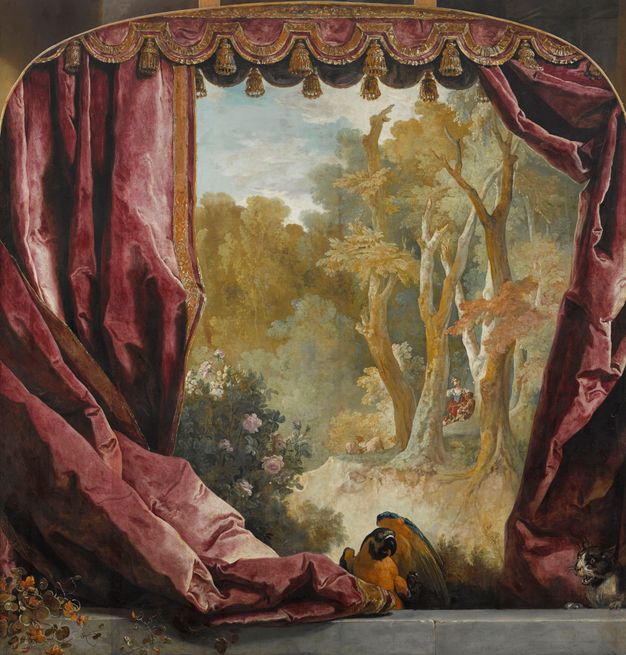
Trompe l’Oeil with a Curtain provides no easy answers. Largillière, as a native of Antwerp, would likely have known and admired the trompe-l’oeil grisailles of antique masterpieces that Rubens recreated on the exterior of his house in that city, to designate it the home of Mercury and Minerva, and he may have aspired similarly to mark his house as a locus of the liberal arts.4 But as a genre, still life spoke only indirectly to Largillière’s professional priorities.5 The technique of trompe l’oeil was marginal to portraiture and also to all the forms of painting taught at the Académie, notwithstanding the growing interest in optics and optical devices (see ) at the turn of the seventeenth century. Trompe l’Oeil with a Curtain was, thus, at one level an incongruous thing. Tellingly, perhaps, it occupied a place in Largillière’s house not in or adjacent to the studio but rather in the space dedicated to sociability and private life.
Trompe l’Oeil with a Curtain, along with its two companion wall paintings (now lost) and four overdoors—two depicting fruit and flowers, the other two Painting and Music (also lost)—invoked an interior that Largillière could not, as a painter, have aspired to own.6 His house was built on land giving onto the elite quarter of the Marais but actually trapped in the densely parceled urban tissue of the commercial and largely working-class neighborhood of Les Halles.7 Admittance from the street was via a porte cochère (carriage entrance), but the house was L shaped—not U shaped, as befitted an hôtel so grandly announced from the street.8 The main living space was distributed on the second floor; the first and best floor was rented out. This second floor consisted of two apartments: one in front, along the street, and the other leading back from the road at a forty-five-degree angle, flanking the courtyard.
Trompe l’Oeil with a Curtain was set into the paneling of a room belonging to this second apartment. It decorated the middle room in an enfilade of three, preceded by an antechamber and followed by Largillière’s bedroom. To reach it the visitor would have had to have entered from the street, traversed the courtyard, mounted the stairs, crossed the sparsely furnished antechamber with its lone piece of furniture, a kneehole desk that advertised the room’s purpose for business, before reaching the decorated room. The surprise must have been considerable at then finding oneself on the threshold of enchantment: that of gracious and leisured piano nobile living cultivated at maisons de plaisance in the capital’s environs.9 The manifest contradiction between the picture’s airy and open fictional vista and the cramped and obscure urban reality upon which the actual windows, curtained in plain white cotton, looked out, could only have amplified the experience of giddy, almost comedic disorientation created by the mingle and contrast of different levels of representation in the pictures. In our painting, folds of madder-red curtain and tumbles of nasturtium reach across the frame to claim existence in our third dimension, and the rustic idyll recedes from it, like a picture within a picture, its framing doubled and contradicted within the picture by the illusion of the parapet. As a device, trompe l’oeil oversteps the conventional function of the picture frame; in this picture it does so in both directions.
The “why?” of Trompe l’Oeil with a Curtain seems obvious: to hijack by force of illusion the aristocratic discourse on the pastoral, and the associated ornaments of a noble rank to which Largillière was excluded by birth, though not by fortune.10 He had himself once painted a nearly identical trompe l’oeil at the country estate for one of his exalted patrons.11 This appropriation of genre and fictional things was seemingly multiplied in the overdoors, notably in Music, in which Largillière extended luxury’s scope from gold-trimmed curtains and richly tasseled lambrequin, to elaborately chased gold and silver vessels, blue-and-white Chinese porcelain, gold-tooled leather-bound books, and a string of pearls. Known from a studio copy (fig. 132), these things push forward in the painting and overwhelm the violin that gives the picture its ostensible emblematic meaning. They are painted, moreover, with an attention to texture and shine that belies the symbolic and bespeaks care and pride in possession.
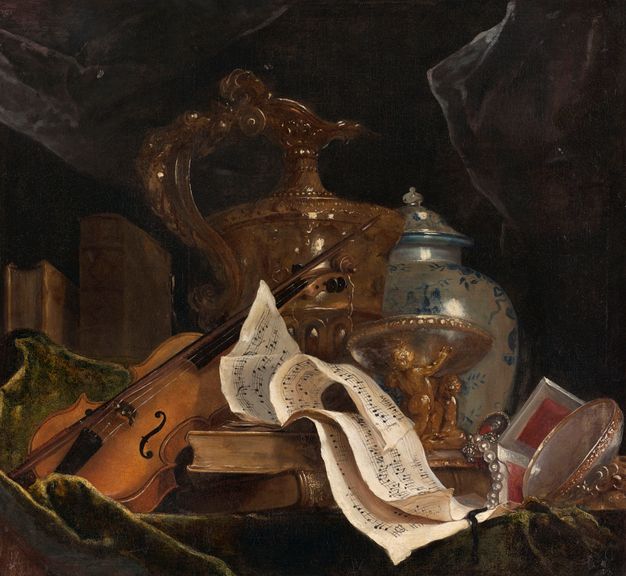
During Louis XIV’s reign, nonnobles were prevented from buying many such luxury items not only by cost but by sumptuary law, which in March 1700 proscribed, for instance, the production and consumption of gold and silver vessels.12 In April that year, and when living in the Rue Saint-Avoye, Largillière had had to surrender those of his things that contravened the act.13 They included a on a gilded stand, two marquetry pedestals (guéridons) with gilded ornament, a marble-topped table on a gilt console, four armchairs, six chairs and four stools, all with frames of gilded wood, and an assortment of hearth furniture with gilt-bronze handles and ornaments. In the wake of this experience, and notwithstanding the eventual return of at least some of his costly furniture, Largillière appears to have chosen for the new Rue Geoffroy Langevin house decoration that, with the exception of the pictures, was comparatively plain and sober.14 Rooms were either simply paneled or dressed in plain fabrics (green and red damask, or yellow satin). The furniture was mainly ungilded. Ormolu was absent from the fire irons. Only the frames of the mirrors and easel paintings were edged with gold, a license admitted by the 1700 edict.15 By recourse to trompe l’oeil, Largillière apparently enjoyed that which he was denied by law.
However, to classify trompe l’oeil painting with other imitations (mock marble, simulated wood, or the faux gilt-leather wallpaper decorating Largillière’s dining room), stuffs that were produced in volume and shaped into “populuxe” goods by the decorative trades for the bourgeois consumer, is to miss an important distinction between these various forms of illusion.16 Where ersatz luxury goods depended for their success on so-called secret arts and on absolute deception for the consumer’s satisfaction, the claim of Largillière’s painted curtain that it is Venice velvet trimmed with gold, and that it will shut, is an open lie. The viewer’s pleasure is one of surprise when the spell shatters and the image is beheld as exactly that: an illusion or artifice.17 Thought, quickened by the eye’s surprise that what it sees is a flat surface, asks how the painter transformed inert, gross matter, or the substance of painting, into this lively picture of the world.18 The impossibility of possessing the picture intellectually though having it materially within touch cast a “halo effect” around the work.19 The exchange between picture and beholder is phenomenological. The undeceived viewer saw not the referent, and nobility honored by gleam of gold, but painting, and the artist’s parade of his own skill.
Trompe l’oeil has a long, storied history in the life of the artist, beginning with Zeuxis’s grapes, so lifelike that birds attempted to eat them.20 Largillière may have hoped that the amateurs who, according to Germain Brice, beat a path to his door to admire his works, saw echoed in his trompe l’oeil Parhassius’s famous curtain, so seductively real that Zeuxis was said to have lifted his hand to draw it away from the picture “behind.”21 The left-lit pastoral scene revealed beyond Largillière’s curtain appears formally and thematically detached from the right-lit drapes and the balustrade of the extravagant interior “before,” so much so that it does invite analogy with the ancient Greek painter’s devise of the picture-within-a-picture. In the odes and obituaries published after his death, Largillière was praised for his singular ability to capture a likeness—in one elegy, the gods vie to inherit his tools22—but the trompe-l’oeil decorations at his house attracted no sustained comment in the art literature of the time. Nothing to make us think that the trompe l’oeil of the picture succeeded in marking the house as the house of an artist.
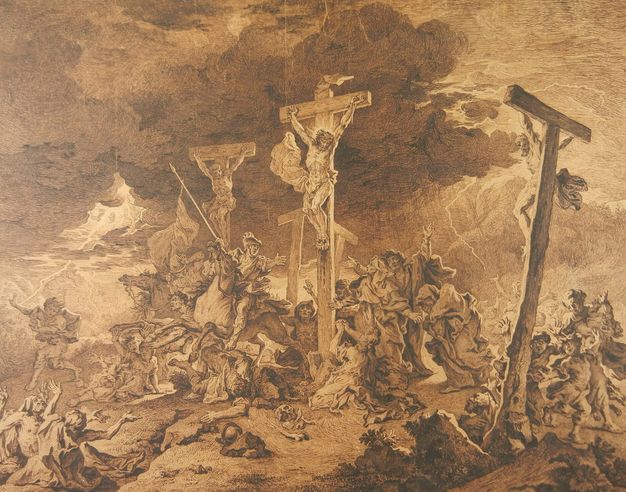
In Antoine-Joseph Dézallier d’Argenville’s life of Largillière, the decorated room helps define the house as “beautiful,” or a place where beauty abides, but both d’Argenville and Pierre-Jean Mariette were more profoundly struck by the quantity and quality of the artist’s religious painting (fig. 133).23 Mariette noted that Largillière had “left his heirs” twelve paintings depicting scenes from the lives of Christ and the Virgin, of which a set of four depicting moments from the Passion warranted “particular attention” by their considerable size, complexity, and “surprising effects.” He singled them out as evidence of the “fecundity” of Largillière’s “genius”; they were proof of his “universal talent.”24 To the extent that Mariette and Dézallier d’Argenville measured Largillière’s achievements, they did so with reference, it would seem, to the hierarchy of genres rather than the ancien régime’s order of estates; they located nobility in history painting, not in the elite’s taste for decorative painting.
The performance of identity through and with things real and depicted was risky. There was a special risk in the gesture of trompe l’oeil. It depends on the readiness of the beholder to overlook contradictory contextual evidence, to stand still and transfixed and be willingly deceived. Largillière doubled that risk when he yoked his apparent desire for status and luxury to his self-reflexive performance of imitation, because the artistry of trompe l’oeil rests ultimately on knowing and valuing the gap between reality and illusion, between legitimate status and a play with—or is it for?—it. For the trompe-l’oeil project to succeed, other observers have to be enrolled in its performance and be persuaded that the illusion of luxe is equal to, if not better than, the stuff of status itself.
What of the religious pictures that weighed so heavily with Mariette and Dézallier d’Argenville? The random hang of the works at Rue Geoffroy Langevin, not in sets as Mariette implied but mixed in with other things and genres, undermines reading them as alternative reputational things. It might be more productive to think of them as counterweights to the materiality of the furnishings, and counter values. Like the decorative paintings, Largillière’s religious works were, with few exceptions, painted for himself and not for public exhibition or for sale. But unlike the decorative works, his devotional painting had no fixed purpose or setting. His practice in religious painting was, apparently, open and ongoing. Myra Rosenfeld dates Christ’s Entry into Jerusalem at the Louvre, one of Largillière’s earliest devotional works, to circa 1690.25 It was a picture he brought with him to his new house, not one he painted for it. The Louvre’s Moses in the Bulrushes is signed and dated 1728 and is among his last.26 Largillière was, in short, busy with religious painting over thirty years or more. To paint such works was for him not a circumstantial interlude but a repetitive, meditative exercise whose makings hung in rooms throughout his house. Both the practice and the products of his devotional work were always on his horizon, not in the background, that is, not decoration. The social discourse of devotion preached reduction of the self, contra market culture’s ideology of infinite extension and upward trajectory. The geometry of devotional work was one of point, not plane, and required focus on the self within the frame chosen by God: “humility does not take up much space.”27
Trompe l’Oeil with a Curtain and the Crucifixion (see figs. 131, 133), painted at around the same time, seem to propose contradictory versions of the artist.28 On the one hand: the would-be gentleman and aristocrat, recognized for the talent of his handiwork whose illusions bested nature’s best and the finest weaver’s and goldsmith’s work. On the other: the devout and self-effacing painter whose representations of the Passion were, according to Pellegrino Antonio Orlandi, “lifelike”—that is, vibrant not surprising; vibrant in the telling of their stories, not in their illusionism. The life force of the Crucifixion derives, according to Orlandi, from the handling of light, which illuminates the scene such that the expressive reaction to Christ’s “consummatum est” is easily read in the ghastly gloom.29 The sacred subject engrosses all the image’s pictorial effects; none is left to draw attention to the author or to art in the narrowly material and technical sense of trompe l’oeil. The possibility remains, however, that decoration and icon made greater sense together, that the fantasy of bourgeois illusions in the inner space of the anteroom was framed by an outer ideal of Christian virtue filling the house. Such a reading suggests that Largillière’s house in the early eighteenth century was a theatrical and semipublic space in which he created illusions in order to prick them, blew bubbles to watch them burst. §
-
Georges de Lastic, “Nicolas de Largillière: Documents notariés inédits,” GBA 98 (1981): 7, 23–27. ↩︎
-
See Catalogue de tableaux, estampes, desseins, bronzes, figures de marbre . . . provenant du cabinet de M. de Largillière (Paris: Merigot, 1765). ↩︎
-
On the provenance of the picture, see Largillière (1656–1746), exh. cat. (Paris: Musée Jacquemart-André, 2003), no. 7. On the house, built on the site of a former tennis court, see Michel and Fabrice Faré, La vie silencieuse en France: La nature morte au XVIIIe siècle (Fribourg: Office du Livre, 1976), 58–60. From a constitution de rente between the Largillière and François Chaban-Delafosse we know that the Largillière family was living at the house by February 1716. See Mireille Rambaud, Documents du Minutier central concernant l’histoire de l’art (1700–1750) (Paris: Imprimerie Nationale, 1964–71), 1:179. ↩︎
-
On Rubens’s house in Antwerp, see Elizabeth MacGrath, “The Painted Decoration of Rubens’s House,” Journal of the Warburg and Courtauld Institutes 41 (1978): 245–72. Largillière, the son of French parents, grew up in Antwerp and received his early training there. At eighteen he left the city, arriving in Paris for the first time in 1679 and settling there in 1686. ↩︎
-
On his still-life practice, see Faré and Faré, La vie silencieuse, 48–62; and Pontus Grate, “Largillière et les natures mortes de Grenoble,” Revue du Louvre 11 (1961): 23–30. ↩︎
-
For the valuers’ summary descriptions of the lost paintings, see de Lastic, “Largillière,” 17 (no. 13), 25 (nos. 59, 60). ↩︎
-
Anne Lombard-Jourdan, Les Halles de Paris et leur quartier (1137–1969) (Geneva: Droz, 2009), 83–111. ↩︎
-
Largillière did not own a carriage but his sitters did, hence the need for a porte cochère and a forecourt. ↩︎
-
See Charles Le Brun’s Gobelins tapestry series, the Maisons royales (1668), with which Largillière’s composition bears comparison. ↩︎
-
On Largillière’s fortune, see Pierre-Jean Mariette, Abecedario, ed. Antoine de Montaiglon (Paris: Dumoulin, 1853–62), 3:61, 62; and de Lastic, “Largillière,” 4, 12–14. ↩︎
-
See Antoine-Joseph Dézallier d’Argenville, Abrégé de la vie des plus fameux peintres, 2nd ed. (Paris: De Bure, 1762), 4:300–301. ↩︎
-
Edit du Roy pour retrenchement du luxe des meubles, habits, vaisselle, équipages et bâtiments, March 1700; see Nicolas de La Mare, Traité de police (Paris: Brunet, 1705–38), 1:419–22. ↩︎
-
AN, Y3583 (17 April 1700), in Emile Compardon in NAAF, 1874–75, 223–24. See also Largilliere, 42. Among other artists to face similar charges were Jacques Van Schuppen (Largillière’s pupil) and Jacques Oudry (father of another). See “Catalogue des noms et demeures de ceux qui ont faits leurs déclarations en execution de l’Édit de Sa Majesté du mois de mars 1700,” BnF, Ms. f.f. 21627. ↩︎
-
They are identifiable from his estate inventory. See de Lastic, “Largillière,” 15–18. ↩︎
-
La Mare, Traité de police, 1:422. ↩︎
-
See Reed Benhamou, “Imitation in the Decorative Arts of the Eighteenth Century,” Journal of Design History 4, no. 1 (1991): 1–13; and Cissie Fairchilds, “The Production and Marketing of Populuxe Goods in Eighteenth-Century Paris,” in Consumption and the World of Goods, ed. John Brewer and Roy Porter (London: Routledge, 1994), 228–48. ↩︎
-
On the aesthetics of surprise, see Roger de Piles, Cours de peinture [1709] (Paris: Gallimard, 1989), 7–19, esp. 8, 11, 14. ↩︎
-
For a firsthand account of the experience of trompe l’oeil, see Charles de Brosses, Lettres d’Italie, 2 vols. (Var: Editions d’Aujourd’hui, 1976), 1:15–16. ↩︎
-
The phrase “halo effect” is Alfred Gell’s. See Gell, “The Enchantment of Technology and the Technology of Enchantment,” in The Art of Anthropology: Essays and Diagrams (London: Athlone, 1999), 159–86. ↩︎
-
Largillière’s still lifes include the trompe l’oeil Two Bunches of Grapes, signed (1677, Paris, Fondation Custodia). ↩︎
-
Germain Brice, Nouvelle description de la ville de Paris (Paris: Gandouin, 1725), 2:68–69. ↩︎
-
“Ode en strophes libres à Titon du Tillet sur la mort de M. de l’Argillière [sic] chancellier et ancien directeur de l’Académie,” in Mercure de France, May 1746, 134. ↩︎
-
Dézallier d’Argenville, Abrégé, 302. ↩︎
-
Mariette, Abecedario, 3:62. ↩︎
-
In Largillière and the Eighteenth-Century Portrait, exh. cat. (Montreal: Museum of Fine Arts, 1981), 56–59. ↩︎
-
See Françoise Maison and Pierre Rosenberg, “Largillière, peintre d’histoire et paysagist,” Revue du Louvre 23, no. 2 (1973): 89–94; and Myra Rosenfeld, “La culture de Largillière,” Revue de l’art 98 (1992): 48–49. ↩︎
-
Jean Puget de La Serre, La vie heureuse, ou l’homme content (Paris: 1709), 119. ↩︎
-
The painting is lost. ↩︎
-
Pierre Rosenberg, “Un nouveau tableau à sujet religieux de Nicolas de Largillière,” Revue du Louvre 39, no 4 (1989): 245–48. ↩︎