Almanac
- Claude-Joseph Vernet (1714–89)
Almanacs are calendars, first and foremost. According to an eighteenth-century dictionary definition, calendar was in fact a synonym of almanac because the almanac invariably begins with a table of the days of the year, arranged in rows and gathered into weeks and months, no matter what else it also contained.1 The almanac proper condensed an impressive amount of astronomical, theological, meteorological, and astrological knowledge (solar and lunar orbits, Catholic feasts and saints’ days, weather warnings, and signs of the zodiac), embedding it in the typographical design by use of columns, variations in type, signs, symbols, and figures, in addition, of course, to numerals. Although the result was a dense, consolidated matrix of abstruse information, almanacs nevertheless remained easy to understand and simple to use. Their purpose was to measure time, not by the hour, like clocks and , but by the day.
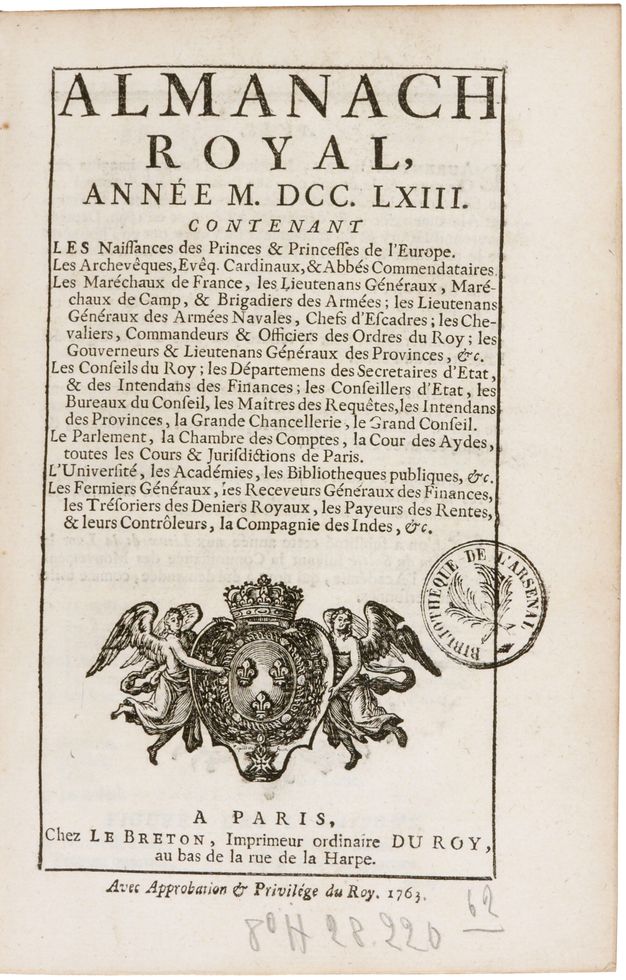
On Saturday, 1 January 1763, the marine and landscape painter Claude-Joseph Vernet bought a copy of the Almanach royal (fig. 1) for 5 livres at the offices of the Maison du Roi and recorded his purchase in his journal-cum-.2 This particular Paris almanac was published by Antoine Le Bretton, the publisher, with others, of Diderot and d’Alembert’s Encyclopédie.3 It enjoyed the status of a semiofficial publication because as an appendix to the calendar the Almanach royal listed, in order of rank and office, the names of appointees to the king’s household and government, and of members of royal and corporate institutions, including the Académie Royale de Peinture et de Sculpture, to which Vernet had been elected a member in 1746. It was a list that by 1763 ran to several hundred pages. Updated annually, the Almanach royal was reputed for its accuracy: the solar and lunar calendars were calculated by the astronomers of the Académie royale des sciences, and the who’s who of the kingdom’s bureaucracy and corporate bodies was scrupulously checked by the editor.4 Every year, it went on sale on 31 December to coincide with the celebration of the New Year. According to Vernet’s accounts, 1763 was the first year he bought such a thing. His purchase is itemized midpoint in his list of expenses on New Year gifts; it was a novelty he apparently afforded himself.5
Why did Vernet buy an almanac in 1763, having not bought one before? How did he use it? Or, should we be asking, how did it use him? There are no simple answers because the questions relate to a heterogeneity of different temporalities: to the time of the body, the individual, the family, and the social, to the time also of biography and of history. They concern the synchronization of some of these temporalities and the discontinuation of others.
Vernet’s copy of the 1763 Almanach royal is lost. It was almost certainly lost during Vernet’s lifetime, because it is not among the possessions inventoried at his death.6 Given the yearly obsolescence of calendars, it is even possible that Vernet threw it away.7 Nevertheless, its particular form provides some clues about why he wanted it and how he might have used his copy. Like others of its day, the Almanach royal was routinely bound with extra blank sheets of paper interleaved between the pages of the calendar, to facilitate annotation and enable its use as a diary or . Marked almanacs that survive from the period indicate that eighteenth-century owners employed them to record events (meteorological, political, economic, financial, and so on) and to schedule activities (jobs, meetings, transactions).8 Since the beginning of his career, Vernet had kept his own daily record of commissions, engagements, letters written and received, and sundry shopping in medium-size vellum-covered ledgers, but between the end of 1762 and the beginning of 1764, that record is, as Léon Lagrange has observed, remarkably thin.9 Entries relating to commissions drop off, and those few recorded warrant only brief mention and rough dating.10 By contrast, his notation of his domestic expenses remains relatively detailed and exact. He noted, for instance, the expenses incurred for hangings, lighting, and fireworks to celebrate the Fête Dieu, a capital-letter day in the Almanach royal.11 It seems possible, therefore, that in 1763 Vernet used his copy to manage and record his professional activity, and in so doing, that he was led to reckon and organize his work-time separately from the time of other daily matters.
To suggest such a division is to ask whether Vernet’s experience of time, the way he lived it, was “modern,” since our current definitions of Western modernity presuppose the disaggregation of work and leisure and the separation of the spaces of work and the home. E. P. Thompson famously argued that modern temporality, that of work discipline, emerged with the advent of capitalism and the factory during the second half of the eighteenth century.12 Intermittent and uneven task-related and seasonal works were replaced by the industrial labor of workers contracted to work continuously for the duration of a set number of hours in the day and a fixed number of days in the week. The proliferation of public clocks in cities like Paris, and the dissemination of pocket and paper instruments of time measurement, such as almanacs, fostered the internalization of this new experience and perception of time by society at large, among those, that is, not themselves dominated by industrial schedules.13 Arguably, the straight-lined frames that parcel out the months in the Almanach royal, and the lines of assembled type, regularly spaced, that conjugate the different days of the week, participated in this transformation: together they served to articulate a more abstract image of time as the equal flow of temporal units in contrast to that afforded by the sensual impact of sounded time emitted by the city’s turret clocks and church bells.14
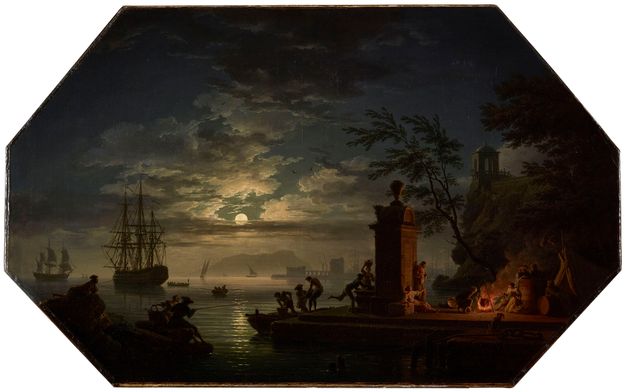
Insofar as art has traditionally been defined as task oriented, historians presume that artists were spared the pain of the temporal transformation brought about by modernity’s disciplines. We rarely question the time of painting in the early modern period, as opposed to time represented in paintings, subject matter that Vernet made his own: at the Salon of 1763 he exhibited Four Times of Day, four overdoors painted the previous year for the dauphin’s library at Versailles. Of Night (fig. 2) Diderot marveled, “everywhere it is night-time and everywhere it is day.”15 He continued: the moonlight “illuminates and colors the world” like sunlight, and “blends with the firelight” that clarifies the daily tasks of night. Across all four paintings time is flexible; the moments of the day stretch and extend into one another, creating, through modulated light, patterns of repetition and renewal at odds with the unidirectional, dark linearity of the almanac and its continuous sequence of rigidly plotted points. It is rather in the participation of artists in print culture and their exploitation of reproduction in all its forms that art historians recognize the modernity of eighteenth-century art: modernity as commoditization and commercialization, not industrialization.16 Such a view fits neatly with alternative theories of modern time. According to Jan de Vries, the eighteenth century experienced not an industrial revolution but an industrious one.17 He identifies change not in the regularity of work time but in its intensity. He argues that increases in work discipline were not imposed by capitalists but self-imposed by workers motivated to work more competitively in order to be able to buy from an expanding range of consumer goods: in Vernet’s case in the year 1763, prints à la grecque, a guitar, a cushion for his sedan chair, and a world of goods that at his death encompassed also a , a , an , and a , all things in this book. By such an argument Vernet bought his almanac in order to enjoy a sophisticated, expert timepiece (in place of his plain, generic ledgers), and to delight in its ornaments.
To propose such an interpretation presumes the correlation of historical change and individual time. However, the exact timing of Vernet’s purchase perhaps indicates something else. In July 1762, Vernet and his family arrived in Paris to take up lodgings at the Louvre after a decade of moving from point to point along France’s Mediterranean and Atlantic seaboards following the prescribed itinerary of the painter’s royal commission of 1753: to paint twenty ports of France. Vernet had first broached the matter of a Louvre logement (lodgings) in December 1759, after six years of “traveling for the king” and shortly after the birth of his second son, Carle.18 The father Vernet wanted to synchronize the family clock, shaped by socially constructed expectations of settled domesticity, with the external meter of work time. He was initially rebuffed by the marquis de Marigny, the directeur des bâtiments du roi (director of the king’s buildings), in whose gift a logement rested, and in whose view the end of migration and the end of the job were necessarily temporally related.19 It was not until April 1762 that Marigny relented and allowed the claims of Vernet’s family and his children’s education to override the king’s command.20 It is possible that the delay and frustration Vernet suffered in setting up a permanent home made the painter especially conscious of his late transition to fatherhood, and that he marked this turning point in his life’s course by purchase of an almanac for the year in which he moved into the Louvre and had his name painted on the door.21
Did Vernet perceive this turning point as a new beginning not only personally but professionally? Did he intend, with the almanac’s help, to find a different way, a more disciplined way, of working and thinking about work, one in which time was reckoned in standard units, regularly performed and coordinated with the actions of others—one, in short, that calendars facilitate? The exchange of letters between Vernet and Marigny during the course of the execution of the Ports of France provides some provisional answers.
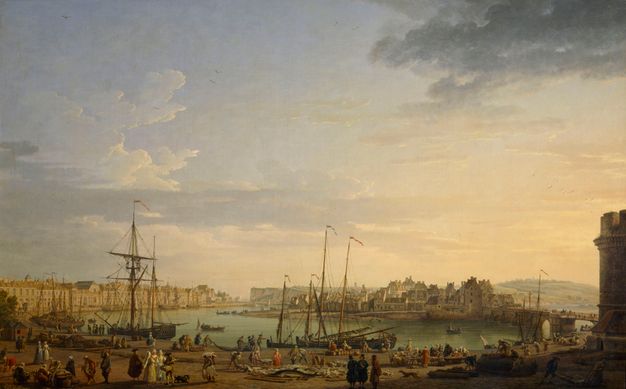
On 1 August 1763 Vernet wrote to Marigny for his orders on which port to paint next, pressing him for a decision because of “the lateness of the season in regard to the things [opérations] I must undertake.”22 There was a season to landscape and a time to the purpose of depicting it: the “beautiful” days of summer, stretching into early autumn.23 In the Port of Dieppe (fig. 3), the modest Normandy port proposed as the subject by Vernet and accepted by Marigny, the time of painting coincides with the time depicted. Vernet arrived in September 1763 and portrayed the quayside at dawn decked with the night’s catch of skate, rays, herring, and conger eel, fish harvested with lines and nets in late summer and early autumn.24 Moreover, the sharp observation of the patterns of light and shadow cast by the sun, rising off-stage to the right, and captured seemingly in the dawn moment, suggests a natural synchrony between the diurnal rhythms of fishing and painting. But if Vernet’s reference to the time of painting in the letters is couched in the vocabulary of nature, the temporal categories he used to articulate his “operations,” and to report on his progress, was much more calculating and abstract. When estimating the time needed to rough out, paint, and finish one of his ports, he reckoned in days and working weeks, measurements of time that in the letters chime with the schedules of the postal system that delivered his canvases to Paris, rather than the order of nature.25
There is a case for saying that Vernet was compelled so to reckon time more abstractly by Marigny’s micromanagement of the project through the continuous flow of his letters enjoining the painter to keep to his task and deliver to schedule.26 Marigny met with some resistance. Vernet reminded the director of the constraints on speed that the frailties of the body and the materiality of paint imposes: the body must rest to recover from illness, paint must dry.27 Ultimately, however, Marigny’s ability to impose time discipline on Vernet was frustrated not by fever or the tackiness of black but by the exchequer.28 With the outbreak of the Seven Years’ War in 1757, regular payments for the Ports in cash and on receipt ended.29 Vernet asked permission to take on private work to mitigate the effects of delayed payment.30 Marigny initially refused. He argued that the Ports of France was a “collection,” that is, an indivisible entity, and as such, Vernet having accepted the commission, he was bound to its continuous serial production.31 Vernet, on the other hand, considered the Ports piecework, like any other commission—that is, a discontinuous series, production of which stopped and restarted with receipt of payment. Thus, where patron and painter were as one in reckoning time in more or less standard units, and on concentrating work by efficiencies of organization,32 they were at odds over regularity in production.
The evidence of the letters indicates that Vernet was using abstract measures of time and value sometime before he bought his calendar in 1763. Moreover, he was prompted to adopt a modern orientation to work time by the disciplines of government bureaucracy, not those of industry. His clock was royal; metaphorically solar. Moreover, he experienced the pressure of it, an experience he shared with Marigny, in the terms and the discourse of deference, not efficiency: Vernet was “anxious” to serve; Marigny was “impatient” to admire, praise, and reward.
However, Vernet’s purchase of an almanac in 1763 is less likely the response of identification with the linearity and rigidity of its tabulated sovereign time than it was the answer to his need to synchronize effectively and blend the rhythms of multiple overlapping commissions necessitated by the breakdown in royal patronage. The appendix of the Almanach royal afforded him, moreover, the names and addresses of those from whom future commissions might come. In September 1764 Vernet was still writing to Marigny for the settlement of his account for the Ports dating back to 1761, a commission that had ended although the “collection” was not complete.33 In the letter, Vernet underscored his right to payment by the pressing needs of his family. He was not given to “mad extravagance”; he was not inflamed by consumer desire.34 His expenditure of 20,000 livres, a huge sum, to establish his “house” at the Louvre was an obligation he owed to rank, and it was the only “extraordinary payment” that he had made since entering the king’s service.35 For Vernet, it seems, the almanac was a hybrid object whose meaning and uses were both backward and forward facing. Its date, “année MDCCLXIII,” was a red-number year in his family’s life and also marked the moment when he fully acceded to his title of academician by his presence in Paris and at the Louvre. These symbolic and collectively determined meanings of family and status time, which the Alamanch royal embodied for him, cohabited irregularly, however, with the calendar’s utility, its force potentially to organize future time for profit and to free the spending of profit on things for pleasure. §
-
See Dictionnaire de l’Académie française, 4th ed. (1762; reprint, Chicago: University of Chicago ARTFL Project, 1998), https://artfl-project.uchicago.edu/content/dictionnaires-dautrefois, s.v. “almanach,” 1:56. See also Véronique Sarrazin-Cani, “Formes et usages du calendrier dans les almanachs parisiens au XVIIIe siècle,” Bibliothèque de l’École des chartes 157 (1999): 417–46. ↩︎
-
Léon Lagrange, Joseph Vernet et la peinture française au XVIIIe siècle (Paris: Didier, 1864), 390. ↩︎
-
On the Almanach royal, see Nicole Brondel, “L’almanach royal, national, impérial: Quelle verité, quelle transparence? (1699–1840),” Bibliothèque de l’École des chartes 166, no. 1 (2008): 15–87. ↩︎
-
See Almanach royal pour l’année MDCCLXIII (Paris: Le Breton, 1763), 2. ↩︎
-
Lagrange, Vernet, 390. On the almanac as a New Year present, see Mémoires et journal de J. G. Wille, graveur du roi, ed. Georges Duplessis (Paris: Renouard, 1857), 2:82. ↩︎
-
Claude-Joseph Vernet, “Inventaire après décès,” 2 March 1790, AN, MC/ET/LXV/369. ↩︎
-
Almanacs retained their value as directories; Vernet renewed his in 1771. See Lagrange, Vernet, 398. ↩︎
-
For an annotated almanac, see “Sur mon Almanach royal de 1750,” in Lyon et l’Europe, hommes et sociétée: Mélanges offerts à Richard Gascon (Lyon: Pul, 1980), 1:230–35; and Nicolas Lemas, “Les 'pages jaunes’ du bâtiment au XVIIIe siècle: Sur une source méconnue de l’histoire du bâtiment parisien,” Histoire urbaine 12 (2015): 175–82. ↩︎
-
Lagrange, Vernet, 342. ↩︎
-
On Vernet’s journal, see Charlotte Guichard, “Les écritures ordinaires de Claude-Joseph Vernet: Commandes et sociabilité d’un peintre au XVIIIe siècle,” in Les écrits du for privé: Objects matériels, objects édités, ed. Jean-Pierre Bardet et al. (Limoges: CTHS, 2007), 231–44. ↩︎
-
Lagrange, Vernet, 390. ↩︎
-
E. P. Thompson, “Time, Work-Discipline, and Industrial Capitalism,” Past and Present 38, no. 1 (1967): 56–97. ↩︎
-
See David S. Landes, Revolution in Time, rev. ed. (Cambridge: Harvard University Press, 2000). ↩︎
-
The carillon of the clock on the Samaritaine on the Pont Neuf was a case in point. ↩︎
-
Denis Diderot, Salons, ed. Jean Seznec and Jean Adhémar, 2nd ed. (Oxford: Clarendon, 1975), 1:228. ↩︎
-
See Ewa Lajer-Burcharth, The Painter’s Touch (Princeton: Princeton University Press, 2018), 13–32, on François Boucher. ↩︎
-
Jan de Vries, “The Industrial Revolution and the Industrious Revolution,” Journal of Economic History 54, no. 2 (1994): 249–70. ↩︎
-
Jules Guiffrey, “Correspondance de Joseph Vernet avec le directeur des bâtiments du roi sur la collection des Ports de France, 1756–1787,” Revue de l’art ancien et moderne 9 (1893): 34–36. ↩︎
-
Guiffrey, “Correspondance,” 36–37. ↩︎
-
Guiffrey, “Correspondance,” 49–50. ↩︎
-
Lagrange, Vernet, 392. Biologically, Vernet was a father long before he moved into the Louvre. The argument here is that the social and moral experience of fatherhood was closely connected to a settled existence. See Jean-Joseph Expilly, Dictionnaire géographique, historique et politique des Gaules et de la France (Paris: Desaint & Saillant, 1762–70), 5:432 for record of names on doors. Under “things to do” in 1763 Vernet listed fitting a doorbell, getting a key to the outer door of the Louvre, and putting “Mon nom sur la porte.” See Lagrange, Vernet, 392. ↩︎
-
Guiffrey, “Correspondance,” 55. ↩︎
-
Guiffrey, “Correspondance,” 21–22, 55. ↩︎
-
See A. R. Michell, “The European Fisheries in the Early Modern Period,” in The Cambridge Economic History of Europe, ed. E. E. Rich and C. H. Wilson (Cambridge: Cambridge University Press, 1977), 5:134–84, esp. 139–40, 153–54. ↩︎
-
On the post, see Guiffrey, “Correspondance,” 10, 21, 28, 31. ↩︎
-
Guiffrey, “Correspondance,” 5, 12, 13, 32. ↩︎
-
Guiffrey, “Correspondance,” 29–30 (illness); 13, 50 (paint). ↩︎
-
Guiffrey, “Correspondance,” 50: his overdoor Night required an extra forty days “étant fait de couleurs difficiles à sécher.” ↩︎
-
See Lagrange, Vernet, 114–15. ↩︎
-
Guiffrey, “Correspondance,” 26, 30. ↩︎
-
Guiffrey, “Correspondance,” 32. ↩︎
-
On not wasting time waiting for the necessary permissions to draw the ports, see Guiffrey, “Correspondance,” 12, 14, 15, 43–44. ↩︎
-
Guiffrey, “Correspondance,” 61–63. ↩︎
-
See the same point in an earlier letter. Guiffrey, “Correspondance,” 34–36. ↩︎
-
Guiffrey, “Correspondance,” 62. Adding up items of expenditure in Vernet’s accounts related to the logement, Lagrange estimates that Vernet only actually spent 3,000 livres. See Lagrange, Vernet, 118. ↩︎