Type of Object
Material
Type of Object
Material
Did Drouais have a sweet tooth? Determining the culinary inclinations of an eighteenth-century artist is hampered by the omission of foodstuffs from the household contents generally itemized in estate inventories (with the notable exception of ).1 What Drouais preferred to eat and drink can, however, be surmised from the less perishable objects that he owned—the utensils, gadgets, and vessels used to prepare, cook, serve, and consume the family’s meals and beverages. Given the period’s proclivity to specialize when it came to the functionality of kitchenware and tableware, many of these items were differentiated for quite specific uses, so that a glance even at their assortment of spoons inadvertently reveals something of the Drouais family’s dietary predilections. Via Drouais’s cuillères à bouche (tablespoons), cuillères à potage (soup spoons), cuillères à ragout (gravy spoons), cuillères à café (teaspoons), a cuillère à olive (olive spoon), a cuillère à moutarde (mustard spoon), and a cuillière à sucre (sugar spoon), we encounter a palate for hot soups and stews, fiery condiments, salty bites, caffeinated beverages, and indulgent sweet treats.2 There may be no trace of sugar itself in the records of Drouais’s home, but its erstwhile presence is betrayed by that silver sugar spoon, and with it the artist’s place in a global economy stretching from his Paris dining table to the plantations of the Caribbean and the slave trading ports of West Africa.
By the mid-eighteenth century, when Drouais was at the height of his career as a court and society portraitist, sugar had become a ubiquitous staple in the Parisian diet. Though still an extravagance for many, it was far from the elite luxury it had been before the expansion of French colonial territories—in particular Saint-Domingue (present-day Haiti) in 1664—and the development of an international trade network worth millions to French investors. Across the eighteenth century, according to Robert Stein, the economic value of French colonial sugar production increased fivefold (from 15 million livres in 1713, to 75 million in 1789) and by the end of the century, Parisians like Drouais consumed an average of ten pounds of sugar per person every year.3 As supply increased demand, and demand increased supply, sugar’s uses proliferated across “larder, kitchen, and pharmacy.”4 It had medicinal value as an ingredient in numerous remedies, particularly against coughs and colds, either as a syrup or as solid candies like sucres d’orge (barley sugars).5 But its primary use was in cooking, both as an addictive sweetener and a powerful preservative, two modes of employment that were certainly in evidence in the Drouais household.6
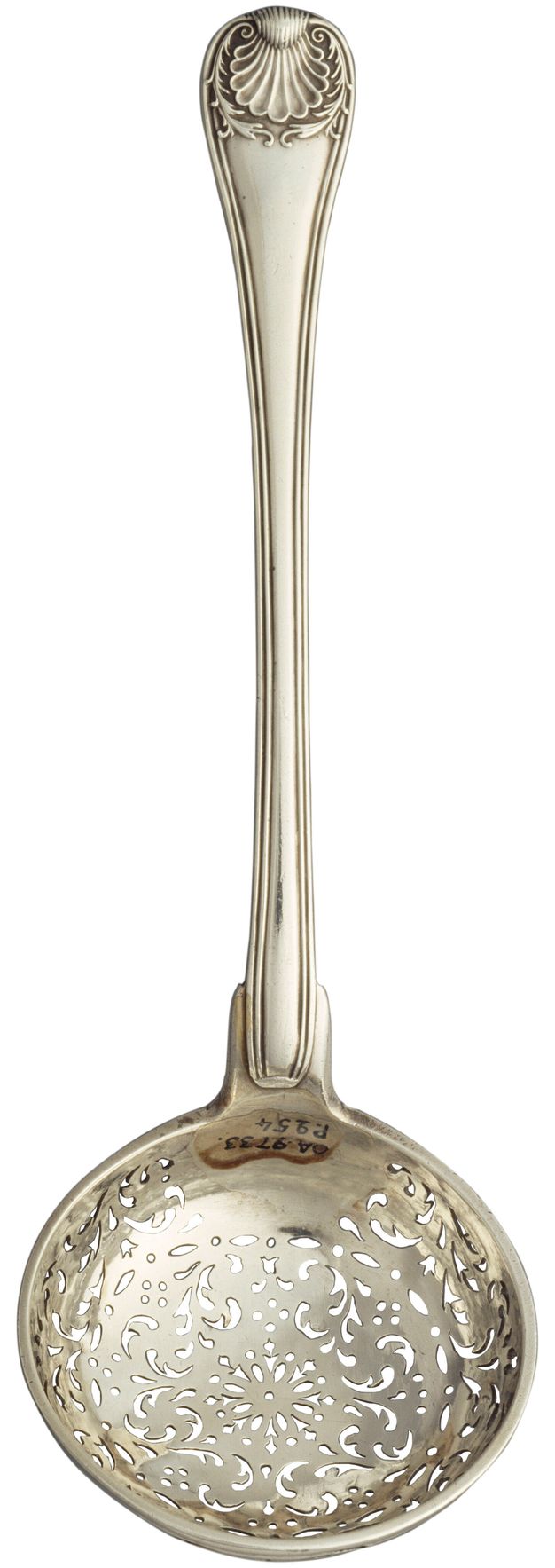
Drouais’s home on Rue Saint-Honoré, right next to the parish church of Saint-Roch, had not one but two kitchens: one on the ground floor backing onto a garden, the other upstairs on the fourth floor near the room that served as Drouais’s painting studio. Each contained a variety of common European domestic items that, like his sugar spoon, owed their existence to a global trade of colonial commodities and reveal the quotidian ways in which the Drouais family participated—consciously or unconsciously—in those consumer economies. The sugar spoon in question was most likely a sifter spoon, used for casting sugar over dishes of fruit, desserts, or cakes. Made of silver by an unknown Parisian orfèvre (goldsmith), it may have resembled one in the Louvre produced by Éloi Guérin (fig. 155), with a perforated head designed to be dipped into a sugar bowl, then shaken gently to sprinkle sugar through the holes.7 The specific foods that Drouais’s spoon may have sweetened are harder to discern, but the family certainly seem to have been partial to a waffle, keeping no fewer than three sets of waffle irons in the upstairs kitchen. Waffles themselves required a substantial amount of sugar in the batter (half a pound per batch according to one midcentury recipe), but this could be supplemented with an extra sprinkle from the silver spoon when served hot at the table.8 More sugar would have been required to sweeten coffee, which was clearly a beverage of choice for a family with seventeen cafetières distributed around the house and a coffee mill in the downstairs kitchen for grinding the roasted beans. The same kitchen was also equipped with a copper poêle à confiture (jam saucepan) for cooking fruits and vegetables into jams and preserves in recipes that required even larger quantities of sugar to act as a humectant, prolonging the life of condiments by fending off bacteria and mold.
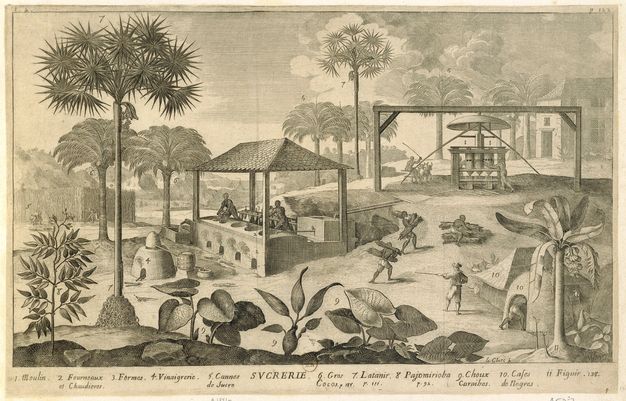
A hearty consumer of sugar, Drouais was a small link in the global economic chain of this commodity, and yet his experience of sugar—as he enjoyed his coffee, waffles, and jam—would rarely have required much recognition of the realities of its production. From local acts of purchase to domestic rituals of use, Drouais’s encounters with sugar were demonstrably detached from those colonial contexts, and indeed, following Elizabeth Heath, may have actively contributed to the increasing abstraction of colonial labor during this period.9 This is not to say that Drouais would have been unaware of sugar’s Caribbean origins or the slave labor that drove plantations. Sugar’s farming and refinement were well documented in early modern texts, both general and specific, from Diderot’s Encyclopédie to Jean-Baptiste du Tertre’s Histoire générale des Antilles, both of which included descriptions and illustrations of enslaved workers.10 Sébastien Leclerc’s Sucrerie (fig. 156), for instance, a plate from Tertre’s book, visualized the stages of sugar’s production set in a Caribbean landscape, where Black plantation laborers gather cane and work the machinery at gunpoint. But, like the refining process that transformed raw sugar into the fine white powder sprinkled at Parisian tables, the sugar that reached Drouais had been semantically distilled from the violence of its production by layers of commerce and ritual.11 For Drouais, shopping for sugar involved a simple walk down the street to one of his neighborhood’s numerous épiciers (grocers) or apothecaries, the two trades permitted to retail sugar in eighteenth-century Paris.12 By the 1770s, on Drouais’s street alone, the lengthy Rue Saint-Honoré, there were at least eighteen épiciers, two of them—Monsieur Carrey-Villiers and Monsieur Travers—specialist confiseurs (confectioners) or purveyors of sugary products.13 Consuming his purchased sugar was then facilitated through that paraphernalia of common household objects—spoons, casters, , bowls, tongs—all of which created habits of practice that made sugar native to the Parisian home, a familiar component of daily routines.14
Drouais’s sugar spoon was, like Oudry’s tobacco-filled , a European thing that existed with and because of a colonial commodity. These luxury objects were symbiotically linked to the substances they served, each depending on the other for purpose and enhancing the market together for both. Yet, in their design, both spoon and snuffbox actively abstracted those colonial economies to which they were inextricably tied.15 In the case of Drouais’s spoon, this is an assumption, for there is no description of its decoration beyond the poinçon (mark) of its Parisian maker.16 Most midcentury sifter spoons, however, adopted the kind of ornamentation found in Guérin’s (see fig. 155): common rococo motifs (like scallop shell ends and C-scroll foliage perforations) that cast no allusions to a colonial connection. While this was the norm, not all tableware maintained such decorative detachment. Though rarer, some objects did explicitly call attention not only to the colonial commodity they held but to the oppressive colonial labor that produced it.
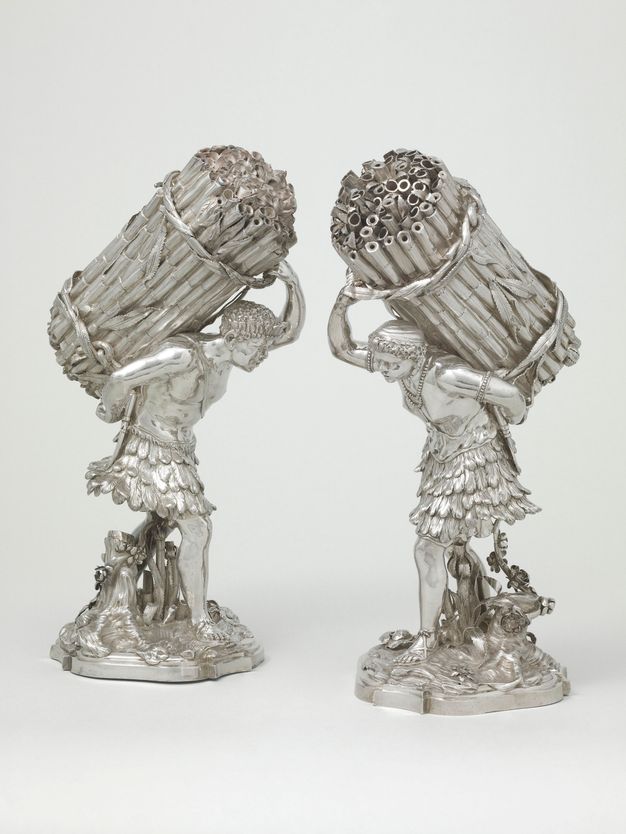
A pair of silver sucriers (sugar casters), once in the collection of Louis-Henri, duc de Bourbon, are a case in point (fig. 157).17 Taking the form of two enslaved plantation workers—a man and a woman—the figures stoop under the weight of enormous bundles of harvested sugar cane, which, in the logic of the instrument, served as the receptacles for the powdered sugar to be poured through pierced holes at the ends. At the time of their making, these enslaved figures circulated through the same decorative discourses as playful peasants or exotic chinoiseries, bodies other to the elite French consumers who owned them.18 To the modern viewer, however, these are far more difficult objects than Drouais’s spoon. Not only does their form grossly trivialize the suffering of the enslaved bodies, turning them into playthings for the aristocratic table, but as functional instruments that serve, the objects become a disturbing stand-in for their represented human subjects who, under France’s Code noir, were likewise items of property serving a master.19 By comparison, a spoon innocuously decorated with organic motifs seems far less problematic. And yet, considered differently, might not the decorative detachment of a spoon like Drouais’s actually be just as troubling? The enslaved figures that form the sucriers are, after all, at least an acknowledgment of some kind (however indifferent) of the trafficked bodies and slave labor that produced the sugar they cast. The spoon, meanwhile, so similar in function, innocently dissociates itself from any colonial connections, placing itself instead at a resolutely European remove: just a piece of Parisian silverware, like any other item of cutlery on the table.
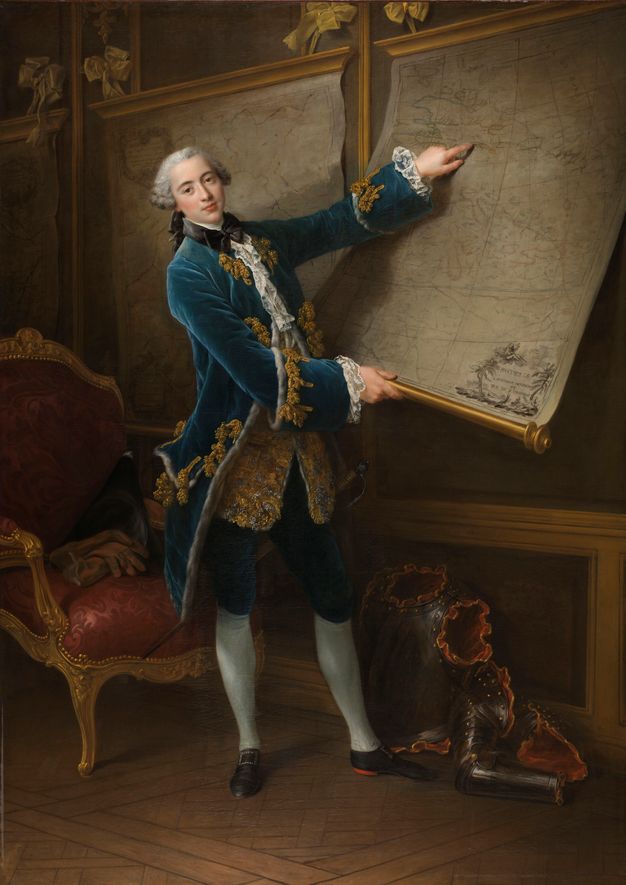
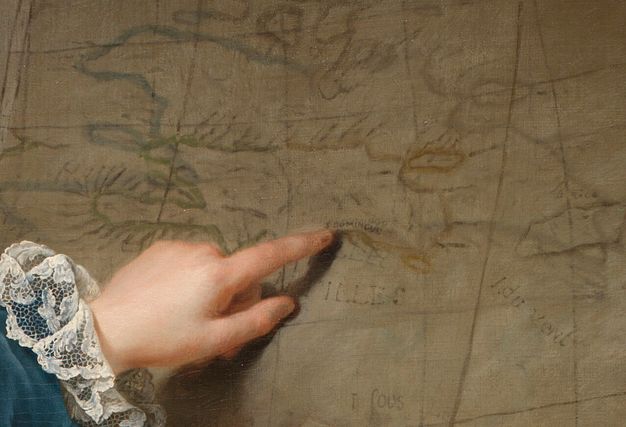
In using his sugar spoon, it is unlikely that Drouais was ever prompted to reflect upon his place within the global colonial economy, not least because that spoon made no demand upon him to do so. But the painter’s place was in fact more complicated than one of mere consumer, as detached in the European metropole as his spoon’s decoration was from the realities on the other side of the world. There is no evidence that Drouais had any direct role in the sugar trade, but as a society portraitist in a fashionable neighborhood of Paris, he was certainly drawn into the social milieu of those who did. Perhaps most notable in this regard was Drouais’s connection to the comte de Vaudreuil (1740–1817), a member of the colonial aristocracy whose portrait he painted in 1758 (fig. 158). Born in Saint-Domingue, Vaudreuil was son of the island’s governor general and owner of several sugar plantations, along with the hundreds of enslaved people who worked them.20 Vaudreuil’s connection to Saint-Domingue, the largest producer of sugar among France’s colonies, was emphasized by Drouais through the setting of the portrait in a map room, where the comte turns his back on a map of European territories and holds one of Caribbean islands.21 In this rhetorical gesture, Vaudreuil makes an embodied claim for France’s colonial interests, their bright future promised in the fall of light, but he also indicates his own interests with a possessive index finger pointing to the words “S. Domingue” (fig. 159), where his family’s plantations were located and their fortunes made. By the 1790s, Vaudreuil estimated that the annual income from his Saint-Domingue property would reach £15,000 sterling (equivalent to over £1 million today).22 Drouais, as the maker of Vaudreuil’s portrait, thus assumed an indirect part in this nexus, profiting from these colonial holdings while devising the visual argument that staked the colonizer’s possessive claim. His sugar spoon may not have prompted the connection, but Drouais certainly had occasion to consider the colonial economies of the sugar that sweetened his coffee and his waffles. ‡
This was in part due to food’s short-lived commercial value (given its perishable nature), and also because food tended to be bought fresh for imminent consumption, rather than stocked for future use. Annik Pardailhé-Galabrun, The Birth of Intimacy: Privacy and Domestic Life in Early Modern Paris (Cambridge: Polity, 1991), 87. ↩︎
François-Hubert Drouais, “Inventaire après décès,” 12 December 1775, AN, MC/ET/LIII/521. ↩︎
Robert Louis Stein, The French Sugar Business in the Eighteenth Century (Baton Rouge: Louisiana State University Press, 1988), 10. ↩︎
“Sucre,” Encyclopédie, https://encyclopedie.uchicago.edu/, 15:608. ↩︎
“Sucre,” Dictionnaire de l’Académie Française, 3rd edition (Paris: Jean-Bapiste Coignard, 1740), 2:710. ↩︎
Stein, French Sugar Business, 12–13. ↩︎
In the inventory it is described simply as being made of silver “poinçon de Paris.” AN, MC/ET/LIII/521. ↩︎
François Marin, Les dons de Comus, ou l’Art de la cuisine, réduit en pratique (Paris: Pissot, 1758), vol. 3, 131–33. ↩︎
Elizabeth Heath, “Sugarcoated Slavery: Colonial Commodities and the Education of the Senses in Early Modern France,” Critical Historical Studies 5, no. 2 (2018): 171–74. ↩︎
The Encyclopédie’s entry “Sucrerie” explains in detail the types of slave labor involved in the production of sugar. Encyclopédie, https://encyclopedie.uchicago.edu/, 15:618. Jean-Baptiste du Tertre, Histoire générale des Antilles habitées par les François, 2 vols. (Paris: Thomas Jolly, 1667). ↩︎
On the full commercial circuit of sugar in this period, see Maud Villeret, Le gout de l’or blanc: Le sucre en France au XVIIIe siècle (Rennes: Presses Universitaires de Rennes, 2017). ↩︎
In 1777, sugar’s trade was ceded entirely to the épiciers. Christian Warolin, “La vente du sucre par les apothicaires et les épiciers parisiens au XVIIe siècle,” Revue de l’histoire de la Pharmacie, 1999, 217–26. ↩︎
Almanach Dauphin, ou Tablettes royales du vrai mérite des artistes célèbres et d’indication générale des principaux marchands, banquiers, négocians, artistes et fabricans des six-corps, arts et métiers de la ville de Paris (Paris: Lacombe, 1777), n.p. ↩︎
On the transformation of tastes, habits, and rituals associated with the rise of the sugar trade, see Sidney W. Mintz, Sweetness and Power: The Place of Sugar in Modern History (New York: Penguin, 1985). On the cultural legacy of slavery in everyday objects, including sugar bowls, see James Walvin, Slavery in Small Things: Slavery and Modern Cultural Habits (Chichester: Wiley Blackwell, 2017). ↩︎
On material culture and colonial economies, see Anne Gerritsen and Giorgio Riello, eds., The Global Lives of Things: The Material Culture of Connections in the Early Modern World (London: Routledge, 2015). ↩︎
François-Hubert Drouais, “Inventaire après décès.” ↩︎
On the provenance of the sucriers, see Jannic Durrand, Michèle Bimbenet-Privat, and Frédéric Dassas, Décors, mobilier et objets d’art du musée du Louvre de Louis XIV à Marie-Antoinette (Paris: Somogy, 2014), 344–46. ↩︎
On the kind of European material culture described as “africaneries” by Anne Lafont, see Lafont, “Géographie du gout ou manufacture des africaneries,” L’art et la race: l’Africain (tout) contre l’oeil des Lumières (Dijon: Les presses du reel, 2019), 253–316. ↩︎
First decreed by Louis XIV in 1685, the Code noir defined legal conditions in France’s colonies. Code noir, ou recueil d’édits, déclarations et arrêts concernant les esclaves nègres de l’Amérique, avec un recueil de règlemens concernant la police des Isles Françoises de l’Amérique et les Engagés (Paris: Libraires Associez, 1743). ↩︎
The comte de Vaudreuil’s father was Joseph-Hyacinthe de Rigaud de Vaudreuil (1706–64), born in Quebec to Philippe de Rigaud de Vaudreuil (1650–1725), the governor-general of all New France. On Vaudreuil’s Haitian holdings at the end of the century, see Carl Ludwig Lokke, “London Merchant Interest in the St Domingue Plantations of the Émigrés, 1793–1798,” American Historical Review 43, no. 4 (1938): 796. ↩︎
Humphrey Wine, The Eighteenth-Century French Paintings: National Gallery Catalogues (London: Yale University Press, 2018), 181–83. ↩︎
Lokke, “London Merchant Interest,” 796. Currency calculations based on the National Archives Currency Converter, https://www.nationalarchives.gov.uk/currency-converter. ↩︎
| words