Type of Object
Theme
Material
Type of Object
Theme
Material
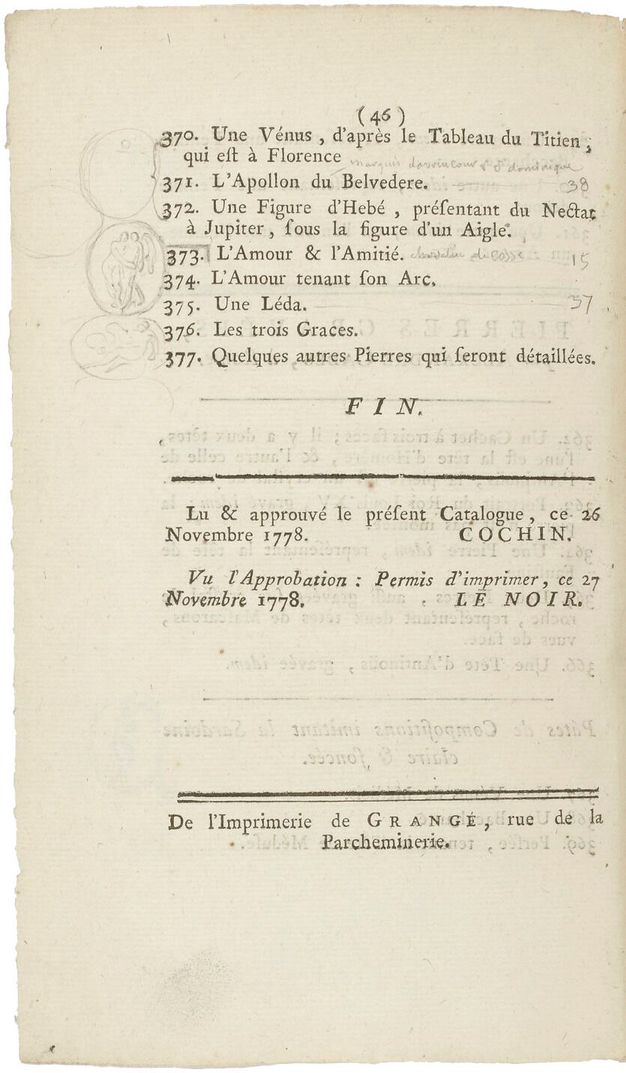
On 14 December 1778, the collection of the history painter and director of the Académie de France à Rome, Charles-Joseph Natoire, was auctioned at the hôtel d’Aligre, Rue Saint-Honoré. Natoire had died in Italy after more than twenty-five years as director at the Palazzo Mancini, but his heirs decided that the collection would sell better in Paris than in Rome.1 Shipped back to France and cataloged by the auctioneer Alexandre Paillet, Natoire’s “cabinet” had contained, in addition to examples of his own paintings and drawings, “choice and distinguished works” by “Pierre Subleyras, Jean-Paul Panini, and other Masters.”2 Among those who attended the sale was the artist Gabriel de Saint-Aubin, whose marginal drawings in his copy of the sale catalog capture in quick, black, accented chalk strokes the salient features of many of the paintings, drawings, and sculptors’ for sale—a sale that ended with a handful of ancient and modern gems, and a crop of red wax sulphur pastes, cast from gems.3 We sense the ebbing of Saint-Aubin’s interest with the gems (fig. 82); his sketches become perfunctory, in some cases no more than the oval ghost of a form, and his record of the winning bids erodes as he grows distracted. Since that brief moment of his glancing attention, total silence has befallen the gems, as no art historian has reflected on their presence.4
Intaglios and cameos are gems, usually no larger than 1 inch (2.5 cm) in diameter, on which a design is recessed, embossed, engraved, or carved. Intaglios were used as seals; cameos were worn as jewelry. According to eighteenth-century antiquarians, both originated in ancient Egypt, from where the art of gem engraving spread throughout the Mediterranean, reaching a high point of noble simplicity and refinement in fifth- and fourth-century BCE Greece.5 In the Renaissance, examples of antique gems were collected by princes, nobles, and scholars alongside classical sculpture and antique medals, but by the early eighteenth century the taste for antiquities in France, particularly medals, was in decline. Krzysztof Pomian’s quantitative analysis of the contents of Paris auctions shows that, after 1750, antiquities were surpassed by and natural history, as objects of desire.6 In partial explanation of this shift in taste, Pomian mapped its gradient onto changes in the social makeup of collectors: the market share of the nobility and clergy, who had dominated the art market to 1750, declined after midcentury in direct proportion to the rise in collecting by new money, that is, by financiers, merchant capitalists, and other professional classes, of which artists were by no means the least significant. In this context, important though Natoire’s cabinet is as an instance of the new economy of collecting, his intaglios appear to strike a false note, to be out of tune with modern trends. Was this, as Georges Brunel has suggested in relation to Natoire’s taste in paintings and drawings, because the painter was isolated in Rome, unaware of or unresponsive to developments in contemporary art and to fashions in curiosity? Should we interpret his intaglios as evidence of a reactionary taste in contrast to his contemporary François Boucher’s radical appetite for both contemporary Italian art (he owned 137 works by or after Giovanni Battista Tiepolo)7 and for ?
The answers may perhaps be found in Natoire’s collecting, not in his collection. This is to acknowledge that Natoire’s “collection” was at least partly the retrospective construct of Paillet’s cataloging. The dealer’s classification of the gems in the 1778 Paris sale implied that the painter had responded to them not individually as things but as examples of types of things: original or reproduction, ancient (fig. 83) or modern, and, if the latter, by Giovanni or Luigi Pichler (fig. 84) or Alessandro Cades.8 The fifteen engraved gems and ten sulphur pastes assume, in the catalog, the appearance of a bounded system whose meanings emerge from the relations between the different examples: by connecting and comparing a paste of an ancient gem of Leda and the Swan with Pichler’s carnelian intaglio, or contrasting Cades’s two versions of the bust of Antinous, or alternatively—for a study of youth and age—of reading the one Antinous mounted on a multifaceted seal (cachet) against a head of Homer, also by Cades, with which it was paired and with which it had been set for Natoire in a three-sided jewel.9
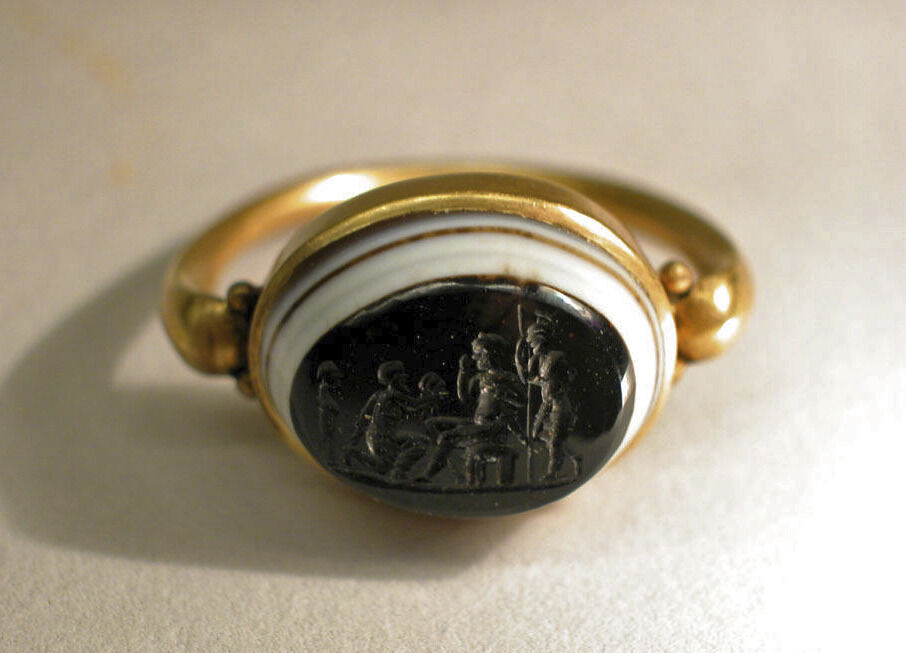
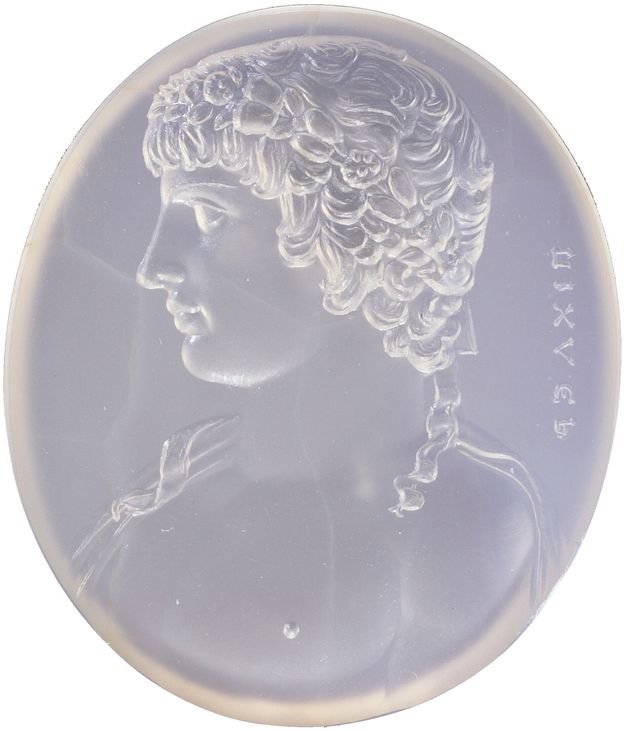
Paillet’s description of the gems focuses primarily on the subject matter, but insofar as he identifies the minerals of which the gems were made, he also invokes their color—red (cornelian), brown (sardonyx), white (chalcedony), and the pure clarity of rock crystal (quartz). Moreover, in the case of the antique gems, he intersperses his description with observations—“one sees . . . ,” “one notices . . .”—observations that prioritize the experience of looking over the value of knowing.10 Paillet’s address to sight and his deft erudition removed Natoire’s gems from the domain of antiquarianism and aligned them with the paintings and drawings in the collection as instances of art and beauty. The reason for Paillet’s appeal to the senses may have been his lack of classical learning, but its effect was to assign autonomy to Natoire’s “collection,” to detach his gems from both their actual uses in antiquity and from their latent function as concrete witnesses of history. Parallels can be drawn with the new historiography of gems generated by connoisseurs like the comte de Caylus and Pierre-Jean Mariette in the 1720s and 1730s, and which culminated in 1750 with the publication of the catalog of the king’s gem cabinet, introduced by a Traité des pierres gravées, written by Mariette.11 Mariette’s Traité reinvented gems as objects of desire, by forgetting or largely ignoring questions of historical and local context in favor of properties of authorship and authenticity, that is, characteristics directly relevant to the exchange economy and the market for art.
Disengaging Natoire’s collecting from Paillet’s collection is tricky. Alternative primary sources are scant. However, by analyzing what little we can extract from his letters to his friend Antoine Duchesne, and by comparing his choices with those of other artists, among them those directly involved in the illustration of Caylus’s and Mariette’s successive cataloging projects of the royal gems—Charles-Antoine Coypel, Jean-François De Troy, and Edme Bouchardon—we may be able to shed some light on it.12 The material, phenomenological, and symbolic factors at play in gem collecting will serve as a focus.
Before leaving Paris, Natoire organized a sale of things not for Rome. A manuscript list of the sale indicates that before his departure he had owned engraved views of Roman ruins and prints after antique sculpture, but no gems, nor any pastes, prints, or books related to them.13 Thus, in spite of his connections with the Caylus-Mariette circle in the 1730s and 1740s, he was not apparently infected with the love of gems—“monuments in miniature” Mariette called them.14 A letter to Duchesne posted en route, in October 1751, suggests that his interest in antique things was sparked by the journey. He remarked on the abundance of medals and other antiquities he had seen for sale at Nîmes,15 and, after arriving in Rome, he sent more news: he alluded briefly to participation in hunting parties for “curiosities and antiquities” (antiquailles). Looking, he seems to imply, had given way to possessing.16 The use of the verb “roder” (to roam) to describe his mode of quest indicates a spontaneous, nonsystematic, and nonserial manner of acquisition, one in which chance and whim played a part, in contrast to the planned and ordered collection by type and set practiced by numismatists and antiquarians like the abbé de Rothelin, by whom Coypel was given a collection of 1,680 glass pastes, cast from the gems in the royal collection and arranged “symmetrically” in red leather–lined trays, inside a pair of olivewood and brass boxes that Coypel kept in his cabinet.17 Natoire’s gems, though mostly originals, not reproductions, were unworthy of such containers for lack of the unity, totality, and coherence that buying for collection confers.
Antiquailles was the word Natoire used to describe the treasures he hunted, translated above as “antiquities” for lack of an equivalent word in English. Unlike antiquities, the meaning of antiquailles is loaded.18 It is unlikely that Natoire intended it to convey contempt for his discoveries; more likely he meant Duchesne to understand the worn agedness, even grubbiness, of his modest finds: wastes of an earlier civilization. His were not gems like De Troy’s, whose “bijoux” (jewels) Pierre Rémy cataloged as rings, not pierres gravées, because they were precious: an amethyst intaglio of a sea horse, an extraordinary onyx and agate cameo carved with the head of a “négresse” (black woman) that “exploited the different accidents in the stone to great effect.”19 If Natoire selected his gems individually, without thought of collection, it was not on the basis of nature’s strange accidents, or the curious exoticism of the design, or the total novelty of the commodity; their subjects were arguably hackneyed: Venus, Leda, the Bacchantes.
Not collected by genre, author, or theme, and not worn as luxuries of dress, Natoire’s gems seemingly formed a more private and personal relationship with their owner than did Coypel’s and De Troy’s. Natoire confessed to Duchesne that it was close bodily experience of the ancient past at Nîmes, on visiting Jacques-Philippe Mareschal’s excavations of the Roman “fountain,” that had made him, instantly—that is, without the mediation of learning—an “antiquaire.”20 On the day of his arrival in Rome, he wrote to his friend that such had been the impact, we might even say the shock, of the city and of his reception there, that he experienced his “landing” almost as a “dream.”21 Not only do his letters register his aesthetic and emotional response to specific changes of scene, they also suggest a more general temporal disorientation. Born at Nîmes, at seventeen Natoire left to finish his training in Paris. Having obtained the Prix de Rome, he spent 1723 to 1729 at the Palazzo Mancini as a pensionnaire. His journey south in 1751 was therefore a much longed-for return, to judge by his bid at the directorship of the school as early as 1737. He remembered the Maison Carrée, “that monument that would not be the least of Rome’s,” but did not recognize his brothers, not seen since he had left as a lad. He was greeted in Rome by “old acquaintances” whom he had forgotten, but he knew again the beautiful “curiosities” of the city studied in his youth.22 Antique things anchored his memory; they marked his place in and passage through life, transforming ancient history into private time. Natoire’s gems were his souvenirs.23
Susan Stewart says of the souvenir, in contrast to the collection, that it prompts narrative, storytelling not about the objects but about the persons to whom the specific things belonged. To categorize Natoire’s gems with souvenirs distinguishes them further from those collected and classified by Coypel and consumed for show by De Troy. It also sets them apart from Bouchardon’s antique gems, with which, on grounds of biography, we could have expected greater affinity. Natoire and Bouchardon had studied together in Rome, and the connection they formed there survived the return to France. In Paris they worked alongside each other on projects for Pierre-Jean Mariette, Natoire making copies of the collector’s drawings, Bouchardon drawing the king’s gems for Mariette’s Traité. In François-Hubert Drouais’s portrait of Bouchardon (1758, Paris, Musée du Louvre), the sculptor holds a volume entitled “Monum[ents] antiq[ues]” with his right hand. On his little finger sits a gem set in a gold ring that we can identify with one of the antique cameos inventoried among the sculptor’s possessions at his death in 1762.24 In the narrative of the portrait, the gem, though closely attached to Bouchardon, signifies across him, connecting along a diagonal “ancient monuments” in the foreground with the of Bouchardon’s modern ones in the background. Insofar as the cameo speaks of Bouchardon, it tells of his participation in the epic transmission of ideal form across time and place, and of his identity in the history of the classical tradition.
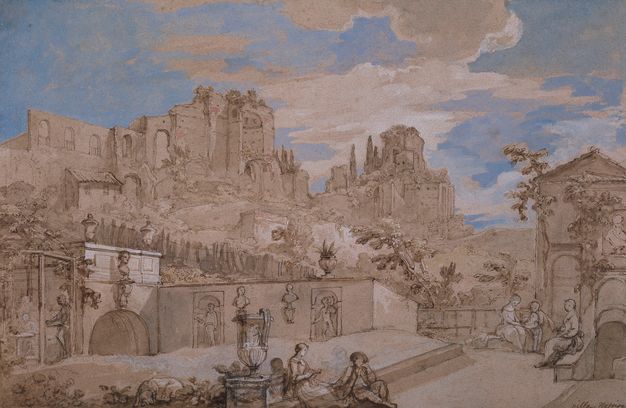
For Natoire, antiquity was a matter first of his own origins at Nîmes, a place he experienced as another Rome, at least in respect to the beauty of the Maison Carrée. Significant in his letters is not, however, the identity of specific monuments, large or small, but his reaction to them. His letters to his “carrissimo amico,” his dearest friend, express his longing for Duchesne’s presence: Natoire wanted to face the sights with Duchesne; more importantly, he seems to have wanted Duchesne to experience Natoire’s own response to them, to witness it as authentic and as coming from within. That response was not unequivocal, like we assume Bouchardon’s to have been from Drouais’s portrayal; rather, it was ambivalent. Natoire’s line about his pleasure in hunting antiquailles was followed in the very next sentence of his letter by distress at news of a death: “here we are,” he cried, “back among the dead.”25 The juxtaposition of topics, and the adverb “back,” suggest that numbered among them are also the dead of antiquity. In response, months later, to the unexpected death of De Troy on the eve of his return to Paris, Natoire observed that “the most brilliant things” are almost always accompanied by shadow. At one level he was no more than repeating the Christian trope of the vanities. However, by articulating it metaphorically using “a phrase from painting,” as he acknowledged, he also suggested that death wastes not just individuals but civilizations.26 The countervailing force of death in the letters shades Natoire’s references to the antique with nostalgia. In Drouais’s portrait and Mariette’s Traité, antique gems are represented as a medium, the means by which the masterpieces of sculpture and paintings of antiquity had unintentionally been perfectly preserved for the present in order to be renewed. For Natoire, antiquities, perhaps including his gems, were the battered material survivals of a past from which he felt separated but for which, desiring, he searched. Finding souvenirs in and around Rome and appropriating these antiquailles for his villa (fig. 85), he set his treasures in niches, on sconces, on pedestals, and on entablatures in the garden, at once safe from and united with the ruins beyond its walls. Past and present came together by his art. §
Some things were sold in Italy before shipment. See CDR, 13:327–28. ↩︎
[Alexandre-Joseph Paillet], Catalogue des tableaux et dessins originaux des plus grands maîtres . . . qui composoient le cabinet de feu Charles Natoire (Paris: Chariot & Paillet, 1778). See also JoLynn Edwards, Alexandre Paillet: Expert et marchand de tableaux au XVIIIe siècle (Paris: Arthena, 1996), 233–34. ↩︎
Paillet, Catalogue: 24 lots out of a total of 377. ↩︎
On Natoire’s collection excepting the gems, see George Brunel, “Charles-Joseph Natoire collectionneur,” in Charles-Joseph Natoire, exh. cat. (Troyes: Musée des Beaux-Arts, 1977), 34–38. ↩︎
See Pierre-Jean Mariette, Traité des pierres gravées (Paris: Mariette, 1750), 1:3–4, 49, 55. ↩︎
Krzysztof Pomian, “Medals/Shells = Erudition/Philosophy,” in Collectors and Curiosities, Paris and Venice, 1500–1800 (Oxford: Polity, 1990), 121–38. ↩︎
Brunel, “Natoire collectionneur,” 37. Boucher’s collection included gems, classed as “jewels” and mostly polished semi-precious stones “engraved” by nature’s hand, not man’s—tree agates and an amber ring with a fly inclusion. Exceptions were an agate portrait cameo, and a white agate intaglio engraved with “the god Priapus and a satyr,” which may have been antique. See Catalogue raisonné des tableaux, desseins, estampes . . . de feu M. Boucher (Paris: Musier, 1771), lots 1083, 1085, 1086, 1088, 1091, 1092, 1098. ↩︎
See Paillet, Catalogue, lots 354–57 (Pierres antiques); 358–61 (Pierres modernes: Pickler); and 362–77 (Pierres modernes: Alexandre Cadès). ↩︎
Paillet, Catalogue, lots 375, 358; lots 362, 366; lot 362. ↩︎
Paillet, Catalogue, lots 355, 356. ↩︎
See Kristel Smentek, Mariette and the Science of Connoisseurship in Eighteenth-Century Europe (London: Routledge, 2014), 191–227. ↩︎
The first attempt to publish the king’s gems was initiated by the comte de Caylus in the 1720s. By 1730 he had enrolled the services of Coypel and De Troy. Sometime between 1733 and 1737 Bouchardon became involved. See Smentek, Mariette, 195–96 and 296n22. ↩︎
Catalogue de la vente des desseins, estampes et tableaux de M. Natoire, fait avant son départ pour Rome (6 September 1751), lots: 143 (volume of prints of Ruines de Rome published by Justus Sadeler); 151 (volume of Figures antiques de Rome, etched by François Perrier); 153, 161 (Two volumes of prints after the Column of Trajan), INHA, Ms. VP1763/1f. ↩︎
See Mariette, Traité, 36. On Natoire and Mariette, see Perrin Stein, “Copies and Retouched Drawings by Charles-Joseph Natoire,” Master Drawings 38, no. 2 (2000): 167–86. ↩︎
Charles-Joseph Natoire to Antoine Duchesne, 6 October 1751, in “Charles Natoire: Correspondance avec Antoine Duchesne, prévôt des Bâtiments du roi,” ed. Paul Mantz, AAF 2 (1852): 261. ↩︎
Natoire to Duchesne, 1 March 1752, in “Charles Natoire: Correspondance,” 272. ↩︎
[Pierre-Jean Mariette], Catalogue des tableaux, dessins, marbres, bronzes, modèles, estampes et planches gravées . . . du cabinet de feu M. Coypel (Paris: n.p., 1753), lot 202. ↩︎
See Antoine Furetière, Dictionnaire universelle (The Hague: Husson, Johnson & Swart, 1727), 1: s.v. “Antiquaille”; Dictionnaire de l’Académie Françoise, 4th ed. (Paris: Brunet, 1762), 1: s.v. “Antiquaille.” ↩︎
Pierre Remy, Catalogue d’une collection des très beaux tableaux, desseins, et estampes . . . de la succession de feu M. J.B de Troy (Paris: Didot, 1764), lots 330, 336. As an executor of De Troy’s will, Natoire was familiar with his gems and arranged their dispatch to Paris after De Troy’s death in 1752. ↩︎
On the excavations, see Caroline Millot, “Les jardins de la Fontaine à Nîmes et l’oeuvre de Jacques-Philippe Mareschal (1689–1778): Un patrimoine aux multiples facettes,” Patrimoines du Sud 8 (2018), http://journals.openedition.org/pds/372. ↩︎
Natoire to Duchesne, 9 November 1751, in “Charles Natoire: Correspondance,” 264. ↩︎
Natoire to Duchesne, 22 September and 6 October 1751, in “Charles Natoire: Correspondance,” 258–63. ↩︎
See Susan Stewart, On Longing (Durham and London: Duke University Press, 1993), 132–50. ↩︎
See Charles-Joseph Natoire, “Inventaire après décès,” 18 August 1762, AN, MC/ET/LXXVI/384. ↩︎
Natoire to Duchesne, 1 March 1752, in “Charles Natoire: Correspondance,” 272. ↩︎
Natoire to Duchesne, 19 January 1752, in “Charles Natoire: Correspondance,” 269. ↩︎
| words