Type of Object
Book
- Gilles-Marie Oppenord (1672–1742)
- Gabriel de Saint-Aubin (1724–80)
Cesare Ripa, Iconologie; ou Explication nouvelle de plusieurs images (Paris, 1636) and Antoine-Joseph Pernéty, Dictionnaire portatif de peinture, sculpture et gravure (1757). Gilles-Marie Oppenord, architect, and Gabriel de Saint-Aubin, draftsman. Two books and two owners. How can we understand the relationship between these artists and the books they owned? That early modern artists were deeply invested in books as a sign of their status as liberal artists is to state the obvious. For Oppenord and Saint-Aubin it was perhaps particularly so since neither were academicians and thus beneficiaries of the reputation for learning that academic membership conferred. A better question is, how did artists read their books? The question is the more pertinent because reading habits were changing. Oppenord and Saint-Aubin belonged to different generations, the architect having grown up and established his career in the last decades of Louis XIV’s reign, while the draftsman came of age professionally at the time Louis XV began his personal rule, in 1742, coincidentally also the year when Oppenord died. Comparison of the two artists’ relations with their books expressed in the marginalia they added to them provides material for thought on how such relations evolved.
To emphasize reading is to set aside approaches to marginalia that construe doodling as an opportunistic colonization of the virgin spaces of the printed page. Instances of “not reading” but drawing often feature in artists’ lives. They serve as tropes of genius, of the irrepressible and defiant exultations of artistic will. According to Charles-Nicolas Cochin, the schoolboy Jean-Baptiste Massé thus crammed his copies of the classics, until his father relented and allowed him to take up art, and not finish the courses in humanities in which he had had him enrolled.1 Doodling as a mode of reading returns drawing to the shores of the text. To interpret it, we should first note than a revolution in European reading practices occurred in the eighteenth century.2 A world in which individuals owned few books and related to them in a manner Rolf Engelsing describes as “intensive”—that is, characterized by close, sustained reading, rereading, and memorization—was disappearing, and in its place, a new world characterized by extensive reading was taking shape, one in which readers browsed, casting their attention lightly and widely over a constellation of different texts. Roger Chartier has since proposed a more nuanced understanding of this “great transformation,” one that also takes into account classes of readers and genres of texts.3 From the work of Engelsing and Chartier the following questions arise: Were artists a particular kind of reader? How did such readers read their chosen texts?
The editors of The Artist as Reader (2013) propose three distinct modes of specifically artistic reading: (1) “following,” or copying; (2) “independent reading,” where the artist’s interpretation competes with the text, and (3) “critical reading,” where reading subverts the discourse of the original.4 We can position these practices as points between the intensive/extensive poles as follows: “following” at the intensive end, and “independent” and “critical” reading toward the extensive end. Modes of reading are, of course, not independent of the specifics of texts. Both Iconologie and Dictionnaire portatif are types of dictionaries, the self-confessed product by collation of extensive reading. Dictionaries surely invite reading of the same extensive kind. Roger de Piles certainly distinguished between such manuals of occasional, dispersed reference, and the proper, concentrated reading elicited by books of poetry and ancient and modern history.5 Yet the material evidence of Oppenord’s and Saint-Aubin’s marginalia suggests the very opposite. The very fact of it, inscribed in both cases throughout the books, from beginning to end, suggests sustained and thoughtful readerly attention. Moreover, Saint-Aubin’s dated annotations (from 1761 to 1770) indicate repeated use of and engagement with his book over the best part of a decade. With these contradictions in mind, “following,” “independent,” and “critical” reading are, nevertheless, helpful categories with which to study the intercourse between artists and books and to trace the shifts in relations of power between reader and author, person and book.
Evidence of “following” in its simplest form is to be found in the scattered tracks left by Saint-Aubin as he sprinted through Pernéty’s introduction, “Traité des différentes manières de peindre,” at the front of the dictionary. He checkmarked passages of note with a cross. He underlined points to remember.6 Saint-Aubin modestly submits to the authority of the text; he reads to annex the other’s knowledge, repeating it with emphasis in order to incorporate it better. This culture of following, or of the copy, is one particularly associated with academic training, and Saint-Aubin gave it visual echo in the nudes he drew, as if from the model, to decorate “A” for “Académie” (2). The education of architects, no less than that of painters, was based on a regimen of exact copying and verbatim transcription. Antoine Desgodets’s courses on architecture given at the Académie Royale d’Architecture in the 1720s have come down to us through the transcripts and copies of his students. Jean Pinard’s copy of Desgodets’s Traité de la commodité de l’architecture was, for instance, made more or less at the same time that Oppenord was “reading” his Ripa.7 Oppenord, however, unlike Pinard, was not a teenager. At the moment the books here in question were being read, both he and Saint-Aubin were in their forties and established artists; moreover, the context of their study was the studio not the classroom. Were acts of copying always also instances of following?
Jean-François Bédard’s analysis of Oppenord’s use of Ripa as a source of ornament shows how the architect extracted motifs from Ripa’s emblems and built them up into ornamental trophies—the zodiac hoops of Agriculture, the dolphin from Courtesy, the star from Reason, the laurels from Patriotism, and the flame from Love of God.8 In the copying process, Ripa was abandoned. His symbolic forms were prized from the text, recycled and gathered as ornamental flotsam and jetsam. They were transformed into detail with pictorial effect but no meaning. Bédard argues that this playful combinatory practice of ornament is best understood in the context of late seventeenth-century honnêteté and demonstrates an aping of the extensive ludic reading and learning practices of the elite, for whom Oppenord created such arabesques, rather than close fellowship with Ripa’s text.9
Saint-Aubin also copied. Below Claude-Alphonse Dufresnoy’s advice, “never a day without a line,” paraphrased by Pernéty in his entry “Ligne” (392), Saint-Aubin chorused “nulla dies sine linea,” chasing the citation back to its source.10 Floating in the margin without context, the phrase, like Oppenord’s ornaments, is insubstantial for all its antique gravity. Though lexically full, parroted mechanically it appears threadbare. It drifts away from trope and toward cliché.11 The effect of déjà dit or déjà vu that characterizes cliché is present also in Saint-Aubin’s response to Pernéty’s definition of pastoral landscape as a stand of trees (447–48). He draws between “arbres” at the top of the page and “paysage” at the bottom, to link the two, a line of saplings (fig. 13) willfully unoriginal in the extreme.
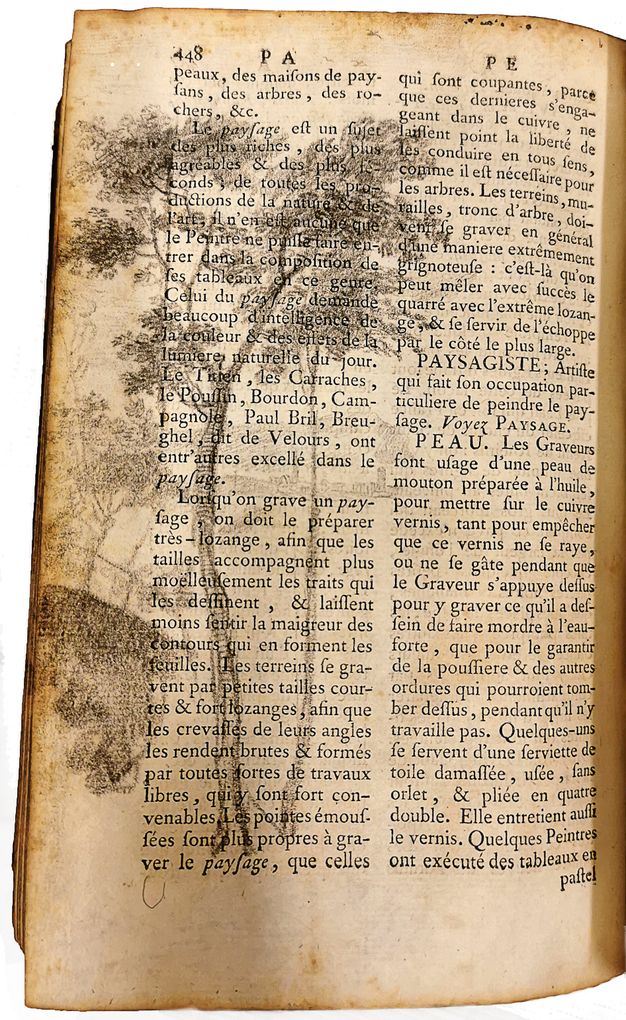
These examples call into question the notion of copying as imitation in the classical sense, which is to say, as the faithful rendition of an original by one who submits to its authority as exemplar. Oppenord’s and Saint-Aubin’s copying, though authentic in its way, is conspicuously lacking in seriousness. It is light. There are, however, differences as well as similarities in the spirit of their copies. For Oppenord, lightness was actively and repeatedly sought as a property of grace and energy. The delicacy and liveliness of his lines is consistent with an intimate, if not always respectful, relationship with Ripa’s emblems. By comparison, Saint-Aubin’s text touching seems automatic and glancing, an engagement that turns outward and extends onto other texts: Pliny by way of Dufresnoy, the landscapes of Bourdon, Campagnola, Brill, Breughel de Velours, whose names as exponents of the genre we discern through the branches of his trees. In the case of both, a more flexible concept of following is required to capture their engagement with their books.
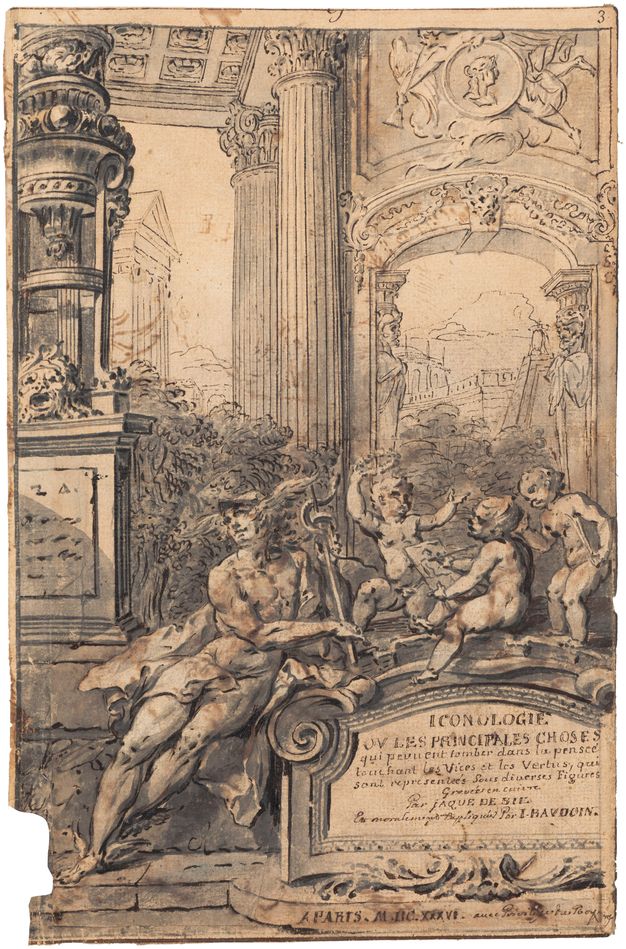
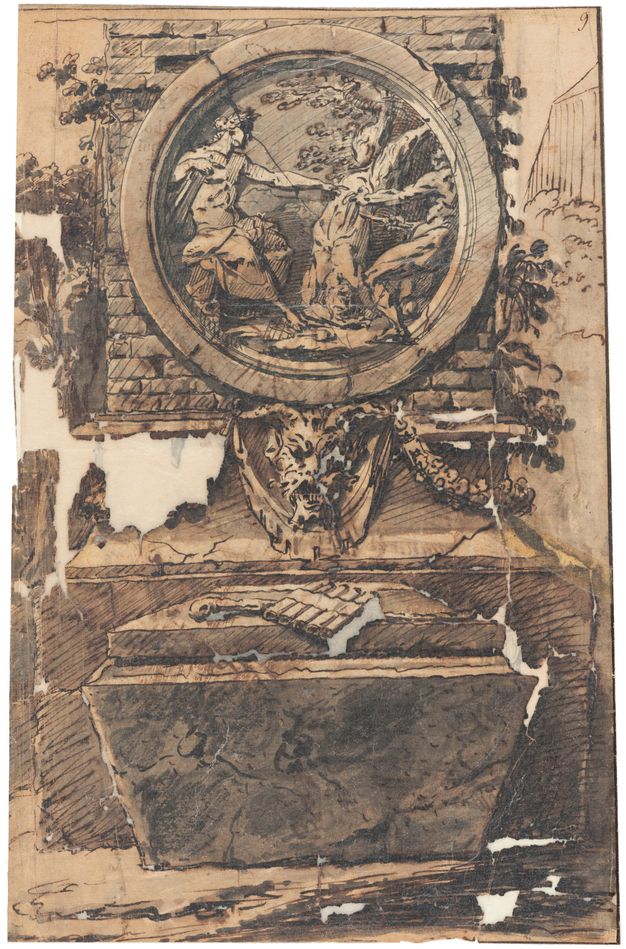
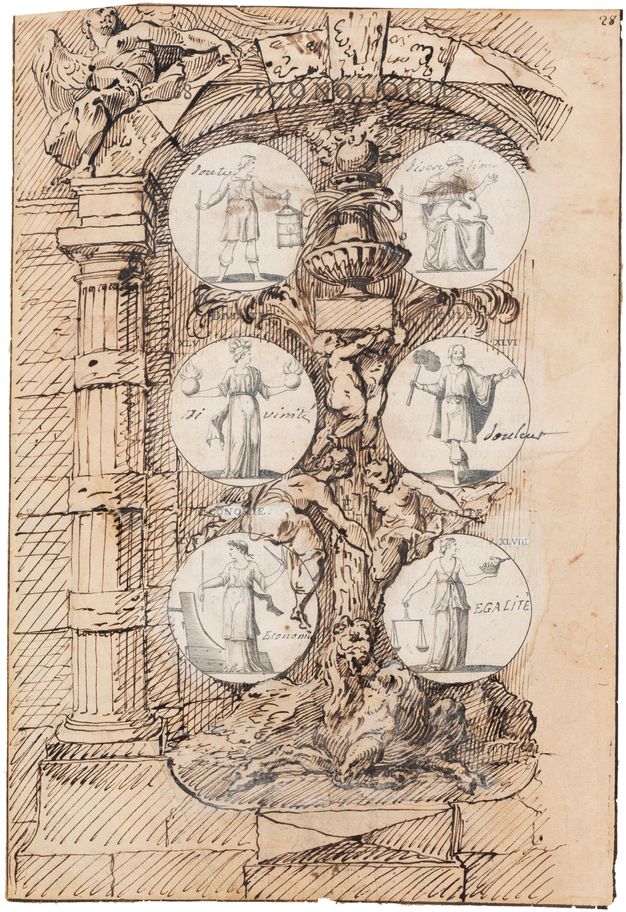
The distinction between following and independent reading is clearly subtle. Independent reading competes with the text but always on the terms of the original. It seems significant that Oppenord’s attention in reading Iconologie was most intense at the beginning and the end: he drew at least two alternative frontispieces (fig. 14) and provided two to three possible endings. It is significant because Oppenord’s repetitions seem to respond to a contradiction inherent in the Iconologie, which simultaneously promotes itself as a compendium of universal knowledge of “moral things” while simultaneously disaggregating that knowledge by distributing it alphabetically. In other words, the Iconologie promotes itself as a full account of affirmative or symbolic signs yet denies the reader the ability to grasp its unity by scattering that knowledge under the arbitrary signs of the alphabet in a way that precludes reasoned articulation of the ethical connections that make sense of its multiple parts. Ripa’s Iconologie is without hierarchy or system; it is, in this epistemological sense, an unmapped continent. It seems possible that Oppenord’s alternative paratexts were an attempt to rescue the Iconologie as a circle of knowledge with the help of allegory and narrative. In one of the alternative frontispieces (see fig. 14) he places the text under the sign of Mercury, god of sense and communication. In place of Zèle (Zeal), that most intense feeling of active agency, of being alive, which paradoxically brings the text of Iconologie to its end, he substitutes a tomb. Marsyas swaps place with Mercury (fig. 15) and silence falls.
Saint-Aubin read with a different kind of independence. His most consistent and conspicuous marginal additions are in connection with artists’ pigments. Pernéty’s dictionary provides basic scientific definitions of them in terms of their organic and mineral sources and rates them for their stability, permanence, and safety. He refers his readers to the Mémoires of the Académie Royal des Sciences and cites such scientific authorities as the chemist Johann von Löwenstern-Kunckel.12 Saint-Aubin’s response seems, at first, to amount to no more than following: he supplements Pernéty’s definitions by using the line ends of the dictionary as so many drawers in which to lodge specimens, like filling up a .13
However, in the accompanying annotations, Saint-Aubin’s reading urges him beyond illustrative repetition. It prompts in him the recollection and articulation of another discourse on color—everyday, concrete, retail talk of suppliers and prices. He takes a virtual tour of Paris to the best shops for , orpiment, ultramarine, umber, and ivory black.14 He measures the rise and fall in prices over time. If we can assume that the paintbrush preceded the pen in this independent reading, we can infer that Saint-Aubin’s autonomy was secured above all by the materiality of the text: by the layout of the page, by the gutter and margins. It was these physical properties that led to samples, and from samples to geography and accountancy. The marbled endpapers were further grist to Saint-Aubin’s private milling of the text (fig. 16). At the front, easy to overlook, is a figure of a boatman curled into a landscape.
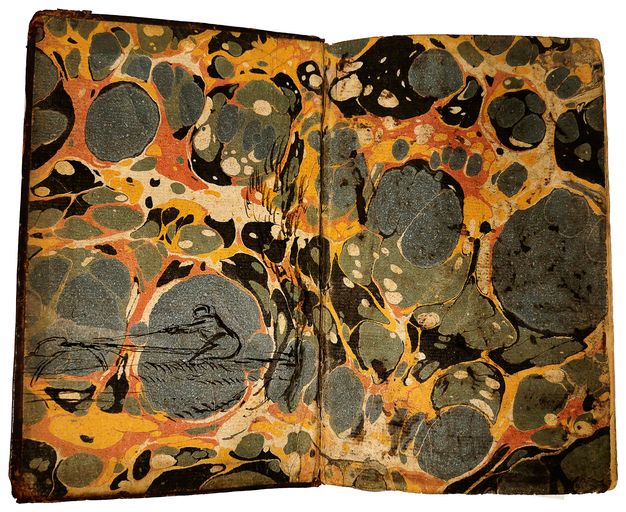
Oppenord and Saint-Aubin responded quite differently to the circle. Oppenord works around the circles of Ripa’s emblems (fig. 17), treating them as fixed features of the page, as monuments in a paper setting. He does not frame them, in the sense of setting them off with more of the same; he offsets them, throwing into relief their difference. Insofar as they are appropriated, it is as found objects, not designs or signs. Saint-Aubin, by contrast, invades the page; his filling figure recasts the marbled paper as background. His is the reading response advocated by Leonardo (and I paraphrase):
[L]ook upon an old wall covered with dirt, or the odd appearance of some streaked stones and in them you will discover landscapes, battles, clouds, uncommon attitudes, funny faces, draperies, etc. Out of this confused mass of objects, the mind will be furnished with an abundance of designs and subjects perfectly new.15
Where Oppenord’s independent reading pursues and demonstrates learning, erudition, and intellect in the same humanist terms as Ripa’s Iconologie, Saint-Aubin’s strategies of reading and response reveal objectives quite at odds with those of Pernéty. They were at once more banal (the price of paint and canvas) and more inspired.
To turn finally to critical reading: critical reading involves challenge: furious skirmishes against authority of the text. There are, perhaps, few unambiguous signs of it in Oppenord’s apostils. But perhaps we can suggest one. Aurora and Avarice, or dawn and greed, have nothing in common; they are not even entities of the same ethical kind. Their adjacency in the Iconologie is an accident of language. Oppenord, however, portrays them as mirror images of one another, virtually counterproofing them across the opening of facing pages.16 They appear materially, and therefore causally, linked: both on chariots, both with torches, neither with their attributes—respectively wings and wolves. Their resemblance at Oppenord’s hand undermines, one could say, the transparency and legibility of Ripa’s icons, and, if deliberate, transforms them into enigmas such that bright Aurora gestures toward Avarice as the dark, hidden side of herself. Did Oppenord understand that every sign has something enfolded within it, something other, and that in order to learn not its explicit and conventional meaning but its more profound and unsettling truth, it has to be unfolded?
Saint-Aubin’s critical approach is more direct. Inserted between the black lines of Pernéty’s definitions of ébauche (sketch) and ébaucher (to sketch) (152–53) Saint-Aubin writes, in tiny letters, alternative definitions—gleaned from Jean-Baptiste Oudry, whose “Discourse on the Practice of Painting” he had attended in December 1752—that run like a red thread of dissonance through the established truths of the text.17 On another occasion he directly contradicts Pernéty. In a discussion of artistic temperament, Pernéty had asserted that painters portray themselves (343): the lighthearted and jocular artist, for example, paints comic scenes and the grotesque. Thus, led to connect his family’s taste for jokes, famously recorded by them in The Book of Bums, and his own propensity for melancholy, Saint-Aubin retorts: “this is not always true.”18 And, on top of critique and contradiction, he also piled irony. Next to the orderly column of Pernéty’s definition of composition (75), he scrawled a collapsing tower, a decomposition, citing as counter-evidence of Pernéty’s fine principles of unity and integrity the tragicomic example of collapse on Rue de la Huchette on 9 February 1767.19
The different modes of reading—imitative and independent, sympathetic and critical—blend into one another and provide through these examples complexity and refinement to the rough binary intensive/extensive. They indicate a smoother, more graduated evolution from one practice to the other, a bloodless revolution, not least because those different modes were, it seems, not mutually exclusive and often exercised together in response to one text. That said, change is surely discernable. On the basis of the marginalia, Oppenord’s reading appears to have been more intense. He cleft to Ripa and to the moralized universe that the Iconologie represented. Saint-Aubin’s reading, on the other hand, erred from the text, jeopardizing its authority and putting its integrity at risk by opening it onto the world of everyday commerce and to the conflicting opinions of other texts. Though idiosyncratic in so many ways, the reading habits of Oppenord and Saint-Aubin were, by this analysis, structured by more general shifts in social and cultural practices brought about by expansion of the book trade and development of new literary products, such as cheap pocket dictionaries.
What do Oppenord and Saint-Aubin and their books tell us about artistic identity in the eighteenth century? The answer is not simple because reading was a focus for anxiety. For Roger de Piles, whose opinions were influential for much of the eighteenth century, learning was essential to the artist, and he lamented the decline of reading among the painters of his day.20 Antoine-Joseph Dézallier d’Argenville was perhaps less categorical. He reported Charles de La Fosse’s view that reading distracted attention from the practice of painting, inhibiting the formation of skill, and he noted with favor painters such as Claude Lorraine and Rembrandt, nonreaders both, whose genius was fed on nature alone.21 Oppenord and Saint-Aubin appear to have subscribed to the first view. They identified themselves in and with their books. In one of his title pages Oppenord added his name at the bottom of the page, beneath the name of Ripa’s translator, Jean Baudouin. In an extra illustration, he framed his monogram “GMO” in a massive cartel toward which a putto, balanced on the upper rim, gestures unnecessarily. Saint-Aubin’s monogram “GDSA” appears in his copy of the Dictionnaire portatif, not on the flyleaf or title page but in the body of the text.22 In the opening page of the introductory “Treatise,” he drew figures of Oil Painting and Encaustic, and inscribed the plinths on which they stand with his initials. There are differences, however. Oppenord’s presence in his copy of Ripa seems to be that of an owner: the cartouche for his monogram resembles those used in the design of bookplates. Oppenord’s Ripa was one book among others. He possessed a library.23 Books, we can infer, were important to the professional and social identity he fashioned for himself. According to the guidebook writer Germain Brice, Oppenord’s house, on Rue Saint-Thomas-du-Louvre, was “filled and decorated with many beautiful things,”24 which at his death included rosewood and purplewood bookcases with marble tops and gilt-bronze fittings in which his books were shelved.25 His acquired knowledge, praised by Brice, may not have been as deep and thorough as connoisseurs like de Piles desired, but Oppenord’s intensive reading and the material display of his learning secured his title as a gentleman and honnête companion to princes and the elite.
By contrast, such was the dirt and chaos of Saint-Aubin’s lodgings, Rue de Beauvais, at his death in 1780 that the inventory of his possessions was delayed.26 Neither his studio nor his stuff, nor in fact his extensive mode of reading, conformed to the classic humanist ideal of doctus Artifex, nor to standards of gentility. By signing his name not on Pernéty’s book but on the fictions conjured up within it by his marginalia, Saint-Aubin realized a profoundly different entanglement with textual things. His annotations display not a rational and ethical self-fashioning, rather they express a more modern subjectivity based on interiority, an interiority not always easily read. On the page facing Saint-Aubin’s inoffensive drawing of trees is a neat inscription in ink at the top (449). It reads, with an insertion mark: “Pédéraste ou Sodomite” (Pederast or Sodomite). What made him write it? What does it mean? Where the inscription “nulla dies . . .” was and is for the researcher a commonplace, a repetition whose voicing fades to echo and into insignificance, “Pederast or Sodomite” explodes on the page, reverberates like the strike of a malediction. According to what eighteenth-century logic did the homosexual man belong to a dictionary of art? By what experience of life, by what inner feeling did the dictionary’s rule of ordered Ps invite, provoke, and apparently require the insertion of “Pederast” between “Péché” (sin), defined metaphorically in relation to art, and “Peintre”? We have no answer: such findings are not only dramatic evidence of breaking rank in the ancien régime—infraction of its criminal laws and transgression of social laws of polite speech—they also confound the researcher’s frameworks for interpreting the past, put her “hors du rang” as a scholar of the eighteenth century. §
-
Charles-Nicolas Cochin, “Éloge de J.-B. Massé,” in Émile Compardon, Un artiste oublié: J.-B. Massé peintre de Louis XV, dessinateur graveur (Paris: Charavay, 1880), 31. ↩︎
-
See Rolf Engelsing, “Die Perioden der lesergeschichte in der Neuzeit: Das statistische Aumass und die soziokulturelle Bedeutung des Lektüre,” Archiv für Geschichte des Buchwesens 10 (1970): 944–1002. ↩︎
-
Roger Chartier, “Commerce in the Novel: Damilaville’s Tears and the Impatient Reader,” Inscription and Erasure, trans. Arthur Goldhammer (Philadelphia: University of Pennsylvania Press, 2017), 104–25. ↩︎
-
Heiko Damm, Michael Thimann, and Claus Zittel, eds., The Artist as Reader: On Education and Non-Education of Early Modern Artists (Leyden: Brill, 2013), 22–23. ↩︎
-
Charles-Alphonse Duquesnoy, De la peinture traduit par Roger de Piles (Paris: Nicolas Langlois, 1668), 79–83. ↩︎
-
His marks begin with the section on oil painting, xciii. Saint-Aubin put a cross by the statement that yellow and red orpiment should be used pure and not mixed, and on xcxvi, by the statement that retouches should be made with darks, not lights. “Particularly” is underlined on cii for mixing vegetable colors with eel bile. Page numbers to the Dictionnaire portatif will hereafter be given in brackets in the text. ↩︎
-
See Oeuvres de Desgodets, Traité de la commodité de l’architecture, copied by Jean Pinard, BnF, Département des Estampes et de la Photographie, Pet Fol-HA-23. ↩︎
-
Jean-François Bédard, Decorative Games: Ornament, Rhetoric and Noble Culture in the Work of Gilles-Marie Oppenord (1672–1742) (Newark: Associate University Presses, 2011), 18–19, 21. ↩︎
-
Bédard, Decorative Games, 26. ↩︎
-
Pliny, Natural History 35. ↩︎
-
See Ruth Amossy and Terese Lyons, “The Cliché in the Reading Process,” SubStance 11, no. 2 (1982): 34–45. ↩︎
-
Antoine-Joseph Pernéty, Dictionnaire portatif de peinture, sculpture et gravure (Paris: Bauche, 1757), s.v.,“Johann von Löwenstern-Kunckel.” ↩︎
-
Pernéty, Dictionnaire, see “Bleu de lavis,” 31; “Cendre bleue,” 51; “Noir,” 421; “Orpiment,” 436; “Outremer,” 437; and “Verd,” 547. ↩︎
-
Pernéty, Dictionnaire, see “Bleu de Prusse,” 31; “Carmin,” 47; “Outremer,” 437; “Stile de grin,” 521; “Terre d’Italie,” 531; “Terre verte,” 532; and “Vert,” 547. ↩︎
-
Leonardo as quoted in Roger de Piles, L’Idée du peintre parfait (1699), ed. Xavier Carrère (Paris: Gallimard, 1993), 30. ↩︎
-
Bédard, Decorative Games, 102–3. ↩︎
-
See Jean-Baptiste Oudry, “Discourse on the Practice of Painting and Its Main Processes” (1752), trans. Steve Stella, https://www.getty.edu/conservation/our_projects/science/coll_res/discours_en.pdf. ↩︎
-
See Colin Jones, Juliet Carey, and Emily Richardson, eds., The Saint-Aubin “Livre de caricatures” (Oxford: Voltaire Foundation, 2012). ↩︎
-
See Siméon-Prosper Hardy, Mes loisirs (1753–1789), Volume 1, 1753–1770, ed. Pascal Bastien and Daniel Roche (Quebec: Presses de l’Université Laval, 2008), “9 February 1767,” 205–6. ↩︎
-
Duquesnoy, De la peinture, 79–83. ↩︎
-
Antoine-Joseph Dézallier d’Argenville, Abrégé de la vie des peintres (Paris: De Bure, 1752), 3:192, 54. ↩︎
-
The portrait sketch on the title page is of the publisher, Jean-Baptiste-Claude Bauche. ↩︎
-
Gilles-Marie Oppenord, “Inventaire après décès,” 9 May 1742, AN, MC/ET/IV/517. His 234 volumes included dictionaries (Bayle, Moreri, Richelet, Furetière, Bruzen de la Martinière), history (Anselme, Mezeray, Fleury, Rollin), and literature (Fénelon, Corneille, Molière, and Swift). ↩︎
-
Germain Brice, Description de la ville de Paris (Paris: Fournier, 1713), 1:127. ↩︎
-
Mireille Rambaud, Documents du Minutier Central concernant l’histoire de l’art (1700–1750), 2 vols (Paris: Imprimerie Nationale, 1964–71), 2:146. ↩︎
-
See Jules Guiffrey, “Scellés et inventaires d’artistes, 1771–1790,” NAAF, 1885, 3:105–7. ↩︎