Type of Object
Table
- Jacques-Louis David (1748–1825)
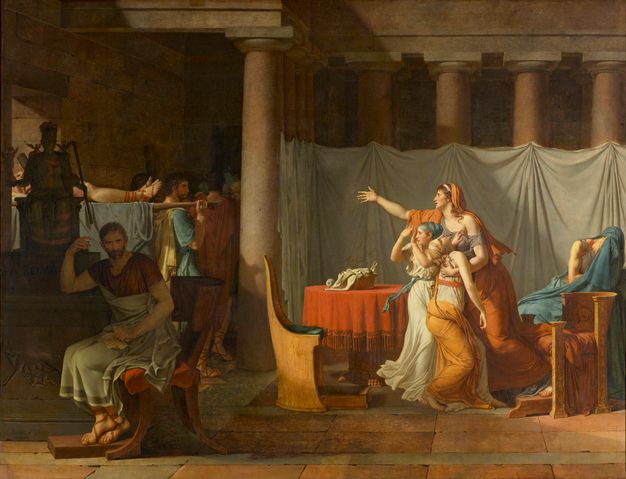
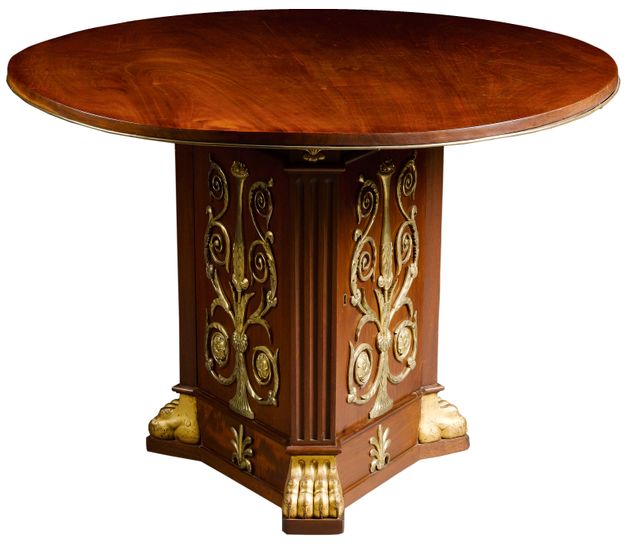
In August 1789, Jacques-Louis David exhibited at the Salon his celebrated painting of The Lictors Returning to Brutus the Bodies of His Sons (fig. 163). At this decisive moment, just weeks after the storming of the Bastille, the painting became an instant icon of revolutionary politics, a celebration of Republican ideals encapsulated in Brutus’s heroic self-sacrifice of having his own sons murdered when they conspired to restore the corrupt Tarquin monarchy and overthrow the new Roman Republic.1 Art historians have written at length about the significance of this now canonical painting, but generally overlooked in these political narratives is a seemingly inconsequential detail at the center of the composition. Almost completely hidden by a red cloth, but recognizable by its distinctive feet, is a table that David commissioned from the menuisier (cabinetmaker) Georges Jacob (fig. 164).
After its starring role as Brutus’s table, this elegant object lived on for many years in David’s studio, and then for even longer in the homes of his heirs. In fact, it did not leave the family’s possession until as recently as 1955.2 The lives and afterlives of this table offer significant insights into David’s artistic practice, but they also lead to some uncanny mediations between real and unreal spaces, and between past and present temporalities. A prop for a painting, a piece of furniture, an inherited heirloom: David’s table is one of those things that sits in the ambiguous space between the professional fabric of an artist’s working life (like Vigée-Lebrun’s or Houdon’s ) and the material culture of a personal life (like Cochin’s or Nattier’s ). The lines between these realms of experience were frequently blurred in the eighteenth century, but in the particular case of David’s table, tensions emerged between those various states it came to inhabit. Its aesthetic role as a designed object was, for instance, frustrated by its theatrical role as a studio prop; and its pervasive fictional life as Brutus’s table complicated its functional role as a piece of furniture, turning it into a quasi that would haunt David’s studio and the domestic interiors of his descendants.
As an aesthetic object, David’s table was a round mahogany pedestal table, decorated with gilt-bronze mounts, measuring 77 centimeters high and 107 centimeters across the top. Its triform plinth has three fluted canted corners, each with a stylized anthemion at the top and a griffin foot at the base. The three panels bear flaming torches flanked by scrolling acanthus, and one is a lockable cupboard door, still with its original .3 Designed by David, the leading history painter of the day, and executed by Jacob, the leading menuisier of the day, this strikingly modern neoclassical interpretation of the antique was stylistically of its moment. Extensive research by decorative arts historian Alvar Gonzalez-Palacios has unearthed classical sources for some of its elements, such as the torch and acanthus motif derived from a fragment of the Ara Pacis Augustae in Rome (Museo Nazionale Romano), where David spent formative years as a pensionnaire at the Académie de France in Rome (1775–80).4 This table was part of the neoclassicizing wave that began in the 1760s but took firm hold in the 1780s and during the Revolution, when it became a politicized stylistic rejection of courtly taste: a new style for the new Republican regime. David’s table was in fact so fashionable as to be ahead of the curve, heralded in retrospect as the dawn of the luxurious Empire style, which came to define Napoleon’s imperial reign (1804–15) and of which both David and Jacob were key designers.5
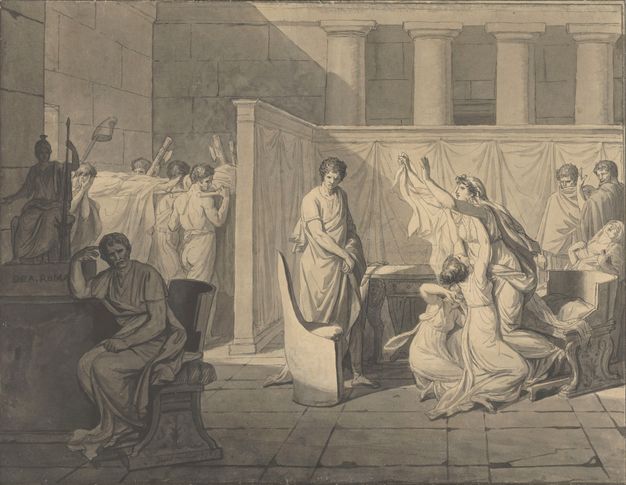
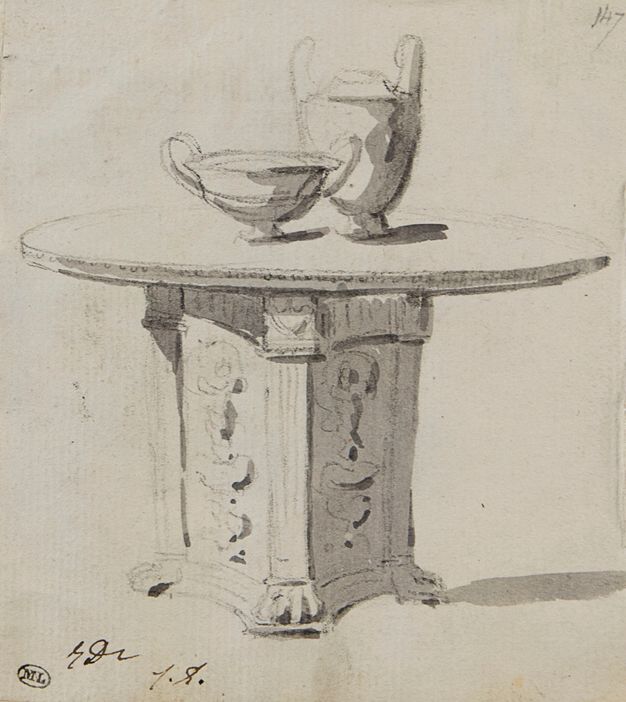
David’s table was not, however, designed with the explicit intent of revolutionizing aesthetic taste. Rather, it was an object purpose built for pictorial composition—an accessory for a painting—not unlike the , armor, and faux-marble columns kept in Jean-Baptiste Le Prince’s studio for constructing his scenes. David began planning Brutus around 1785, laboring (as was his practice) over the setting, distribution of objects, and pose of figures.6 Through a series of preliminary compositional sketches, he settled on the structure of his interior—a spatial demarcation of public and private marked by fabric partitions and domestic furniture (fig. 165).7 At this stage, the table found its position within the scene, but not its final stylistic form. David next started working through the details, experimenting with the furniture’s size, shape, and decoration. In his hunt for archaeological accuracy, David’s earliest design for the table was a spindlier three-legged affair, taken from a probably made in Rome (Paris, Musée du Louvre, album 11, folio 21), and rehearsed in the Getty drawing. But in the end he found his model in an engraving of antiquities in the abbé de Saint-Non’s Voyage pittoresque de Naples et de Sicile.8 David sketched the table (fig. 166) and Jacob created it, the two working together to create a “modern pastiche” (as Gonzalez-Palacios puts it) of classical Rome.9
David and Jacob worked successfully to create several such pieces of “stage” furniture, including the upon which Madame Récamier would later recline in her portrait (1800, Paris, Musée du Louvre). But while Récamier’s bed is almost as central to the composition as the sitter herself, what is perplexing about the table is the minimal role it eventually played. Indeed, it raises more questions about David’s practice than it answers. If, for instance, it was so important for David to have a quintessentially antique table for his image of Republican Rome, why invent a modern pastiche instead of replicating an original? Having taken such time, care, and expense in the design and production of the table, why cover all but its feet with a plain red cloth? And why did David even need an actual table, given that he had already designed it in the two-dimensional form required for his composition?
As a prop in the staging of Brutus, the table inhabited a very different role from that of aesthetic object. Through placement and use, props on stage define space and create narratives.10 Their material qualities enhance the realism of a fictional place, but they also exert what performance theorist Gay McAuley calls a “gestural force,” contributing to the dynamics of the play by determining the actions that take place around them.11 Like an actor in character, props are material things playing fictional roles; thus, unlike other objects, they have the unique quality of being simultaneously real and unreal.12
The setting for the table’s theatrical début was Brutus’s palace. In David’s static tableau, the table becomes one of three key points in this emotional climax as its red costume resonates with two further chromatic notes: Brutus’s chair cushion and the sandal straps of his dead son. This tonal connection between Brutus and the dead body emphasizes the agonizing import of the father’s decision, the pain suffered in placing civic duty before personal feeling. Linked to the table, spotlit at center stage, the red echo then turns this political drama into a domestic drama. The anguished outpouring of grief by mother and sisters is heightened by this still center, where the life-altering event contrasts poignantly with the quotidian calm of a sewing basket. An ordinary habitual activity is paused—the needle poked through the cloth—to be resumed later, “afterward,” when going back to it will inevitably and painfully recall the cause of interruption. The table’s concealing costume now makes sense as a directorial choice to sacrifice continuity for affect. In David’s sketch of Saint-Non’s engraving (see fig. 166), his original model is an archaeological artifact, displayed with two antique vessels that perfectly evoke the look of Republican Rome. But these unlived archaeological specimens lack the emotional connection of domestic things. Covering his antique table with that incongruous but homey red cloth, and replacing the cold ancient vases with a modern sewing basket, David let historical accuracy give way to dramatic intensity.13 His domestication through textiles extended to the palace itself, where the space of home was demarcated by blue sheets pinned to stark Doric columns. This stagey partition creates a crucial subspace, setting the women apart as agents who respond rather than act, while creating that necessary juxtaposition of civic and familial realms.
Theatrical analogies are only pertinent because this table existed in real life. Most objects in history paintings only have a fictional life; they do not need to be accommodated, adjusted, or costumed for performance, because they are created for and within the pictorial space. But David’s table existed in both real and unreal states, physically and fictionally. The German painter Johann Heinrich Wilhelm Tischbein claimed that David had accessories made for his compositions because he could only paint objects if they existed in three dimensions.14 Gonzalez-Palacios argues that this was so David could accurately represent the effects of perspective and depth.15 But this explanation glosses over the issue. After all, imagining three-dimensional worlds in two dimensions was the very business of a history painter. Scaled models, , or tools like a might be used to aid the translation process (Charles-Antoine Coypel even owned miniaturized theater sets for this purpose), but a history painter as skilled as David did not need to create life-size replicas to represent a historical or fictional scene. David’s interest in fabricating objects like his table instead looks like a vested aesthetic interest. During the Revolution and the decades that followed, David became the nation’s tastemaker because his modern incarnations of classical forms were not mere representations of Republican or Imperial Rome, but fresh re-creations for a Republican or Imperial France. In terms of his artistic practice, David’s desire for these objects seems more in the vein of a method actor—a “method artist,” if you will—seeking verisimilitude through immersive techniques. Through material things, David could access the experience of his characters, entering into shared phenomenological encounters, sitting in their chairs or standing at their tables.
David’s props tended to perform only once, rather than being reused in other fictional worlds. So after its starring role in Brutus’s dramatic narrative, the table retired from theatrical life. But it did not retire from the studio. Continuing to reside in the spaces of David’s daily life, the table commenced its afterlife as , a role it has inhabited ever since. Literally remnants or remains, relics are objects that hold significance as traces; things instilled with the power to embody and even to connect with lost individuals via a differed bodily encounter—touching something they once touched. While more commonly used to describe the sacred traces of holy figures (like Rigaud’s of the True Cross), it is a term that might be applied figuratively to any of the things in this book. As items once owned by eighteenth-century artists—used, misused, held, played, worn, and handled—all these things are relics of a sort, mediating between past and present, between their world and ours. But as an object both real and unreal, the relichood of David’s table is twofold.
Initially, for David and for visitors to his studio, the table became a relic of its fictional owner, Brutus. One of David’s students, Étienne Delécluze, recalled years later his first experience of entering his master’s studio in 1796, when following David’s release from prison he had returned to official favor with lavish lodgings in the Louvre.16 In the north wing of the colonnade, David had set up his “atelier des Horaces” (studio of the Horatii), so named because it contained David’s two great quasi-pendant masterpieces: Brutus and The Oath of the Horatii (1784, Paris, Musée du Louvre).17 Delécluze’s memoirs provide an evocative account of this space. Climbing a narrow creaking staircase, he emerged into a dark and slightly unnerving space full of stacked canvases and draped , before passing through a tiny doorway into the enormous “atelier des Horaces.”18 About 45 by 30 feet, the room had olive-gray walls and a single window at one end, and the two famous paintings were hung on the long lateral walls: The Oath on the left upon entering, Brutus on the right.19 But despite their brilliance, it was the furniture that most drew Delécluze’s attention, for the room was also home to all those period pastiches made by Georges Jacob: the tables, , and chairs that once starred in those paintings on the walls and in other well-known works, like Madame Récamier or Paris and Helen (1788, Paris, Musée du Louvre).20
Delécluze tellingly describes this room as a “vessel,” evoking a space consciously conceived as a container, a reliquary for David’s past productions.21 Displayed here, the table was unequivocally “Brutus’s table,” a pervasive trace of its one-off performance. But standing alongside that performance (that is, next to the painting itself), the table’s studio installation effected a palpable blurring of real and unreal worlds, dissolving the metaphysical divide between the painting-as-object in the room and the painting-as-representation within the frame. There is no doubt that this was David’s intention. At the other end of the studio, David had dramatized it even further, setting in place some partitioning that recalled Brutus by hanging green sheets pinned precisely in the manner of the domestic quarters in his painting.22 Like an eighteenth-century prefiguration of Hollywood’s Universal Studios, where visitors walk through movie sets, Brutus’s table in David’s studio invited visitors into uncanny encounters with actual things from imaginary places. In this strange performative studio space, the table made the fictional world of Brutus’s palace seem real, while the painting made that piece of furniture into a memento from an unreal world.
Starting its afterlife in this near-sacred diorama perhaps explains why the table led such an inactive existence thereafter. Over 220 years since its making, David’s table is now in a remarkable state of preservation. Apart from a crack in the cupboard panel and some thin-wearing gilding on the feet, it shows few blemishes and minimal scars of use. Inside, the shelves have been replaced, suggesting it may have been used for storage, but that is unlikely given the awkward size of the cavity and the difficulty of access. There are a few scratches underneath the table-top from turning on its pedestal, but hardly enough to suggest daily activity. Even after David’s death, the table seems to have remained a relic: an object for veneration rather than a piece of furniture to be used. But passing into the hands of its subsequent owners, it transformed from a relic of the Brutus painting into a relic of David himself.
Inside the cupboard, a brass plaque attached toward the end of the nineteenth century records the object’s history: “This table belonged to the painter Louis David. It was left to Madame Bianchi, great-granddaughter of David, by Monsieur Jules David-Chassagnol, grandson of David.”23 In this account of its significance, Brutus rates no mention. What matters now is that this table once belonged to David, its authenticity as a relic secured in a firm provenance via heirs whose relationships to the great man are clearly marked.24 While most of the things in this book that survive in physical form did so in museums or archives as historical artifacts, David’s table survived as a family heirloom. But apart from its journey through hands, it is difficult to know the life the table had with David’s descendants. Was it a cherished souvenir of a beloved forebear; a prized possession that showed off distinguished bloodlines? Or was it an annoying thing looming awkwardly around their homes; too “special” to be used as a piece of furniture, but with too much sentimental value to be given away?
Whatever its subsequent owners’ attachment (or lack thereof), David’s table survived because it was never just a table but rather a material object with layers of significance from the outset. Its performances, exchanges, and interactions passed from a fictional Roman palace and an eighteenth-century Paris studio, to nineteenth-century domestic interiors and, more recently, the back room of a London auction house. Through its experiences, we witness the political drama of the Brutus clan, the family dynamics of the David line, and the working practices of an artist who designed the decorative look of two successive French regimes. Throughout its lives and afterlives, its gestural force continued to determine the dynamics of the play, whether as aesthetic object, theatrical prop, symbolic relic, sewing table, memorabilia, antique, heirloom, commodity (lot 28 in a Sotheby’s sale), or even here in this book as “research object.” One thing, one life, but countless roles. ‡
-
Thomas Crow, Painters and Public Life in Eighteenth-Century Paris (New Haven: Yale University Press, 1985), 247–54; and Antoine Schnapper, David, témoin de son temps (Paris: Bibliothèque des Arts, 1980), 89–93. ↩︎
-
This provenance was established when the table came up for sale at Sotheby’s in London in 2012. “Princely Treasures,” Sotheby’s sale catalog, 4 July 2012, 184. With thanks to Mia Jackson for alerting us to the presence of David’s table in this sale. ↩︎
-
“Princely Treasures,” 184. ↩︎
-
Alvar Gonzalez-Palacios, “Jacques-Louis David: Le décor de l’antiquité,” in David contre David, ed. Régis Michel (Paris: Documentation Française, 1993), 2:948–950. ↩︎
-
Gonzalez-Palacios, “Jacques-Louis David,” 949. On David’s engagement with the antique during the First Empire, see Philippe Bordes, Jacques-Louis David: Empire to Exile (London and New Haven: Yale University Press, 2005), 183–97. ↩︎
-
On David’s working methods, see Perrin Stein, “Crafting the Neoclassical: Two New Drawings for Jacques-Louis David’s The Lictors Bringing Brutus the Bodies of His Sons,” Master Drawings 47, no. 2 (2009): 221–36; and Thomas Crow, Emulation: David, Drouais, and Girodet in the Art of Revolutionary France, rev. ed. (New Haven: Yale University Press, 2006), 102–11. ↩︎
-
Most of the drawings related to Brutus are cataloged in Pierre Rosenberg and Louis-Antoine Prat, Jacques-Louis David (1748–1825): Catalogue raisonné des dessins, 2 vols. (Milan: 2002). Two works discovered later are discussed in Stein, “Crafting the Neoclassical,” 221–36. ↩︎
-
Abbé de Saint-Non, Voyage pittoresque de Naples et de Sicile (Paris: 1781–86), 2:225. ↩︎
-
Gonzalez-Palacios, “Jacques-Louis David,” 946. ↩︎
-
Andrew Sojer, The Stage Life of Props (Ann Arbor: University of Michigan Press, 2003), 2. ↩︎
-
Gay McAuley, Space in Performance (Ann Arbor: University of Michigan Press, 1999), 175. ↩︎
-
McAuley, Space in Performance, 171. ↩︎
-
For an alternative interpretation of the sewing basket as a historicized element of the scene, see Yvonne Korshak, “Paris and Helen by Jacques-Louis David: Choice and Judgment on the Eve of the French Revolution,” Art Bulletin 69, no. 1 (1987): 106. ↩︎
-
Louis Hautecoeur, Louis David (Paris: Table Ronde 1954), 304, cited in Gonzalez-Palacios, “Jacques-Louis David,” 937. ↩︎
-
Gonzalez-Palacios, “Jacques-Louis David,” 937. ↩︎
-
David was in prison following Robespierre’s fall, first from 2 August to 28 December 1794, then from 29 May to 3 August 1795. On David in prison, see Anita Brookner, Jacques-Louis David (London: Thames & Hudson, 1980), 121–35. ↩︎
-
Étienne Delécluze, Louis David: Son école et son temps (Paris: Didier 1855), 14–16. ↩︎
-
Delécluze, Louis David, 17. ↩︎
-
Delécluze, Louis David, 19. ↩︎
-
Delécluze, Louis David, 20–21. ↩︎
-
Delécluze, Louis David, 19. ↩︎
-
Delécluze, Louis David, 21. ↩︎
-
“Cette table a appartenu au peintre Louis David. Elle a été léguée à Madame Bianchi, arrière petite fille de David, par Monsieur Jules David-Chassagnol, petit fils de David.” ↩︎
-
When David died, the table was bequeathed to his second son, Eugène, who left it to his son, Jacques-Louis-Jules David (the “Jules David-Chassagnol” of the plaque). Without children of his own, Jules bequeathed the table to his cousin’s daughter, Mathilde Jeanin, who became “Madame Bianchi.” She left it to her daughter and only then, after Thérèse Bianchi’s death in the mid-twentieth century, was the table sold out of the family. “Princely Treasures,” 184; and Gonzalez-Palacios, “Jacques-Louis David,” 950. ↩︎