Key
- Pierre Peyron (1744–1814)
Returning to Paris from Rome in February 1783, the history painter Pierre Peyron was handed the key to a studio on the first floor of the Cour Carré at the “old” Louvre. He must have been aglow with pleasure from the exceptional privilege. He was officially still a student, having yet to be admitted to the Académie.1 His neighbors at the Louvre, by contrast, were all academicians of established distinction.2 Only later was he made aware of the fracas his preferment provoked.
The studio key, a thing almost invisible to history as a material object and personal possession, in this instance leaves a trace in the correspondence between the directeur des bâtiments du roi, the comte d’Angiviller, and the painters Claude-Joseph Vernet and Jean-Baptiste-Marie Pierre. Pierre was the king’s premier peintre (first painter) and responsible as such for the execution of d’Angiviller’s orders with regards to the artists employed by the king, and resident in his palaces; Vernet was the injured party in the reallocation of studio space. In early February it was Vernet who had had the key to the studio whose title belonged neither to him nor to Peyron but to the painter Louis-Jean-François Lagrenée, who was temporarily in Rome, discharging his duty as director of the French school.3 Vernet had been given use of the studio to paint six large landscapes for Carlos, prince of Asturias, pictures that had been despatched to the Escorial in Spain at the end of the previous year.4 But in a letter of 15 February, d’Angiviller accused Vernet of having refused to return the key though he had finished the work for which enjoyment (“jouissance”) of it had been granted.5 Affronted and indignant, Vernet replied via Pierre that he had uttered no such refusal, and indeed, that no one had asked him for return of the key. Four days later he moved out of the Cour Carré and proposed a compromise: division of the studio between Peyron and himself, because he too had commissions of scale in the pipeline.6 By February 23 he had withdrawn the requested concession and resigned himself to working in the cramped quarters of his logement (lodgings) at the Galerie du Louvre beside the Seine.7 Pierre noted, at the very end of the month, that the key had been returned, and that Peyron had called on Vernet. The men apparently kissed and made up, following Peyron’s explanation that he had been unaware that his arrival entailed Vernet’s departure.
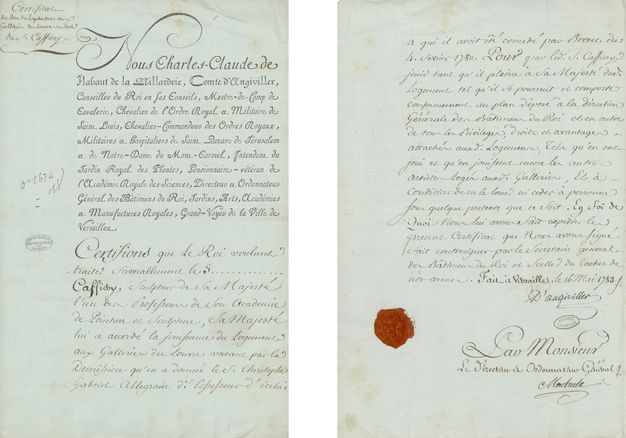
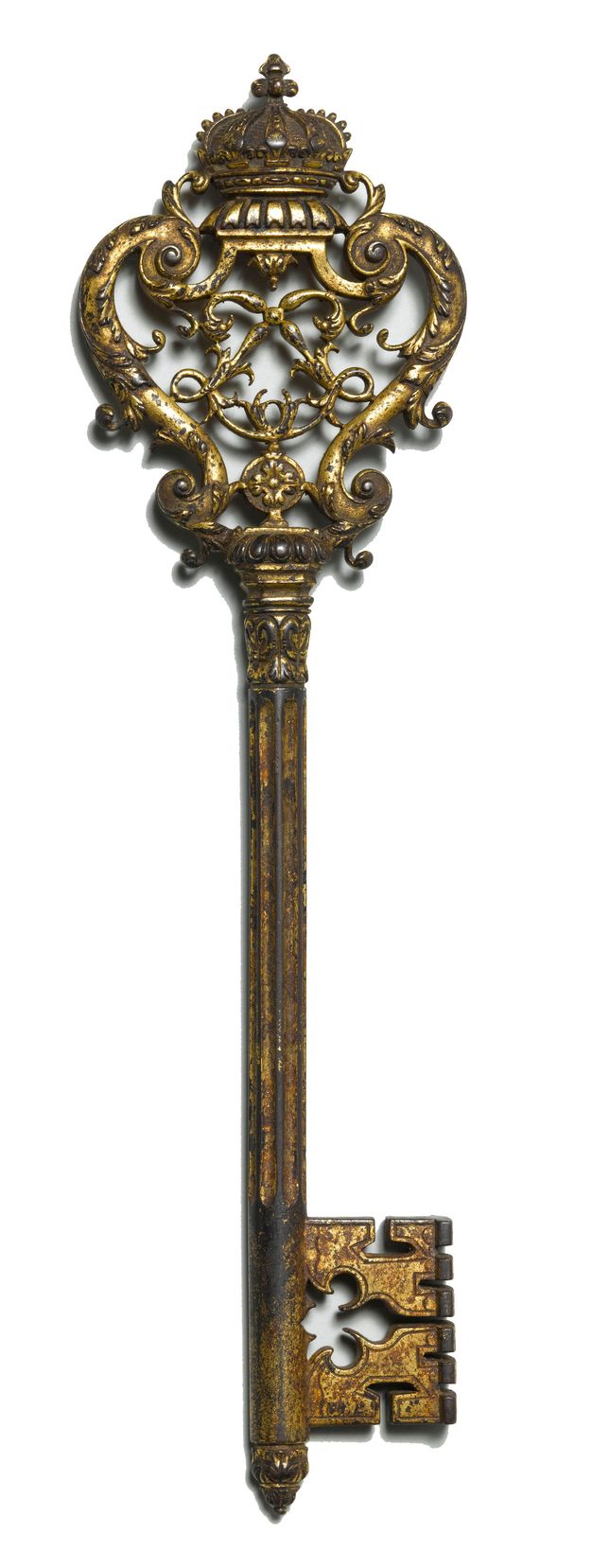
What more can we learn from this anecdote, this microhistory of a key? To progress, we need to know why, and to what effect, the key became the focus of debate, rather than the brevet, or certificate, which formally established a title of residency, and which was, in the ancien régime, the paradigmatic administrative instrument of royal housing for the arts. A brevet, legally speaking, was a royal act expedited by a secretary of state, and by which the king conferred the gift of a title, office, property, pension, or other gratuity.8 In the case of the Louvre logements, these certificates granted named artists exclusive and lifetime residency rights to a studio-cum-living space in exchange for royal service. Issued first under Henri IV, during whose reign the system of logements was established, and on parchment, the official medium of legal acts, by the time of d’Angiviller’s administration, the brevet-as-thing involved standardized paperwork, a partially printed form (fig. 90), to which the personal details of the individual recipient, in this example the sculptor Jean-Jacques Caffieri, were inserted by hand.9 To us this degraded paperwork seems dull, dreary, and even fragile next to the heavy and enduring significance we imaginatively project onto a royal, fleur-de-lis key (fig. 91), forged with a bow at one end and with a notched bit for the lock at the other, the parts united by a circular iron shank. But this would be a mistake. The key on its own afforded no security of tenure, though in the technical discourse on locksmithing, keys and locks were the instruments, par excellence, for enclosing and safeguarding private property.10 It functioned, in fact, more like a hinge or a handle, the furniture that opened the door and kept it moving and to which Henri-Louis Duhamel de Monceau categorically opposed lock and key in L’art du serrurier (1767).11
Getting the key to a royal studio was, arguably, an easier challenge than securing a brevet, because entry by key was always conditional. The directeur des bâtiments was, therefore, less constrained in his choice by precedent and succession planning. When requesting such temporary studio space, how then did artists attempt to unlock d’Angiviller’s favor? In Vernet’s case, he reiterated his need, post loss of the Lagrenée/Peyron studio, on the grounds of the prestige of his patrons and the size of their commissions: specifically, in November 1783, he informed the directeur des bâtiments that the “Grand duc of Russia” had ordered from him “grands tableaux” (big pictures), repeat uses of the adjective “great” that he underscored in his letter with capital Gs.12 Only when d’Angiviller turned him down did he make a spectacle of his age, rank, and years of royal service.13 Several years earlier, the young genre painter Étienne Aubry, a d’Angiviller protégé, had requested a temporary Louvre studio, not this time for its size but for its better light: the direct brightness of the midday sun.14 Here again, the painter stressed both practical needs and the contingencies of the moment; his search for appropriate accommodation in Paris had yet to yield fruit. Both Aubry and Vernet framed their applications in terms of production, the execution moreover of specific painting projects. Neither refers to invention, or to the mind’s need for personal space and solitary retirement, that is, to those spatial tropes of the artist that, since the renaissance, have been associated with genius. They appealed to the directeur des bâtiments’s reason, not his values.15 Neither, however, was successful.
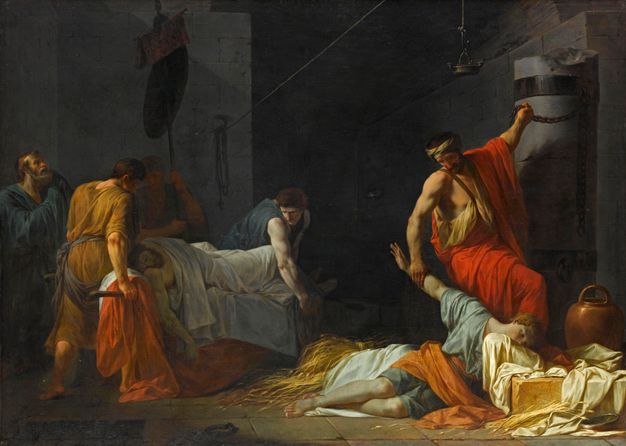
In d’Angiviller’s hands the studio became a pivotal tool of reform, one by which he turned prime working space over to key artists in pursuit of his proclaimed goal to reorient and regenerate the French School.16 For d’Angiviller, “grand” denoted the genre of history painting and the values of public art; the Louvre studios were to produce works for the king and the Salon public, not subsidize artists’ commissions in lesser genres for private clients, however distinguished. Peyron returned to Paris to take his place at the Louvre, bringing with him his large Funeral of Miltiades (fig. 92), a scene of heroic filial self-sacrifice in ancient Athens that is informed by the study of classical sculpture and Italian old masters. It was commissioned privately by d’Angiviller but served also as Peyron’s diploma piece and was exhibited at the Salon in 1783 after his election as an agréé (provisional member) of the Académie.17 The agency of the diploma piece, its unlocking not just of Académie membership but also of studio space at the Louvre, finds its parallel coincidentally in the masterpieces of the Paris guild of serruriers, makers of miscellaneous metal things: the lock and key traditionally earned locksmiths the title of master.18 The studio at the Cour Carré was, however, not so much a reward as a goad. D’Angiviller intended it to expand Peyron’s creative vision, talent, and ideas, and to inspire him to realise ever larger and more consequential works for the king.19
At the Louvre’s Cour Carré, d’Angiviller had a freer hand because, as Jules Guiffrey observed in his inaugural study of the royal studios, the convention of lifetime tenure as a form of virtual property was less entrenched there than at the gallery logements by the river.20 D’Angiviller not only assigned space in the “old” Louvre on shorter terms, he also rescinded longer arrangements. In 1784 the sculptor Jean-Baptiste Cyprien d’Huez was given three months’ notice to quit his studio. In reply to his angry objections, d’Angiviller reminded him that a brevet was a contract, not a deed—that is, an exchange, not a gift. He added, bluntly, that had he another studio to offer him by way of alternative, but “justice” would compel him to assign it elsewhere, to an academician “who by assiduous work endeavors to merit the king’s grace.”21 The year before, Caffieri had been given a studio, not before time, to continue his work on d’Angiviller’s grands hommes (illustrious men) series.22 D’Angiviller’s logement policy was, you could say, one of “key,” not brevet, insofar as he successfully allocated studios to those with talent, instead of by “succession,” that is, by descent from father to son, as had often been the practice in the administrations of previous directors.23 Use of keys, which in the discourse of the Bâtiments department had formerly denoted illegitimate circulation, came to represent a dynamic exercise of administrative power.
We can never know how Peyron felt as he took the key from his pocket, slipped it into the lock, turned it, and opened the door into his room looking out to the river. The records of the Bâtiments du Roi, rich though they are in information about the emotions that motivated artists to ask for a studio—pride, ambition, entitlement, love, desperation, etc.—tell us nothing about the experience of taking possession of one. The history painter Louis Galloche was an exception: he wrote to Philibert Orry in January 1744 of his joy on learning that the king had granted him a logement, and he fully expected to blossom from “the great advantage” of occupying “one of the most beautiful vantage points in the universe” from which to view and reflect upon Nature’s “tout ensemble.”24 Peyron’s joy, if such it was, was short-lived. In 1785 he was moved to the Gobelins. §
-
Peyron was agréé on 27 September 1783. See PV, 9:168. ↩︎
-
At the Cour Carré in 1783 were Nicolas Brenet, Gabriel-François Doyen, Joseph-Siffred Duplessis, Jean-Baptiste Le Prince, and Hubert Robert. ↩︎
-
It was Lagrenée’s idea initially that Peyron, one of his pupils, be assigned his studio, thereby safeguarding its return to Lagrenée when he returned to Paris. See CDR, 14:96, 97, 265, 266. ↩︎
-
The six paintings sent in October arrived in Madrid in January 1783. Three (Landscape with a Sunset, Landscape with a Waterfall, and The Kite) are at the Prado, Madrid, and a fourth is in the Duke of Westminster’s collection. The remaining two are lost. ↩︎
-
Jules Guiffrey, “Correspondance de Joseph Vernet avec le Directeur des Bâtiments du roi sur la collection des Ports de France, 1756–1787,” Revue de l’art ancien et moderne 9 (1893): 85. ↩︎
-
Guiffrey, “Correspondance,” 85. Vernet’s letter does not survive, but its contents were communicated by d’Angiviller’s to Pierre on 19 February 1782. ↩︎
-
Guiffrey, “Correspondance,” 86–87. ↩︎
-
“Brevet,” Encyclopédie, http://encyclopedie.uchicago.edu/, 2:414; and Dictionnaire de l’Académie française, 2 vols, 4th ed. (Paris: Brunet, 1762), 1: s.v. “Brevet.” Secretary of State of the Maison du roi was at that time Louis Charles Auguste Le Tonnelier, baron de Breteuil. ↩︎
-
“Papier et parchemin timbré,” Encyclopédie, http://encyclopedie.uchicago.edu/, 11:862–72. ↩︎
-
“Serrurie,” Encyclopédie, http://encyclopedie.uchicago.edu/, 17:811–31, at 821–22. ↩︎
-
Henri-Louis Duhamel de Monceau, L’art du serrurier (Paris: Saillant & Desaint, 1767), 109, 119–20. ↩︎
-
AN, O1/1674/158: Vernet to the comte d’Angiviller, 4 November 1783. ↩︎
-
Guiffrey, “Correspondance,” 90: Vernet to the comte d’Angiviller, 2 December 1783. ↩︎
-
AN, O1/1673/504: Aubry to the comte d’Angiviller, 1 March 1777. ↩︎
-
Both also said they had found it impossible to find alternative studio space in the immediate environs of the Louvre. ↩︎
-
As classically retold by Thomas Crow in Painters and Public Life in Eighteenth-Century Paris (New Haven: Yale University Press, 1985), 175–209. In October 1784 David was granted a studio at the Louvre to return to after completing The Oath of the Horatii (1785) in Rome. ↩︎
-
Crow, Painters and Public Life, 201–3. ↩︎
-
See Duhamel de Monceau, L’art du serrurier, 203–4. ↩︎
-
D’Angiviller’s commissioned the Death of Alcestes (1785) for himself, and the Death of Socrates (1787) for the king. ↩︎
-
Jules-Joseph Guiffrey, “Logements d’artistes au Louvre,” NAAF, 1873, 15, 18. ↩︎
-
AN, O1/1674/240, Jean-Baptiste Huez to the comte d’Angiviller, 27 November 1784; and AN, O1/1674/240bis, d’Angiviller to Huez, 15 December 1784. D’Angiviller took much more care in choosing his words to Vernet. The repeated crossed-out words in a draft of a letter to Vernet, 21 February 1782 (AN, O1/1674/104) indicate that he was keen to spare Vernet’s pride. ↩︎
-
AN, O1/1674/117. ↩︎
-
See Guiffrey, “Logements d’artistes au Louvre,” 14, 127–35. ↩︎
-
AN, O1/1672/81. ↩︎