Type of Object
Votive
- Pierre-Imbert Drevet (1697–1739)
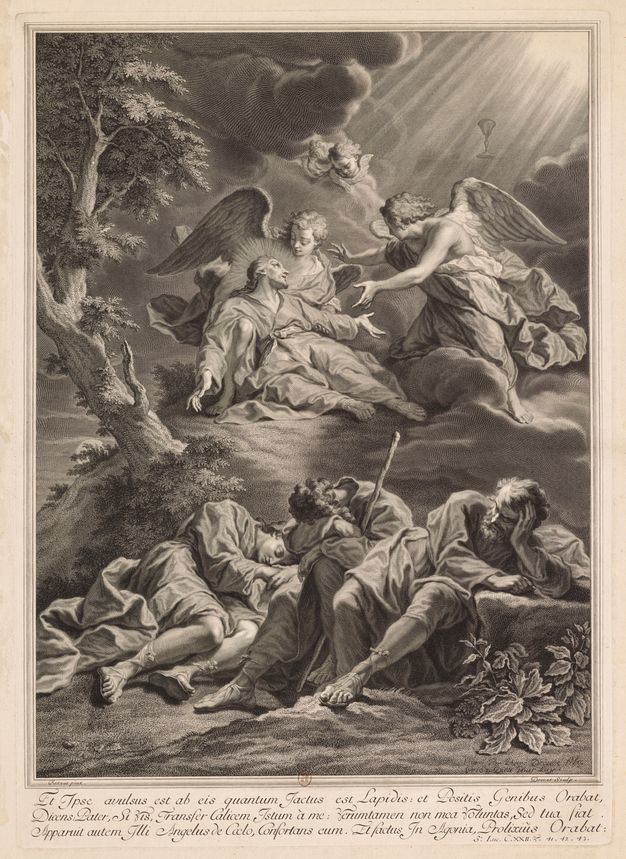
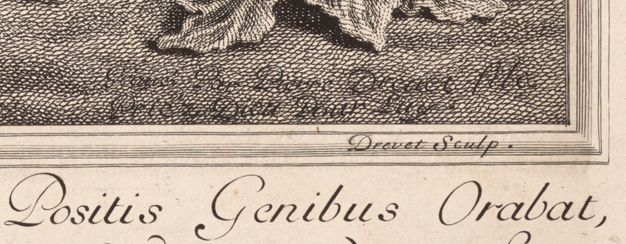
“Pray to God for him.” The words are easy to miss at first, nestled under a plant within the loose cross-hatched lines in the lower-right foreground of Pierre-Imbert Drevet’s engraving of Christ’s Agony in the Garden (fig. 173). From afar, they might be mistaken for an accident on the plate, an inconsistency in the engraver’s otherwise crisp, controlled handling delineating the varied textures, substances, and gestures of his subject. Upon closer inspection, though, the seemingly misplaced marks resolve into their intentionally lettered forms: “Gravé Par Pierre Drevet fils / Priez Dieu Pour Luy” (engraved by Pierre Drevet son / Pray to God for him) (fig. 174). Yet even once read, the words remain somewhat elusive in their legibility—never really clear, from no matter how close or what angle they are viewed. There is a persistent uncertainty about their place here. Discrete, but not hidden. Legible, but only just. Intentional, but somehow hesitant. Present, but out of place. Much like Drevet himself at the time he engraved this plate—the final artwork he would ever make—these words recall, in their meaning and their materiality, the desperate disquiet and spiritual suffering of their maker.1
In 1739, the year Drevet finished engraving Christ’s Agony, he was experiencing his own anguishing torment in the form of a relapsing mental instability. For around ten years, Drevet had suffered intermittently from psychological episodes, difficult to diagnose retrospectively according to modern psychopathologies, but described variously by his contemporaries as: “la démence” (insanity); “une faiblesse d’esprit” (a weakness of the mind); “le dérangement de son esprit” (mental disturbance); and “une maladie [qui l’empêche] de se gouverner” (an illness that prevents him from controlling himself).2 Drevet was far from the only eighteenth-century artist who experienced such episodes, as attested, among others, by the tragic demises of his colleagues François Lemoyne (who committed suicide by his in 1737) and later of André Rouquet (who died in an asylum in 1758).3 Artists’ lapses in mental stability were often attributed to “excessive work” (as some of Drevet’s relatives suggested), but Drevet believed his ill health was an act of God.4
Writing to the directeur général des bâtiments in August 1738 after his father’s death (afraid that he might lose the Louvre logement they had shared), Drevet described his ongoing mental problems as “la maladie dont Dieu m’a affligé” (the illness with which God has afflicted me).5 His father, the engraver Pierre Drevet, had also considered his son’s psychological complaints to be a divine operation—“ayant plus à Dieu [de] l’affliger d’une faiblesse d’esprit” (having pleased God to afflict him with a mental weakness)—and made allowances in his will in case “le Seigneur” (the Lord) chose to strike him again. It was during one of these subsequent strikes predicted by his father that Drevet executed Christ’s Agony, channeling his faith and skill to create an exquisite votive—an object that might help bring an end to his suffering.
If God was responsible for Drevet’s pain, then God alone had the power to relieve it. That was the reasoning behind any votive, or material offering made in a moment of crisis by or for a person seeking deliverance.6 Materially, Drevet’s engraving of Christ’s Agony was like any other print; but spiritually, it was an entirely different category of object. Invested with religious purpose as a physical sign of the artist’s supplication, this was an artwork made to do, rather than merely to be. Comparable in that respect to Largillière’s painted or Houdon’s sculpted , this was yet another artwork that can be thought of usefully as a “thing,” finding its place in this book because of its functionality rather than for its aesthetic qualities.
As its inscription reveals, the object’s votive task was twofold. The first line—“Engraved by Pierre Drevet son”—underscores the artist’s act of making the print itself as an offering, an object of devotion given in exchange, as it were, for the request tendered. The second line—“Pray to God for him”—switches from a description of the print to an imperative entreaty to its beholder, turning future viewers into potential agents of prayer to perpetuate Drevet’s supplication. Yet poignantly, it is the print, not Drevet, who makes this plea (pray for him) in this rare instance of an inanimate thing given direct speech to compel its beholders to do something. For Drevet, this degree of detachment no doubt made the request easier to make, but it also suggests the role he envisaged for his engraving as an object of intercession: a thing that might speak and act on his behalf.
For a man descending into a state of despair and suffering, Drevet could not have chosen a more appropriate subject for his votive. Recounted in the Gospel verses that Drevet included below the image, Christ’s Agony in the Garden takes place at Gethsemane just before his crucifixion, when, in a moment of fear and sorrow at the pain of his imminent sacrifice, Christ prays to his Father to relieve him of the burden: “Then he withdrew from them about a stone’s throw, knelt down, and prayed, “Father, if you are willing, remove this cup from me; yet, not my will but yours be done.” Then an angel from heaven appeared to him and gave him strength.”7
As the New Testament’s ultimate story of overwhelming mental anguish, and the power of prayer to overcome it, Christ’s agony must have presented a source of solace for Drevet. His meditations on this subject—as a focus during his own moments of torment—were no doubt aided by the painting of the scene by Jean Restout (now lost), which hung in Drevet’s home and was almost certainly the version that served as the engraving’s model.8 Drevet’s personal connection to Restout’s original makes it seem all the more likely that the creation of the print was a devotional exercise, rather than a commercial commission. In due course, the engraving would become a marketable commodity: its second state included the address for sale (“chez L. Surugue . . . rue des Noyers”), and an advertising notice was published in the Mercure de France a few years after Drevet’s death.9 But for Drevet, the original motivations were religious—an act of art making in which creative energy, time, and labor were all dedicated to the votive cause.
Contemplating the artwork instigated by Drevet’s mental instability and created through his faith, it is impossible to discern any impairment in his abilities or detriment to its aesthetic qualities. Even the Mercure described it as “un de ses plus beaux ouvrages” (one of his most beautiful works).10 Thus for the beholder of this votive print, there is a profound contrast between the mastery and competence of Drevet the engraver and the desperation and vulnerability of Drevet the man. This juxtaposition is most striking in the lower-right corner, at the intersection of his two signatures on either side of the frame (see fig. 174). While the sign of the engraver’s authorship—“Drevet Sculp.”—is precisely where it should be, his votive inscription is unsettlingly astray. It is set within the image, but it is not part of its pictorial space; the words are not written into the earth or onto some other surface in the scene but, rather, through the engraved lines of the plate, hovering liminally inside and outside. In their contrasting positionality and presence, these two inscriptions seem to represent the two Drevets: the artist who confidently knows his place and the disoriented man who has lost his way in the margins.
Drevet’s psychological condition was certainly deteriorating quickly as he worked on the engraving through the early months of 1739.11 On 24 January the Lieutenant Civil of the Châtelet was called to Drevet’s logement at the Louvre to assess his mental capacity. In his bedroom, wearing and cap, Drevet received his visitor in a barely responsive state. Having stood, he ignored all entreaties to sit; in the face of numerous questions, he remained completely silent; and when asked to sign the assessment, he turned his head and bowed his body in refusal.12 Several weeks later, his cousin, the engraver Claude Drevet, reported that the pitiful situation had escalated and that Pierre-Imbert was now “dans une imbécillité totale” (in a state of total insanity).13 Accordingly, on 9 April the Châtelet issued a Sentence d’interdiction, legally prohibiting Pierre-Imbert from any longer managing his own affairs, and officially appointing Claude Drevet as his curateur, with power of attorney over his property and guardianship over his person.14 Pierre-Imbert did not suffer the indignity for long, dying three weeks later on 27 April at the age of forty-one. Somewhere in all this suffering, Drevet finished his votive engraving, carving those tentative, elusive words in a final effort to come back from the margins of his mind and retrieve his place in this world, or find a new one in the next. ‡
-
The engraving is considered Drevet’s final work according to Ambroise Firmin-Didot, Les Drevet: Pierre, Pierre-Imbert et Claude (Paris: Firmin-Didot, 1876), 95. ↩︎
-
[Hendrick van Hulst], “État général des portraits et autres tableaux sortis du pinceau de l’illustre M. Rigaud,” in Mémoires inédits, 2:197; Will, Pierre Drevet, 23 April 1736, AN, MC/ET/LX/257; Mercure de France, June 1742, 1416; and Plaidoyer pour les héritiers paternels de Pierre-Imbert Drevet, intervenants, contre Claude Drevet, graveur du roi, appellant (Paris: d’Houry, 1742), 2, 3. ↩︎
-
On Lemoyne’s suicide, see and Hannah Williams, “The Mysterious Suicide of François Lemoyne,” Oxford Art Journal 38, no. 2 (2015): 225–45. On Rouquet, see David Maskill, “The Neighbor from Hell: André Rouquet’s Eviction from the Louvre,” Journal18 2, “Louvre Local” (Fall 2016), http://www.journal18.org/822. ↩︎
-
Plaidoyer pour les héritiers, 1. ↩︎
-
Letter from Pierre-Imbert Drevet to Philibert Orry, 12 August 1738, transcribed in Cécile Perroud-Christophle, Les graveurs Drevet, XVIIe–XVIIIe siècle (Lyon: Selbstverlag, 1985), 84. ↩︎
-
Votives or ex votos can also be given after deliverance has been granted as offerings of gratitude for divine intervention. ↩︎
-
Luke 22:41–43. ↩︎
-
The painting Christ au jardin des Oliviers by Jean Restout is recorded in Drevet’s “Inventiare après décès,” 26 June 1739, AN, MC/ET/LX/266. On Restout’s painting, see Christine Gouzi, Jean Restout: 1692–1768 (Paris: Arthena, 2000), 237–38. ↩︎
-
Mercure de France, June 1742, 1415–16. ↩︎
-
Mercure de France, June 1742, 1416. ↩︎
-
This engraving of Christ’s Agony seems to be the “ouvrage regardé aujourd’hui comme un Chef-d’oeuvre de l’Art” that Drevet was working on at the start of April 1739, described in the Plaidoyer pour les héritiers, 3. ↩︎
-
Perroud-Christophle, Les graveurs Drevet, 88. ↩︎
-
“Sentence d’Interdiction,” Pierre-Imbert Drevet, 9 April 1739, AN, Y/4562. ↩︎
-
“Sentence d’Interdiction.” On legal proceedings concerning the mentally incapacitated in ancien régime France, see Fayçal El Ghoul, “Enfermer et interdire les fous à Paris au XVIIIe siècle: Une forme d’exclusion,” Cahiers de la Méditerranée 69 (2004): 175–87. ↩︎