Type of Object
Theme
Type of Object
Theme
Becoming a member of the Académie—the preeminent institution of the Paris art world—was a process transacted through a ritual exchange of “things.” The artist’s side of this material interaction was a reception piece: an artwork that demonstrated the candidate’s requisite skill in their chosen media or genre (thus sculptors submitted sculptures, landscapists submitted landscapes, portraitists submitted portraits, and so on).1 If a reception piece was deemed worthy, the artist would be admitted directly into the Académie and the object would be accessioned into the institution’s collection, to be hung on a wall or displayed on a plinth somewhere within the Louvre apartments. From the Académie’s side, the counter offering in this ritual exchange was paper: a set of official letters—known as lettres de réception or lettres de provision—customarily given to the artist before or during their first meeting as a member. Though materially far less substantial than the artist’s contribution, the letters were just as consequential when it came to their ritual and legal significance, as objects that both embodied and declared the artist’s new status as an academician and peintre du roi (painter to the king).
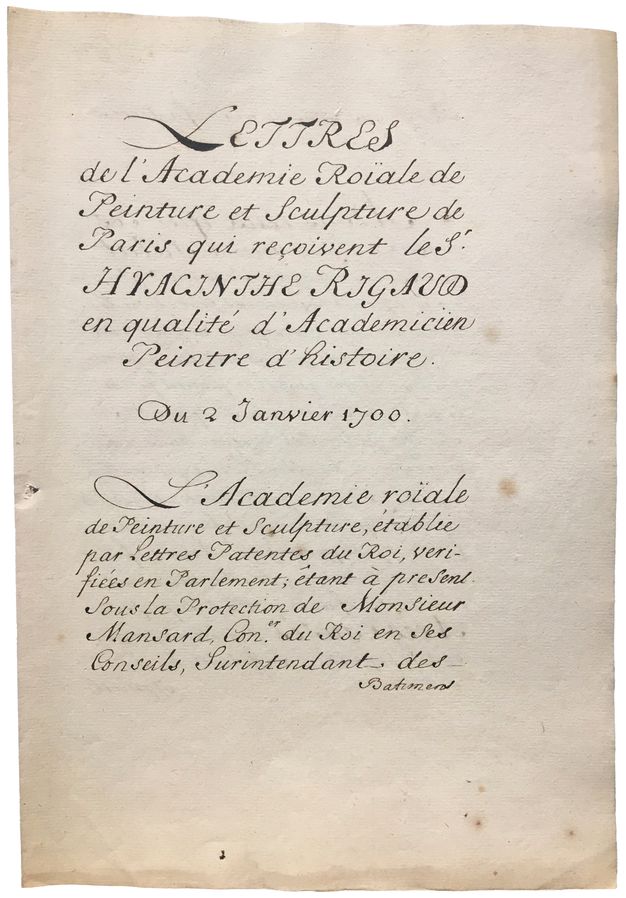
A copy of Hyacinthe Rigaud’s reception letters (fig. 95), now in the archives of the École Nationale Supérieure des
Beaux-Arts, reveal an object whose contemporary equivalent
might lie somewhere between a membership card and an
employment contract. Beginning with a clear indication of
institutional identity (“Letters of the Académie Royale”), the
document went on to designate the holder (“Hyacinthe Rigaud”)
and the date of issue (“2 January 1700”), marking the point of
validity of this non-transferable title.2
Crucially, the letters also established the precise nature of
Rigaud’s membership, designating him not only as an
academician but, more specifically, as a history painter. This
was key in an institution where medium and genre functioned as
a class system, in which only history painters and sculptors
were allowed to hold the highest ranks and were thus the only
artists with any real administrative power. The remaining text
of the letters then proceeded to celebrate the ideological
mission of the Académie (“to raise the arts . . .
to the highest degree of perfection possible”), to establish
the duties of Rigaud as a member (“to see that its lessons,
lectures, and other public and private activities are
undertaken attentively to the complete satisfaction of His
Majesty”), and to note the benefits due to the painter in his
new capacity (including all the “privileges, honors, pensions,
and rights” attributed to academicians). Finally, before the
Académie’s wax seal and the signatures of its current director
(Charles de La Fosse) and other officers, the letters recorded
the genre in which the new member was received and gave
specific details about the correlating reception piece
accepted by the Académie.3
In Rigaud’s case, this is where things got complicated.
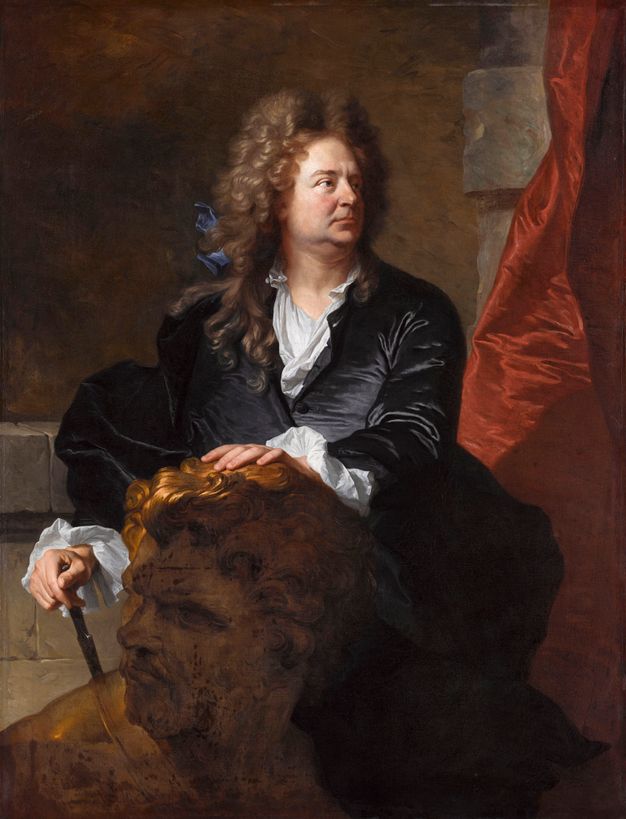
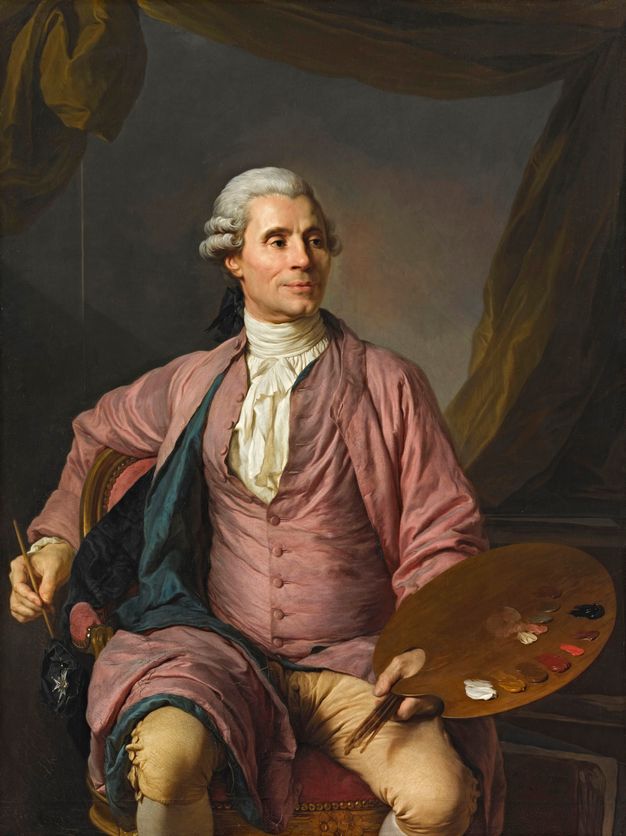
Though Rigaud’s letters were categorically those of a history painter (declared in the words “Peintre d’histoire” emblazoned across the first page), the reception piece he had submitted was only (as the Académie might have considered it) a portrait, representing the sculptor Martin Desjardins (fig. 96). Rigaud’s letters attempted to camouflage this imbalance through some clever wording, registering his talents in both genres and describing this painting as a “portrait historié” (historicized portrait), a term conventionally used for allegorical portraits in which the sitter appears in a historical or mythological guise.4 Yet even if a historicized portrait could be envisaged as a history painting, Rigaud’s reception piece was no such thing. Desjardins appeared as himself, uncostumed, with the sculptor’s chisel and a bronze sculpture as his only attributes, no different, in fact, from any other portraitist’s reception piece in the Académie’s collection (a later example being Duplessis’s portrait of Joseph-Marie Vien (see fig. 36). Thus, in the composition of Rigaud’s letters, the Académie seems to have fiddled the paperwork, bureaucratically obscuring a moment when it had collectively acted against its own theoretical principles.
One of the things that precipitated this situation was that, by 1700, Rigaud had proved himself a far more impressive artist than academician. He had actually been agréé (provisionally admitted) in 1684 at the age of twenty-five and, as per the custom, given six months to complete his reception pieces (portraits of Desjardins and an honorary member, Henri de La Chapelle-Bessé).5 But missing the deadline spectacularly, he ended up taking sixteen years and only managed half the task.6 In the interim, however, Rigaud had made a name for himself in Paris and beyond as an exceptional artist with an elite list of clients (from the Archbishop of Paris to Louis XIV) and had become, for the Académie, both a respected colleague and a figure whose reputation would raise the prestige of the institution.7 So when, at forty-one, Rigaud eventually sought to complete his admission, there was no question that this was an artist who was worthy (artistically and socially) of joining the institution’s highest ranks. But there remained that problem of his genre. Rigaud’s particular talent for portraiture was at odds with the Académie’s entrenched theoretical privileging of history painting, and so the only way to reward him with the career he deserved was to make him, on paper at least, something he was not.8
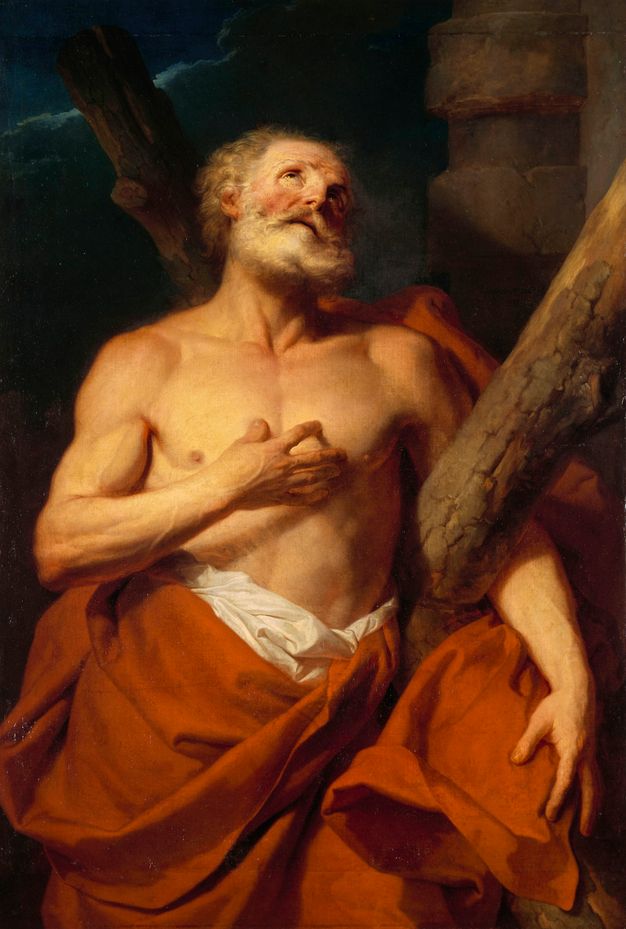
Rigaud’s reception letters make it seem that his status as a history painter was a done deal. But in fact, the minutes of his reception stipulate that Rigaud had only been admitted in that capacity on “the promise” that he would furnish the Académie “as soon as possible” with a history painting.9 In other words, this was to be a reversal of the conventional exchange—artwork-for-letters became letters-for-artwork—but in this order of things, the Académie had no leverage to exact its tribute. Armed with the status embodied in his letters, Rigaud steadily climbed the ranks of the Académie becoming recteur and directeur in the 1730s, but year after year he failed to submit his history painting. The Académie did not forget this ritual debt, issuing occasional reminders, and, eventually, the year before he died, Rigaud made good on his promise.10 Whether an elderly man’s effort to settle accounts and safeguard his legacy, or a gesture of acknowledgment for his career as a “history painter” (despite an oeuvre consisting overwhelmingly of portraits), in 1742, Rigaud presented the Académie with a painting of Saint Andrew (fig. 97), explaining its forty-two-year delay (somewhat unconvincingly) by noting how frustrating it had been that “a constant series of affairs had prevented him from keeping his word any sooner.”11 Rigaud’s Saint Andrew stayed true to the painter’s real talents, presenting a historical subject in the form and composition of a portrait—a single three-quarter-length figure with identifying attributes and minimal setting—not so different after all from the “portrait historié” alluded to in his letters. Whatever its accomplishments as a history painting, this object was at least a retrospective fulfillment of that ritual exchange and a belated ratification—at the age of eighty-four—of the status Rigaud had held throughout his career.
Though Rigaud received his letters in that ritual exchange in 1700, the copy that survives in the Académie’s archives (see fig. 95) was not the set owned by Rigaud during his lifetime. Instead, this was a version created not long after his death in 1743 to serve a very different purpose. They were copied word for word from the originals by Henri van Hulst, an amateur at the Académie and Rigaud’s friend and first biographer, who created an archive of duplicate documents to preserve the details of Rigaud’s career: from his letters of ennoblement from the consuls of Perpignan (his hometown) in 1709, to the letters declaring his nomination to the Order of Saint Michel in 1727, to extracts of his recording all the artworks he produced.12 In a book of object biographies, this particular version of Rigaud’s letters thus shares something of the self-reflexivity of Wille’s : a material thing destined from its inception to record the life of an artist. ‡
On the rituals of the admission process, see Hannah Williams, Académie Royale: A History in Portraits (New York: Routledge, 2015), 82–98. On reception pieces submitted by painters, see Les peintres du roi, exh. cat. (Paris: Réunion des Musées Nationaux, 2000). ↩︎
Copy of Hyacinthe Rigaud’s lettres de réception (1700), ENSBA, Ms. 117, n.p. ↩︎
The text of Rigaud’s lettres de réception was, as per the custom at the time, transcribed into a register so that the Académie also had a copy of its contractual contents: Registre de toutes les expeditions emenées de l’Académie Royalle de Peinture et de Sculpture—commencé le dixième octobre 1681. ENSBA, Ms. 40. ↩︎
Encyclopédie méthodique: Beaux-Arts (Paris: Panckoucke, 1788), 1:415–16. ↩︎
Rigaud was agréé in August 1684: PV, 2:281–83. ↩︎
Rigaud struggled to get La Chapelle-Bessé to sit, so in 1687 the Académie agreed that his reception could proceed with the portrait of Desjardins alone: PV, 2:347. Rigaud was still supposed to paint the other portrait, but this presumably became more difficult after La Chapelle-Bessé died in 1694. ↩︎
Between his agrément and his réception, Rigaud’s studio produced more than six hundred portraits. See Ariane James-Sarazin, Hyacinthe Rigaud, 1659–1743 (Dijon: Faton, 2016), 2:37–231. ↩︎
Most artists of other genres who wanted the status of a history painter were initially given letters in the “lesser” genre and then had to reapply with a history painting for a second reception. For instance, Jean-Jacques Bachelier was admitted as a still-life painter in 1752 but submitted a new reception piece of Roman Charity and was reissued the letters of a history painter in 1763: PV, 7:231. ↩︎
2 January 1700: PV, 3:285. ↩︎
One such reminder was issued in January 1712, PV, 4:139–40. ↩︎
26 May 1742, PV, 5:320. ↩︎
ENSBA, Ms. 117. ↩︎
| words