Type of Object
Material
Type of Object
Material
A relic—the physical remnants of a saint or holy figure—is something one might expect to find in a church, rather than in the home of an artist. Fragments of bodies (bones, hair, teeth, or vials of blood) and material things that once touched those bodies (clothing, belongings, instruments of death or torture) are readily accommodated in sacred sites where their ritual purpose is evident, but we do not often imagine the domestic environment of an eighteenth-century artist as a space for that kind of activity. Yet among the possessions of Hyacinthe Rigaud was an item that would suggest otherwise. Indeed, the history painter was the devoted owner of one of the most sacred types of relic worshiped within the Catholic Church: a small piece of the True Cross upon which Jesus Christ was crucified.1
Perhaps the first question posed by Rigaud’s relic is how a fragment of Christ’s cross, from the first-century Holy Land, got into the hands of an eighteenth-century French painter. This is not actually as unlikely as it might seem, for while traces of the True Cross were among the most venerated of relics (due to their direct connection to the body of Christ), they were also fairly common.2 Following its legendary discovery in fourth-century Jerusalem, the cross was supposedly broken up and parts of it taken to Rome and Constantinople before being fragmented and dispersed further, until alleged pieces proliferated to quite impossible extents.3 While the Catholic Church accepted and even facilitated this proliferation through a system of relic regeneration (in which new, lesser relics could be created by touching an original), it became a point of contention during the Protestant Reformation, prompting John Calvin’s mocking quip that if all the relics of the True Cross were collected together, there would be enough wood “to fill the hold of a very large ship.”4 This abundance does, however, suggest how a Parisian painter might have found himself in possession of such a precious sliver of wood. During Rigaud’s lifetime, Paris was home to a particularly celebrated relic of the True Cross, acquired by the medieval king and saint Louis IX, kept in Sainte-Chapelle, and later destroyed during the Revolution.5 But there would also have been a profusion of smaller or “lesser” versions, like Rigaud’s tiny fragment, circulating through more recent Counter-Reformation economies of religious material culture.
For Rigaud, this holy object was one of his most treasured possessions, evident in both how he kept it during his life and what he planned to do with it after his death. Like most relics, Rigaud’s was preserved in a reliquary, a bespoke container designed to protect the precious and often physically fragile remnants inside. Rigaud’s wooden fragments had been shaped into a cross (recalling their sacred origins in the True Cross) and then encased within a gold cross-shaped reliquary, fashioned as a pendant, and hung on a gold chain.6 During his life, the painter wore the cross at all times around his neck (so he claimed in his ), and upon his death he wanted it to pass to his beloved wife, Elisabeth de Gouy, and for her to do the same. In several versions of his will, Rigaud included these special instructions regarding the relic, noting that the bequest was made as a mark of his consideration for and friendship with his wife, and that he could not conceive of “a more precious gift,” nor one better suited to “her virtue and her piety.”7 In the end, however, Elisabeth de Gouy died a few months before her husband and, as Rigaud had not made a new will before his own death, the relic presumably passed to one of his other heirs. Having no children, Rigaud divided most of his estate between his three nieces, among whom the universal legatee was Marguerite-Elisabeth Rigaud, the wife of Rigaud’s former student and fellow academician Jean Ranc.8
Although they represent but a few lines in a notarial document, this trace of Rigaud’s relic in his will offers an intriguing insight into the way that devotional objects were treated in eighteenth-century France. On one hand, it suggests there was something distinct about the relic that made it different from other things: we glean how special it was to Rigaud, venerated for its sacred value, worn on his person at all times, and considered the most precious gift imaginable for his pious and virtuous wife. But on the other hand, despite its sacred status, the relic was also like many other things that belonged to the painter: an item of property that was treasured during his life and bestowed as a sign of affection on his death. While in a religious sense Rigaud’s relic was unique among his possessions (the only thing he owned that had touched Christ), in a legal sense it was not so different from, for instance, his gold medal from the king of Poland, which, a couple of paragraphs earlier in his will, Rigaud bequeathed to his godson, the history painter Hyacinthe Collin de Vermont.9
Yet the fact that an ordinary individual like Rigaud could own a relic, as though it were any other consumable product, did not make that object any less holy. Indeed, this was characteristic of a broader shift in the circulation and ritual use of religious material culture during the early modern period. As Cissie Fairchilds has observed, this was a moment when devotional objects evolved from public things worshiped collectively in sacred spaces to personal possessions that could be worshiped privately in the domestic sphere.10 In eighteenth-century Paris, where the heightened ritualization of Counter-Reformation religiosity combined with the emergence of consumer markets, religious objects like relics had, in other words, become luxurious commodities. Whether Rigaud bought his relic himself (perhaps from one of the merchants selling devotional objects on the Pont Notre-Dame) or acquired it some other way (a gift or bequest), his ownership of this sacred item was part of the commercialized circulation of such objects and the increasingly individualized religious practices around them.11 It would, after all, be difficult to envisage a devotional object intended for more personal use than a reliquary designed as a pendant necklace. Hanging constantly at his chest, Rigaud’s relic was not a fashionable accessory (like Charles-Antoine Coypel’s or Charles-Nicolas Cochin’s ), not an adornment for display (never visible in any of his numerous portraits), but a sacred item kept close to the body in an act of permanent private devotion.
Aside from Rigaud’s revelation about wearing his relic, however, there is little to indicate precisely how he used it in his devotional life. Certainly there were particular feasts throughout the liturgical calendar in which Christ’s cross became a focus of veneration, not least Good Friday, the feast of Christ’s crucifixion, which was marked by an adoration of the Cross. There were also special feasts devoted to the True Cross, such as the Invention of the Cross, celebrated on 3 May, and the Exaltation of the Cross, celebrated on 14 September (both of them listed annually in the royal ). But given its constant presence around his neck, Rigaud’s relic likely featured much more frequently in the artist’s private religious practices, which, based on the other items in his home, probably took place in his bedroom. According to his after-death inventory, all the objects in this room served a devotional purpose. Hanging on the wall, there was a small painting of the Virgin and Child, and a framed crucifix mounted on black velvet. Along with these, Rigaud also kept another crucifix: a gilded copper figure of Christ, mounted on a wooden cross, “with neither stand nor frame.”12 Comparable from its description to the handheld crucifix in Jean Restout’s portrait of the Jansenist Abbé Tournus (fig. 139), this was an object, like the relic pendant, intended for personal devotions and in particular for meditations on Christ’s suffering. Rigaud may indeed have used both objects together—the sculptural representation of the cross and the actual fragment of it—signifier and signified united, held in different hands, each intensifying the spiritual resonance of the other and creating a powerful material vehicle for daily prayers and devotional rites.
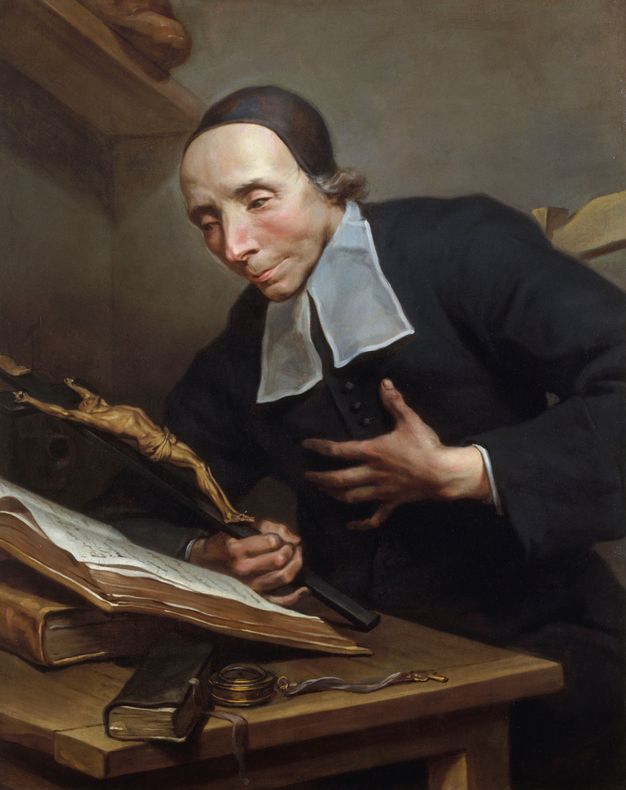
Retrieving a sense of artists’ inner spiritual lives is an elusive challenge with a dearth of textual sources to explore them. But as Rigaud’s relic suggests, their material possessions can often fill in the gaps. Every artist at the Académie, according to the institution’s statutes, was supposed to be a professed Catholic (unless a foreigner granted exception by the king), and it is clear from Rigaud’s will that he dutifully performed the religious responsibilities of a devout believer, leaving money to his parish church for the poor, and requesting a requiem mass to be sung for the repose of his soul.13 But in a less public sense, the objects in his home grant insights into Rigaud’s more personal religious inclinations. His books, such as Louis-Isaac Lemaistre de Sacy’s translation of the Bible (1667–96) and Nicolas Letourneux’s Année chrétienne (1686), point compellingly to sympathies with Jansenism, a controversial doctrinal thread considered heretical in the Catholic Church, which nevertheless became a strong current of belief in France and especially in Paris.14 Among his artistic colleagues, Rigaud was not alone in sharing these theological inclinations. While declarations of Jansenist tendencies were seldom made overtly, many artists of the Académie were connected with the movement, most prominently the history painters Philippe and Jean-Baptiste de Champaigne, Jean Restout, and the engraver Charles-Nicolas Cochin.15 A doctrinal interest in Jansenism would certainly chime with Rigaud’s possession of the relic and his crucifixes, and with their Christocentric focus and their devotional functionality. In the absence of writings articulating his beliefs, contentious or otherwise, the material things in Rigaud’s life thus offer a tantalizing glimpse of the painter’s religiosity, in terms of both his ideas and their embodied practices: a sense of the theological tenets underlying his faith, and the ritual acts he may have performed to fulfil them. ‡
Rigaud’s relic is described in several of his wills, including those of 16 June 1726, AN, MC/ET/LIII/237; 11 February 1731, AN, MC/ET/LII/256; and 29 September 1735, AN, MC/ET/LIII/275. It is mentioned in Ariane James-Sarazin, Hyacinthe Rigaud (Dijon: Faton, 2016), 1:247. ↩︎
Theologically, Christ is said to have ascended bodily into heaven, and so, unlike saints, there are very few corporeal relics related to Christ. Passion relics (like the True Cross) are thus among the most venerated. ↩︎
Joe Nickell, Relics of the Christ (Lexington: University of Kentucky Press, 2007), 77–95. On the history of relics of the True Cross, see also Anatole Frolow, Les reliquaries de la Vraie Croix (Paris: Institut Français d’Études Byzantines, 1965); and Barbara Baert, A Heritage of Holy Wood: The Legend of the True Cross in Text and Image, trans. Lee Preedy (Leiden and Boston: Brill, 2004). ↩︎
Jean Calvin, Traité des reliques (1543) (Paris: Bossard, 1921), 113. ↩︎
On Sainte-Chapelle’s relic in eighteenth-century Paris, see Jérôme Morand, Histoire de la Sainte-Chapelle royale du Palais (Paris: Clousier, 1790). On the medieval cult of the True Cross, see Cynthia Hahn, Passion Relics and the Medieval Imagination: Art, Architecture, and Society (Los Angeles: University of California Press, 2020). Thanks to Emily Guerry for directing me to scholarship on Sainte-Chapelle and medieval relics. ↩︎
These details are recorded in the relic’s description in Rigaud’s wills; see note 1. ↩︎
Will, Hyacinthe Rigaud, 29 September 1735, AN, MC/ET/LIII/275. The relic is mentioned in the three wills listed in note 1. ↩︎
The terms of inheritance of Rigaud’s estate are outlined at the beginning of his estate inventory: 6 March 1744, AN, MC/ET/XLIII/383. The relic is not mentioned in this inventory. ↩︎
Will, Hyacinthe Rigaud, 29 September 1735, AN, MC/ET/LIII/275. ↩︎
Cissie Fairchilds, “Marketing the Counter-Reformation: Religious Objects and Consumerism in Early Modern France,” in Visions and Revisions of Eighteenth-Century France, ed. Christine Adams, Jack R. Mason, and Lisa Jane Graham (University Park: Pennsylvania State University Press, 1997), 33–34. On the presence of devotional objects in Parisian homes, see Annik Pardailhé-Galabrun, The Birth of Intimacy: Privacy and Domestic Life in Early Modern Paris, trans. Jocelyn Phelps (Cambridge: Polity, 1991), 202–12. ↩︎
On the location of dealers in religious material culture, see Jeffry Kaplow, The Names of Kings: The Parisian Laboring Poor in the Eighteenth Century (New York: Basic Books, 1972), 6. ↩︎
Hyacinthe Rigaud, “Inventaire après décès,” 6 March 1744, AN, MC/ET/XLIII/383. ↩︎
Will, Hyacinthe Rigaud, 29 September 1735, AN, MC/ET/LIII/275. In practice, if not in theory, some of the Académie’s French artists were actually Protestants, such as Jean-Baptiste Massé and François-André Vincent. ↩︎
“Inventaire après décès.” James-Sarazin has explored the Jansenist tone of Rigaud’s library in more detail: James-Sarazin, Hyacinthe Rigaud, 1:247–54. On the history of Jansenism, see William Doyle, Jansenism: Catholic Resistance to Authority from the Reformation to the French Revolution (London: Macmillan, 2000). ↩︎
On artists associated with Jansenism, see Christine Gouzi, L’art et le jansénisme au XVIIIe siècle (Paris: Nolin, 2007). ↩︎
| words