Type of Object
Bed
- Charles-Antoine Coypel (1694–1752)
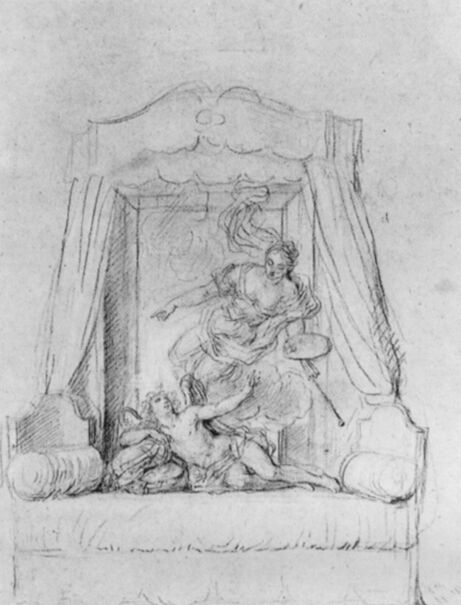
Charles-Antoine Coypel’s bed does not survive, or not as a bed. What remains is a picture (fig. 10), oil on canvas, 190 by 135 centimeters, which originally served as the backboard for a lit à la Polonaise.1 Such beds stood sideways against the wall and were distinguished by two chevets, or bed ends. Rarely did they incorporate large decorative paintings. However, a preparatory drawing by Coypel (fig. 11), a history painter and a royal academician, establishes Painting Awakening Genius in its original function as furniture. Information about the dimensions, materials, and exact form of the bed to supplement the evidence of the drawing, alas, is not to be had because, by the time of the painter’s death, bed and picture had parted company; this bed is not the one inventoried with his effects.2
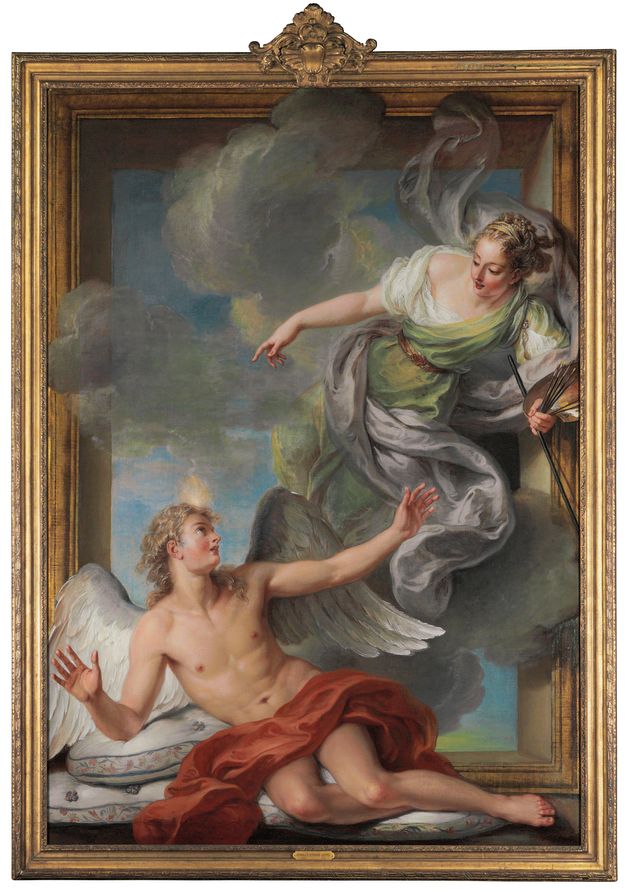
At some point before 1752, the painting had been relegated to the studio, where it was itemized unframed with a miscellany of other paintings, plaster casts, prints, drawings, and other paraphernalia. Meanwhile, Coypel’s bed had returned to the norm.3 It was, according to his inventory, dressed with a base valence of old, jonquil-colored damask and hung with yellow serge curtains. On the frame were three differently stuffed mattresses piled with bolsters, cushions, and horsehair pillows. Coverlets and various fur foot warmers were scattered upon it. It was valued for probate at 300 livres and was the most expensive single item in the room, which was otherwise furnished with armchairs, a settee, assorted tables, a chest of drawers, two corner cupboards, and a desk, and was decorated with seven mirrors and over fifty pieces of Chinese and European porcelain, some of them mounted on gilded sconces.4 The beds had, nevertheless, dominated the scene.
Henri Havard, in Dictionnaire de l’ammeublement et de la décoration (1894), assembled a vast primary literature on the bed, culled from inventories, letters, , plays, novels, and the first newspapers, which testify to the cultural and social significance of beds in France from the thirteenth century to the end of the ancien régime. He notes not only that beds hosted the most important moments in the lives of their owners, he establishes also that, in the seventeenth and eighteenth centuries, beds were exchanged to commemorate those events. His examples are mostly drawn from the history of the king and his court, but he cites, from the history of art, a four-poster bed with gray serge curtains that the painter Pierre Mignard brought to his marriage in 1656, and a bed with curtains and a counterpane in “yellow tabby,” or silk taffeta, that Nicolas Fouquet provided for Charles Le Brun to seal his contract for work at Vaux-le-Vicomte.5 This suggests that the history of Coypel’s bed was closely entangled with the story of his life and in ways, moreover, not all envisaged by Havard, because Coypel invented as well as owned and used his bed.
Havard attends only superficially to the material history of the bed, or lit. For information about its forms, materials, and the techniques of its manufacture we turn instead to the monumental L’art du menuisier en meubles, written by the furniture maker André-Jacob Roubo and published by the Académie Royale des Sciences fifty years after Coypel designed his bed. In it, Roubo divides beds into two basic types: the French bed that stands out in the room, has four posts and a tester, or canopy, that mirrors the size and rectangularity of the base, and the “Polish” bed and its variants (à l’italienne, à la turque, etc.), which hugs the wall and whose tester, smaller than the base and variously shaped, sits on two rather than four posts.6 Roubo favored the French. He singled out for particular praise examples where the woodwork—in oak or walnut—was glossy and apparent, and not hidden by the curtains or incorporated in the upholstery.7 Coypel’s bed appears at first glance to have belonged to the second of Roubo’s categories, to the modern “fashionable” bed, made with a cheaper structure—which, Roubo argued, broke not only with the traditions of furniture making but also with the customs of the chambre de parade, the formal bedroom.8 Interpretation of Painting Awakening Genius rests not simply on recognizing its decorative function and its provenance, but also on determining the kind of bed the picture embellished and the physical and social space it occupied in Coypel’s house.
The bed and its headboard were made sometime shortly after 1722.9 Coypel was twenty-eight years old and a bachelor. In that year his father, Antoine Coypel, formerly the director of the Académie Royale de Peinture et de Sculpture, died. From him Charles-Antoine inherited the twin offices of first painter to the duc d’Orléans and keeper of the King’s Cabinet of drawings. Title to the Coypel lodgings at the Louvre, in part a perquisite of the second of Antoine’s offices, also passed to him, along with a studio in the Cour Carré of the old Louvre that had originally belonged to his grandfather, the history painter Noël.10 Coypel marked this prodigious legacy and his social and professional coming of age by embarking on a reorganization and renovation of his estate.
Artists had been awarded logements (lodgings) at the Louvre by the kings of France since the reign of Henri IV, in recognition of their service to the Crown.11 The logements were located below the Grande Galerie that until 1871 ran along the embankment of the Seine and linked the Louvre with the Tuileries palace. Behind the magnificent seventeenth-century river and court facades, artists were provided with apartments, more like terraced houses, rising the full height of the building. Charles-Antoine had grown up there, his father having moved in when his son was only three. The family lived in a total of some fifteen rooms distributed over three floors and entresols.12 Comparison of Charles-Antoine’s 1752 inventory and the inventory taken at his father’s death reveals that Charles-Antoine redistributed the rooms in his father’s house along lines that more closely resemble those of an aristocratic hôtel than a bourgeois home.13 He removed the bedroom to the first floor, or piano nobile, and assigned it the role of principal reception room in the vertically articulated enfilade of his accommodations. The bed was placed in the depth of the room, between two garderobes, or closets, and facing the windows onto the courtyard.
Roubo’s dismissal of Polish, or niche, beds as suitable only for private, domestic apartments, where comfort is the priority, was based on a number of counts. First, such beds disrupt the orientation of the bedroom by sidelining the bed.14 Decorum dictated the bed to be the axis of the room. Secondly, enclosed on three sides, the alcove bed restricts opportunities for social intercourse between the seigneur on the bed and those in attendance in the room.15 On both counts such beds undermined the identity of the bedchamber as the prime locus of display and public reception.16 The design for Coypel’s bed (see fig. 11) suggests that the painter was not unaware of the issues. The verticality of Painting Awakening Genius and the high art of its allegory corrected the lateral and self-marginalizing drift of the niche bed. In effect, the picture turned the bed’s side into the front. Moreover, Coypel used the illusion of Painting flying into the room through a window, opposite the real windows, to allude to the double aspect of the grand Bourbon gallery above, famed for its heroic decoration tragically left incomplete by Nicolas Poussin. According to Roubo, the distinguishing mark of the seigneurial bed was its size, not, of course, he acknowledged, because the nobleman is built bigger but because in the houses of the nobility the proportions of the furniture are in keeping with the architecture, that is, with the nobility’s symbolic, not physical, body.17 By internalizing the aspect, form, and proportions of the Louvre’s architecture into the fiction of the painting, Coypel reoriented his niche bed and represented its modest structure as nevertheless de parade.
Roubo blamed the demise of the parade bed on fashion and society’s apparently insatiable desire for novelty.18 In the 1770s Paris upholsterers sourced a dizzying range of cloth suitable for bed hangings, from heavy and expensive silk brocades and velvets to cheaper and lighter printed cottons.19 Coypel’s summer hangings for his second bed were exactly of this pretty kind of thing: cotton, with sprigged flowers.20 But in the case of his first, more consequential bed, we can ask whether his painting was intended rather as an alternative to tapestry, that most prestigious stuff of European court cultures, and a genre that readily combined ornament and figure.21 The Mercure galant, according to Havard, reported that the bed that the comte de Toulouse had made to receive the dauphin during the latter’s stay at Rambouillet in July 1707 was “extremely beautiful” because it was hung with the finest tapestry that incorporated “portraits” into its design, meaning pictures as opposed to pattern.22 Moreover, to Toulouse himself belonged a bed in Paris that, according to one of the city’s guidebooks, was “a masterpiece of tapestry pictures” embellished with gold embroidery of a delicacy to match “the grace of the figures.”23 Tapestry, it seems, offered itself to the decoration of beds as a figurative and narrative art of noble substance, in contrast to the ephemerality that Roubo identified with fashion. Painting Awakening Genius does not imitate tapestry in any formal sense—it has not the touch of textile, so to speak—but it did, arguably, model its place as picture in the composition of the bed on tapestry’s artistic achievements. Thus, in structure, stuff, and figuration, Coypel’s bed emulated the parade of the seigneur and fitted its form to the decorum of the palace in which it stood. It did so with the means at Coypel’s disposal and within the constraints imposed by his logement: by substitution, that is, of cheaper materials for more expensive ones and by adjustment of the axiality of the bed by the illusion of the picture.
Coypel’s drawing of the bed (see fig. 11) represents it as a stage, curtains raised, in the depths of which we see depicted not Morpheus quiet with his poppy crown, but Genius quickened, flames dawning on his brow (see fig. 10). Genius awakened by Painting represents, you could say, the painter’s levée, his morning call to rise to art. It is an image and it was an occasion that presumed an audience. To judge by the other furniture inventoried in Coypel’s bedroom, that audience was potentially at once large and socially mixed. Its needs and expectations were to be variously met by twelve armchairs as well as the large settee, an assortment of tables for writing and playing games, as well as the desk, a coffee grinder, and seven tobacco jars. Charles-Antoine owed his logement not only to the accumulated talents of generations of Coypels but also, as noted, to his office of the king’s keeper of drawings; he would no doubt have received visitors to the Cabinet first in his bedroom. The bureau in the room suggests that he conducted professional business there. On the other hand, the games table, boxes of cards, and ivory counters for playing quadrille; the coffee grinder and ; and the tobacco jars all mark the bedroom as a space of sociability:24 for receiving friends, patrons, and neighbors from other logements at the Louvre. The bedroom was an imbricated space: both public and private, for both the performance of status and the related exercises of business, and for pleasure.
Bed and bedroom, object and space are not as idiosyncratic as they perhaps at first appeared. They marked Charles-Antoine’s accession to his hereditary titles and his determination to honor and equal his father’s success and reputation in the language of distinction. Antoine’s triumph had been lent symbolic expression by the and pair of horses given to him toward the end of his life as a reward for the decoration of the Aeneas Gallery at the Palais Royal by the regent in 1717.25 Coypel’s achievements, by contrast, were only anticipated—anticipated, moreover, in a thing of the expectant son’s own devising. That its parade was not absolutely conventional, that it “modernized,” in Roubo’s terms, both the forms and the materials of the bed, raises questions about Coypel’s conviction.
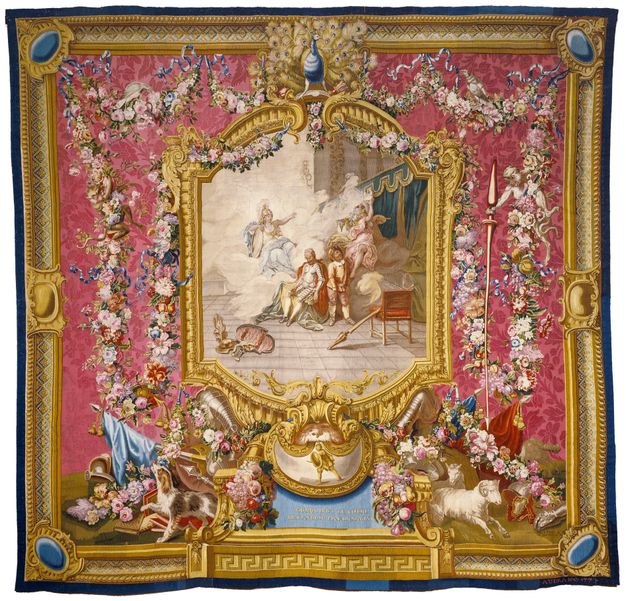
It invites us to compare Painting Awakening Genius not with the father’s scenes of Aeneas’s tragedy but rather with its travesty: the son’s Don Quixote series. In 1727 Charles-Antoine painted for the Gobelins the cartoon for the last scene in his set of The Adventures of Don Quixote (fig. 12), in which Quixote, asleep in his bedroom, is visited in his dreams by Minerva, who by her wisdom cures him of his chivalric illusions embodied by Folly, who beguilingly flutters by the bed, her drapery merging with the bed hangings.26 The same model appears to have served Coypel for the blonde female figures of Folly and Painting. Insofar as Painting is also Folly’s familiar, we can consider the possibility that the parade of the bedchamber was semiseriously and semiconsciously staged by Coypel as a fantasy—that his bed was his castle in the air.
Among Coypel’s high-born friends was the marquis de Calvière, an aristocrat and courtier, for whom Coypel wrote an epistle, published in the Mercure de France in 1724.27 A lyrical letter on the subject of friendship and the importance of truth in the commerce between true friends, the poem betrays Coypel’s fear of ridicule for aspiring to mix in company socially and in virtue above his own. The not-quite-rightness of Coypel’s bed, its artistic misprision of noble design, manifests the difficulty of steering a social course that balances prerogatives of distinction while politely appearing not to believe oneself deserving of them. That Coypel eventually dismantled his bed and put the painting into storage in the studio suggests he came later to regret his levée as an overreach of the claims of his talent. §
-
See Thierry Lefrançois, Charles Coypel: Peintre du roi (1694–1752) (Geneva: Arthena 1994), P 115. The terminology of bed types is in André-Jacob Roubo, L’art du menuisier en meubles, 4 parts in 5 vols. (Paris: Delatour, 1769–75), 3, pt. 2:665–85. ↩︎
-
Charles Coypel, “Inventaire après décès,” 25 September 1752, AN, MC/ET/LXXVI/337. ↩︎
-
The phrasing is ambiguous because the documentary evidence does not indicate whether the picture alone was detached or whether the whole bed was replaced. ↩︎
-
AN, MC/ET/LXXVI/337, 25 September 1752: only the cost of the mirrors approximated the cost of the bed. ↩︎
-
Henri Havard, Dictionnaire de l’ammeublement et de la décoration (Paris: Quantin, 1894), 3:424. Havard mistakenly gives the date of Mignard’s marriage as 1660. ↩︎
-
Roubo, L’art du menuisier, 3, pt. 2:665–85. ↩︎
-
Roubo, L’art du menuisier, 3, pt. 2:671. ↩︎
-
Roubo, L’art du menuisier, 3, pt. 2:681. ↩︎
-
Thierry Lefrançois dates it on stylistic ground to circa 1730. See Lefrançois, Charles Coypel, P 115. For alternative dating to ca. 1724–25, see Katie Scott, “Parade’s End: On Charles-Antoine’s Bed and the Origins of Inwardness,” in Interiors and Interiority, ed. Ewa Lajer-Burcharth and Beate Söntgen (Berlin: De Gruyter, 2016), 17–47. ↩︎
-
On the Coypel studios, see Nicole Garnier, Antoine Coypel (1661–1722) (Paris: Arthena, 1989), 171–72; and Lefrançois, Charles Coypel, 42. ↩︎
-
Jules-Joseph Guiffrey, “Logements d’artistes au Louvre,” NAAF, 1873, 1–221. ↩︎
-
See Coypel’s “Inventaire après décès.” ↩︎
-
For Antoine Coypel’s inventory, see Garnier, Antoine Coypel, 249–55. For further comparison of the Louvre lodgings, see Scott, “Parade’s End,” 23–37. ↩︎
-
Roubo, L’art du menuisier, 3, pt. 2:681. ↩︎
-
Roubo notes the impossibility of servants waiting on their masters in such beds. ↩︎
-
On the enfilade and bedchamber, see Katie Scott, The Rococo Interior (London: Yale University Press, 1995), 106–7. ↩︎
-
Roubo, L’art du menuisier, 3, pt. 2:668. ↩︎
-
Roubo, L’art du menuisier, 3, pt. 2:681. ↩︎
-
For the silks available in the second half of the eighteenth century, see Lesley Ellis Miller, Selling Silks: A Merchant’s Sample Book 1764 (New York: V&A, 2014). ↩︎
-
AN, MC/ET/LXXVI/337, 25 September 1752: hangings “de cotton à fleurs.” ↩︎
-
Thomas P. Campbell, “Collectors and Connoisseurs: The Status and Perception of Tapestry, 1600–1660,” in Tapestry in the Baroque: Threads of Splendor, exh. cat. (New Haven: Yale University Press; and New York: Metropolitan Museum of Art, 2007), 325–39. Tapestry was used also in nonelite housing; see Annik Pardailhé-Galabrun, La naissance de l’intime (Paris: Presses Universitaires de France, 1988), 368–76. ↩︎
-
Havard, Dictionnaire, 3:421–22; and Mercure gallant, September 1707, 153. They are identified by Charissa Bremer-David with a set of four tapestries at the Metropolitan Museum of Art (MMA46.43.1–4). See Bremer-David, “The Tapestry Patronage of Mme de Montespan and Her Family,” in Tapestry in the Baroque: New Aspects of Production and Patronage, ed. Thomas P. Campbell and Elizabeth A. H. Cleland (New Haven: Yale University Press, 2010), 324–25. ↩︎
-
Havard, Dictionnaire, 3:421–22; and Jean Aimar Piganiol de La Force, Description de Paris, de Versailles, de Marly, de Meudon, de S.-Cloud (Paris: Poiron, 1745), 3:87. ↩︎
-
AN, MC/ET/LXXVI/337, 25 September 1752: sixty-nine different porcelain teacups, saucers, and pots pouri, valued collectively at just 8 livres, indicating useful wares. On Coypel’s sociability, see Jean-Baptiste Massé, “Lettre de M. Massé, Peintre du roi et conseiller en son Académie Royale de Peinture et de Sculpture,” Mercure de France, August 1752, 147–48. ↩︎
-
See Garnier, Antoine Coypel, 250. Antoine Coypel’s carriage, which was upholstered in red velvet and taffeta curtains, was valued at 300 livres. ↩︎
-
On the series, see Charissa Bremer-David, French Tapestries and Textile in the J. Paul Getty Museum (Los Angeles: J. Paul Getty Museum, 1997), 40–53. ↩︎
-
Charles-Antoine Coypel, “Epître sur l’amitié,” Mercure de France, December 1724, 2550–52. ↩︎