Type of Object
Model
- Edme Bouchardon (1698–1762)
The word model (modèle) meant a number of different things according to the dictionary compiler Antoine Furetière. In life it meant the “original”—person or thing—selected for emulation; in industry it denoted the “template” used to direct operations; and in the arts it referred to a sketch medium: the sculptor’s equivalent to a drawing.1 This is not to say that sculptors didn’t draw. The sculptor Edme Bouchardon was regarded by his contemporaries as sculptor and draftsman in equal measure.2 Inventoried in his “cabinet d’études,” or studio, after his death were many and various models (one of them in mid-process on a four-legged ), a drawerful of assorted brass and compasses, and a range of drawing surfaces (pine tables and boards) used to make some, possibly all, of the four hundred–plus drawings related to his last project, the equestrian statue of Louis XV.3 However, of the three hundred drawings of the horse and rider, most were studies “after nature,” which is to say drawings that declare their orientation to the object depicted (the flesh-and-blood stallion and king), not the monument commissioned.4 By contrast, sculptors’ models were more like Furetière’s “originals” and “templates,” that is, targeted by emulation at inventions yet to be realized. Models were tools made by the sculptor for doing sculpture. As such, they were the product of a contract of work and belonged to the studio; they were not made for the market, though some of Bouchardon’s models found their way into collectors’ hands during his lifetime.5
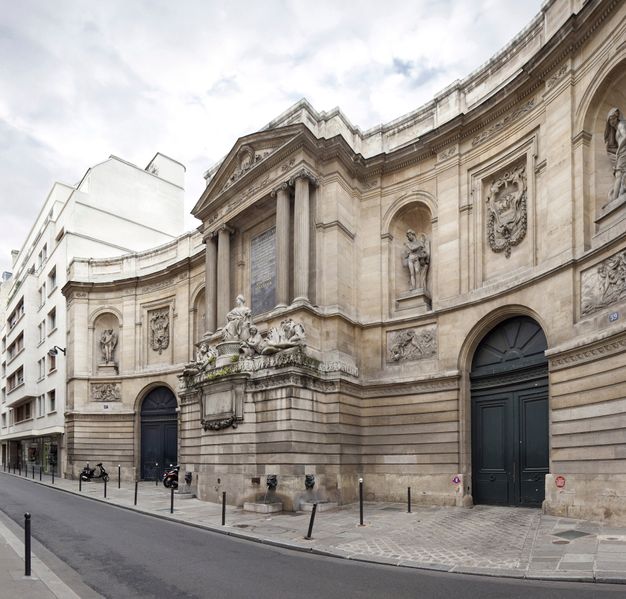
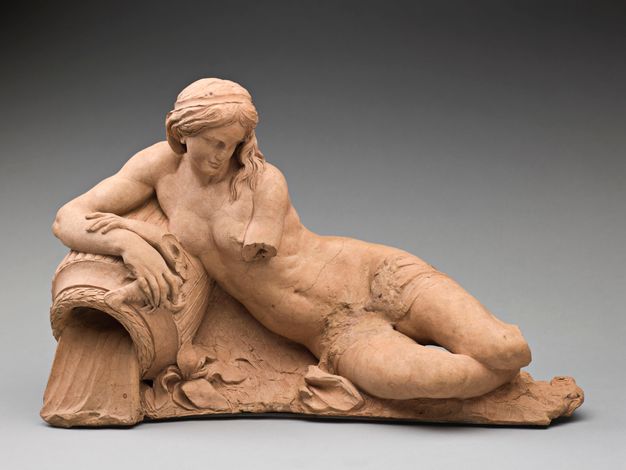
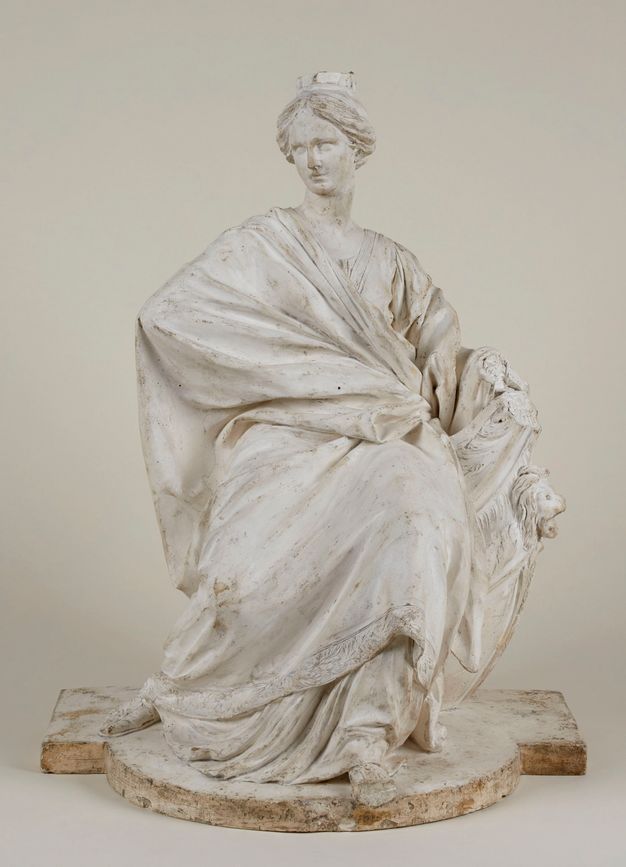
Bouchardon made models in a variety of media: wax, clay, and plaster. To model the figures of the Four Seasons Fountain, built on the Rue de Grenelle between 1739 and 1745 (fig. 106)—our “thing” for this book—Bouchardon used all three: wax in a model (now lost) of the central portion of the monument,6 clay in a terracotta model of the River Marne at the Louvre (fig. 107), and plaster in the model, exhibited at the Salon in 1740 and recently acquired by the Musée Carnavalet (fig. 108).7 Plasticity was the characteristic these media shared. Choice between them was determined by the structural resilience of each, or each substance’s ability to hold form without distortion or breakage, from weakest (wax) to strongest (plaster). By relating model size proportionately to material strength, the Encyclopédie’s description of modeling established not only a typology of models, from smallest (wax) to largest (plaster), it also suggested a chain of operations from first to last.8
The physical property of pliability was thus crucial not only in the practice of sculpture but also, at a metaphysical level, to eighteenth-century ideas of creativity as the outflow of genius.9 Implicit in the comte de Caylus’s comparison of drawing and modeling as creative acts inserted in his Life of Bouchardon (1762) is the notion of unmediated artistic expression, or matter’s absolute passivity, its utter subsumption to the thrust of the artist’s thinking hand.10 He envisaged the and the ébauchoir (modeling tool) as instruments for giving immediate form to inner states. Bouchardon shared his view, to judge by the invoice he submitted to the directeur des bâtiments du roi in 1743 for a project that never progressed beyond the model stage.11 In justification of his claim of 210,000 livres in remuneration, a vast sum, Bouchardon enumerated his costs: (1) eight days of thought in preparation to meet the king’s order; (2) thirty-five years of study in France and Italy to satisfy the king’s standards of taste; (3) three months of working on “different ideas, both in chalk and modeled in wax, ideas made and remade a number of times, and vigorously subjected to artistic critique by the author.”12 Making was conceptualized as a movement outward from mind to world in the conduct of which the ideal model served as a transparent interface between conception and realization.
Gerold Weber, who inaugurated study of Bouchardon’s models, understood his task as one of reconstructing the linear sequence of the modeling operations. He naturalizes the trajectory from interior to exterior, imagination to world, by analogy to gestation. Like Caylus, he explains Bouchardon’s models as iterations of an idea, a progress of representation, in which the “first thought,” called a maquette, is superseded and surpassed by the second and more finished model, and so on, increasing in size and development until the end work becomes.13 Although Weber’s classification of the models depends on sequence, the models do not represent discrete stages of operation: rather, they are construed as a continuum of things, models all of an equestrian monument, or a fountain, or a tomb. However, models, in their difference from representations, are also models for, or things capable of intervening in the world.
What are the properties and merits specific to Bouchardon’s models, and how is their functionality manifest? To return to materials, Bouchardon used wax and clay not only because they are cheap, tractable, and easy and quick to work but also because of the potential of each to anticipate the appearance of the medium selected for the finished work. The consistency of beeswax could be varied by addition of plasticizers (turpentine, olive oil) to maximize ductility, or hardeners (rosin) to increase resistance.14 A stiffer consistency enabled the modeling of carved detail and surface polish prized in marble.15 Comparing the maquette (see fig. 107) and the model of the River Marne (fig. 109), we immediately note that matter is more assertive in the maquette. La Marne emerges from the loaf of clay: an outcrop of the riverbank, she is united yet with her vase source.16 The condensed forms of her shoulder and neck betray clay’s softer structure. The sensuality of her body’s surface suggests sensitive fingers have been at work. By contrast, in the Lille model, figure, riverbank, and urn are clearly distinguished by undercutting. La Marne’s arm, shoulder, and neck lift in expectation of the greater rigidity afforded by marble. A gap opens up between body and urn, the neck disengages from the mass of the upper chest, and the silhouette of the figure becomes more emphatically linear and hardens. Meanwhile, the seemingly open, sensitive surface of the maquette closes; it is sealed in the model.17 By artificial manipulation and alteration of clay and wax matter, Bouchardon successfully modeled the otherness of the material proposed for the commissioned sculptures: marble.
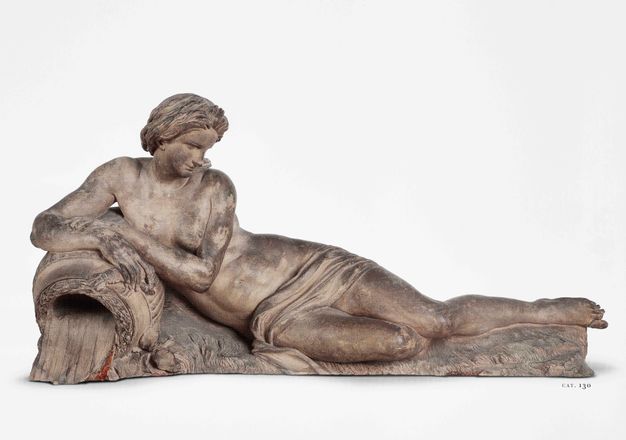
Plasticity was not the model’s only property of convenience. Size was another. Bouchardon’s models for the Four Seasons Fountain are between a quarter and a third of the size of the executed marbles. The reduced dimensions scaled Bouchardon’s gestures of grasping, experimenting with, and evaluating forms for the monument comfortably to the distance between his two hands.18 At the same time, the conventions of the colossal—that is, prioritization of volume and weight over surface and detail—were imported into the model such that, smallness notwithstanding, the models of Paris (see fig. 108) and the River Marne (see fig. 109) rehearse holding the viewer at a respectful distance, the response that public monuments demand as appropriate.19 Charles-Nicolas Cochin called this “the art of working for the site.”20 The models, in short, have not the allure of the small bronzes avidly collected in the early eighteenth century for intimate contact with the precious and the ornamental.21 They make no virtue of smallness as an aesthetic property; smallness in them is a condition for success on a large scale.22
Analysis of the properties of models demonstrates that making models, like making in general, according to the philosopher Vilém Flusser, was dialectical, not linear.23 Bouchardon’s hands modeled not only what he thought his fountain monument ought to be, externalizing his idea, but also the physical conditions and social settings with which the realized monument would have to contend, thus internalizing relevant aspects of the external world. In recounting the genesis of another fountain, the Neptune fountain at Versailles (1737–40), the comte de Caylus described how Bouchardon abridged his initial idea for a complex and rich group of two figures to a single, “simple, real, and fully formed” Triton, because it was more fitting for the setting. Caylus made a point (without explanation) of emphasizing that the Neptune maquette had not been made after nature. According to Weber, the purpose of nature was not to inspire but—and as seen in Bouchardon’s life drawings for the Grenelle fountain’s river gods and seasons—to provide a testing ground for the dessein (in the dual sense of design and intention), to check form against objects in the real world.24 Models, in this sense, were fictions.
Once the experimental stage of modeling was complete and the design established, the model as a physical thing required stabilization in order to be put to work. Clay models could be rendered immutable by firing. However, firing involved risks. The broken arm, legs, and terrace of the Louvre Marne (see fig. 107) was damage sustained either when the maquette dried out and shrank, or when water trapped in the clay (due to poor preparatory kneading) turned to steam and expanded in the kiln, breaking the model apart.25 In the eighteenth century, sculptors increasingly chose the safer option of casting their models in plaster (see fig. 108). At Bouchardon’s studio on the Rue du Roule, the plaster workshop, or gachoir, was one of the largest, consisting of two rooms in which gypsum was calcinated, broken up in mortars (forty were inventoried in 1762), mixed with water, and stored as plaster in barrels (ten wood barrels were itemized in the gachoir).26 The molds for the models were made by specialist cast makers, and the models cast were made by studio hands.27 Stabilization was achieved not just materially, by the greater durability of plaster, but also temporally: an infinity of casts could be made from the molds.
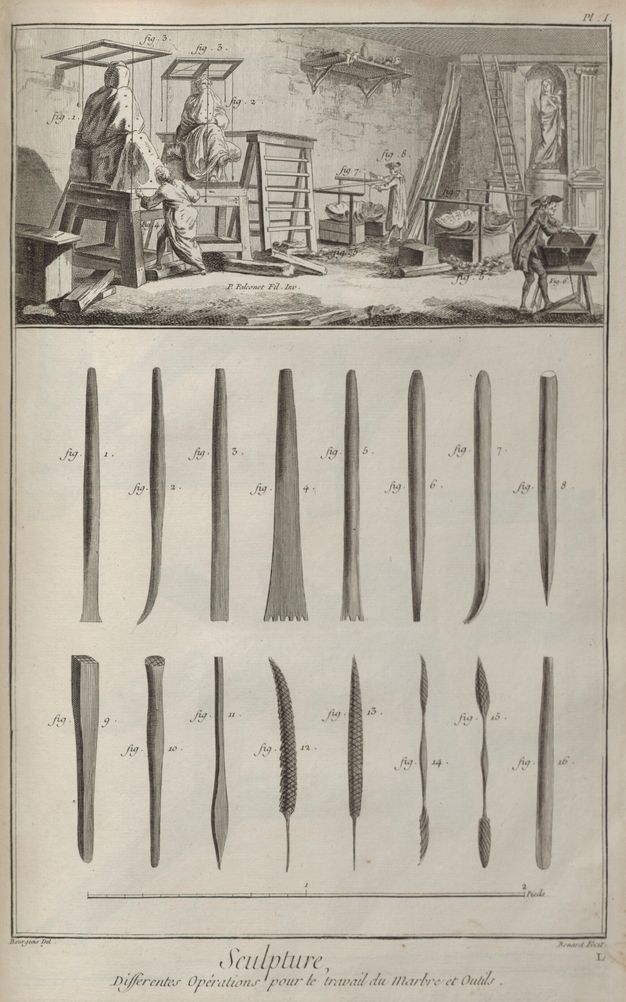
The plaster model was a “transitional” object, transitional not only in the sense that it functioned to mediate between all the models and drawings networked by the production process but also in the sense in which it is defined by knowledge visualization theory as an object for sharing knowledge and collaboration. With the plaster model, our viewpoint shifts from Bouchardon’s cabinet d’études, his private work space, to the workshop, where the finished model on its stand serves as a fixed reference point for collective work on the sculpture proper. In the vignette on working in marble (fig. 110), one of the plates illustrating sculpture in Diderot and d’Alembert’s Encyclopédie (1765), a roughly shaped block of marble with an uncanny resemblance to Bouchardon’s Paris is depicted in the foreground, with the plaster model next to it, slightly set back.28 Hanging from the ceiling above both block and model is a measuring device, called an equerre, consisting of a chassis, its edges notched in units of length, from which plumb lines drop. The geometric principle informing the device is triangulation. What it afforded was measurement not only of the distance between two points but the relationships of those points to one another in space—so, not just the distance between the fall of the drapery from Paris’s waist to her hem but the depth of the synch relative to the projection of the fold over her knee.29 The text keyed to the plate explains that the figure standing before the block of marble is not carving but taking depth soundings to set points on the block. The equerre enables sharing exact knowledge about the design in all relevant parameters, and thus the faithful replication of the model in marble in its essential points by the studio hands.
Bouchardon was thorough in setting points, and excessively so according to Cochin.30 Cochin supposed that the points were to guide Bouchardon’s own work and was astounded that so “skilled” an artist should feel obliged to copy himself so “slavishly.” The draftsman thought he was observing an absurd instrumentalization of the model, or the model as template. Such a template does rather than makes sculpture, in the sense in which we understand the difference between doing and making as actions respectively commensurate and incommensurate with their ends.31 Making models, as we have seen, involves techniques of modeling distinct from the model produced, but when the model becomes the instrument of its own duplication, means and ends are identical and sculpture becomes a performance. The points Bouchardon set rigidly orchestrated reproduction of the work. Cochin claimed that Bouchardon had set more points than would the greenest journeyman, but it was almost certainly to obtain compliance from his studio hands that Bouchardon multiplied them beyond conventional practice.32 Of the motivations for Bourchardon’s idiosyncrasy considered by Cochin—“precaution” and “supererogation”—precaution seems the more likely.33 The focus of Bouchardon’s anxiety was deviation from the model.
Cochin’s anecdotes on Bouchardon’s life were written after the sculptor’s death and revised circa 1780.34 They appear to paint a picture of the early-stage mechanization of the sculptural process and the quasi-alienated sculptural labor that are usually associated with late eighteenth-century studios, such as Jean-Antoine Houdon’s, where casts were used routinely to reproduce sculpture as commodities for the market. But such a reading of Bouchardon’s models seems inappropriate. He was attached to his models not as means to extract surplus profit by merchandising his artistic estate but, according to Cochin, emotionally. He insisted on keeping his models, even though convention held that the finished model belonged to the patron. He kept and cared for them as both originals and as tools whose value to him endured even when their utility was spent.35 Other sculptors, such as Claude-Philippe Cayeux, who worked with him on the Rue de Grenelle fountain, treasured his models as embodiments of right principles to emulate.36 §
-
Antoine Furetière, Dictionnaire universel, 2 vols. (Paris: Husson, Johnson & Swart, 1727), 2: s.v. “Modèle.” ↩︎
-
See Juliette Trey, “‘Ils veulent tous l’imiter, et aucun n’en approche’: Bouchardon et les dessinateurs de son temps,” in Edme Bouchardon (1698–1762): Une idée du beau, exh. cat. (Paris: Musée du Louvre, 2016), 24–33. ↩︎
-
Edme Bouchardon, “Inventaire après décès,” 18 August 1762, AN, MC/ET/LXXVI/384. ↩︎
-
See Édouard Kopp, Edme Bouchardon: The Learned Draftsman (Los Angeles: J. Paul Getty Museum, 2017), 193–234. ↩︎
-
For Pierre-Jean Mariette, see Édouard Kopp, “Les Collectionneurs de Bouchardon,” in Edme Bouchardon (1698–1762), 44–53. For the comte de Caylus, see Anne-Claude-Philippe de Tubières, comte de Caylus, Vie de d’Edme Bouchardon, sculpteur du roi (Paris: n.p., 1762). ↩︎
-
See François Basan, Catalogue des tableaux, desseins, estampes . . . modèles en cire et en plâtre laissés après le décès de M. Bouchardon (Paris: de Lormel, 1762), lot 16. ↩︎
-
This is a representative sample of the models actually produced. For a wider canvas, see Guilhem Scherf, “La Fontaine de Grenelle,” in Edme Bouchardon (1698–1762), 228–34. ↩︎
-
Encyclopédie, http://encyclopedie.uchicago.edu/, s.v. “Modeler,” 10:600. ↩︎
-
On fountain as metaphor, see Isabelle Trivisani-Moreau, “L’Ultime métamorphose: Enjeux et difficultés de la représentation et de l’utilisation de l’eau dans les romans de 1660 à 1680,” in Sources et fontaines du Moyen Âge à l’âge baroque (Paris: Classiques Garnier, 1998), 415–35. ↩︎
-
Caylus, Vie, 16–17. ↩︎
-
See Edme Bouchardon (1698–1762), cat. 212, model for the Cardinal Fleury monument. ↩︎
-
AN, AB/XIX/4228, dossier 10, Mémoire des frais fait par E.B. . . . pour le mausolée de Son Emce le Cardinal de Fleury, 24 May 1743. He gave four months’ anxiety and worry as his fourth and last reason. He received 4,000 livres for the work and kept the model. ↩︎
-
Gerold Weber, “Dessins et maquettes d’Edme Bouchardon,” Revue de l’art 6 (1969): 39–50. ↩︎
-
Encyclopédie, http://encyclopedie.uchicago.edu/, s.v. “Modeler,” 10:599. See also Nicolas Penny, The Materials of Sculpture (New Haven: Yale University Press, 1993), 215–18. ↩︎
-
Caylus conflates softness of medium and quietness of sorrow when describing the “impressions douces” of the model of the Fleury monument; see Vie, 75. In its stiffer consistency, wax was also used for portraiture. ↩︎
-
See Nicolas de Largillière’s Portrait of René Frémin (ca. 1713, Berlin, Gemäldegalerie) for a juxtaposition of unformed matter and full-formed models. ↩︎
-
On Bouchardon’s balance of hardness and softness, see Pierre-Jean Mariette, “Lettre de M. M*** à un ami de province, au sujet de la nouvelle Fontaine de la rue de Grenelle” (1746), reprinted in Caylus, Vie, 93. ↩︎
-
On the gesture of making, see Vilém Flusser, Gestures (Minneapolis: University of Minnesota Press, 2014), 32–71. ↩︎
-
Mariette uses “colossal” to describe and commend the fountain’s forms. See Mariette, “Lettre de M. M***,” in Caylus, Vie, 90. ↩︎
-
Charles-Nicolas Cochin, Mémoires inédits de Charles-Nicolas Cochin, ed. Charles Henry (Paris: Baur, 1880), 86. Cochin thought Bouchardon’s models failed to reach perfection in this regard. ↩︎
-
See, for instance, the small bronzes of the antique Nile and the Tiber by Buirette in the sculptor François Girardon’s collection. ↩︎
-
On smallness, see John Mack, The Art of Small Things (London: The Trustees of the British Museum, 2007), esp. 49–60. ↩︎
-
Flusser, Gestures, 32–71. ↩︎
-
Weber, “Dessins et maquettes.” ↩︎
-
See Bernini: Sculpture in Clay, exh. cat. (New York: Metropolitan Museum of Art, 2012), 89–93. ↩︎
-
Pierre-Jean Mariette, Description des travaux qui ont précédé, accompagné et suivi la fonte en bronze . . . de la statue équestre de Louis XV (Paris: P. G. Le Mercier, 1768), plate 1. See also Geneviève Bresc-Bautier, “Fonderie et ateliers du Roule,” in Rue du Faubourg Saint-Honoré (Paris: DAAVP, 1997), 372–77. ↩︎
-
See AN, MC/ET/LXXVI/384, 18 August 1762, for models stored in the principal atelier. ↩︎
-
Encyclopédie, http://encyclopedie.uchicago.edu/, 25:22:1. ↩︎
-
For a description and history of setting points, see On Sculpture by Leon Battista Alberti, ed. Jason Arkels (Morrisville, NC: Lulu, 2013), 39–53. ↩︎
-
Cochin, Mémoires, 98. ↩︎
-
On making and doing, see Giorgio Agamben, “Poiesis and Praxis,” in The Mass without Content (Stanford: Stanford University Press, 1999), 68–94. ↩︎
-
The context was the model of the Louis XV monument. See Guilhem Scherf, “Le Monument à Louis XV,” in Edme Bouchardon (1698–1762), 371. ↩︎
-
Cochin, Mémoires, 98. ↩︎
-
Christian Michel, Charles-Nicolas Cochin et l’art des lumières (Rome: École française de Rome, 1993), 614. ↩︎
-
Gilbert Simondon, The Mode of Existence of Technological Objects (Minneapolis: University of Minnesota Press, 2016). ↩︎
-
Pierre Remy, Catalogue raisonné des tableaux, bronzes, terres cuites, figures et bustes de plâtre . . . qui composent le cabinet de feu M. Cayeux (Paris: Vente, 1769), lot 87. ↩︎