Water Fountain
- Jean-Siméon Chardin (1699–1779)
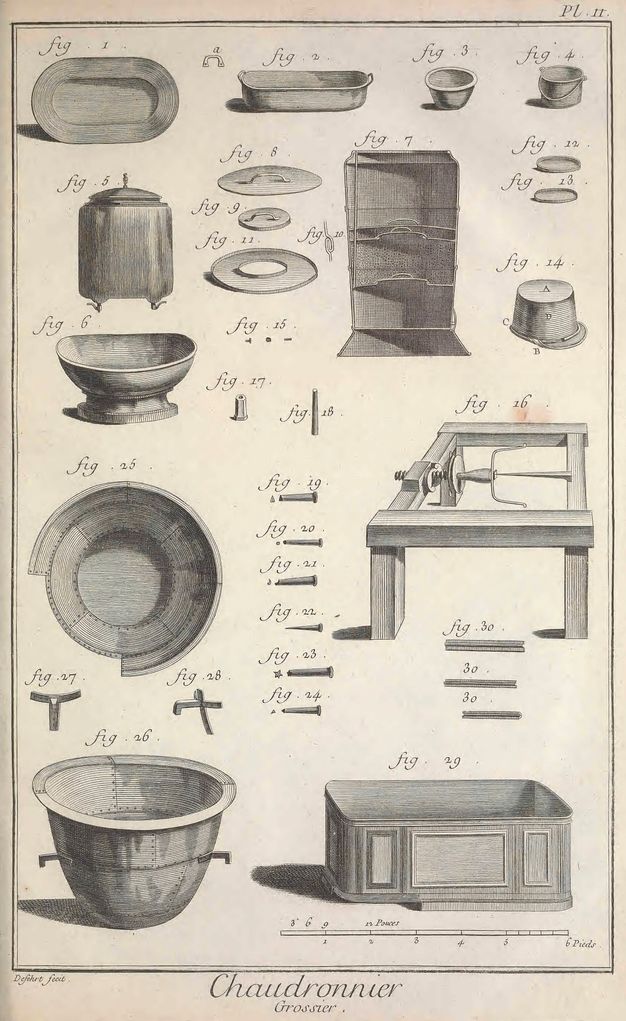
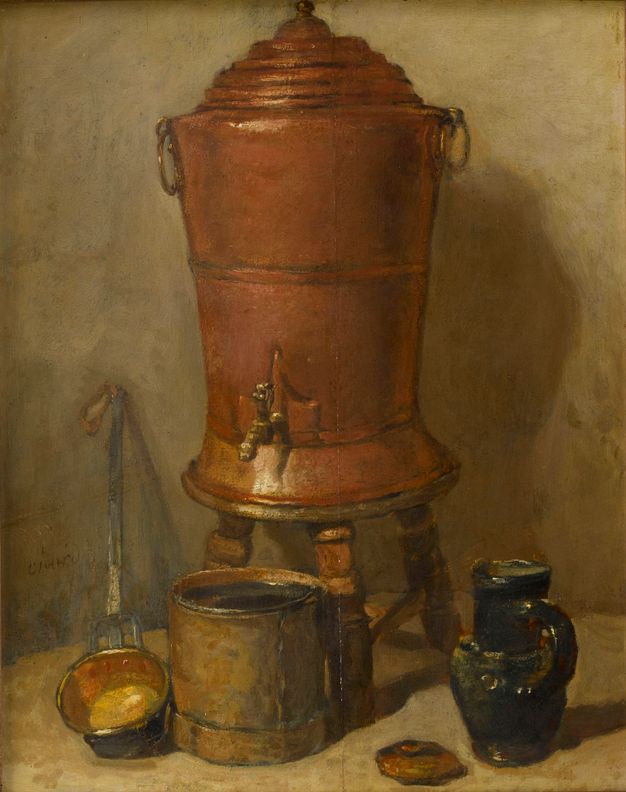
1731 was an important year for the still-life painter Jean-Siméon Chardin. He married Marguerite Saintard in January and set up his own household in five rooms sublet from his mother and carved out of the family’s home, a house on the corner of Rue du Four and Rue Princesse in the parish of Saint-Sulpice.1 A kitchen was installed on the third floor and furnished with a large copper water fountain (fontaine de cuivre) on an oak stand to supply the needs of his household, which included, in addition to his wife, their servant, Marie-Anne Cheneau, and, from November 1731, a son, the newborn Pierre-Jean.2 A second, “small” copper fountain, of the tabletop variety, illustrated alongside the “large” in volume 3 of the plates of Diderot and d’Alembert’s Encyclopédie (fig. 179), probably graced either the sideboard or the kitchen table. Both fountains were inventoried in 1737 following the untimely death of Saintard in February 1735. Such mundane things of ordinary consumption are present in countless artists’ inventories;3 only Chardin, however, made the water fountain the subject of his painting (fig. 180), thus providing us with a visual record of its existence.4 His studio was, according to Georges Wildenstein’s reconstruction of the layout of the third floor from land registry records, directly opposite the kitchen, on the other side of the central staircase and at the end of a short corridor.5 Art historians assume that either the fountain migrated to the studio or that the painter migrated to the kitchen for the realization of the Louvre’s small painting, executed on panel circa 1734, which was unsold in 1737 and inventoried in the studio along with two other pictures of kitchen utensils.
What of the copper fountain itself? What kind of a thing was it and in what sense was it Chardin’s? It was not a prop or studio tool consciously devised to model for a painting, like Jacques-Louis David’s , or the costumes in Watteau’s , so it cannot, therefore, be read as a mark of the painter’s dedication to verisimilar depiction. Nor was it a thing like an , , or , a sign more or less consciously acquired to denote personal taste and social distinction. Nor yet was it a novelty, like a or an , or a curiosity like a , that is, a purchase apparently prompted by desire and the caprices of taste.
Study of Chardin’s things has generally focused on the objects depicted in his still lifes of the 1750s and 1760s: the smoking box, the porcelain , and the glass.6 Scholars have argued that these things reflect Chardin’s rising standard of living after his second marriage and the consequent enlargement of his taste. Ordinary, mundane, utility wares like water fountains are, however, poorly captured by such economic and semiotic models of consumption because, as everyday necessities, neither personal choice nor symbolic value seems appropriately to describe ownership of them. They are not the kinds of goods that eighteenth-century Europe, envisaged as birthplace of the consumer society, and site of the industrious revolution, supposes. More promising are theorizations of consumption as practice. Prompted by the material turn, theories of practice focus not on the choice of the sovereign and expressive individual consumer; instead, they trace collective and customary practices of acquiring, appropriating, and using things, and analyze the effect, or doings, of those everyday things.7
Ordinary consumption concerns modes of behavior that are routine.8 Habits such as fetching water, making up fires, lighting candles, and opening doors, severally performed using buckets, pokers, tapers, and handles, are almost entirely lost to history. They were automatic, conventionalized gestures that passed then and pass now largely unnoticed. Domestic water, and the equipment that enabled its procurement, storage, and use, stands more often than not in the shadow of other more conspicuous and meaningful activities, such as cooking, bathing, and washing. In order to see it we shall have briefly to reconstruct the fountain’s existence as a technology.
Chardin’s water would have been supplied as a matter of routine by watercarriers.9 It was probably sourced either from the Fontaine Palatine on Rue Garancière, near the Luxembourg palace or from the Samaritaine on the Pont Neuf over the Seine.10 Inside the home, water as element was remade by servants for domestic purpose. The Copper Cistern (see fig. 180) acknowledges the toil of regular polishing but not care of the fountain’s interior, essential to providing water fit for drinking. Copper fountains were tin lined to prevent contamination of the water by verdigris, which forms when water reacts to copper.11 Fountains, like those illustrated in the section by A. J. Defehrt (see fig. 179), were sometimes also fitted with sand or sponge filters to purify the water. Chardin’s is unlikely to have been one of these, however, because they were not widely available until the 1760s.12 His fountain was simpler and relied on the natural density of matter to separate water from its impurities. The tap was judiciously sited above the filths that sank and gathered at the bottom, and below those that rose floating to the top.13 Fountains of both kinds required regular maintenance: emptying, cleaning, checking for damage to the tin parts, mending, and refilling. They made temporal as well as spatial demands.
Since owners generally delegated responsibility for those demands to others—servants, wives—kitchenware such as water fountains are rarely considered artists’ things. However, Chardin’s portrayal of his fountain suggests that his engagement with it ran deeper than mere acquisition and delegation, that he made it, so to speak, his, if not directly through touch and use, then by interpretation and through painting.14 The still-life objects of The Copper Cistern locate Chardin’s encounter in the kitchen associating the water fountain specifically with cooking, as opposed, for example, to washing. But his painting is not a cook’s picture. The compositional arrangement of pan and pitcher on the ground detaches them from the bodily gestures of cooking. Chardin’s portrayal singularized the fountain as his own by presenting it as the fulcrum of a system of collection and distribution. Water has arrived by pail. It awaits to be lifted, poured, and stored in the cistern. When needed, it will run out from the brass tap to fill a copper pot or pitcher. The simple, logical order of the composition distributes the actions (of fetching, lifting, pouring, tap turning, filling) embodied in the objects in time, but the primacy of the vertical axis mutes the impression of operational flow. Chardin interprets the fountain as a container more than a conduit, an instrument not shaped by but shaping time. By storing water, the cistern secured economies of time spent fetching and carrying water up to the third floor. Chardin’s fifty-five-liter fountain contained sufficient water for three adults for two and a half days, calculated on the average daily adult consumption of 7.45 liters.15
Norman Bryson has argued that Chardin painted ordinary things and the domestic interior from “a native’s point of view.”16 He attributes to the male artist a unique sensibility that enabled him to achieve psychological closeness with the domain of his women subjects. Instead of reproducing the household’s gender divisions, Bryson argues that Chardin took great pains to disguise painting’s intrusiveness.17 The “informality of his compositions” and the “relaxed focus” of his depictions work, he says, suggest that the painter entered “gently” and “invisibly” into feminine spaces, observing (in senses both of seeing and heeding) the harmonies he discovered there and reproducing them in his painting. In The Copper Cistern, however, things do not refer to the ordinary routines of cleaning and cooking performed in domestic space. As we have seen, Chardin’s arrangement of the accoutrements of household water articulates a more abstract logic, that of water supply. In the geometry of the composition, the relative positions of the pail, cistern, pot, and pitcher re-trace the circulation of water and money necessary to connect productively coppersmiths, the makers of fountains, water sellers, servants, wives, and Chardin, head of the household and thus master and manager of the system. They represent not the “experience-near” concept of housework but the “experience-far” ideal of household oeconomy, embodied by Chardin’s household and understood in the social and moral terms of good order and collective well-being as well as in the more narrowly economic terms of sound stewardship of resources to meet the family’s needs.18
The fountain became an extraordinary object for Chardin in the 1730s and was consciously appropriated by him, we suggest, because of the responsibilities he assumed on his marriage. Coincidentally, 1731 was also one of the hottest years on record, exceeded in the eighteenth century only in 1733; during both years Paris experienced severe drought.19 Shortage of water no doubt sharpened further Chardin’s awareness of his fountain and of the responsibility for keeping it supplied.
This reading of The Copper Cistern suggests that the water fountain as material object engaged Chardin’s social and moral self, that it entangled him in a network of sustained and sustaining material, economic, social, and ethical relations with family, servants, coppersmiths, and sundry suppliers of water and household goods: buckets and cookware. To that extent the kitchen and Chardin’s water fountain had possibly more in common with the neighborhood fountain and the public street than with the still-life objects the painter imported into the notoriously enclosed personal space of his studio.20 Indeed, the steep raking light in The Copper Cistern and the stone floor and walls that ground the scene invoke a street-level space, internalizing and inverting the corner of corner urban plots (like the one on which Chardin’s house stood) as domestic niche.
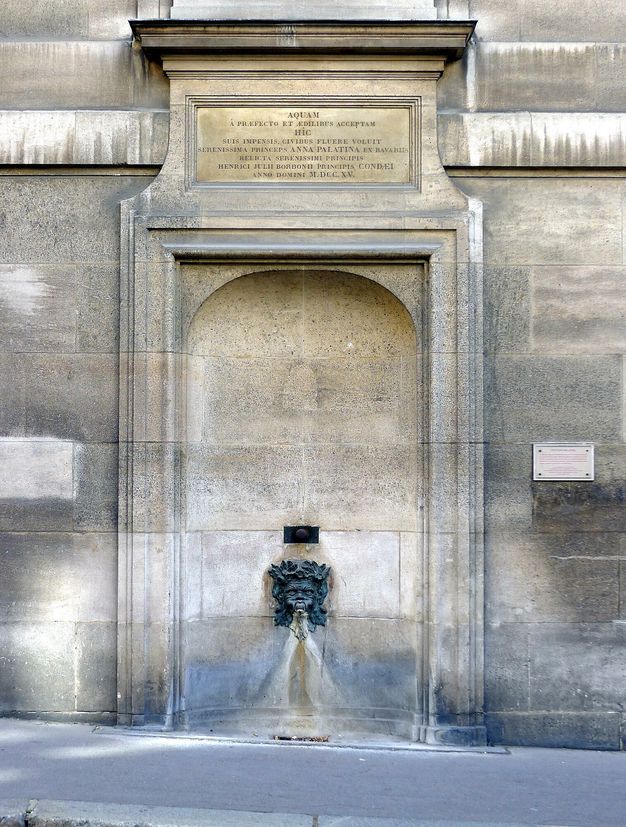
The Fontaine Palatine, designed by the city’s architect Jean Beausire and erected little more than a stone’s throw from the Rue Princesse, is simple and ordinary, consisting of a single spout mounted in a shallow recess (fig. 181). The Latin inscription advertised that Anne of Bavaria had ordered its erection, desiring that “water will flow, at her expense, for the citizens” of her neighborhood.21 Supply and consumption of water are thereby framed in a discourse of civic as well as domestic virtue, and raise questions about how the material culture of containers and conduits, of domestic fountains and cisterns, of pails and pots and pitchers may have served to shape Chardin’s subjectivity in the public sphere.22 His depiction of his fountain does not, to be sure, reproduce the hospitality of the Palatine’s. It is portrayed as a cistern, not a fountain. All the other vessels in the picture are lidless, poised either to lose or to gain contents. Only the fountain is sealed. In appearing to hold back and carefully to husband the flow of water, the domestic fountain can, however, be said to mirror the ethics of noble largesse, reproducing it in reverse as private virtue. The virtues of containment are those of temperance, prudence, and, in times of dearth, thrift and fortitude.23
Chardin’s copper fountain challenges not interpretation of his still-lives as operating on the same plane of existence as the things they depict, but rather the construal of early eighteenth-century domesticity as modern, meaning a separate sphere, distinct from the public, a private realm of women and children. Chardin’s attachment to, even identification with, his fountain, as manifest in The Copper Cistern, was that of the master of a household in which the practices of consumption, reproduction, and production overlapped. The coexistence of his studio and the kitchen on the same floor speaks eloquently of the interpenetration of the spheres of work, family, and the social. Contemporaries noted as exceptional not the privacy of Chardin’s home but the enclosure of his atelier. His door was closed to both students and patrons. In the configuration of his rented rooms, the studio was divided from the communal areas by a lobby that, while scarcely large enough to call a room, nevertheless marked the boundary of the studio, if not guarded the threshold.24 By contrast, the kitchen was open and busy. Water ascending two or three times a week through the house to fill the copper fountain very likely stamped a background rhythm on Chardin’s everyday life. By its cadence the painter may have known the days of the week and times of day.25 Moreover, this acousmatic signature, overheard in the studio, could also have worked to buttress Chardin’s sense of his social self, put at risk when alone, painting. §
-
See Félix Herbert, “Les demeures de Jean Siméon Chardin,” Bulletin de la Société historique du VIe arrondissement 2 (1899): 142–47. ↩︎
-
For a reconstruction of the third floor, see Georges Wildenstein, “Le décor de la vie de Chardin d’après le tableaux,” GBA 53 (1959): 97–106. On the inventory of 1737, see André Pascal and Roger Gaucheron, Documents sur la vie et l’oeuvre de Chardin (Paris: Éditions de la Galerie Pigalle, 1931). ↩︎
-
According to Annik Pardailhé-Galabrun, almost 70 percent of Paris houses were equipped with domestic water fountains. See Pardailhé-Galabrun, La Naissance de l’intime: 3000 foyers parisiens XVII–XVIIIe siècles (Paris: Presses Universitaires de France, 1998), 349. ↩︎
-
See Humphrey Wine, National Gallery Catalogues: The Eighteenth-Century French Paintings (New Haven: Yale University Press, 2018), 89: The Water Cistern. Wine provides an in-depth account of water cisterns on which we have been pleased to draw. ↩︎
-
Wildenstein, “Le décor,” 106. The building was pulled down in 1945. ↩︎
-
See J. Barrelet, “Chardin du point de vue de la verrerie,” GBA 53 (1959): 305–15; “De quelques objets chez Chardin,” in Chardin, 1699–1779, exh. cat. (Paris: Grand Palais, 1779), 67–72; and Marie-Laure de Rochebrune, “Ceramics and Glass in Chardin’s Paintings,” in Chardin (1699–1779), exh. cat. (London: Royal Académie, 2000), 37–52. ↩︎
-
See Frank Trentmann, “Materiality in the Future of History: Things, Practices, and Politics,” Journal of British Studies 48, no. 2 (2009): 283–307; and Alan Warde, Daniel Welch, and Jessica Paddock, “Studying Consumption through the Lens of Practice,” Routledge Handbook of Consumption (London: Routledge, 2017), 25–35. ↩︎
-
Jukka Groncon and Alan Warde, eds., Ordinary Consumption (London: Routledge, 2001). ↩︎
-
See Roche, Everyday Things, 152. ↩︎
-
See Roche, Everyday Things, 143–45; and Daniel Rabreau, Paris et ses fontaines (Paris: AAdP, 1997). ↩︎
-
See Joseph Amy, Extrait du livre intitulé Nouvelles fontaines domestiques approuvées par l’Académie des sciences (Paris: Coignard & Boudet, 1752) on attempts to persuade consumers to buy iron rather than copper fountains. Amy dubbed the copper fountain a “masked assassin” because of its potential toxicity. By the 1770s, according to the tradecard of Clément & Cie, quai de la Mégisserie, sale of copper cisterns was prohibited. ↩︎
-
See Montbruel and Ferrand, Eau de la Seine filtrée et épurée pour la consummation de Paris (n.p.: n.p., 1764) on the introduction of commercially filtered water. Servants, they argued, could not be relied upon to manage domestic filtration. ↩︎
-
Wine, National Gallery Catalogues, 90–91. ↩︎
-
For a discussion of consumption as appropriation, see Alan Warde, Consumption: A Sociological Analysis (London: Palgrave Macmillan, 2017), 59–78. ↩︎
-
Wine, National Gallery Catalogues, 90–91. For estimates of average daily water consumption, see Roche, Everyday Things, 157. ↩︎
-
The phrase is Clifford Geertz’s. Geertz, “‘From the Native’s Point of View’: On the Nature of Anthropological Understanding,” Bulletin of the Academy of Arts and Sciences 28, no. 1 (1974): 26–45. ↩︎
-
Norman Bryson, Looking at the Overlooked (London: Reaktion, 1990), 162–68. ↩︎
-
Geertz, “From the Native’s Point of View,” 28–29. Antoine Furetière’s definition of “oeconomie” in volume 3 of Dictionnaire universel (The Hague: Husson, 1727) assigns it a composite moral, social, and economic meaning. “Oeconomie” was also a term in art theory coined by Roger De Piles to denote the good order of a composition’s “tout ensemble.” See Roger De Piles, Cours de peinture par principes (1709; reprint, Paris, 1989), 50, 65–70. On the concept of oeconomy, see Lissa Roberts, “Practicing Oeconomy During the Second Half of the Eighteenth Century: An Introduction,” History and Technology 30, no. 3 (2014): 133–48; and Keith Tribe, “Oeconomic History: An Essay Review,” Studies in the History and Philosophy of Science 36 (2005): 586–97. ↩︎
-
See Fréderic Graber, “Inventing Needs: Expertise and Water Supply in Late Eighteenth- and Early Nineteenth-Century Paris,” British Journal for the History of Science 40, no. 3 (2015): 318. The drought was such that it gave rise to epidemics. See Bernard de Jussieu, “Examen des causes qui ont altéré l’eau de la Seine, pendant la sécheresse de l’année 1731,” Mémoires de l’Académie royale des sciences, Année 1733 (Paris: 1735), 351–60. Jussieu delayed making the report until 1733, when a repeat of the conditions in 1731 allowed him to verify his findings. ↩︎
-
On the privacy of Chardin’s studio, see Lajer-Burcharth, The Painter’s Touch, 90–91. ↩︎
-
The inscription reads: “Aquam a praefecto et aedilibus acceptam hic suis impensis, civibus fluere voluit Serenissima Princeps Anna Palatina, ex Bavarii . . . Anno Domini MD.CC.XV.” ↩︎
-
For a theorization of containers, see Jean-Pierre Warnier, “Inside and Outside: Surfaces and Containers,” in Handbook of Material Culture, ed. Chris Tilly et al. (Los Angeles: Sage, 2006), 186–95. ↩︎
-
See Simon Werrett, Thrifty Science (Chicago: University of Chicago Press, 2019) on economy as a context for experimental science. ↩︎
-
One of its two doors was covered in damask and raises the possibility that the studio door was actually masked; the walls of the lobby were decorated with coarse wool-and-hemp hangings into the texture of which the door may have appeared enfolded. See Pascal and Gaucheron, Documents. ↩︎
-
Subscribers to Montbruel’s and Ferrand’s filtered water, available from 30 January 1764, were required to agree to a fixed amount and time for delivery, which suggests that water supply in Paris was more generally time-regulated. See their notice and advertisement in Journal Oeuconomique, February 1764, 54. ↩︎