Nightingale
- Marie-Anne Collot (1748–1821)
On 15 May 1769 a nightingale arrived at the residence of the French sculptor Marie-Anne Collot in Saint Petersburg, together with the following note from the empress Catherine II to Étienne-Maurice Falconet, Collot’s master, whom she had accompanied to Russia: “Beg Mlle Collot to be kind to this little wild thing (petit sauvage).”1 Collot was in a state of heightened anticipation and anxiety apparently, the bird having been announced for some time.2 Five days earlier the gift had suddenly seemed in doubt. Catherine had written to say that not one bird in song could be found in the city, though the feast day of Saints Peter and Paul, ordinarily the time when nightingales fall silent, had yet to pass.3 Collot’s wholehearted joy at the nightingale’s eventual arrival did not, however, suspend Catherine’s caution to hang cage and bird outside her palace lodgings, because “no one can long endure his song indoors.”4 What are we to make of this thing, a thing that proved both so difficult to give, because of the unpredictability of the creature’s performance, and a challenge to receive, because it was wild and excessive in song? Our knowledge of Collot’s life and career is largely indirect, refracted through Falconet’s correspondence with the empress and with the philosophe Denis Diderot (see ). Does the nightingale, her very own thing, speak to us more directly about her?
Catherine’s gift was, most likely, a thrush nightingale (Luscinia luscinia), not the common nightingale (Luscinia megarhynchos) familiar to France, which does not venture so far north.5 Small, brown, and plain, the thrush nightingale differs in appearance from its common or garden relative only in added drabness. Nightingales of neither sort were kept for their looks.6 In this, they bucked the trend for strange and highly colorful imported species such as canaries, parrots, and mynahs that had taken hold of bird keeping in Europe from the late seventeenth century.7 Neither expensive nor rare—that is, not an expression of the depth and scope of Catherine’s power—nor yet a thing connected, like a portrait, to her person, Collot’s nightingale was quite unlike the conventional gifts the empress made to courtiers, ambassadors,8 and other visitors to her court.9 It was, in this regard, an especially recipient-focused present. To understand it, we need to know what singled Collot out for a gift, and what made a bird seemingly appropriate for this “prodigy,”10 a woman apparently unique in her talent in the eighteenth century.11
In 1766 Catherine II had formally invited Falconet to Saint Petersburg to create a colossal equestrian monument to Peter the Great in bronze.12 Falconet accepted on condition that Collot was included in the contract as a sculptor in her own right, independent of him, though eighteen and as yet virtually untested.13 However, by 1769, the time of the nightingale, Collot had successfully completed two different marble busts of Catherine, one in Russian dress, wearing a kokochnik and veil, the other crowned with laurel, together with a bust of count Orlov, Catherine’s favorite.14 Moreover, in progress in Collot’s studio were a further marble bust of Catherine, intended by the empress as a gift to Voltaire, and one of Falconet, also commissioned by Catherine. Meanwhile, on 10 January 1767, Collot had been elected a foreign associate member of the Russian Académie of Fine Arts. Thus, in little more than two years Collot’s status had risen from that of unknown student of Falconet to that of a premier court artist and academician, if not exactly Falconet’s equal then at least first among all the other sculptors at the Russian court and certainly worthy of imperial note.
For each of her works Collot was paid in addition to the royal pension she received from Catherine. Having arrived at Saint Petersburg without a penny, her fortune on her marriage in 1777, was estimated at an impressive 110,000 livres, over twice that of the groom’s.15 Evidently, the nightingale was not an alternative form of recompense, like Coypel’s . But nor does it resemble Falconet’s silver with repoussé relief of Peter the Great’s victory at the battle of Poltava, or his miniature of Aleksander Menshikov, hero of Poltava, both gifts from Catherine that directly related to the monument for Saint Petersburg on which he was working.16 Was gender perhaps a factor?
Although the literature on bird keeping that emerged in tandem with the proliferation of avian pets in middle-class urban households in the first half of the eighteenth century was often addressed to curieux, or amateur men of science, the “soft and innocent pleasures” of rearing, domesticating, and training birds described in these manuals drew conspicuously on a feminine discourse about household management and child care.17 As Julia Breittruck has noted, careful consideration was given to the layout of the bird’s cage as a living space (and not a trap), with a ground floor long enough for hopping and an upper level sufficiently high for flight to a perch.18 In Jean-Siméon Chardin’s genre painting La serinette (fig. 114), the equivalence of the bars of the birdcage and those of the window render cage and interior, bird and woman, uncomfortably alike. Chardin’s bird is a serin, or canary, the eighteenth-century pet of choice: pretty, easy to raise, and, above all, rewarding to train.19 Among the effects listed in the inventory of the painter’s friend and neighbor, the portraitist Jacques-André Joseph Aved, is a serinette, a mechanical barrel organ that, at the crank of a handle (the action Chardin depicts) plays single-octave tunes for the canary to imitate.20 Aved’s serinette completed the furnishings of a small cabinet upholstered in red calamanco and appointed with seat furniture and porcelain tea sets. It very likely served as his wife’s private room.21
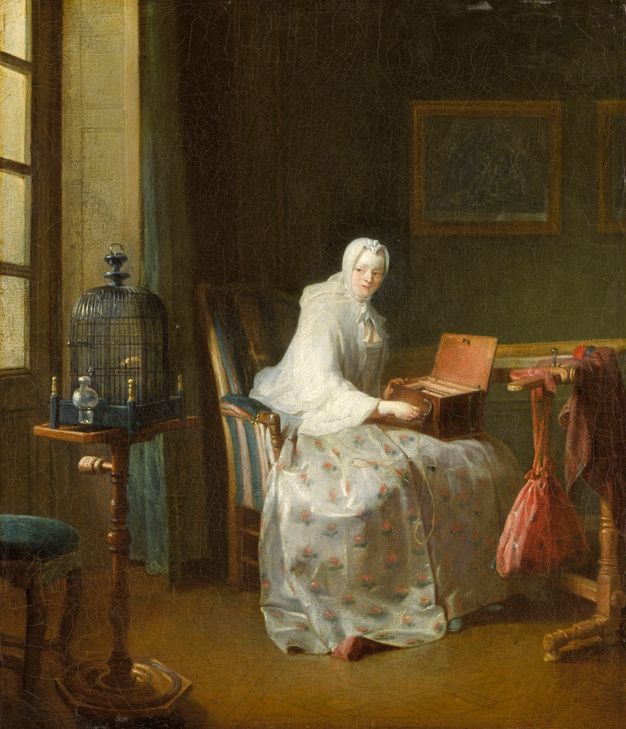
The comparison is not, however, enlightening, first because Collot was not the mature, poised, and confidant Mme Aved, née Anne-Charlotte Gauthier de Loiserolles, daughter of a military officer, whom we know from Aved’s portrait of his wife, engraved by Jean-Joseph Balechou.22 She was young and unmarried, without, that is, a household of her own. Moreover, her relationship with her master, the fifty-year-old Falconet, whom she followed unchaperoned to Russia, was the subject of unwanted and malicious gossip.23 It is unlikely that the gift of a “pet” was intended by Catherine to remind Collot of what she had not and all that she was not.
Secondly, nightingales are not canaries. Indeed, the naturalist Georges-Louis Leclerc, comte de Buffon, made a point of contrasting them. In his audit of their respective characteristics, Buffon determined that for every trait that denoted the canary as tame and social, thus eradicating the ordinary distinctions between human and animal, the nightingale exhibited qualities that marked it as essentially animal and utterly other.24 Not only are nightingales difficult to keep because, as insectivores, they require live prey, they are also difficult to domesticate and train.25 Where the canary is an “open learner” (it listens, it remembers, it imitates), the nightingale is “closed.”26 It despises all song but its own, says Buffon.27
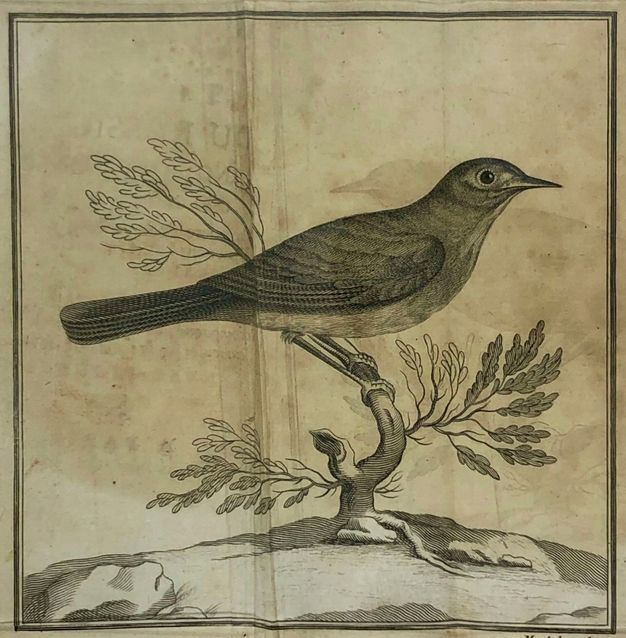
Finally, where canaries have a heart and form human attachments, nightingales are proud and solitary.28 So secretive are they, claimed Arnoult de Nobleville, that illustration of the bird in his treatise was justified, because its appearance, though lackluster, was virtually unknown.29 The bird is portrayed in the wild (fig. 115), the bloomy spray of its foliated perch serving as a synecdoche for nature, specifically silvan nature, the bird’s preferred habitat. Of human civilization there is no trace. We can infer from Catherine’s recommendation that Collot hang the nightingale outside her window, rather than inside her casement, and that the empress was aware of the limits to this songbird’s taming. The gift was an addition to Collot’s logement, not her household.
Collot was not, however, without feeling for her songbird—“joy” at his arrival, “pity” for his injured wing—but hers (unlike Duplessis’s for his ) were emotions that emanated, according to Enlightenment thinking, from the soul and thus set her and humanity apart from the animal kingdom.30 If not a love object, what was the nightingale’s purpose and meaning? For an answer we should perhaps consider the recipient’s professional rather than her personal and domestic life. Catherine’s gift punctuated a stream of commissions issued with avowed impatience and at escalating pace. In her exchanges with Falconet on the subject of Collot’s work, nightingale and marble almost serve as counterpoints. Catherine cannot wait to see “a good and large body of marble between Collot’s hands,” begs her in July 1768 to take a “block” from the royal reserve, “marble” Collot quits carving in May the following year only “to jump for joy” at the prospect of the nightingale’s arrival.31 Catherine thus openly acknowledges the manual labor of carving, refuses to disguise sculpture’s rude materiality, and, contrary to convention, does not, on these grounds, deny the chisel to this woman, Collot.32 Instead she sends her a bird: not a canary to occupy her leisure, but a nightingale to afford her rest.
Birdsong was closely associated with repose. A commonplace, or “topic,” in French chamber music and opera, birdsong invoked pastoral’s idyll: at Delos in, for example, one of Elizabeth Jacquet de La Guerre’s “French” cantatas (ca. 1710), or at Diana’s grove, in Jean-Philippe Rameau’s opera Hippolyte et Aricie (1733).33 In Collot’s case, the nightingale’s song may have opened her casement magically onto more recent, but no less ideal, times and spaces, onto recollections of the garden, Rue d’Anjou, where she and Falconet had shared a studio, and of times spent there among friends, memories stoked by Diderot’s reminiscences of their “cottage” in his letters to them.34 However, to interpret the nightingale as an instrument only of Catherine’s hospitality doesn’t seem fully yet to account for the choice and time of it as a gift for Collot.
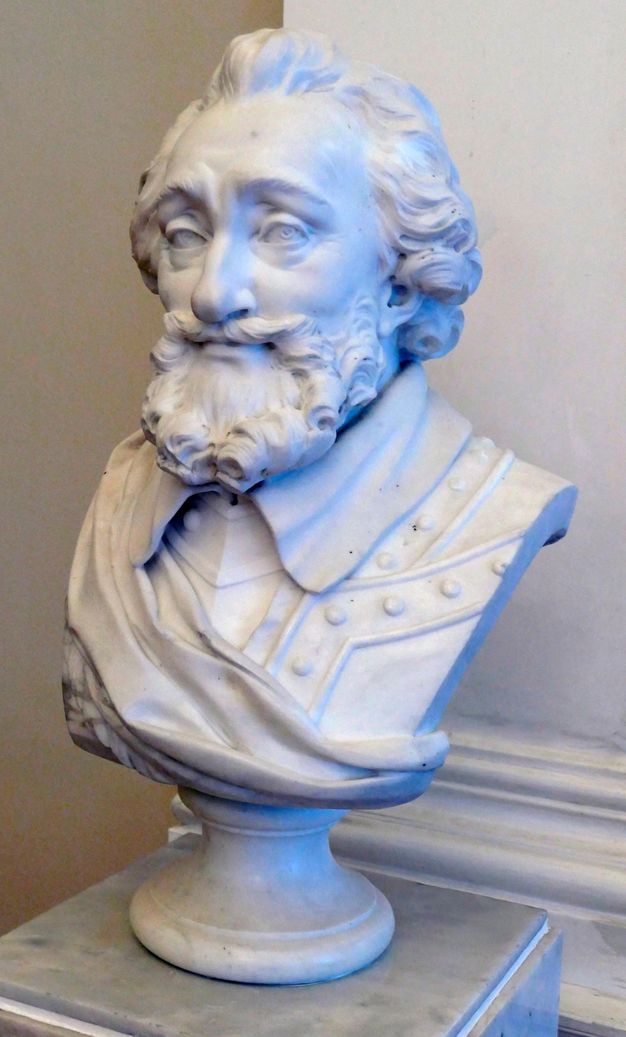
Regarded as the origin of music, birdsong symbolized freedom and imitation of nature as foundational principles of the fine arts.35 Such was the nightingale’s passion for liberty that it often broke its wings against the cage in its efforts to escape.36 Such was its pride in its song that its melodies were originals, the product of a creative or virile, and not a servile, imitation.37 It seems significant that Catherine chose to recognize Collot’s talent with a nightingale soon after gaining her consent to produce a pair of historical effigies. Portraits of the dead called, arguably, for genius that making a portrait from life did not. In May 1768 Catherine had asked Falconet whether Collot had ever “seen” Henri IV and Sully “en rêve,” that is, in her imagination.38 Falconet hastened to confirm that Collot was indeed “very dreamy,” that the idea of these Bourbon heroes would in fact probably prevent her from waking for some three or four days, and that the outcome would in fact be very happy.39 In the busts (fig. 116) Collot deftly combined naturalism (the sideways glance, the fleeting expression of animation) and historicism (the regal calm and seventeenth-century costume), elevating portraiture above mere likeness and demonstrating that the scope of a woman’s artistry extended beyond mere copying to invention. In recognizing the nightingale in Collot, in attending to his or her needs, and in thus favoring one “who dares to raise herself above her sex,” Catherine secured for herself not only Collot’s talents but the reputation of a patron and sovereign who, rather than oppressing genius, sets it free.40 §
-
Catherine II to Falconet, 15 May 1769, in Louis Réau, ed., Correspondance de Falconet avec Catherine II, 1767–1779 (Paris: Édouard Champion, 1921), 81. See also Christiane Dellac, Marie-Anne Collot: Une sculptrice française à la cour de Catherine II, 1748–1821 (Paris: L’Harmattan, 2005), 45. Warmest thanks to Melissa Hyde for her brilliant suggestion of Collot’s nightingale for this book. ↩︎
-
Falconet to Catherine II, 14 May 1749, in Réau, Correspondance, 79. ↩︎
-
Falconet to Catherine II, 14 May 1749, 77. ↩︎
-
Falconet to Catherine II, 14 May 1749, 79. On Collot’s lodgings, first on Nevsky Prospect and, by 1769, in Millonnaya Street, see Alexander Schenker, The Bronze Horseman: Falconet’s Monument to Peter the Great (New Haven: Yale University Press, 2003), 95–98. ↩︎
-
Today, nightingales are more closely associated with Moscow than Saint Petersburg. Mospriroda counts returning nightingales every year as part of its environmental program. See the map at https://www.google.com/maps/d/viewer?mid=11TgYCIPoMRNnRtbsqHvE50anCdWu0jrv&hl=ru&ll=55.74903519084849%2C37.543251199999986&z=9. ↩︎
-
See Arnoult de Nobleville, Aëdologie, ou Traité du rossignol franc ou chanteur (Paris: Debure aîné, 1751), 2. ↩︎
-
See Louise E. Robbins, Elephant Slaves and Pampered Parrots: Exotic Animals in Eighteenth-Century Paris (Baltimore: Johns Hopkins Press, 2002), 110–13. For contrast with the seventeenth century, see “Rossignol, linotte, pinson: l’inventaire d’un oiselier en 1665,” Archives minutes, 28 August 2017, https://archivesminutes.wordpress.com/2017/08/28/le-contraire-dune-tete-de-linotte-linventaire-dun-oiselier-en-1665/. For an example of a parrot-owning eighteenth-century artist, see the inventory of the printmaker Gilles Demarteau (6 September 1776), according to which he kept a parrot at the printing shop on the Île de la Cité. See partial transcript of the inventory at the Musée Carnavalet library (Yb3 337), 7. Warm thanks to Carole Nataf for drawing our attention to this. ↩︎
-
In 1763 Catherine had given a set of Russian-made hunting weapons to Louis Charles Auguste Le Tonnelier, baron de Breteuil, the French ambassador. The flintlock fowling piece from the set is now at the Art Institute of Chicago. ↩︎
-
In 1768 Catherine had given an Imperial porcelain tea and coffee set to the English physician Thomas Dimsdale in thanks for inoculating her against smallpox. It was acquired by the Hermitage Museum, Saint Petersburg, in 2013. ↩︎
-
“Prodigy” was Prince Gallitzin’s word for Collot when describing her to Nikita Ivanovitch Panine, secretary of state for foreign affairs in 1766. See Marie-Louise Becker, “Marie-Anne Collot (1748–1821), l’art de la terre-cuite au féminin,” L’objet d’art 325 (1998): 73. ↩︎
-
She may have been alone in her profession in France, but not in Europe. See Marjan Sterckx, “Pride and Prejudice: Eighteenth-Century Women Sculptors and Their Material Practices,” in Women and Material Culture, 1660–1830, ed. Jennie Batchelor and Cora Kaplan (New York: Palgrave, 2007), 86–102. The number of women sculptors rose markedly by the turn of the nineteenth century. See Anastasia Easterday, “Labeur, Honneur, Douleur: Sculptors Julie Charpentier, Félicie de Fauveau and Marie d’Orléans,” Women’s Art Journal 18, no. 2 (1997–98): 11–16. ↩︎
-
On the commission, see Louis Réau, Étienne-Maurice Falconet (Paris: Demotte, 1922), 1:81–89, and most recently Schenker, The Bronze Horseman. ↩︎
-
This distinguished Collot from the studio hands that Falconet also contracted to take with him. On Collot’s works before her departure to Russia, see Becker, “Marie-Anne Collot (1748–1821),” 72–82. ↩︎
-
On Catherine’s commissions, see Réau, Falconet, 2:429–48; and Marie-Liesse Pierre-Dulau, “Trois artistes à Saint-Petersburg au XVIIIe siècle,” in L’Influence française au XVIIIe siècle, ed. Jean-Pierre Poussou, Anne Mézin, and Yves Perret-Gentil (Paris: Presses de l’Université de Paris-Sorbonne, 2004), 148–56. ↩︎
-
See Louis Réau, “Contrat de marriage de Pierre-Étienne Falconet et de Marie-Anne Collot, 27 juillet 1777,” BSHAF (1918–19): 157–61. Collot did not enter into a “communauté de biens” with her husband, as was then the custom (see and ), but expressly retained control of her own money. ↩︎
-
See Louis Réau, “Inventaire après décès de M. Falconet, 31 janvier, 1791,” BSHAF (1918–19): 163–68. ↩︎
-
See [Nicolas Venette], Traité du rossignol qui enseigne la manière de les connoître et de les élever (Paris: Claude Prudhomme, 1707), preface (unpaginated); and Nobleville, Aëdologie, i. Jean-Claude Hervieux de Chanteloup’s Nouveau traité des serins de canarie (Paris: Claude Prudhomme, 1713) was dedicated, however, to the princesse de Condé. Hervieux was the keeper of her aviary. On the visual discourse, see René Démoris, “L’oiseau et sa cage en peinture,” Lumières 5 (2005): 29–48. ↩︎
-
Julia Breittruck, “Pet Birds: Cages and Practices of Domestication in Eighteenth-Century Paris,” Interdisciplines 1 (2012): 6–23. See also, for example, Hervieux de Chanteloup, Nouveau traité des serins, 14–25, esp. 22; and Nobleville, Aëdologie, 58. ↩︎
-
See Olga Petri and Philip Howell, “From the Dawn Chorus to the Canary Choir: Notes on the Unnatural History of Birdsong,” Humanimalia 11, no. 2 (2020): 163–92. ↩︎
-
See Georges Wildenstein, Le peintre Aved: Sa vie et son oeuvre (1702–1766) (Paris: Les Beaux-Arts, Edition d’Études et de Documents, 1923), 2:205. The instrument’s maker was the famous Jean Richard, whose shop was on the Rue de Richelieu. The collection of the Philharmonie de Paris includes a late eighteenth-century serinette by Ferry. It plays a mixture of “airs,” often marches, such as “Malbroug s’en va en guerre,” intended to render the bird’s song comic. To hear a serinette played, see Audrey Defrasne’s performance at Musée de la musique mécanique, Les Gets: https://www.youtube.com/watch?v=1RF4P3kRuJ0. The Aved barrel organ raises the possibility that Mme Aved may have served as a model for Chardin’s picture; it is unlikely to have been a portrait, since the painting was a royal commission. ↩︎
-
Described as a “salle” and the penultimate room in an enfilade of four, giving onto the Rue de Bourbon (now Rue de Lille). The theme of birds was picked up in the decoration: a pair of gilt bronze girandoles decorated with Meissen birds provided some of the lighting of the room. See Wildenstein, Aved, 205. ↩︎
-
The portrait (current whereabouts unknown) was exhibited at the Salon of 1740. Balechou’s print was advertised in the Mercure de France, October 1743, 2248. ↩︎
-
See Réau, Falconet, 1:100–101. ↩︎
-
On pets in the human/animal debate, see Marc Shell, “The Family Pet,” Representations 15 (1986): 121–53. ↩︎
-
Georges Louis Leclerc, comte de Buffon, called nightingales “carnivors,” in contrast to grain-eating, and by implication, tamer canaries. See Buffon, Histoire naturelle des oiseaux [1770–83] (Dordrecht: Blusse, 1796), 4:2. Venette called nightingales “birds of prey” in Traité, 56. ↩︎
-
Buffon, Histoire naturelle, 4:2. Nobleville disagreed: see Aëdologie, 83–93. See also Marc Shell, “Animals That Talk,” Differences: A Journal of Feminist Cultural Studies 15, no. 1 (2004): 93–95. ↩︎
-
Buffon, Histoire naturelle, 4:1–2. According to the ornithologist Tim Birkhead, the failure of nightingales to learn songs other than their own may in fact have been consequent on the lack of incentive to persuade them to do so. See T. R. Birkhead and S. van Balen, “Bird-Keeping and the Development of Ornithological Science,” Archives of Natural History 35, no. 2 (2008): 283. ↩︎
-
Buffon, Histoire naturelle, 4:2. See also [Venette], Traité, 13, 34; and Nobleville, Aëdologie, 8. Both Venette and Nobleville insist that nightingales do not flock together, even when migrating. The English language does, however, possess a collective noun for nightingales: a watch. ↩︎
-
Nobleville, Aëdologie, 2. The nightingale’s Latin name, Luscinia, can be translated as “little-seen songster,” from the Latin “luscus,” meaning “half-blind” or “half-understood,” and “cano,” “to sing.” ↩︎
-
See the essays by Richard Nash (“Joy and Pity: Reading Animal Bodies in Late Eighteenth-Century Culture”) and Jonathan Lamb (“Sympathy with Animals and Salvation of the Soul”) in a special issue of The Eighteenth Century: Theory and Interpretation 52, no. 1 (2011). ↩︎
-
Réau, Correspondance, 52, 56, 83. ↩︎
-
In contrast, see Diderot’s letter to Ivan Ivanovitch Betsky, 28–31 August 1766. In it, Diderot cannot stop himself from drawing attention to the contrast between Collot’s “delicate hands” and the materials (clay and stone) that her art gave her to work. Denis Diderot, Correspondance, ed. Laurent Versini (Paris: Robert Lafont, 1997), 688. The unsuitability of carving for women was a prejudice perpetuated by academic theory until the end of the nineteenth century; see Karl Robert, Traité pratique du modelage et de la sculpture (Paris: Henri Laurens, 1889), 7. ↩︎
-
See Charles Blainville, Histoire générale, critique et philologique de la musique (Paris: Pissot, 1767) v, 1–3. ↩︎
-
See, in Diderot, Correspondance: Diderot to Falconet, 10 September 1766, 698; Diderot to Falconet, 12 November 1766, 704; and Diderot to Falconet, 15 May 1767, 737. The nightingale’s haunting song was, of course, used by Diderot as a metaphor for posterity in his debate on that subject with Falconet. Falconet drew on birdsong heard daily in his garden at Rue d’Anjou to counter Diderot’s arguments. See . ↩︎
-
See Matthew Head, “Birdsong and the Origins of Music,” Journal of the Royal Musical Association 122 (1997): 1–23. ↩︎
-
[Venette], Traité, 44. ↩︎
-
Nobleville, Aëdologie, 7–8. ↩︎
-
Catherine II to Falconet, 16 May 1767, in Réau, Correspondance, 42–43. See also Réau, Falconet, 2:435–36. ↩︎
-
Falconet to Catherine II, 23 May 1768, in Réau, Correspondance, 44. ↩︎
-
Diderot to Ivan Ivanovich Betzki, 28–31 August 1766, in Diderot, Correspondance, 688. On the relations between salonnières and men of letters as relations between bird-keepers and birds, see Jean Starobinski, “Diderot: A Geography of Chatter,” Hudson Review 65, no. 3 (2012): 368–80. ↩︎