Type of Object
Material
Type of Object
Material
Amid the extensive collection of bijoux (jewelry) itemized in the inventory of Charles-Antoine Coypel’s possessions after his death, a luxurious watch was described in some detail: “[A] repeater watch, made in Paris by Julien Le Roy, in a gold casing adorned with a gold chain, comprising two seals mounted on rings, one of agate the other of carnelian, and with two rows of brilliants on the hour hand and on the minute hand, all in a green case garnished with gold.”1 One of at least three watches that Coypel owned, this was, according to the notary who priced it, the most elaborate and the most expensive.2 It may also have been the most valuable to Coypel in another sense, not due to its cost, per se, but because of how it came to be in his possession.
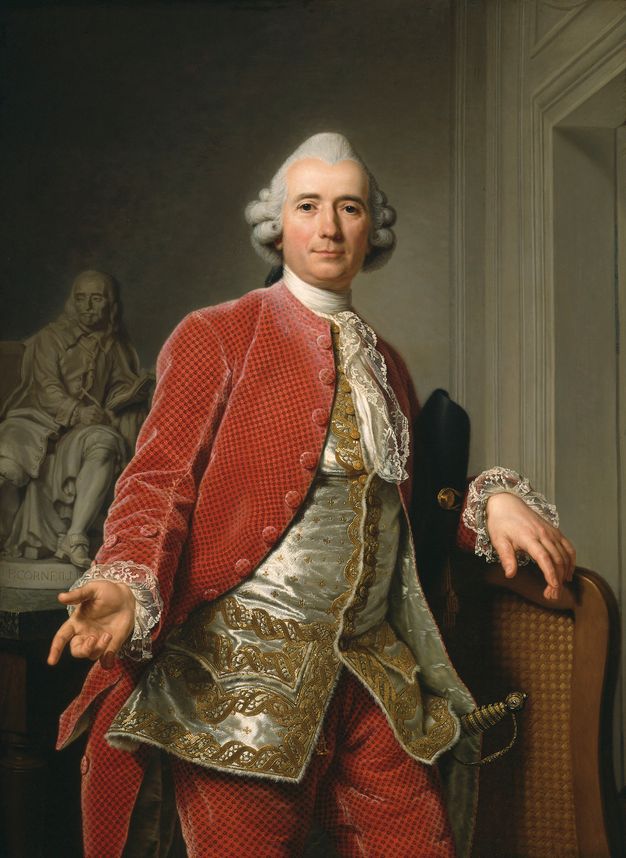
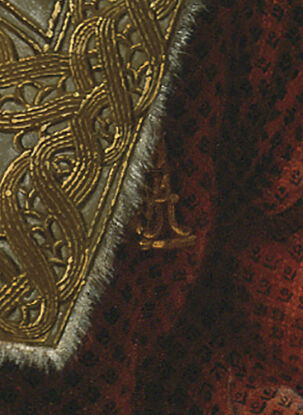
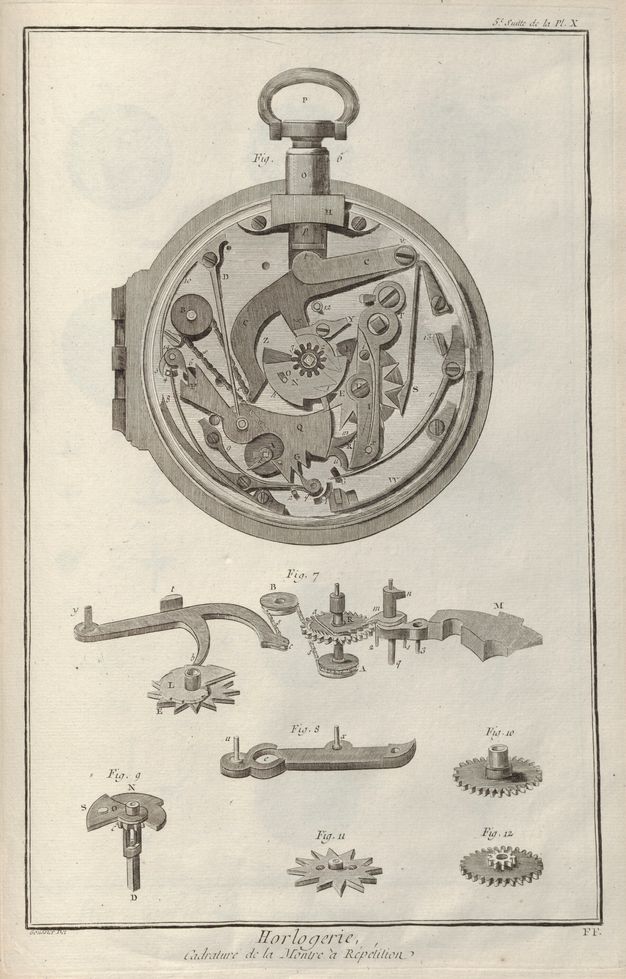
In terms of its price, the watch’s value came in part from its materials and design: precious metals and semiprecious stones worked by an orfèvre (goldsmith) into an elegant item of apparel. Conventionally worn hanging off the breeches beneath the waistcoat, a watch was an ostentatious sartorial accessory, but not one that could always be seen in its entirety.3 The watch’s tentative visibility is evident in Adolf-Ulric Wertmüller’s portrait of the sculptor Jean-Jacques Caffieri (figs. 175, 176), where all that can be glimpsed of his watch is one of its cachets (seals) peeping out from behind the waistcoat. When hidden temporarily by clothing, there was still the sound of the chain and its hanging seals, jangling with the wearer’s movements, to indicate the extent of the covered adornment. In the case of Coypel’s watch, a different kind of sound was the other source of its value as a luxury. Described as a “repeater watch,” this was the latest in pocket-watch technology, its mechanism comprising a whole separate set of cogs that activated a striking instrument to chime on the hour (fig. 177).4 Though the orfèvre responsible for the decorative design of Coypel’s watch is now anonymous, the horloger (clockmaker) responsible for its engineering was recorded in the signature on its face—Julien Le Roy—one of Paris’s most renowned horlogers, appointed clockmaker to Louis XV in 1739.5
Coypel’s fancy piece of modern technology was a desirable commodity. Such a high-end luxury was certainly not out of place among Coypel’s possessions, for the wealth of material things in his after-death inventory and sale catalog suggest a life lived in opulent surrounds.6 His apartments in the Louvre (those Boucher would later inherit and adapt to accommodate his collection) were filled with luxury objects, among them porcelain vases, lamps, and potpourris; gold boxes; ornate mirrors; lacquered furniture; musical instruments; ; a Meissonnier clock and barometer; his elaborate ; and a gilt-bronze Boulle chandelier. His person was also luxuriously adorned, his wardrobes filled with velvet suits, lace shirts, cotton , diamond-encrusted shoe buckles, gold-hilted , and rings with precious jewels. Artists in eighteenth-century France came from a variety of backgrounds and achieved varying degrees of financial success throughout their careers, which, as this book demonstrates, was often reflected in the material environments they inhabited. As the lavish exteriorization of wealth in his lodgings attests, Coypel was certainly one of the richer ones. Premier peintre (first painter) to the king and the duc d’Orléans, and director of the Académie, Coypel was part of a successful dynasty of similarly high-status artists, inheritor of his father and grandfather’s collections, and he remained unmarried and without dependents, except for his four servants.7
Coypel’s watch was thus a luxury owned by a man who indulged readily in the delights of material extravagance. But as we know, the value of things cannot always be attributed to their market price. Being expensive might make an object desirable, but it is not the only reason a person may own it, nor the only quality that makes it valuable. Coypel’s watch is a case in point, for the story of its acquisition does not take us into Paris’s boutiques and commodity markets, but rather into a church, to meet not orfèvres and horlogers but a parish priest. Indeed, Coypel’s watch reveals as much about the artist’s faith, his charitable acts, and the social relations formed in his local neighborhood as it does about his penchant for beautiful expensive things.
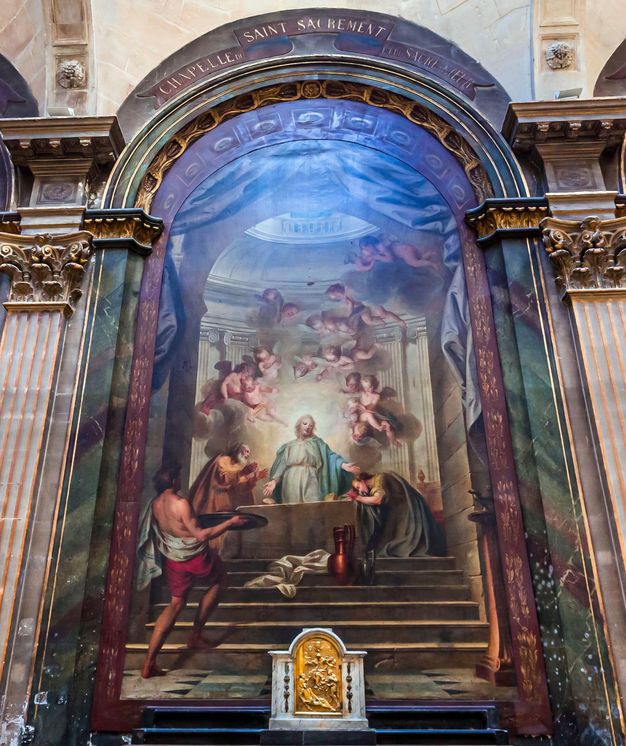
In 1749 Coypel was commissioned to paint an enormous Supper at Emmaus to serve as altarpiece for the new Communion chapel in the church of Saint-Merry (fig. 178). As a resident of the Louvre, Coypel was not a parishioner of Saint-Merry, but he had a personal relationship with the curé (parish priest), Antoine Artaud, established years earlier when Artaud had worked at the church of Saint-Nicolas-du-Louvre.8 Back in 1734, artist and clergyman had made their acquaintance when Coypel donated a large altarpiece of Christ’s Entombment (now lost) for this small church in his neighborhood.9 Their long-term association was probably behind Saint-Merry’s decision to commission Coypel, for, as it turned out, this high-profile artist was actually far beyond the church’s budget. According to the parish accounts, Saint-Merry’s annual income just covered their running costs, leaving no revenue for additional expenses.10 Decoration of the new chapel was funded through special collections from parishioners, but these were quickly exhausted when it came time to pay the numerous artists and tradesmen involved. Faced with dwindling coffers and insufficient funds to pay Coypel, the church instead offered him the Le Roy repeater watch as payment for the painting.11
Transactions where luxury objects stood in for monetary payments were fairly common in eighteenth-century France. Watches, as Natacha Coquery has shown, were among the most frequently exchanged items in this business of barter.12 But in this particular exchange, two things stand out. First, the identity of the giver. A watch is not something usually owned by a corporate body, like a parish council, but rather by an individual, suggesting that this was a personal payment coming directly from Artaud, Coypel’s friend. Second, the question of value. There is no record of the original commission for the altarpiece, so we do not know how Coypel estimated the cost of the painting, but the parish accounts valued the watch at 1,277 livres.13 In transactions where luxury goods were used as currency, the items exchanged usually held equivalent values. But that was not the case here. Going by its market value, the watch would have given the Supper at Emmaus a price of only around 6 livres per square foot. Compared with Coypel’s other paintings from this period—when he was at the peak of his artistic career—this was around ten times less than his usual going rate.14
Either the watch was never meant as full payment (though it was the only payment Coypel ever received) or the value of the watch in this exchange was not being defined in purely financial terms. Certainly, both the watch and the painting were commodities, objects whose prices were determined by the materials and labor involved in their production. But when used as currency, objects are different. Unlike abstract sums of money, objects are material things that have lives and relationships; they have a cash value, but they also acquire sentimental value through meanings that become attached to them. Like so many of the objects in this book, Coypel’s watch circulated in commercial economies, but also symbolic ones.
In this exchange, the watch’s value depended not only on its estimated price but on what it meant to the giver and the recipient. Perhaps this meaning was only acquired at the point of exchange, when the watch became a token of thanksgiving for the altarpiece, a memento forever recalling that event. Perhaps its sentimental value was intensified by the personal touch, for presumably Artaud knew of Coypel’s penchant for expensive luxury goods, and maybe Coypel even particularly desired a watch of this kind. Or perhaps its meaning was invested by the previous owner, that is, during its time in Artaud’s possession and what it already meant to him—a gift, an inheritance, or another significant exchange that somehow intensified the significance of its next exchange. As for the altarpiece, the art market measured value differently from the luxury market, not on cost of materials (paint and canvas) but on skill and labor. A painting’s price was dependent on the status of its artist, and as premier peintre du roi and directeur of the Académie, Coypel’s paintings could claim some of the highest prices around. But even here “value” was more ambiguous. After all, Supper at Emmaus was not just any painting, but an altarpiece—a sacred object destined to play a devotional role in acts of worship for hundreds of souls—and it is difficult to put a price on that.
Coypel and Artaud’s exchange was not a straightforward commercial transaction but an exchange of symbolically resonant objects between two friends, one a priest, the other a member of the faithful. Artaud was not commissioning a painting for a private residence but seeking an object to provide a setting for the distribution of the sacrament to his parishioners. Coypel was not just fulfilling a commission but yet again making a charitable donation, as he had fifteen years earlier for the church of Saint-Nicolas-du-Louvre.15 This time, however, it seems not to have been intended as a donation from the outset. Instead, when Saint-Merry ran out of money, Coypel performed a face-saving favor for his friend, accepting the watch as “payment” and canceling the rest of the debt as a charitable offering. Coypel’s altruistic act depended entirely on the symbolic value of the watch, for it would never have worked if the payment had come in cash. If Artaud had simply given Coypel 1,277 livres, it could only ever have appeared as a partial payment, an embarrassing undervaluing of Coypel’s work. The watch, however, was not just a stand-in for money but an enduring sign of this offering, retrospectively transforming Coypel’s altarpiece into a donation and Artaud’s watch into a gift of gratitude.
The value of Coypel’s watch was increased (or at least disguised) in this exchange by its ambiguous position between various economies (commercial, social, and symbolic). And so it continued through the object’s life. When the notary itemized the watch in the inventory of Coypel’s possessions taken after his death in 1752, it was priced modestly at 1,000 livres, but it appears to have been worth more than that to Coypel. Another of the watches listed by the notary ended up in the sale of the artist’s possessions the following year, but this watch did not.16 Instead, it passed to his brother, Philippe, who inherited most of Coypel’s estate, apart from the few special bequests Coypel made in his to family and associates (including 1,000 livres to the curé of his own parish of Saint-Germain-l’Auxerrois).17 This luxury item stood out from many others Coypel had acquired, valued enough to be offered again rather than sold off for revenue. Passing through its varied economies, the object was imbued with new sentimental resonances: changing from the watch that Antoine Artaud gave Coypel for painting Supper at Emmaus, to become the watch that Coypel left his brother when he died. ‡
“Une . . . montre à répétition faite à Paris par Julien Le Roy dans Sa boette d’or garny de Sa chaine d’or, deux cachets montés en Bague l’un d’une agatorin et l’autre de Cornaline, deux Batons de Brillants tant Sur l’eguille des heures que Sur celle des minutes dans Son Etuy de trousset Vert et garny d’or.” Charles-Antoine Coypel, “Inventaire après décès,” 25 September 1752, AN, MC/LXXVI/337, 11. ↩︎
It was valued in the inventory at 1,000 livres; the other watches were 700 and 200 livres. ↩︎
Genevieve Cummins, How the Watch Was Worn: A Fashion for 500 Years (Woodbridge: Antique Collectors’ Club, 2010), 19. ↩︎
Repeater mechanisms for watches were patented by David Quare in the 1680s. David Landes, Revolution in Time: Clocks and the Making of the Modern World (Cambridge, MA: Belknap, 1983). ↩︎
Jean-Dominique Augarde, Les ouvriers du temps: La pendule à Paris de Louis XIV à Napoléon 1er (Geneva: Antiquorum, 1996); and La dynastie des le Roy, horlogers du roi, exh. cat. (Tours: Musée des Beaux-Arts, 1987). ↩︎
See Coypel’s “Inventaire après décès” and Catalogue des tableaux, dessins, marbres, bronzes, modeles, estampes, et planches gravées; ainsi que des bijoux, porcelains, et autres curiosités de prix du cabinet de feu M. Coypel, premier peintre du roi & de Monseigneur le duc d’Orléans, & directeur de l’Académie royale de peinture & sculpture (Paris, 1753). ↩︎
On Charles-Antoine Coypel’s professional and personal life, see Thierry Lefrançois, Charles Coypel, 1694–1752 (Paris: Arthena, 1994), 37–112. On the Coypel dynasty, see Hannah Williams, Académie Royale: A History in Portraits (New York: Routledge, 2015), 166–77. ↩︎
Lefrançois, Charles Coypel, 360–61. ↩︎
Lefrançois, Charles Coypel, 276–79. ↩︎
Abbé Constant Baloche, Église Saint-Merry de Paris: Histoire de la paroisse et de la collégiale, 700–1910 (Paris: the author, 1911), 568–70. For an analysis of Saint-Merry’s finances, see Hannah Williams, Art and Religion in Enlightenment Paris (forthcoming). ↩︎
Baloche, Église Saint-Merry, 531. ↩︎
Natacha Coquery, “The Language of Success: Marketing and Distributing Semi-Luxury Goods in Eighteenth-Century Paris,” Journal of Design History 17, no. 1 (2004): 84–86. ↩︎
Baloche, Église Saint-Merry, 531. ↩︎
Comparative rates (based on prices recorded by Lefrançois) for Coypel’s paintings include: Sainte Thaïs and Garden of Olives (1736)—each 3 ft. 5 in. by 1 ft. 10 in.—700 livres (58 livres/sq. ft.); Sainte Landrade (1747)—3 ft. 8 in. by 2 ft. 5 in.—600 livres (66 livres/sq. ft.); Cleopatra swallowing poison (1749)—6 ft. 10 in. by 8 ft. 9 in.—3,500 livres (59 livres/sq. ft.); L’évanouissement d’Atalide (1750)—6 ft. 6 in. by 5 ft.—2,500 livres (78 livres/sq. ft.). Soon after, the marquis de Marigny regulated tariffs for history paintings produced for royal commissions. A work of this size (circa 200 square feet) would have fetched at least 5,000 livres (or 10,000 depending on the size of figures). Fernand Engerand, Inventaire des tableaux commandés et achetés par la direction des bâtiments du roi (1709–1792) (Paris, 1900), xxii–xxiii. ↩︎
Coypel also donated an Ecce Homo for the church of the Oratoire in 1729. Lefrançois, Charles Coypel, 222–25. ↩︎
Catalogue des tableaux . . . de feu M. Coypel, 100. ↩︎
Will, Charles-Antoine Coypel, 13 June 1752, AN, MC/ET/LXXVI/335. ↩︎
| words