Material
Handkerchief
- Charles-Nicolas Cochin (1715–90)
On 30 June 1782, the draftsman and printmaker Charles-Nicolas Cochin the Younger, formerly secretary of the Académie and responsible for the day-to-day royal administration of the arts during the ministry of the marquis de Marigny, wrote from Paris to his friend and fellow academician, the painter Jean-Baptiste Descamps at Rouen, with a “small commission”: purchase on his behalf of a dozen pocket handkerchiefs.1 The handkerchiefs do not survive, but Cochin’s letters do. Carefully kept by the Rouennais artist, they were ceded at Descamps’s death along with the rest of his papers to the Académie de Rouen and are now at the Bibliothèque Municipale. Indirectly these letters afford evidence of the penetration of a relatively new and apparently elite thing into the consumer lives of artists. They unfold, at this one level, a practical narrative of getting in all its particular historical complexity and associated anxiety. At another, however, the handkerchief opened up a discursive space for the correspondents, supplying them with an anchor, reassuring in its banal materiality, for reflection on transcendental matters of art and death.
Of the importance of the commission to Cochin there can be no doubt. He was embarrassed, in fact, by the length and detail with which he set out his instructions and apologized for his long-winded chat on so trivial a matter in the letter of 30 June. A month later, he wrote again and began by shamefacedly admitting to “pestering you and ruining you in postal charges” for the sake of his petty haberdashery wants, before giving equally detailed instructions for the delivery of the handkerchiefs to his logement (lodgings) at the Louvre.2 In August, two additional letters on the subject followed in which Cochin warmly thanked his friend and arranged payment.3 From the letters we learn that Cochin didn’t know where to shop for such items in Paris and that he had lately been in the habit of buying his handkerchiefs at Orléans, through which he passed once a year en route to the marquis de Marigny’s country estate, Ménars.4 However, Marigny’s death in May 1781 had robbed him of the opportunity of shopping in person on Orléans’s Rue Royale. His friend Aignan-Thomas Desfriches, amateur artist, sugar trader, and native of Orléans, had tried to make good the handicap.5 He had sent Cochin samples of stuff from which to choose, but the handkerchiefs that had arrived from Orléans in April had disappointed, in spite of Desfriches’s precautions.6
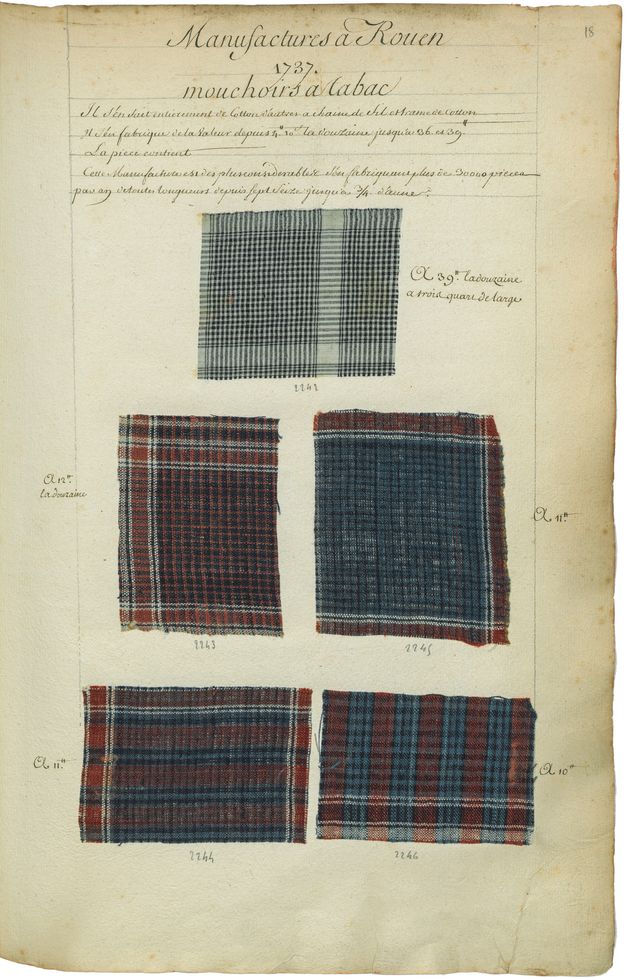
Cochin was not wrong in thinking that Rouen was better placed than Orléans to meet his needs. Cloth had been an important industry in that city and its hinterland since the seventeenth century. In 1737, when Louis-François-Armand Du Plessis, duc de Richelieu, was collecting samples of French stuffs for his library scrapbooks, Rouen’s weavers were producing handkerchiefs in a range of stuffs, some cotton, others mixes (notably of cotton and linen) and in a range of colors and patterns, at prices starting at 36 livres and rising to 39 livres per dozen (fig. 70). Annual output from the city’s workshops in 1737–38 was, according to the Richelieu albums, in excess of 30,000 pieces: the smallest were 18 centimeters square, the largest 860 centimeters.7 Fifty years later, a memorandum on Rouen’s cloth industry drawn up for the Bureau of Trade and Industry estimated that the 1,250 master weavers of Rouen and its environs were producing cotton goods to the value of 50 million livres per annum, of which handkerchiefs continued to form a significant proportion.8
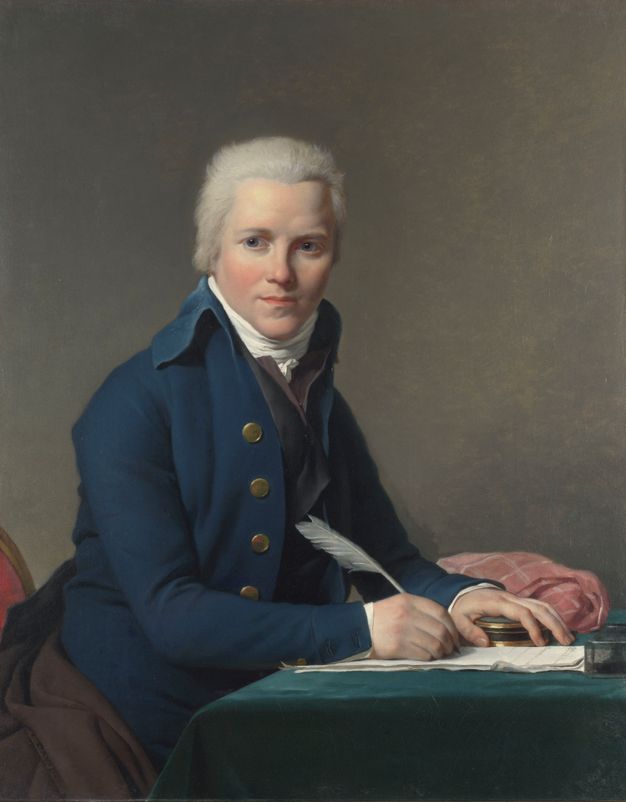
Cochin told Descamps he was prepared to pay top price for such “beautiful” handkerchiefs as were to be had at Rouen: 36 livres for a dozen small ones and 48 livres for large ones.9 He was evidently not too particular about size, but he was exigent about stuff and color. His preference, against general consumer trend, was for linen not cotton, for a robust handkerchief whose softness was countered by stoutness and absorbency. As to color, his first choice was for red ones, but he also countenanced brown. By the 1780s, so-called Turkey red, a saturated hue, had successfully been introduced at Rouen’s dyeworks and was replacing the traditional darker, duller madder.10 It provided precisely the strong color of handkerchief that Cochin was after and that is depicted in Jacques-Louis David’s portrait of Jacobus Blauw (fig. 71).
In spite of the references to price and payment, the status of Cochin’s handkerchiefs as either commodities or gifts is not certain. They stand apart from the gifts of food (sweets and cherries), the small coin of social bonding, that Descamps sent Cochin from time to time, and from the drawings, prints, and texts that Cochin, for his part, gave his friend.11 The services required to unite Cochin with his new handkerchiefs involved, however, investments of time, attention, and personal care that are generally associated with gifts, the more so since, in order to avoid the custom duties of the Grande Ferme, Descamps had had to oversee the hemming and laundering of the handkerchiefs before their dispatch to Paris.12 When Cochin requested a final invoice from his friend, he was sensitive to say that had this hemming and washing been done by Descamps’s daughters, he would not insult them by offering wages, gallantly promising instead to send them an equal number of pairs of bedsheets in return.13 Thus, Cochin’s “small commission” for petit linge commodities was in its execution giftwrapped by the mutual regard of the parties for each other’s feelings; it was the occasion and site of shared intimacy.
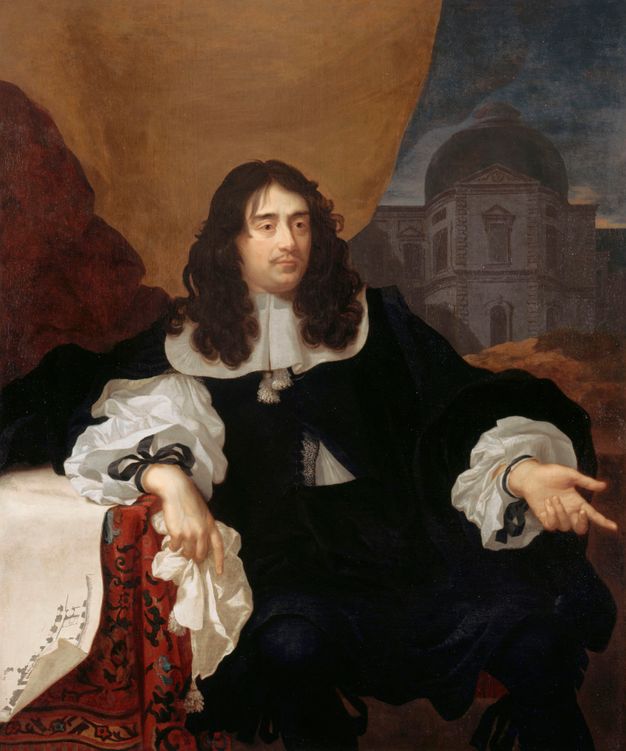
Why did handkerchiefs—objects of little intrinsic value and short lived—give rise to such feelings? The advent of handkerchiefs as items of dress in the seventeenth century has generally been linked to rising standards of polite comportment and personal hygiene.14 Cochin acknowledged to Descamps that he felt obliged to keep up the appearance of nobility, given his in 1757 with the cross of the Order of Saint Michel, though he was often short of the ready means for doing so.15 The inventory of his clothes taken after his death in May 1790 confirms that commitment.16 In the pair of wardrobes in his cabinet, notaries found twelve three-piece suits, five pairs of britches, seven frocks, eighteen waistcoats, and two redingotes. Most of the items were sober and of good woollen broadcloth: blacks, browns, and grays predominate. But there was luxury too: a brown suit with gold embroidery, another of “spring” or silk velvet with gold buttons. There were silk and satin breeches and, stunningly, a scarlet waistcoat embroidered with gold. His linen was likewise generous and included thirty-two shirts, four camisoles, five caps, thirteen collars, and six pairs of variously colored stockings, as well as twenty-six handkerchiefs.17 The handkerchiefs Cochin was after were not, however, of the kind held by the surintendent des bâtiments du roi Antoine de Ratabon in Pierre Rabon’s 1660 portrait, its finely woven folds glowing white in Ratabon’s casually elegant grasp (fig. 72). Though handkerchiefs, Cochin’s ideal corresponded more to mouchoirs de col, the large colored kerchiefs worn for work around the neck and head. Cochin’s friend Jean-Siméon Chardin represented himself with two such in his 1771 self-portrait (Paris, Musée du Louvre) and in so doing voiced painting’s connection with the trades because mouchoirs de col were items of the occupational dress of artisans, tradesmen, coachmen, and sailors.18
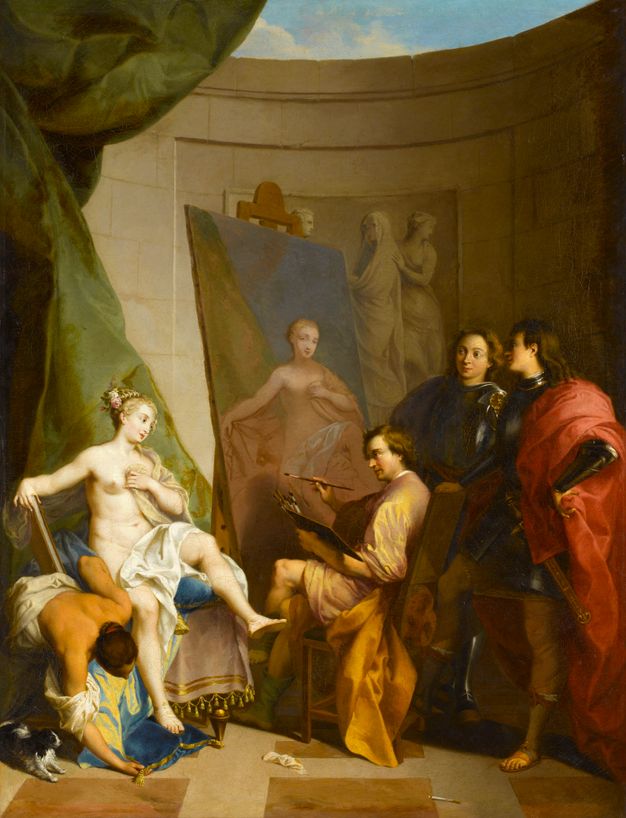
The contradictory evidence of the inventory of Cochin’s wardrobe and the request expressed in his letters forestalls interpretation of his mouchoirs à moucher as signs of upward social mobility and increased bodily propriety. Cochin did, to be sure, emphasize to Descamps his need of thick, dark hankies, thick enough to prevent the unhappy feeling of blowing one’s nose in one’s hands, and dark enough to camouflage the shaming ocher stains of snot and phlegm discharged by snuff takers like himself and diplomat Blauw; Blauw’s handkerchief is coupled with a (see fig. 71).19 But as mere pieces of unstructured cloth, handkerchiefs were close relatives of cleaning cloths and rags used in the studio. Their ambiguous status as both high—like fine linen collars and cuffs or cotton veils—and defiled was registered in history painting. In Nicolas Vleughels’s Apelles and Campaspe (fig. 73), a scrap of white fabric smeared with yellow ocher lies on the floor. We might mistake it for a handkerchief, given its proximity to Apelles in yellow and to Campaspe cushioned and veiled in white and gold, were it not for the fallen paintbrush that has rolled away to the right.20 Stuff played a significant role in the daily toilette of art—cleaning brushes and , wiping copperplates—just as it did in the grooming and comfort of artists.21
In light of the continuities in materiality, functionality, and signification across cloths as items of dress and as artistic tools, is there more to be said about Cochin’s quest for handkerchiefs in 1782? Is the meaning of the handkerchief exhausted by reconstruction of the historical contexts of production and consumption and of the social connotation of handkerchiefs, high and low? If so, how do we account for the exceptional emotional investment of both parties in the exchange of words and things? More was surely at stake.
Cochin’s request for handkerchiefs followed in the wake of regular news bulletins about his health in which he alluded to the messes and wastes of his aging body: he was sixty-six years old. He was plagued, apparently, by incurable sores and heavy colds that made his eyes weep.22 The handkerchief, in this sense, indirectly denoted his failing body, itself the ultimate example, surely, of Bill Brown’s reasoning that we are most aware of the thingness of things, of our mortality, when things and bodies break down.23 Notwithstanding his ailments, Cochin continued to work; the state of his finances apparently left him no choice. The anxiety about his infirmities that Cochin projected onto his worry about the getting of handkerchiefs was, professionally speaking, not, however, an anxiety about practice and did not focus on sight or touch. The aged artist’s shaky hand was virtually a trope in the narrative of artists’ lives, but not one mobilized here.24 Rather, Cochin worried, in a letter to Descamps in July 1781, about the cooling of his imagination, that is, of mental atrophy. He didn’t think his talents were declining but couldn’t be sure.25 Three years earlier he had written at greater length about getting old and on the falling off of his genius, something he sought to remedy with a regimen of copying the Old Masters to nurture the embers of his remaining talent in the comforting knowledge that “should genius fail entirely no one will notice and it will save me the humiliation that befalls old men who work beyond their time.”26
In theories of everyday life, repetition is often equated with commoditization, with the standardization of modern, industrially produced goods and with the homogenization of consumption.27 It is tempting to interpret the copies that Cochin confessed to making, and indeed his late reprises of his earlier compositions, as analogues in art to the increasingly stock handkerchiefs offered for sale by industry and produced in the deregulated market that followed the suppression of the guilds in 1776. In such a picture, the natural bodily cycles of the artist-become-ancient-automaton are in harmony with the increasingly regimented cycles of modern, protoindustrial production. But by linking repetition with the highest standards of quality, the Old Masters, Cochin assigned a positive value to repetition. Moreover, as his comments to Descamps about the printmaker Jean-Baptiste Le Bas indicate, he was critical of precisely the routinization of practice and the cheapening of product that was becoming increasingly widespread in the printshops of late eighteenth-century Paris.28 Cochin equated repetition with tradition. He understood it as a buttress (in art and in haberdashery) against the erosions of time and progress. In begging Descamps’s help in the getting of “beautiful” handkerchiefs, he was asking not only for an apparently limited kind of thing but also for the rare values that such kinds embodied. Good handkerchiefs—thick, color-permanent, and square—made good artists. They not only helped to articulate artistic identity and to secure, by cleaning, sharp lines and pure color respectively in printmaking and painting, they also perpetuated beauty and the dignity of artistic and artisanal work.
This portrait of Cochin’s handkerchiefs accounts, we think, for the intensity of his concern for them. It describes how, as a material thing, a handkerchief could tether ideals of the aesthetic, and how, as a sign, it resonated with meaning about the pain of suffering and the fear of death. Moreover, the close identification of the handkerchief with tears in eighteenth-century literature suggests that it not only served to ground Cochin’s anxieties about mortality in the material everyday, but reference to it also helped to mobilize Descamps’s sympathy and kindness.29 Cochin had observed to Descamps in 1778, during a bout of illness, that he was not afraid of dying, only of suffering. He would, he said, have wanted the upright death of the young man—the good, clean cannon shot on the battlefield (he was writing during the War of American Independence)—not the mess and misery of the old man’s portion,30 not, that is, the pathetic, out-of-breath death, prone between the sheets, hand on hanky, bed curtains closed. Loss of Descamps’s letters deprives us of the comfortable words that the Rouennais surely sent his friend in reply; we know them only in the handkerchiefs and in the pains he evidently took to secure and send them. §
-
Christian Michel, “Lettres adressées par Charles-Nicolas fils à Jean-Baptiste Descamps, 1757–1790,” AAF 28 (1986): Letter LXXVI, 68. ↩︎
-
Michel, “Lettres,” Letter LXXVIII, 69. Postage was paid by the recipient rather than the sender of a letter. ↩︎
-
Michel, “Lettres,” Letters LXXX and LXXXI, 70–71. ↩︎
-
Michel, “Lettres,” Letter LXXVI, 68. ↩︎
-
On Desfriches’s involvement with the sugar trade, see Patrick Villiers, “Quelques influences atlantiques à Orléans au XVIIIe siècle,” in Villes atlantiques dans l’Europe occidentale du Moyen Âge au XXe siècle, ed. Guy Saupin (Rennes: Presses Universitaires de Rennes, 2006), 89–100. ↩︎
-
See Paul Ratouis de Limay, Aignan-Thomas Desfriches (1715–1800) (Paris: Honoré Champion, 1907), 81–82; and a second letter on the subject on 18 May 1782, 82–84. ↩︎
-
Echantillons d’étoffes et toiles des manufactures de France recueillis par le maréchal de Richelieu (n.p.: n.p., 1736–37), 4:fol. 18, BnF, Département des Arts Graphiques, Réserve LH–45 (B) folio), published in Roger-Armand Weigert, Textiles en Europe sous Louis XV: Les plus beaux spécimens de la collection Richelieu (Fribourg: Office du Livre, 1964), 86. See also François-Alexandre-Pierre Garsault, L’art de la lingerie (Paris: Delatour, 1771), 20. ↩︎
-
“Mémoire général sur les bureaux de visite et de marque établis dans la ville et généralité de Rouen, sur les différentes fabriques, et sur les principaux établissements de commerce” (1787), AN, F12/1365, 2–3. ↩︎
-
Michel, “Lettres,” Letter LXXVIII, 69. ↩︎
-
Rouen was home to ninety-six dyers, among them two Englishmen who had brought a superior method of indigo dying to the town, and Sr. Osmont, who introduced red dyes, so-called façon rouge d’Andrinople, or Turkey red. See “Mémoire général,” 8. On madder see also . ↩︎
-
Michel, “Lettres,” Letters XIII and LXX, 19, 63. Desfriches regularly sent Cochin wine, vinegar, and pâté. See Ratouis de Limay, Desfriches, 63, 73, 75, 79, 81, 83, 85. ↩︎
-
Michel, “Lettres,” Letter LXXVIII, 69. ↩︎
-
Michel, “Lettres,” Letter LXXX, 70. ↩︎
-
See Daniel Roche, The Culture of Clothing: Dress and Fashion in the Ancien Régime (Cambridge: Cambridge University Press, 1996), 184–220. ↩︎
-
Michel, “Lettres,” Letter LXXII, 65. ↩︎
-
Charles-Nicolas Cochin, “Inventaire après décès,” 4 May 1790, AN, MC/ET/CXV/967. ↩︎
-
On linen as an index of class, see Roche, Culture of Clothing, 151–83. ↩︎
-
See Françoise Bayard, “Le mouchoir à Lyon, en Lyonnais et en Beaujolais au XVIIe et XVIIIe siècles,” in Le mouchoir dans tous ses états (Cholet: Musée du Textile de Cholet, 2000), 91–104. ↩︎
-
Oddly, there are no snuffboxes among the “jewels” listed in Cochin’s inventory, AN, MC/ET/CXV/967, 4 May 1790. ↩︎
-
If not yellow ocher, the pigment may be Naples yellow, one of the first synthetic pigments on the market. ↩︎
-
Specifically in relation to Cochin’s art, printmaking, see Charles-Nicolas Cochin, De la manière de graver à l’eau forte (Paris: Jombert, 1745), 145–48 and plate 19. For painting, see Elisabeth Lavezzi, “La peinture au supplice,” Cyncos 11, no. 1 (1994), http://revel.unice.fr/cycnos/index.html?id=1368, 29 August 2019. ↩︎
-
Michel, “Lettres,” Letters LVII and LX, 51, 54. ↩︎
-
Bill Brown, “Thing Theory,” Critical Inquiry 28, no. 1 (2001): 1–22. ↩︎
-
See René Démoris, “Les enjeux de la main en peinture au siècle Classique,” in La main (Orléans: Presses universitaires François-Rabelais, 1986), 243–58. ↩︎
-
Michel, “Lettres,” Letter LXXII, 66. ↩︎
-
Michel, “Lettres,” Letter XXXVIII, 40. See also Christian Michel, Charles-Nicolas Cochin et l’art des lumières (Rome: École française de Rome, 1993), 149–62. ↩︎
-
See Henri Lefebvre, “The Everyday and Everydayness,” Yale French Studies 73 (1987): 7–11. ↩︎
-
See Michel, “Lettres,” Letter XXXVII, 38, in which Cochin relates to Descamps how he rebuked Le Bas approaching printmaking “comme un vray marchand d’images” rather than “un Artiste distingué”; Michel, Cochin, 443. ↩︎
-
See Anne Vincent-Buffault, The History of Tears: Sensibility and Sentimentality in France (Basingstoke: Palgrave Macmillan, 1986), 3–76. ↩︎
-
Michel, “Lettres,” Letter LVII, 51. ↩︎