Snuffbox
- Jean-Baptiste Oudry (1686–1755)
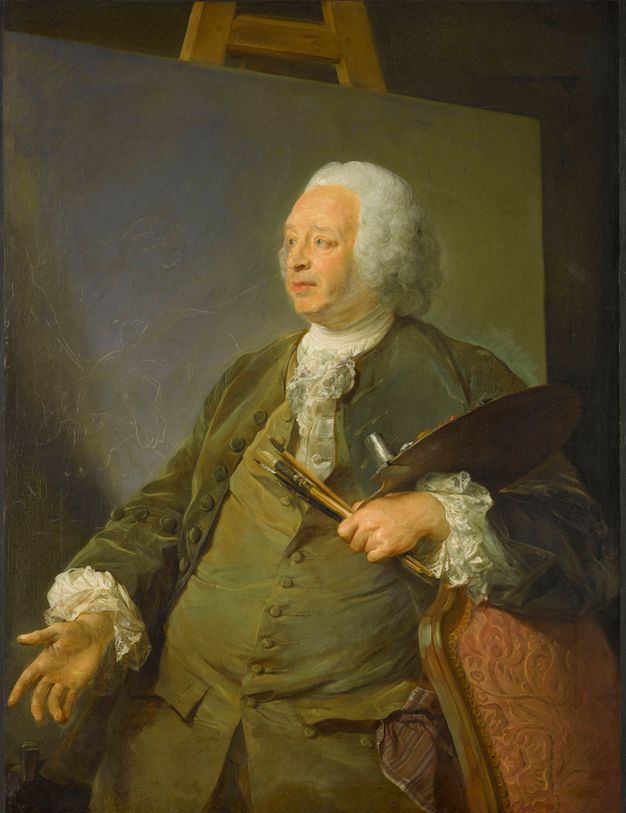
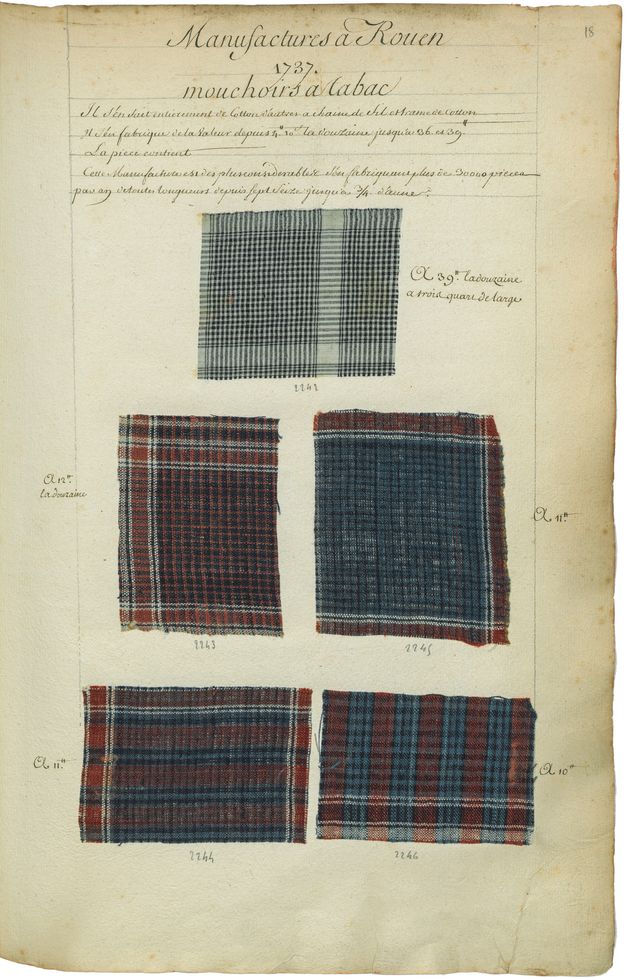
The still-life painter Jean-Baptiste Oudry took snuff. The evidence for his habit is circumstantial. In the portrait of the artist painted by Jean-Baptiste Perronneau in 1753 (fig. 152), a red, white, and blue striped blooms from the sitter’s unbuttoned pocket. It is the kind of large, dark-colored utilitarian handkerchief that was known as a mouchoir de tabac, or snuff napkin (see fig. 70). The painted handkerchief therefore implies the presence of a snuffbox, if not in the same pocket then perhaps in the pocket of his white silk under-waistcoat, closer to the body for safer keeping. It could have been any one of the twenty different snuffboxes inventoried two years later at Oudry’s lodgings at the Galerie du Louvre, Rue des Orties.1 Given the studio context of the portrait’s fiction and the silhouette of the dog outlined in white on the canvas ready for work, the gold-lined, lacquered box (boëte de vernis) listed in the inventory and described as decorated on all sides with animals and hunting scenes, “painted by the late Mr. Oudry,” would have been particularly appropriate. It is this lost thing that our book aims to know better in order to understand how and why a snuffbox became an artist’s thing in the eighteenth century, precious (valued at 240 livres in the inventory) and doubly personal to Oudry for having been made for and, in part, by him.
Inventory and portrait point to contexts for the interpretation of Oudry’s snuffbox. The dominant piece of case furniture inventoried in Oudry’s mezzanine cabinet, where the snuffboxes were found, was an “English” oak bureau-bookcase with multiple drawers and compartments in which the snuffbox was possibly kept when not on his person.2 Pockets and drawers have this in common: in them things are recessed and removed from view. In other ways, however, drawers and pockets differ. The sequestered world of the drawer created by new techniques of cabinetmaking that transformed old forms of case furniture like the coffer into new varieties, such as the chest of drawers and the bureau, reorganized domestic belongings by imposing on them systems of classification and valuation detached from use.3 Snuffboxes came under the category of bijoux, or jewels. As such, they were grouped with other luxuries, such as , and were separated from clothes, on the one hand, and from papers and writing equipment (the things typically brought to order by the desk), on the other.4 In the space of the desk, each of Oudry’s snuffboxes would have assumed an identity in relation to all the others: as the round, oval, square, or oblong box; as the gold, turtle-shell, wood, lacquer, or porcelain box; as the snuffbox covered in shagreen, or decorated with rhinestone; as the portrait box, or the box with the medal on its lid, struck to commemorate the marriage in 1745 of the dauphin to the infanta of Spain.5 Their functionality was secondary to their variety—variety fostered by expansion of the overseas trade in tobacco. By the 1740s, the volume and value of France’s importation of Virginian tobacco via Britain exceeded that of every other nation.6 Completely indigenized as a commodity by travel literature, natural history texts, newspaper articles, and consumer literature, tobacco was, by 1700, poised to spread as a consumer item to all social classes and to stimulate in turn growth and diversity in the snuffbox.7
The contents of a pocket, in contrast, is seemingly random and without singular cause. When the history painter Jean-Marc Nattier was arrested for sodomy in 1725, the inventory of his pockets itemized the following: a desk key, a toothpick holder, two , a lorgnette, and a microscope.8 These objects make sense not as a category or collection of thing but in relation to the body. The pocketed things variously enhanced, by prosthetics, the pocket-coat wearer’s skills: to access, to clean, to draw, and to see, in Nattier’s case. Things in pockets are always, therefore, connected to actions and gestures. The pocket is the starting point of a highly stylized gesture by which the snuffbox is drawn from the pocket with the right hand, placed in the left, tapped, opened, a pinch of snuff removed with the right thumb and index finger, the box closed, the snuff inhaled from the thumb or the back of the left hand, and the box returned with the right hand to the pocket, only for the performance to begin again.9 Significant here is the technology of the box, not its style: first, precision in the working of its moving parts to ease opening and closing while preserving tightness in the seal to prevent spillage of snuff when the box is stored, and second, balance when the box is open so that the weight of the lid does not upend the mess of contents.
Snuff-taking as a two-handed gesture is an occupation that necessarily interrupts others, such as drawing and painting. That Perronneau did not depict a snuffbox in his portrait of Oudry at work (see fig. 152), that he, in fact, painted its absence by rhyming the colors of the handkerchief with the paint charged on the palette, disavowing snuff’s power to suspend painting, is perhaps not surprising, given that as a morceau de récéption the portrait was to hang in the rooms of the Académie and to inspire future generations of painters and sculptors. The image of the studio that the Académie sought to perpetuate through its member portraits was, predictably perhaps, of the studio as a place of art, not sociability, though we know the practices of both were in fact tightly enmeshed. Why, then, did Oudry decorate one of his snuffboxes, and in so doing underscore his relation to a substance, habit, and thing apparently contrary to his vocation?
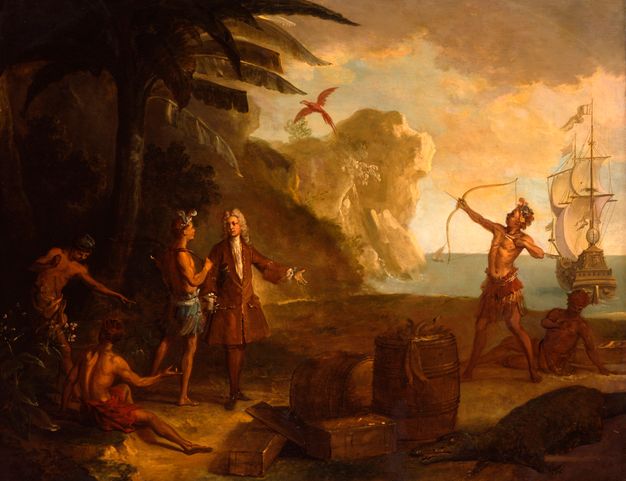
Eighteenth-century painters were active in the luxury trades, which from the 1760s included the production of gold boxes mounted à cage.10 In snuffboxes of this kind only the armature (cage), rather than the whole body of the box, was made of gold. Plaques of lacquer, or mother-of-pearl, or semi-precious hardstone, or miniatures painted on card, ivory, or vellum were inserted into the cagework to create a complex and “curious” visual effect.11 Some artists, such as the Van Blarenberghe family, specialized in such commercial painting. For academicians it provided some others with an occasional outlet: Claude-Joseph Vernet supplied his friend and neighbor at the Louvre, the court jeweler Ange-Joseph Aubert, with miniature landscapes for the purpose.12 We will probably never know exactly what kind of landscapes Vernet supplied—whether, for instance, scenes from his Atlantic seaports, such as the Port of Bordeaux, or the Port of La Rochelle, ports at which the colonial commodities he depicted on the quayside—tobacco, sugar, cotton—were actually landed. We do know for certain, however, that Oudry eschewed drawing on his repertoire of imagery of the Four Continents to match the decoration of his snuffbox to its contents. In the center foreground of America (fig. 153), one of four overdoors he painted in 1724, he depicted the hogsheads in which tobacco was traded and transported to Europe. Omitted here is any direct reference to plantations and enslaved labor.13 Such failures to connect slavery and the things produced from it were, according to historians of colonialism, commonplace before the beginning of the abolitionist movements in the 1770s.14 Oudry’s occlusions in the overdoor were perpetuated, even amplified, in his decoration of his snuffbox, on the surfaces of which America in any of her discursive forms is nowhere to be seen.
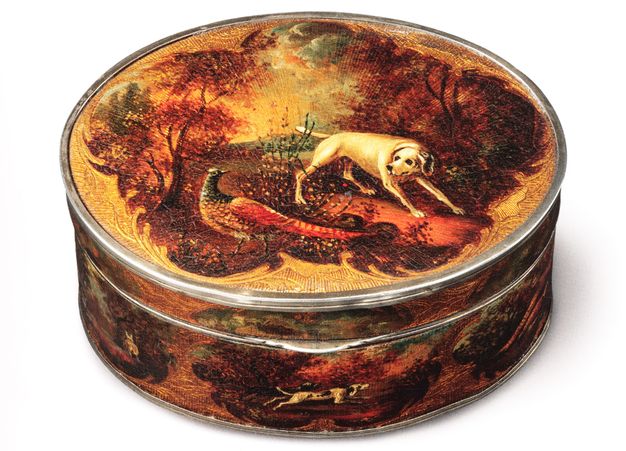
The notary’s description of the craftsmanship of Oudry’s snuffbox is short on the kind of detail that would enable us to know it fully as a material thing, and, in particular, to understand how it integrated different materials and media: (Oudry’s) painting in gouache and lacquer. Consumers had been infatuated by lacquer since its arrival from Asia in significant quantity at the end of the seventeenth century, infatuated sufficiently to give rise, in the eighteenth, to a market for imitation domestic lacquer combining surface shine with chinoiserie or pittoresque ornament.15 Oudry’s snuffbox may have resembled one of the papier maché tabatières, with hunting-dog, exhibited at Les Secrets de la laque française at the Musée des Arts Décoratifs in 2014 (fig. 154), which featured an Oudry hunting-dog on its lid.16 Were this so, it might on the one hand indicate the painter’s openness to exploiting his talent to decorative ends, and a related interest in new uses for art materials (varnish) in the luxury trades.17 On the other hand, choice of lacquer and the exotic, orientalist glow it affords can also propose Oudry’s snuffbox as a candidate of Madeleine Dobie’s “displacement,” whereby representation of the colonial is relocated on the veneered surfaces of the “oriental.”18 By bringing together materials, techniques and representation in this way, even hypothetically, we can entertain the possibility of tension in the surfaces and voids of Oudry’s snuffbox, not so much in the making as in the meaning of the making. Though Oudry assumed a position at either end of the commodity chain, as simultaneously both producer and consumer of the snuffbox, it was, however, in his place as consumer that this particular snuffbox served as a foundation of the subjectivity that he projected through his possession of it.
Louis-Nicolas van Blarenberge signed his snuffboxes; arguably, Oudry’s snuffbox was his signature. In his desk along with his snuffboxes and was a seal emblazoned with a —the seal with which, presumably, he closed his letters and announced himself to addressees in advance of those letters being opened.19 The dog figures in the abbé Louis Gougenot’s life of Oudry likewise as the sign and agent of the painter’s artistic identity.20 Oudry had first trained as a portrait painter under Nicolas de Largillière; it was, according to Gougenot, Largillière’s praise of Oudry’s portrayal of the dog, not the sitter, in Oudry’s inaugural portrait of a chasseur, that instituted his calling to animal painting and set him on the road to independent artistic recognition. The simple, single, and explicit function of biography and seal to name is not, however, shared by the snuffbox, which characterizes rather than denotes its subject, and does so by association with the ideology of snuff.
The work performed by the snuffbox in the visual discourse of eighteenth-century male portraiture was to signify status through leisure, not luxury. In Quentin de La Tour’s portraits of the 1740s, for example, it either recalibrated the active, standing body around a decentered axis, delicately swaying the pose to the right to counter the weight of the box in the left hand, or, when the sitter was depicted seated, it silenced the fiction of speech acts by monopolizing both hands in the gesture of snuff taking, their withdrawal from meaningful bodily communication marked by analogy with the knot of gracefully crossed legs. In neither of the portrait by La Tour of Étienne Perrinet de Jars (1740, Baltimore Museum of Art) nor Louis Duval d’Épinay (1745, Lisbon, Museu Calouste Gulbenkian), evoked here, was the snuffbox itself the fetishized object of attention. Virtually hidden by the hands, it was a prop in the ritualized performance of a social practice.21 In the literary discourse of the eighteenth century, meanwhile, the snuffbox was often paired with the , not on grounds of difference but on principle of likeness. Leisure time is for watching, not regulating and filling.22 In Jacques le fataliste (ca. 1765–80), Denis Diderot assigned play with snuffbox and watch to Jacques’s master as his defining tic. His tap to gather snuff in advance of the prisé, and his snap to follow and close the box, echo the tick-tock of his watch, and afforded time a daily measure for the tedium of leisure by the quantity of snuff remaining unconsumed at nightfall.23 Diderot appropriated the elite commodity box, and its image of benign gentility, and freighted it anew as an iconic object of bad luxe, or waste, in this his late comic fable of aristocratic idleness.
The snuffbox’s lack of semiotic fixity, its standing as a metasymbol for luxury goods, and the debates for and against the materiality of modern culture suggests that acting out the self through gestures of snuff taking was not without risk. The refinement of snuff, its dark natural color lightened by addition of yellow ocher, its acrid taste and smell when raw, softened by blending with orange blossom, jasmine, or rose, raised the snuff taker above the vulgar smoker;24 yet inactivity—idleness—potentially also shamed the nicotine-addicted artist.25 For Oudry it was a risk apparently worth taking. The aristocracy of his clientele, his extensive employment by the crown, and his lodgings at the Louvre had not conferred upon him the reputation of a gentleman. He was known rather for his exceptional industry: Gougenot describes him as a workaholic, straining to build a family enterprise, exploiting his artistic capital by efficient production of lines of copies—in short, as commercially orientated and successful in business.26 Was the attraction of snuff its promise to offset this bourgeois artisanal image by integrating gentlemanly leisure as the also, not the other, of the entrepreneurial artist? Not according to Gougenot. He selected the guitar as the sign of Oudry’s affective life away from the studio, no doubt because of the sisterhood attributed to music and painting in humanist art theory, and also, more importantly, because sociability is necessarily entailed by musical performance.27 Oudry the guitarist was gay, cheerful, amusing, or good company, defining characteristics in the eighteenth century of the good artist or happy genius. The consumption of snuff, though a companionable habit, did not resonate with painting in the same way, even though the practices involved in its preparation and consumption required many of the substances, tools, and skills familiar to painting.28 It was the immateriality of smoke and the association of smoking with dreaming that revolutionized relations between tobacco and art and led to the representation of smoking as a condition of creativity.29 §
-
Jean-Baptiste Oudry, “Inventaire après décès,” AN, MC/ET/LIII/345, 7 May 1755. ↩︎
-
The cabinet was situated on the mezzanine floor, next to the dining room. The bureau is described as “an English oak secretaire with two large and two small drawers below and several compartments and drawers above enclosed behind a pair of doors (un secrétaire anglois de bois de chêne à deux grands et deux petits tiroires par bas, à deux volets par haut avec plusieurs compartimens et tiroirs).” It was valued at 84 livres. ↩︎
-
Glenn Adamson, “The Labor of Division: Cabinetmaking and the Production of Knowledge,” in Ways of Making and Knowing: The Material Culture of Empirical Knowledge, ed. Pamela Smith, Amy Meyers, and Harold Cook (Chicago: University of Chicago Press, 2014), 243–79. ↩︎
-
Inventoried were two Paris-made à répétition in their gold cases. ↩︎
-
The argument that the snuffboxes in the desk address themselves to sight more than use is supported by the lack of other snuff-taking paraphernalia (tobacco jars and rasps) inventoried in the room. ↩︎
-
See Jacob M. Price, France and the Chesapeake: A History of the French Tobacco Monopoly 1674–1791 (Ann Arbor: University of Michigan Press, 1973); and also Jacob M. Price, “The Economic Growth of the Chesapeake and the European Market, 1697–1775,” Journal of Economic History 24, no. 4 (1964): 796–511. ↩︎
-
On the role of books in the indigenization of tobacco in the West, see Peter C. Mancall, “Tales Tobacco Told in Sixteenth-Century Europe,” Environmental History 9, no. 4 (2004): 648–78. Oudry’s modest collection of books included only one example of such literature: Nouvelle relation contenant les voyages de Thomas Gage dans la nouvelle Espagne (1648, Paris, Marret, 1699). While Gage describes a number of foods and products from the Americas and West Indies, notably chocolate, these do not include tobacco. On demiluxury goods, including snuffboxes, see Cissie Fairchilds, “The Production and Marketing of Populuxe in Eighteenth-Century Paris,” in Consumption and the World of Goods, ed. John Brewer and Roy Porter (London: Routledge, 1994), 228–48. ↩︎
-
Philippe Renard, Jean-Marc Nattier (1685–1766) (Saint-Rémy-en-l’Eau: Monelle Hayot, 1999), 52. ↩︎
-
See Mercure galant, December 1693, 176–80; and Tessa Murdoch, “Snuff-taking, Fashion and Accessories,” in Going for Gold: Craftsmanship and Collecting of Gold Boxes, ed. Tessa Murdoch and Heike Zeik (Brighton: Sussex Academic Press, 2014), 1–16. ↩︎
-
See Charles Truman, “From the Boîte à Portrait to the Tabatière: The Production of Gold Boxes in Paris,” in Going for Gold, 17–28, esp. 25–26. Some illegally produced boxes began to appear on the market in the 1740s, but production à cage only accelerated after 1756, when it became legal by an arrêt du Conseil of May 4. ↩︎
-
None of Oudry’s boxes were described as à cage, but along with them the notary inventoried two “petites plaques de Caillou d’Egypte en forme ovale” for mounting in that manner. ↩︎
-
On Aubert, see Vincent Bastien, “L’orfèvre-joailler, Ange-Joseph Aubert, fournisseur de la reine Marie-Antoinette,” Versalia 16 (2013): 31–46. On Vernet’s work for him, see Léon Lagrange, Joseph Vernet et la penture au XVIIIe siècle (Paris: Didier, 1864), 1:188, 270–71. ↩︎
-
Enslaved labor is depicted in the overdoor Africa. For viewers of the set, connections were there to be made between Africa, America, and Europe through colonial trade. ↩︎
-
Exceptions in the case of Britain include Elizabeth Kim, “Race Sells: Racialized Trade Cards in Eighteenth-Century Britain,” Journal of Material Culture 7, no. 2 (2012): 137–65; and Catherine Molineux, “Pleasures of the Smoke: ‘Black Virginians’ in Georgian London’s Tobacco Shops,” The William and Mary Quarterly 64, no. 2 (2007): 327–76. ↩︎
-
See Thibaut Wolvesperges, Le meuble français en lacque (Paris: Édition de l’Amateur, 2000). ↩︎
-
Les Secrets de la laque française, Paris, Musée des Arts Décoratifs (2014), 161, cat. 104. On the making of papier-maché boxes, see also “Tabatière de carton,” Encyclopédie, http://encyclopedie.uchicago.edu/, 15:793–94. ↩︎
-
Inventoried among Oudry’s drawings were volumes of unattributed ornament (nos. 30, 37), containing designs by Gilles-Marie Oppenord (no. 25), Claude Gillot (no. 77), prints after Juste-Aurèle Meissonnier (no. 94), and a volume of his own ornamental work (no. 34), not to mention many items of chinoiserie. There can be little doubt of his interest in design. ↩︎
-
Madeleine Dobie, Trading Places: Colonization and Slavery in Eighteenth-Century French Culture (Ithaca, NY: Cornell University Press, 2010), esp. 61–88. ↩︎
-
“Un cachet garni d’un petit chien avec une cornaline” (a seal with a carnelian decorated with a little dog), valued with one of his watches at 100 livres. According to Pierre-Jean Mariette, seals were understood to have had biographical significance since antiquity; see Mariette, Traité des pierres gravées (Paris: Mariette, 1751), 20–25. ↩︎
-
Abbé Louis Gougenot, “Vie de M. Oudry,” in Mémoires inédits, 2:367. ↩︎
-
When snuffboxes are visible in portraits (e.g., fig. 71), they are not in the hands but rest on a surface. ↩︎
-
On the late emergence of accuracy as a measure of value for watches in the eighteenth century, see Marie-Agnès Dequidt, “La qualité de l’horlogerie commune à Paris, à la fin du dix-huitième siècle,” Histoire et mesure 27, no. 2 (2012): 137–64. ↩︎
-
Denis Diderot, Jacques le fataliste (Paris: Folio Classique, 1970), 59–60, 75, 77, 82, 138, 141, 143, 167, 169, 176–77, 202, 262, 286. ↩︎
-
Gougenot, “Vie de M. Oudry,” 377. ↩︎
-
See the anecdote the painter Jacques-Charles Dutillieu tells about his grandfather’s spoiled career at court owing to his having allowed a snuff-stained “roupie” (drop of snot) to fall on and ruin work destined for the duc de Bourgogne. Livre de raison de Jacques-Charles Dutillieu, ed. F Breghot du Lut (Lyon: Mougin-Rusand, 1886), 10–11. ↩︎
-
Gougenot, “Vie de M. Oudry,” 379. ↩︎
-
Four guitars “de différentes marqueterie” were listed in Oudry’s cabinet (along with the gold boxes) and valued together at 100 livres. ↩︎
-
See Edme Ballard, Discours sur le tabac (Paris: Jombert, 1693), 88–89; and [J. Brunet], Le bon usage du tabac en poudre (Paris: Quinet, 1700), 46–48. ↩︎
-
Marc-Antoine Girard de Saint-Amand’s sonnet “Le fumeur” (1629) is an early example; Tacita Dean’s Portrait of David Hockney Smoking (2016) is a recent one. ↩︎