Type of Object
Material
Type of Object
Material
What does it mean to own a thing but not have the power to command its functions? More importantly, perhaps, how does it feel? These questions arise in the case of Joseph-Siffred Duplessis’s bath. In 1788 Duplessis, Louis XVI’s official portrait painter, had been in possession of a bathtub for some time, but in that particular year he sought to install it at his logement (lodgings) at the Galerie du Louvre. To that end he wrote to the comte d’Angiviller, the directeur des bâtiments du roi, for permission to do so. His request was denied. An argument ensued, the progress of which was first recounted by Jules Belleudy in his yet-to-be bettered monograph on the painter.1 From the summary description of the bath given during the exchanges between Duplessis and d’Angiviller, we learn that it was a common or garden bath, an infraordinary thing that for most of its life existed below the level of conscious notice, but as a result of the men’s disagreement about the practical and social values of bathing, and of bathing in relation to art and royal service, became momentarily contentious and thereby conspicuous.
By 1788 Duplessis had been living at the Louvre for over a decade. Unlike artists such as the Coypels and the Silvestres, that is, families of artists who had worked for the Crown for generations, whose members held and inherited offices in the Maison du Roi and the lodgings at the Louvre attached to those offices, Duplessis was a newcomer.2 He was born in Carpentras in the south of France. He arrived in Paris in his mid- to late twenties following a trip to Rome at his own expense. He was without either connections or introductions. Initially he joined the painters’ and sculptors’ guild, the Académie de Saint-Luc;3 it was not until 1774, more than twenty years after stepping foot in the capital, that he was admitted a full member of the Académie. In that year he was commissioned by d’Angiviller to paint the king’s portrait, and the following year he was awarded a studio at the Louvre to enable him to do so.4
The year 1774 had also been the year of d’Angiviller’s appointment as directeur of the king’s works.5 He inherited an office that was a shambles and critically in debt. Within two years he had instituted new rules and regulations for the structure and running of his department.6 The allocation of studios and logements was largely unaffected; it continued to proceed on the mixed basis of seniority, talent, utility, and connections (see ). However, reforms were introduced to the maintenance and repair of the royal buildings. The 1776 regulation established a clear division in law between the responsibilities of the Bâtiments to maintain the structure of the building, specifically the load-bearing walls, beams, and roofs, thereby ensuring its safety, and the liability of the “concessionaires,” or occupants, for the cost of the decoration undertaken to make their accommodations pleasant and commodious.7 To that end, artists were required to seek permission from the director for any works they intended to carry out; moreover, those works had to be approved by one of the Bâtiments’ architects and realized by its workmen.8 The clarity of that dividing line was not, however, absolutely crystal. When Duplessis moved from the Cour Carré to a new logement in the Galerie du Louvre in 1781 he wrote to d’Angiviller: “[W]hen you gave me this logement I thought that you had also given me tacit permission to secure it with doors and windows, but I have made it a law unto myself not to employ a mason for even the simplest things, without the approbation of M. [Maximilien] Brébion [the Louvre’s architect].”9 The note of irony in Duplessis’s request to enclose his living space was lacking in the letters of May 1788 about the installation of his bath, but they nevertheless parade Duplessis’s confidence that permission was a formality, since a bath was “such a small thing of no consequence and of which there are [already] other examples at the Galerie.”10
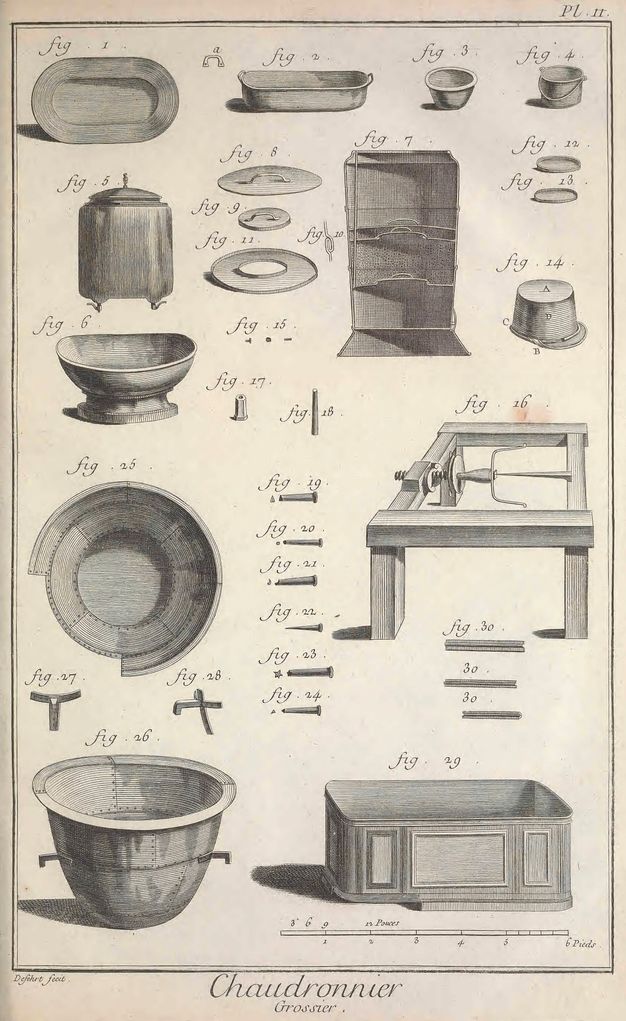
D’Angiviller’s refusal came as a surprise to Duplessis and prompted him to write an unusually long and detailed reply.11 In it he sought to strengthen his case by addressing the points that had motivated the director’s decision. The bath is disclosed in the process as not one thing, but two: an unprepossessing, tin-lined copper vessel of average dimension (see fig. 179) and a hazardous object of administration.12 D’Angiviller had argued that the bath, with its water tank and heater, put the Louvre at risk of both fire and flood. By implication, he categorized it with other objects, notably stoves, that had engrossed the attention of successive directors. In 1754 a stove fire had broken out in the logement of the engraver Claude Drevet, from which the Louvre was saved only by the prompt action of the police.13 Moreover, such was the continuing concern of the comte d’Angiviller’s predecessor, the marquis de Marigny, about the unlicensed proliferation of such stoves, that in 1773 he ordered the inspection and review of those in all artists’ studios and logements and the removal of any judged defective or unsafe.14 By more closely regulating permissions to improve, maintain, and repair the accommodations granted to concessionaires, d’Angiviller had hoped to preempt the risk of disaster, but in June 1787 a fire broke out at the Tuileries that virtually destroyed the Pavillon de Flore.15 Duplessis could not have made his request at a more inopportune moment, nor in more inappropriate terms: “a small thing of no consequence.”
D’Angiviller’s objection had not, however, been limited to questions of safety. In his opinion, apparently, Duplessis’s bath was both a novelty and a luxury, one to which neither the portraitist’s order nor his estate entitled him. Baths were rare “amenities” even in the houses of the elite, he had observed.16 In this respect, d’Angiviller perhaps also classed the bath with another category of administrative object: the status symbol. Article 4 of the 1776 regulations legally reserved the distinction of a doorbell installed and maintained at the Bâtiments’ expense, for office holders only.17 The doorbells of simple concessionaires, or the bulk of the artists lodged at the Louvre, would be tolerated, but no claims on the royal purse could be made for them. In summary, d’Angiviller’s objections to Duplessis’s bath were based, sight unseen, on a perception of it as a luxury and a technological novelty that threatened both the physical building and the social order at the Louvre.
Duplessis dispatched d’Angiviller’s objections on grounds of safety, reluctantly but swiftly by renouncing his chaudière and offering to conform to the normal practice of heating (bath) water in the hearth.18 However, he actively challenged d’Angiviller’s perception of the bath as a luxury. It was not, he insisted, in his case “a sensual object,” and he was not “a petit bourgeois” tormented by desire to possess one and appear grand.19 Rather, it was a medical object: the means to relieve his suffering and necessary to the preservation of his health, specifically his eyesight.20 Duplessis was, that is to say, reminding d’Angiviller that his painting skills were embodied. Unlike the administrative personnel in d’Angiviller’s department, whose knowledge and bureaucratic competences were transferable, the talent of the artist was in his hands and eyes, and Duplessis’s royal service thus depended directly on the health of them both. He did also point out that if indeed few bourgeois homes could pretend to bathrooms, many contained bathtubs on doctors’ orders.
In response to d’Angiviller’s advice that he bathe not at home but in one of the capital’s many public baths, Duplessis noted not only that he was often too ill to venture out, but also the inconvenience, when well, of wasting time for art waiting in line. Moreover, he observed, that a home bath was cheap, little more than the price of coal to heat the water, unlike a bath chez a wigmaker-cum-steambather (perruquier-étuviste), or one taken at one of the newer bathhouses on the Seine.21 In place of d’Angiviller’s discourse on the bath as contrived object with both material and symbolic effects for the corps of artists at the Louvre, Duplessis’s proposed arguments grounded in the natural body and the benefits to it of bathing, on the one hand, and on his thrift in domestic economy, on the other.
During the course of Duplessis and d’Angiviller’s correspondence, the bath, use of which the painter had initially thought so small and trivial a matter that he had almost forgotten to mention it, grew dramatically in importance to the point of requiring a full account of Duplessis’s medical history and an informal portrait of his temperament. At stake was not just the thing itself but the terms of the relationship between the director and the painter. That relationship was repeatedly construed by Duplessis as one of patronage, which is to say, a relationship in which the exercise of power was personal and not derived from bureaucratic rules and regulations. He referred to his request as a “prayer” (prière) a word from the vocabulary of eighteenth-century civility that denoted the reciprocal obligations between friends.22 Structured by asymmetries of rank and power, patronage was, of course, a lopsided form of friendship. Duplessis offered his obedience and his unstinting and profound “respect,” immaterial assets in return for the more immediate and tangible fruits he hoped to elicit from d’Angiviller’s “goodness.”23 The detail of his letter, which alluded to his professional sufferings—his lack of work and his financial losses—in addition to his many health problems, aimed to oblige d’Angiviller to treat him as a person and not a case. He regretted not being able to entreat d’Angiviller face to face, that he might press his need by exhibition of his suffering body. His excessive elaboration of his theme, his endless repetition of salient points, and his generous deployment of emphatic adjectives and particles was substitution by missive for the physical affect of presence. Even the unsaid in Duplessis’s letter is enrolled to his plea. Nowhere does he state, but everywhere he implies, that d’Angiviller was his only source of succor and comfort. Such was his health and melancholy temperament that he was alone, isolated, and without other resources.24 He was not, like Hubert Robert and Anne Vallayer-Coster, the painters already enjoying baths at the Louvre, blessed with powerful connections at court.25
There is no evidence in the Bâtiments papers to suggest that d’Angiviller was moved by Duplessis’s anguish to change his mind. Seemingly, he did not relent from his “measured refusal.” He replied to Duplessis’s entreaty in the calm, controlled, and depersonalized language of the nobleman and the royal office holder enforcing bureaucratic regulations by his rational and objective decision making. In order to bathe, Duplessis was forced to keep additional rented lodgings outside the Louvre, a cost he had hoped to save himself by fully installing himself at the Galerie. However, the painter seems not to have borne d’Angiviller any ill will for his perceived betrayal of the trust. In 1791 Duplessis publicly defended d’Angiviller and his administration against accusations of corruption leveled by revolutionaries.26 §
See Jules Belleudy, J. S. Duplessis, peintre du roi (1725–1802) (Chartres: Durand, 1913), 101–7. ↩︎
See Jules-Joseph Guiffrey, “Logements d’artistes au Louvre,” NAAF, 1873, 1–221. For Coypel, see also . For the Silvestres, see Dena Goodman and Emily Talbot, “Documenting Art, Writing Biography: Construction of the Silvestre Family History 1660–1868,” Journal of Family History 40, no. 3 (2015): 277–304. When Jacques-Augustin Silvestre wrote to Marigny in 1766 formally to request the succession of his father’s logement, he observed, “for more than one hundred years it has been our honor, inherited from father to son, to teach the king and the royal family to draw. For almost the same amount of time our ancestors have enjoyed possession of a logement at the Louvre” (“il y a plus de cent ans que de père en fils nous avons l’honneur d’enseigner à dessiner au Roy et à la famille Royale. Il y a à peu près le même temps que nos ancestres ont l’avantage de posséder un logement aux galleries du Louvre”). See AN, O1/1673/24: Silvestre to Marigny, 30 April 1766. ↩︎
See Jules Guiffrey, “Histoire de l’Académie de Saint-Luc,” NAAF, 1915, 277–78. ↩︎
The portrait was exhibited at the Salon of 1775. On the portrait, see Belleudy, Duplessis, 53–74. ↩︎
See Jacques Silvestre de Sacy, Le comte d’Angiviller dernier directeur des bâtiments du roi (Paris: Plon, 1953), 49–65. ↩︎
Bâtiments du roi: Règlements pour leur administration par déclaration du Roi 1er septembre 1776; Edit de règlement, donné au mois de septembre 1776 (Paris: Hérissant, 1776). ↩︎
Bâtiments du roi: Règlements, art. 1 and 3. See, for example, the correspondence relating to the fitting out of Ménageot’s and Vincent’s studios in 1784: AN, O1/1674/230, 232, 239. ↩︎
The bâtiments regulations by the Arrêts du conseil du roi of 30 January 1672, 16 March 1757, and 30 January 1774 required the use of Bâtiments agents for works at the royal palaces; they had not been enforced. In July 1781 d’Angiviller pursued a case against a mason (Guérin) and a joiner (Bellanger) for works on the logement of the comtesse de Salles. The workmen were fined 300 livres but avoided imprisonment. For the Judgement de police, see AN, O1/1674/24. ↩︎
Belleudy, Duplessis, 95–107. ↩︎
Belleudy, Duplessis, 102. ↩︎
D’Angiviller’s letter to Duplessis has not survived, however its content is summarized in Duplessis’s reply; see Belleudy, Duplessis, 102. ↩︎
Contemporary descriptions of bathtubs suggest they were standardized. See Encyclopédie, https://encyclopedie.uchicago.edu/, 2:15–16. See also François-Alexandre-Pierre de Garsault, L’art du perruquier (Paris: n.p., 1767), 33 and plate 5; and André-Jacob Roubo, L’art du menuisier en meubles, 4 parts in 5 vols. (Paris: Saillant & Nyon, 1772), 3, pt. 2:660–61 and plate 240. ↩︎
AN, O1/1672/293: Garnier d’Isle to Marigny, 28 November 1754. ↩︎
AN, O1/1673/273: [Jacques-Germain Soufflot], Rapport à Monsieur le Directeur général faite par ses ordres les 29 janvier et 5 février 1773 (15 February 1773). ↩︎
Silvestre de Sacy, D’Angiviller, 65. ↩︎
D’Angiviller’s assertion is confirmed in Georges Vigarello, Concepts of Cleanliness: Changing Attitudes in France since the Middle Ages (Cambridge, England: Cambridge University Press, 1988), 96. See also Mimi Hellman, “Staging Retreat: Designs for Bathing in Eighteenth-Century France,” in Interiors and Interiority, ed. Ewa Lajer-Burcharth and Beate Söntgen (Berlin: De Gruyter, 2016), 49–72. ↩︎
Bâtiments du roi: Règlements, art. 4. ↩︎
Belleudy, Duplessis, 103. ↩︎
Belleudy, Duplessis, 104. Suggestively, bath follows chaise longue in Roubo’s L’art du menuisier en meubles. ↩︎
On Duplessis’s health problems, see Guiffrey, “Logements d’artistes au Louvre,” 189; and Belleudy, Duplessis, 96–97. See also . ↩︎
Belleudy, Duplessis, 103–4. For the cost of baths in the 1770s, see Almanach parisien en faveur des étrangers et personnes curieuses, ed. Daniel Roche (Saint-Étienne: Presse Universitaire de Saint-Étienne, 2000), 117–18. On the bath boats on the Seine, see Reed Benhamou, “The Public Baths and the Press: Changing Behaviors in Eighteenth-Century Paris,” SVEC 371 (1999): 275–303. ↩︎
See Antoine Furetière, Dictionnaire universelle, 3 vols. (The Hague: Husson, Johnson & Swart 1727), s.v. “Prière”: “se dit . . . par civilité des devoirs réciproques qu’on ne refuses point aux amis, aux voisins quand ils les demandent.” ↩︎
Belleudy, Duplessis, 103–6. ↩︎
See Belleudy, Duplessis, 97. ↩︎
Robert and Vallayer-Coster were protected by Marie Antoinette, whose influence secured Vallayer-Coster a logement. See Marianne Roland Michel, Anne Vallayer-Coster (1744–1818) (Paris: C.I.L., 1970), 260–64. ↩︎
See Silvestre de Sacy, D’Angiviller, 225–26. ↩︎
| words