Modeling Stand
- Jean-Antoine Houdon (1741–1828)
One of the more mundane objects on display at the Musée Carnavalet, the museum of the history of Paris, is an eighteenth-century selle (modeling stand) (fig. 111) that once belonged to the sculptor Jean-Antoine Houdon. Mundane as it is in the context of the Carnavalet’s collections, and also as an item of the sculptor’s equipment, this stand is, however, rare as a tool that survives from an eighteenth-century studio. There are few such others, and certainly none to compare to Jean Bourdelle’s at his house-museum near Montparnasse, or to the contents of Constantin Brancusi’s atelier reconstructed at place Georges Pompidou. Both Bourdelle and Brancusi bequeathed their tools to the public in the belief that these objects were uniquely placed to promote a better understanding of their work. That conviction was not shared by sculptors in the eighteenth century. Their tools, if not passed on to sons, pupils, or assistants, were sold in job lots in estate sales and have been lost to history. This object, like the and the in the case of painting, stands, therefore, as an example of a larger category of artists’ things: their tools—whose purpose was to assist, develop, and improve skills of making, and to make artists smarter and cannier.
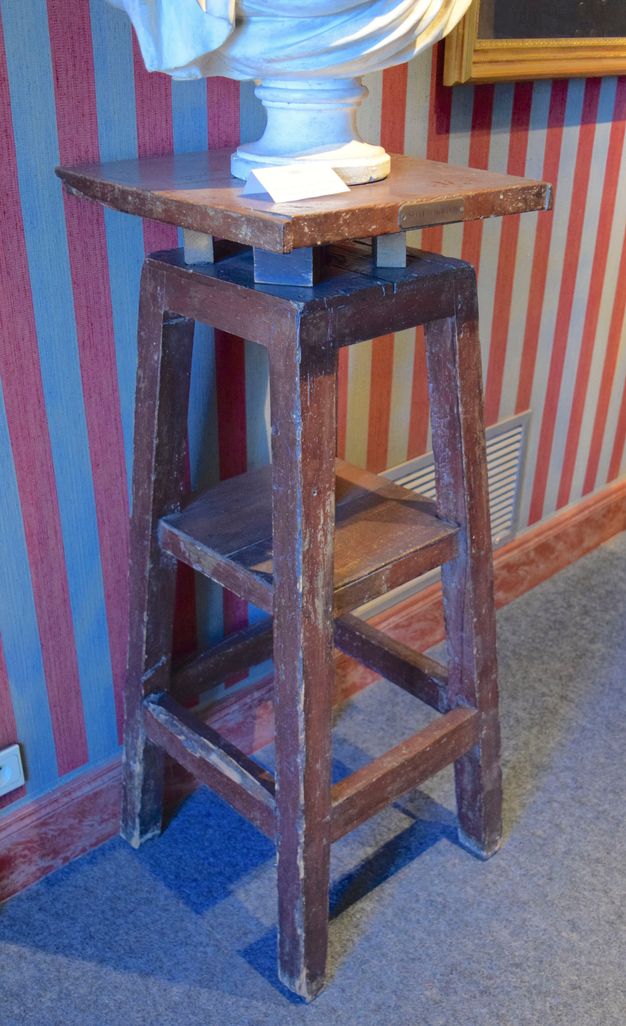
As an instance of stands more generally, Houdon’s selle is mundane, too, in the sense that the French anthropologist Pierre Lemmonier gives to the word: “not much to look at,” yet crucially important to the sculptor who used it, and a material anchor, potentially, for his conceptual thinking.1 Stands belong, in this sense, to that category of object whose origin is unknown and that appear timeless, part of culture, unlike novel or specialist sculptural tools such as the lathe and the well-tempered chisel, whose historicity is the more usual subject of art-historical inquiry: to understand both the creation of new forms and the materials whose working they newly made possible.2 Lemonnier characterizes “mundane objects” as a form of nonverbal communication, sometimes, indeed, the unique and only available expression of the structure and values of a social order. In the eighteenth century, however, language, and specifically technical discourse, was foregrounded as the new and progressive tool that exteriorized the embodied know-hows of the arts and trades and replaced craft secrets with rational knowledge and information. In 1765 the theorist and academician Michel-François Dandré-Bardon lamented that no author had yet taken up the task of describing the mechanics of sculpture.3 The same year also saw the publication of volume 14 of the Encyclopédie, which contained entries on “sculpture of all kinds,” but Diderot and d’Alembert’s commitment to making known the arts and trades notwithstanding, the tools and processes of modeling and carving were not, in fact, the primary concern of Étienne-Maurice Falconet’s definition in the text.4 It was only with the publication of the Encyclopédie’s plates in 1771 that enumeration and description of them was finally made fully known.5 These plates will help us understand Houdon’s modeling stand, but in the spirit of Lemonnier they will be read both with and against the grain of its technical discourse.
Houdon’s stand rests firmly on four square legs braced by stretchers at the bottom and gathered at midpoint by a shelf. The top afforded the sculptor a secure work surface. In the plates of the Encyclopédie, such stands are subdivided into two kinds (fig. 112): first, the tall tripod stand for modeling (wax, clay, plaster); and secondly, the lower, squatter, four-legged stand for carving (wood, stone, and especially marble).6 They were rudimentary machines insofar as they contained moving parts set in motion by muscle power.7 In the case of the modeling stand, a screw system or, alternatively, a hole-and-peg system, transformed the stand into a lever that by relaying force through the parts, raised or lowered the upper platform and the matter on it. A ball-bearing mechanism, in the case of the carver’s stand, likewise enabled through a lateral movement of force the sideways displacement of its surface and the block of stone in work.8 Sculptors’ stands thus performed a double function: they held fast the material the sculptor wished to fashion (a function enhanced in the case of the modeler’s stand by addition of a brace to support the stuff on the vertical) and they performed its removal: upward, downward, and side to side.
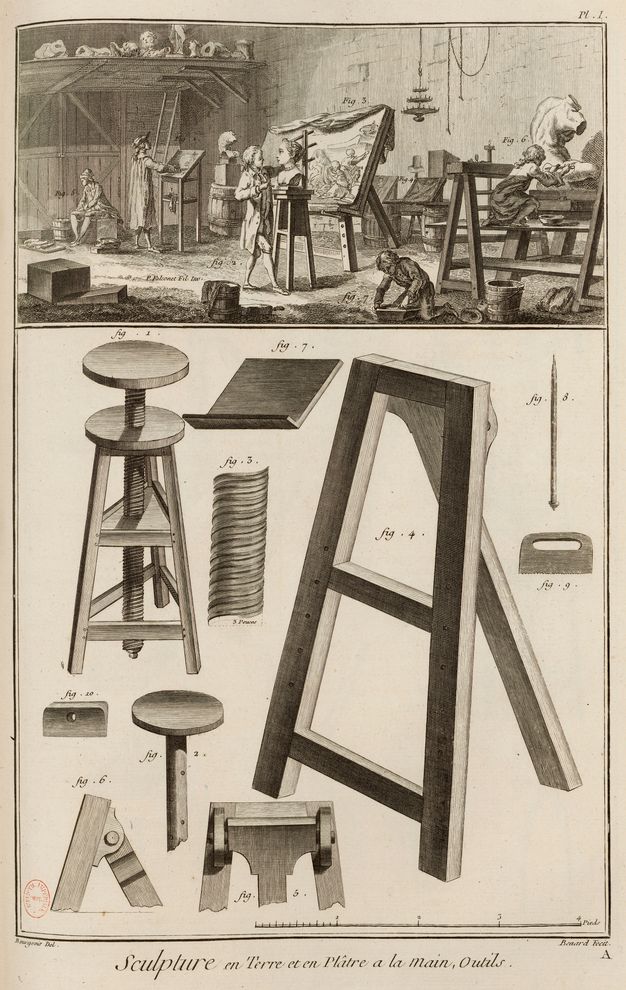
In the vignette above the selection of tools (see fig. 112), the stand is depicted in real rather than abstract space. According to Tony Vidler, this spatial transposition, rather than introducing a different pictorial mode, in fact merely extends and completes the technological discourse of the tools and machines, representing the studio workshop as “a kind of machine in its own terms.”9 Another way to put it might be to say that “tools” and “vignette” perform an analogy between machine and (scientific) method: the successive turns of the screw that relay force rigorously through the stand, raising the platform by degrees, correspond to links in the chain of reasoning that transport evidence, strictly and without deviation, along a line from premise to conclusion. Geometry, according to Vidler, articulates this analogy by superimposing temporal sequence onto spatial order. In this instance, the diagonal of the studio wall that runs from the background to the right foreground becomes a line of trajectory that causally links the preparation of the clay by the studio hand over there to the modeling of the prepared loaf by the sculptor in the middle, and, finally, to the tempering of plaster to cast the clay model produced over here. The tools (kneading trough, modeling stand, trowel, and pan) function in the image as discrete landmarks in this technical discourse that enables the gaze of the unenlightened, nonprofessional viewer to run through the spatial structure grasping, understanding, and remembering production as ordered sequence, not skill. The depicted human agents, as William Sewell has noted, are little more than “appendages” to the technology, appearing almost alienated from their tools and environment.10
The stand itself (see fig. 111), in contrast to the Encyclopédie’s image, is not generic, nor manifestly a standard stand. Rather, it was made by a joiner to a specification scaled to the user, the sculptor Houdon. It afforded him a work surface. Any steady, rigid, flat, and level surface could have served his modeling, but this stand, which Houdon could tune minutely, limited the risk of accident, unforeseen displacements of the clay, or slips of the hand. If the abbé Louis Gougenot recounted with relish Robert Le Lorrain’s lack of precautions when sculpting, and his insouciant improvisation of a cask in lieu of a stand,11 the scuff marks on the stretchers of the Carnavalet stand made by Houdon’s shoes indicate that he was careful to balance and brace his body while working. The shelf below the work surface provided Houdon, in addition, with a convenient storage surface within arm’s length for his hand tools: the round- and tooth-ended spatulas, and the leaf and spear tools variously used for cutting, piercing, scoring, and smoothing clay.12 Its surface also presented a handy resting place for a bowl of water into which Houdon could dip a sponge to moisten his work, and a place across which to drape a damp cloth to cover the model at the end of the modeling session and thereby prevent it from drying out before the next. In short, the stand’s virtue was that of a lodestone rather than a landmark—that is, not a signpost of discrete stages of production but a source of attraction that drew things and agents together in a “sphere of activity.”13
That sphere of activity was not limited to the immediate vicinity of the stand, and attraction is not the only virtue of the loadstone; it also affords direction. The plinthlike shape of Houdon’s stand, and its capacity figuratively as well as practically to elevate, invokes the pedestal and points to a destination; the end of the work is present from the beginning. At Carnavalet today, Houdon’s selle is repurposed just so: to display a plaster cast of his bust of “le beau Barnave.”14 Similarly, the tools on the shelf, immediately in Houdon’s line of vision and ready to hand, were prompts to potential action. Latent in them were solutions to modeling problems that the primary, forming gestures of the hand could not solve alone.15 Such tools were ingrained with the memory of the knacks found by the tool and the hand together in the past; touch of the tool brought that experience alive.16 When we open up the site of the stand to encompass Houdon’s studio, known from Louis-Léopold Boilly’s genre portraits of 1804 and 1808 (fig. 113), we can imagine how Houdon may have jigged his whole workspace to direct and support his creative choices in analogous ways.
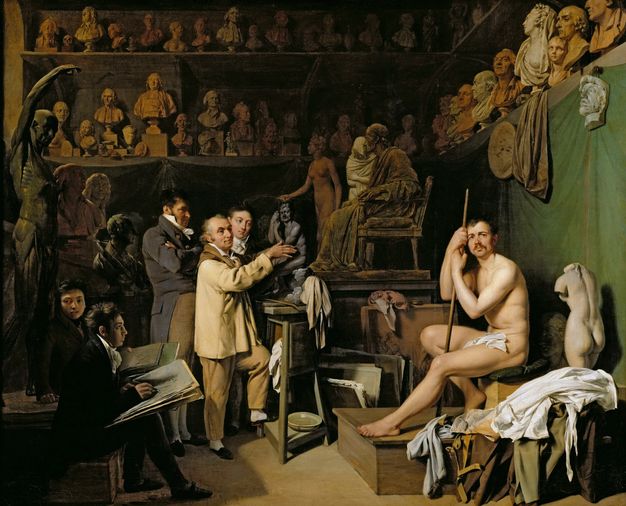
Art historians have tended to interpret Boilly’s paintings in terms of sociability—Houdon’s studio as a space open to family, students, amateurs, the public—or in light of the sculptor’s energetic commercialization of replicas of his works cast from the “originals” depicted on the shelves in the background.17 Considered instead as a portrayal of a space of creative work, we can note that Boilly organized around the stand an encompassing field of force that includes not only manual tools but also other objects that his composition encourages us to interpret as resources of invention, and as guides and goads to Houdon’s choices, judgments, and adjustments of his work in the flow of execution. Thus, the cast of Voltaire Seated (ca. 1780–90, Montpellier, Musée Fabre) appears to triangulate the relation between the life models and the clay models, cueing Houdon’s earlier rendition of a “seated figure” as the potential solution to the pose of his present project after life.18 Likewise, the models of the and a female nude with which Boilly brackets the scene suggest themselves as triggers for Houdon’s embodied knowledge of anatomical and ideal forms, to be drawn on in the realization of his work. In short, in this version of Studio of the Sculptor, Houdon is represented taking his bearing from his stand, and Boilly’s organization of the scene suggests some of Houdon’s leading lines of passage to the safe delivery of his task.
The detail and precision of Boilly’s depiction notwithstanding, Studio of the Sculptor brings us little news of the practical gestures of eighteenth-century modeling as such; it is not in that sense informational.19 Its narrative is that of the storyteller rather than the encyclopedist. Time is condensed so that tradition, present making, and its future accomplishment appear to overlap. A heterogeneity of seemingly conflicting discourses about modeling—as practice and as idea, from the life and after the ideal, after the flayed model and from the antique fragment—are successfully drawn together. The rules that define the spatial organization of modeling depicted in the painting do not form a clear and continuous linear sequence of measures; they form a pattern that endows the posing, the modeling, and the witnessing with meaning by identifying them as part of the whole. What, then, is the meaning of the stand and of modeling in Studio of the Sculptor? And why is a stand, not a spatula, or a chisel, or a rasp, the sculptor’s tool that history has chanced to save?
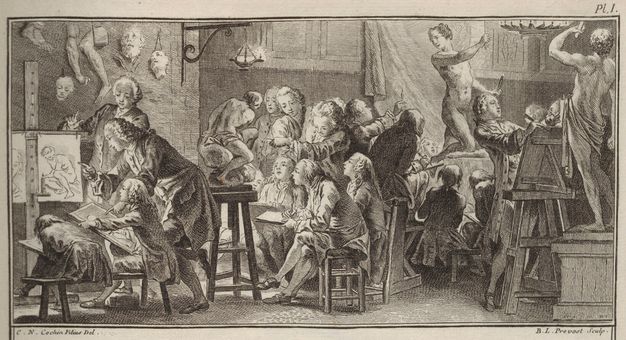
Before the 1770s, modeling was not a sign for the art of sculpture as a whole, at least not on the evidence of the portraits of sculptor academicians painted as morceaux de réception for admission to the Académie.20 This was because it was associated with trial work. Ébauchoir, the French word for the spatula used in modeling, appears in the Encyclopédie as a term of reference in the legend to plate 1 of “Dessein” (see fig. 93). The viewer is directed to notice in Charles-Nicolas Cochin’s vignette of a drawing class, a young student using an ébauchoir to model in clay after the antique.21 The abbé Pernéty tells us that students habitually destroyed these trials at the end of every class, no doubt recycling the material.22 Clay was cheap and messy, a base material used in elementary and preparatory work.23 It was neither enduring as a material prior to firing nor sure in its statements. Michel-Ange’s Slodtz’s indecisiveness was figured by reference to his compulsive model making in Cochin’s memoirs.24 The verb ébaucher means to begin. From the midcentury, however, it was identified increasingly with the sculptor’s première pensée, his first creative thought, analogous, therefore, to the painter’s sketch. Some have connected the rise in the status of terracotta as a sculptural medium to rival marble and bronze to the taste of amateurs and connoisseurs for artists’ sketches in which they discovered material evidence of the immediacy and verve of genius.25
Houdon, however, did not use clay for rough work, or, to be more exact, he buried his beginning in the finished work, rather than leaving it standing. Moreover, his exacting commitment to the perfect imitation of his sitters—in the busts that made his reputation and dominated his output—precluded the expression of his self on the surface of his forms through traces of his touch. However, his commissions did always begin with clay. Sometimes they also ended in terracotta. At others, the clay model led to a marble, or more rarely to a bronze, and almost invariably generated multiple plaster casts. In all cases he reserved the right to the “original.”26 The modeling stand thus anchored that point of origin of his oeuvre, in the formal sense of all the work he acknowledged, and in which he formally recognized himself as author. It speaks, therefore, to the social and ideological investments that artists had in this modern notion of authorship. Purchased after his death in 1828, a brass plaque was screwed to it that reads “SELLE DE HOUDON”: the stand had become an icon. §
-
Pierre Lemonnier, Mundane Objects: Materiality and Non-Verbal Communication (London: Routledge, 2012), 13. ↩︎
-
See Joseph Connors, “Ars Tornandi: Baroque Architecture and the Lathe,” Journal of the Warburg and Courtauld Institutes 53 (1990): 217–36; and Porphyre: La pierre pourpre des Ptolémées aux Bonapartes, exh. cat. (Paris: Musée du Louvre, 2003). ↩︎
-
Michel-François Dandré-Bardon, Essai sur la sculpture (Paris: Desaint, 1765), 60. Consequently, he recommended observation of the moderns as the best means to understand the techniques of the ancients (p. 61). See also Louis Guy Henri de Valori, “Vie de M. Frémin,” in Mémoires inédits, 2:202, who regarded this “veil of ignorance” as a point in sculpture’s favor. ↩︎
-
“Sculpture,” Encyclopédie, http://encyclopedie.uchicago.edu/, 14:834–37; and Juan A. Calatrava, “Idées sur la sculpture dans l’Encyclopédie,” Dix-huitième siècle 24 (1992): 397–410. ↩︎
-
“Sculpture,” Encyclopédie, Recueil des planches, http://encyclopedie.uchicago.edu/, 25:22/1–2, 12 plates. ↩︎
-
Encyclopédie, Recueil, http://encyclopedie.uchicago.edu/, 25:22/1. André Félibien, Principes de l’architecture, de la sculpture et de la peinture et des arts qui en dépendent (1676) represents both stands on the same page, making comparison easier. ↩︎
-
In Antoine-Joseph Pernéty, Dictionnaire portatif de peinture, sculpture et gravure (Paris: Bauche, 1757), s.v. “Selle,” the stand is defined precisely as a “machine de bois.” ↩︎
-
Encyclopédie, Recueil, http://encyclopedie.uchicago.edu/, 25:22/2. ↩︎
-
Antony Vidler, “Spaces of Production: Factories and workshops in the Encyclopédie,” The Writing of the Walls (Princeton: Princeton Architectural Press, 1987), 23–24. ↩︎
-
William H. Sewell Jr., “Visions of Labour: Illustrations of the Mechanical Arts before, in, and after Diderot’s Encyclopédie,” in Work in France: Representation, Meaning, Organization and Practice, ed. Steven Kaplan and Cynthia Koepp (Ithaca, NY: Cornell University Press, 1986), 258. ↩︎
-
Louis Gougenot, “Robert Le Lorrain,” in Mémoires inédits, 2:219. ↩︎
-
See the definitions of “Ébauchoir,” “Lance,” and “Lancette” in Pernéty, Dictionnaire portatif, and also his description of the actions “Bretter,” “Bretteller,” and “Ébaucher.” ↩︎
-
Encyclopédie, http://encyclopedie.uchicago.edu/, s.v. “Aimant,” 1:214 ↩︎
-
Antoine Barnave (1761–93), elected to the Estates general by the third estate of the Dauphiné, and renowned orator at the Assemblée Nationale. ↩︎
-
Encyclopédie, http://encyclopedie.uchicago.edu/, s.v. “Modeler,” 10:600; and Gougenot, “Le Lorrain,” 219. ↩︎
-
See David Esterly, The Lost Carving (New York: Penguin, 2012), 196. Esterly recounts his experience of restoring and reconstituting carvings at Hampton Court Palace badly damaged by fire in 1988. ↩︎
-
Heather Belnap Jensen, “Picturing Paternity: The artist and father-daughter portraiture in post-revolutionary France,” in Interior Portraiture and Masculine Identity in France, 1789–1914, ed. Balducci et al. (London: Routledge, 2009), 36–37; and Ronit Milano, The Portrait Bust and French Cultural Politics in the Eighteenth Century (Leiden: Brill, 2015), 56–57. ↩︎
-
The cast has been identified with the one now at Musée Fabre, Montpellier. ↩︎
-
See Walter Benjamin’s “The Storyteller: Reflections on the Works of Nikolai Leskov,” in Dorothy Hale, ed., The Novel: An Anthology of Criticism and Theory 1900–2000 (Redwood City: Stanford University Press, 2006), 262–378, on the difference between information and narrative. ↩︎
-
The portraits of Jean-Baptiste Lemoyne (1734) and Christophe-Gabriel Allegrain (1774) by Louis Tocqué and Joseph-Siffred Duplessis, respectively, represent the sculptors with chisel in hand, marble at the ready, and with monumental marble figures on massive low stands in the background. ↩︎
-
“Dessein,” Encyclopédie, Recueil, http://encyclopedie.uchicago.edu/, 20:21/4 ↩︎
-
Pernéty, Dicionnaire portatif, s.v. “Éreinter” (“to scrap”). In the context of sculpture competitions in ancient Rome, Dandré-Bardon noted that the losing models were always destroyed; they were thrown into the Tiber. See Dandré-Bardon, Essai sur la sculpture, 62. ↩︎
-
Louis-Jean-Marie Daubenton defines clay (argille) as the most plentiful and useful material known to man (“Argile,” Encyclopédie, http://encyclopedie.uchicago.edu/), 1:645; sculptor’s clay was sourced in Normandy, according to Pernéty (Dictionaire portatif, s.v. “Glaise”). Étienne Aubry’s Portrait of Louis-Claude Vassé (1771, Musée et Château de Versailles) is a remarkable pictorial attempt to obscure the dirt of working with clay by hand. ↩︎
-
See Charles Henry, ed., Mémoires inédits de Charles-Nicolas Cochin sur le comte de Caylus, Bouchardon, les Slodtz (Paris: Baur, 1880), 113–14. ↩︎
-
Notable collectors included La Live de Jully and Crozat de Tugny. See Maria Giulia Barberini, “Base or Noble Material? Clay Sculpture in Seventeenth and Eighteenth-Century Italy,” in Earth and Fire: Italian Terracotta Sculpture from Donatello to Canova, exh. cat., Museum of Fine Arts, Houston (New Haven: Yale University Press, 2001), 43–59. ↩︎
-
Guilhem Scherf, “Houdon ‘Above All Modern Artists,’” in Jean-Antoine Houdon: Sculptor of the Enlightenment, exh. cat. (Washington: National Gallery of Art, 2003), 16–27, esp. 22–23. ↩︎