Type of Object
Palette
- Elisabeth Vigée-Lebrun (1755–1842)
On one memorable occasion early in her career, Elisabeth Vigée-Lebrun had her social plans unexpectedly disrupted by her palette. She had received an invitation to dine with the Princess Rohan-Rochefort and was readying herself for this high-society occasion, dressing fashionably in a brand-new white satin gown.1 Just on the point of calling her , the painter found herself momentarily distracted by the portrait she had begun that morning. Absorbed in that feeling of creative intensity at the start of a new project, she was “seized by a sudden desire” to revisit the canvas, so she sat down in front of her easel to contemplate what she had achieved so far.2 To her utter dismay, however, she discovered she had left her palette face-up on the chair. With the morning’s wet oil paint now smeared all over her new white dress, she was forced to abandon her dinner invitation, and she resolved there and then never to accept another.
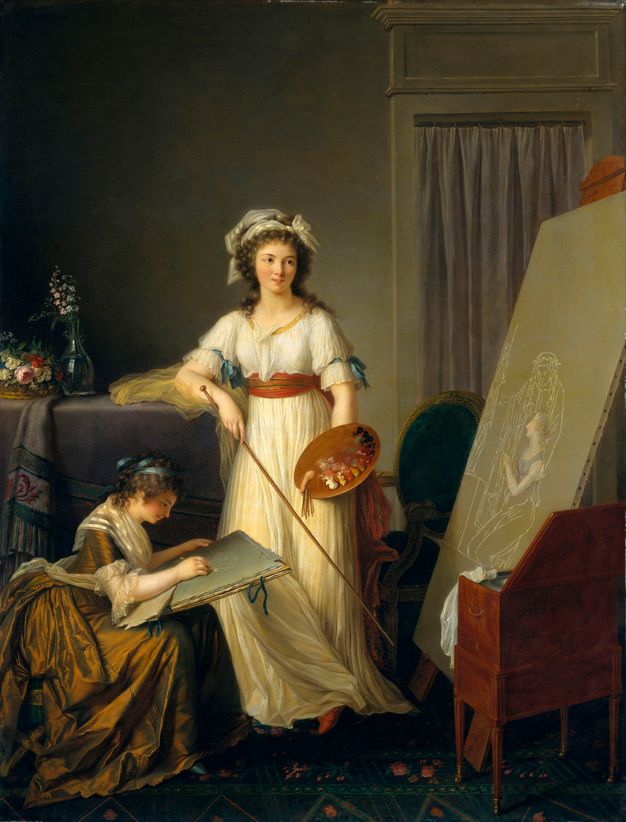
Palettes, it would seem, were not always the innocuous objects they might first appear. Recalled decades later in her memoirs, Vigée-Lebrun’s anecdote about her palette is striking for several reasons, not least for the relatable nature of that quotidian crisis caused by a momentary lapse of concentration. But it also offers a glimpse into the place of tools in the working practices of an eighteenth-century painter. Few artists had the luxury of a studio separate from the home, so art making—with all its technical processes and messy procedures—often had to take place alongside domestic activities, sometimes in the very same rooms.3 The workspace of a portraitist like Vigée-Lebrun was especially complex, needing to accommodate the competing social and practical demands of sittings. These required a space commodious enough for elite clients to visit, yet utilitarian enough to cope with the paraphernalia of tools and activities, be it preparing paint, cleaning brushes, or mixing colors. For a woman artist, the difficulties of carving out a working space in the home could be even more difficult, depending on the claims already made on the domestic environment by her husband’s or father’s profession. A painting like Marie-Victoire Lemoine’s Studio of a Woman Painter (fig. 121) articulates the sometimes uncomfortable juxtapositions of such multiuse spaces, the studio in question being simultaneously a finely appointed cabinet. The room’s ornate carpet, upholstered , and embroidered tablecloth all seem dangerously at risk from the equipment of the studio: its open , an easel with wet canvas, dust from a chalk drawing, and, above all, the heavily charged palette in the center, tilting perilously with gleaming globules of paint, held against the artist’s pristine white dress. Lemoine’s painting may have been an artistic construction of studio space, but Vigée-Lebrun’s anecdote underscores its realities, as the mess of art making could clearly become a domestic hazard. Both of these encounters, moreover, remind us that artists’ studios were spaces defined as such by things—tools, supports, and media that demarcated the room’s transition to professional functionality. And for a painter, no thing was as definitive as the palette, whether practically, symbolically, or self-reflexively.
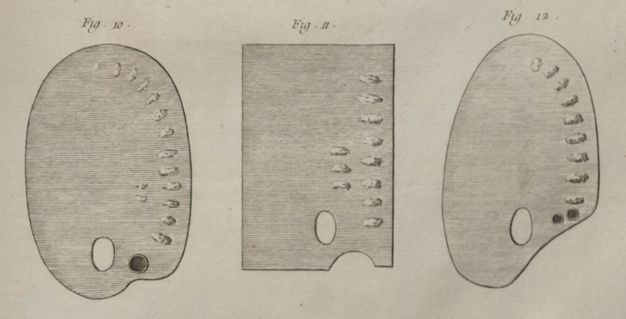
As a tool, the palette was fundamental to the painter’s craft. Though extremely simple (a flat plank of wood), if made and maintained properly a palette was also an incredibly effective item of art-world technology. In terms of material, woods of choice for eighteenth-century palettes were apple or walnut, both hardwoods with tight grains that could be polished to a smooth finish, creating an ideal surface for mixing colors and for cleaning afterward.4 New palettes had to be prepared before they could be used, by coating the top numerous times with walnut oil until the wood could absorb no more.5 Without this preparation, the binder in mixed oil paints (usually linseed or walnut oil) would seep into the wood, leaving the paint to dry out and stain the palette’s surface.6 Designwise, there was a selection of shapes available, as illustrated in the plates of painters’ tools in the Encyclopédie (fig. 122). Most eighteenth-century painters, like Vigée-Lebrun, preferred an oval palette—certainly the most ubiquitous in artists’ portraits—but a minority opted for rectangular (among them, Louis-Michel Van Loo and Nicolas Bertin).7 No matter the shape, all palettes were engineered in a similar way to ensure the ergonomics of use. A bevel-edged thumbhole and a cutaway section on the palette edge (to accommodate a bunch of brushes and sometimes a godet (pot) for oil) permitted the painter to hold everything at the ready in their left hand, while the active right hand undertook the dexterous work of mixing and applying colors. For the minority of left-handed painters (among them, Nicolas Mignard), the configuration was reversed.8 Palettes were also designed to be thicker at the thumbhole side and thinner toward the “tail,” ensuring an efficient distribution of weight and a more commodious experience when working for lengthy periods.9
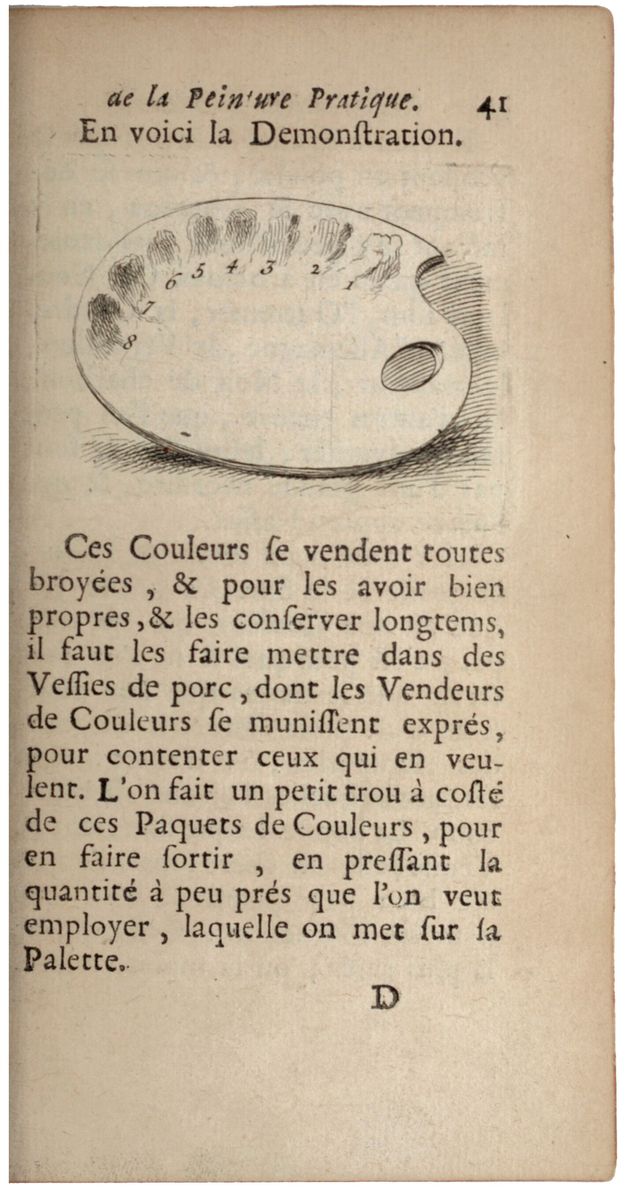
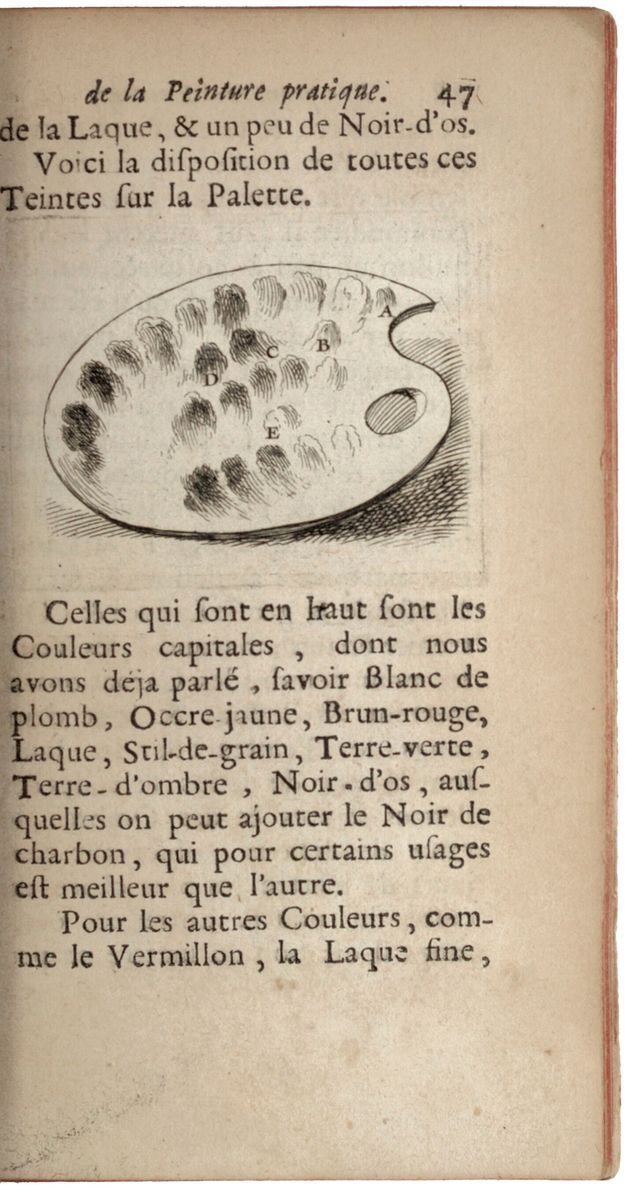
Along with its physical optimization for being comfortably held, the palette’s design as a tool also supported its principal function as a “color laboratory,” to invoke Charlotte Guichard’s term for a space where scientific color theories were transformed into practical painterly substances.10 Though little more than a flat, unmarked piece of wood, for the trained painter a palette was far from a mere undifferentiated surface. Instead, it was divided invisibly into distinct zones, where colors were distributed in fixed patterns or one-off concoctions. At the top, a register of raw colors was arranged in a set scheme; then in the middle and bottom of the palette, those raw colors could be progressively mixed to achieve the range of tones and shades required for a particular artwork.11 Describing this practice in Les premiers éléments de la peinture pratique (1684), Roger de Piles included a diagram for the following top register of couleurs capitales (principal colors) (fig. 123): (1) lead white, (2) yellow ocher, (3) brown red, (4) , (5) stil de grain, (6) green earth, (7) umber, (8) bone black. In a second diagram, he included additional pigments that might be added below (e.g., vermillion (A), massicot (B), or ultramarine (D), and he showed how the artist used the palette surface systematically to create a spectrum of mixed tonal variations (fig. 124). Judging by the palettes represented in artists’ portraits, it would appear that the method de Piles described was largely adhered to throughout the eighteenth century, at least as a shared theoretical starting point. Most portrait palettes show a top register of whites, yellows, reds, browns, and blacks, arranged roughly lightest to darkest from thumbhole to tail. But painters also developed their own idiosyncratic palette habits to suit their style and subject matter. Thus, when it came to the number of principal colors and the actual pigments selected, there were as many variations as there were artists: Vien, for instance, began with a restricted set of seven principals (see fig. 36), while Vernet preferred a lavish array of eleven (see fig. 183).
Palettes in artists’ portraits prove intriguing evidence for exploring their use, but their presence in these artworks also draws attention to their roles beyond utility. So ubiquitous was the palette as a studio tool, so synonymous with the trade, and so personal to the artist, that, not surprisingly, this piece of wood also became the artform’s defining attribute. As a symbol, the palette performed both self-fashioning and allegorical services, whether as that traditional prop held in so many professional portraits, or in decorative allegories or still lifes, like Jean-Siméon Chardin’s Attributes of the Arts (1766, Minneapolis Institute of Art). More than any other material thing, the palette came to stand for both painting, as an art, and the painter, as its agent.
It is in this performative guise that we come face to face with the palette of Vigée-Lebrun in her celebrated Self-Portrait in a Straw Hat (fig. 125). Set unconventionally outdoors, the portrait places Vigée-Lebrun beyond any of those material markers of the studio described in Lemoine’s portrait (see fig. 121). In the absence of other signs, her palette deftly assumes full visual responsibility for signifying its bearer’s professional identity. Tilted forward to face the viewer and lit brightly from above, the palette’s indexical value is immediate, indicating categorically who Vigée-Lebrun is and what she does. Held so naturally on her thumb that it is practically worn over her arm, it becomes a corporeal extension, as much part of Vigée-Lebrun as the rest of her clothing. Yet it is the blobs of paint on the palette that make it such a potent “site of self-declaration,” to use Philip Sohm’s expression for when the portrayed palette serves as metacommentary on the image containing it.12 Emerging as the artwork’s captivating punctum, those blobs of paint pierce the divide between the fiction of the canvas and the reality of its making. For if the painted Vigée-Lebrun is a self-portrait of the maker, then the painted palette is likewise: a self-image of the surface bearing the principal colors that created it all, from the white collar to the black shawl, via the blue sky, soft pink dress, bright red flower, and even the warm brown of its own polished wood.
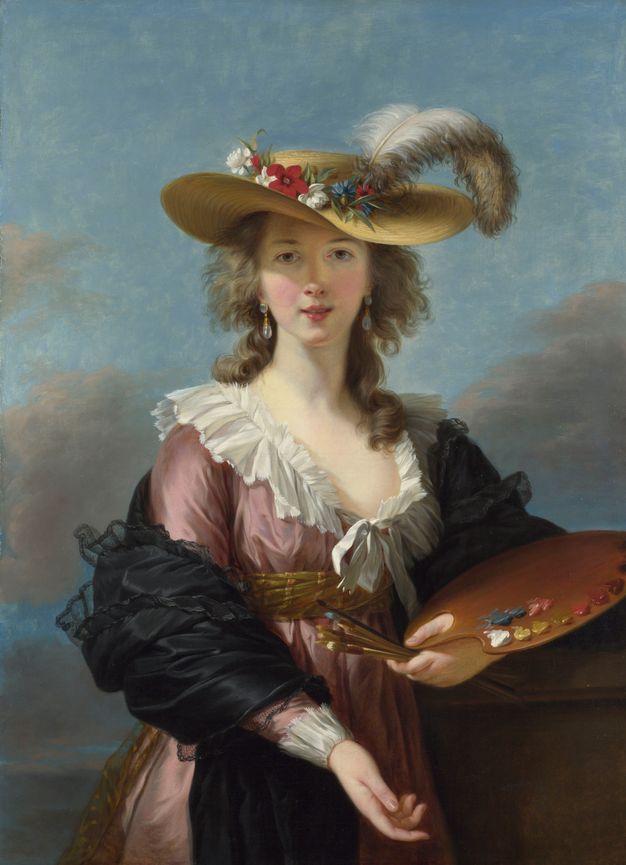
Vigée-Lebrun’s self-reflexive engagement with her palette in her self-portrait underscores its complex role in the painter’s working life. As an intermediary surface in the stages of painterly creation—the space where color was workshopped before being applied to its next and final surface—the palette was different from most tools in the artist’s studio. Some tools, like easels or , were valuable mechanical aids, but not exactly indispensable; things intentionally designed to make easier, speed up, or simplify the practices of the studio. Others, like brushes or , were more imperative to the actions and gestures of art making; things that served as extensions of the artist’s hand, enhancing its dexterity, precision, or facility. The palette, meanwhile, was both and more: a useful mechanical aid, an extension of the hand, and also an extension of the mind—an experimental space where ideas could be rehearsed and refined into material form. In this respect it was perhaps closer to the , though instead of investigating form and subject matter for future use, the palette concocted color in the moment, to be wiped clean afterward, ready for the next the experiment.
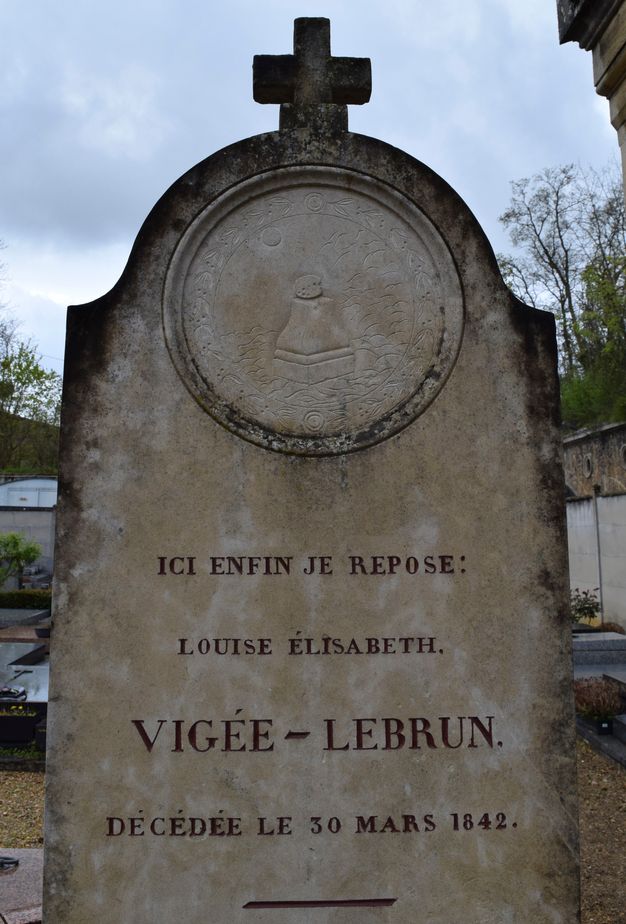
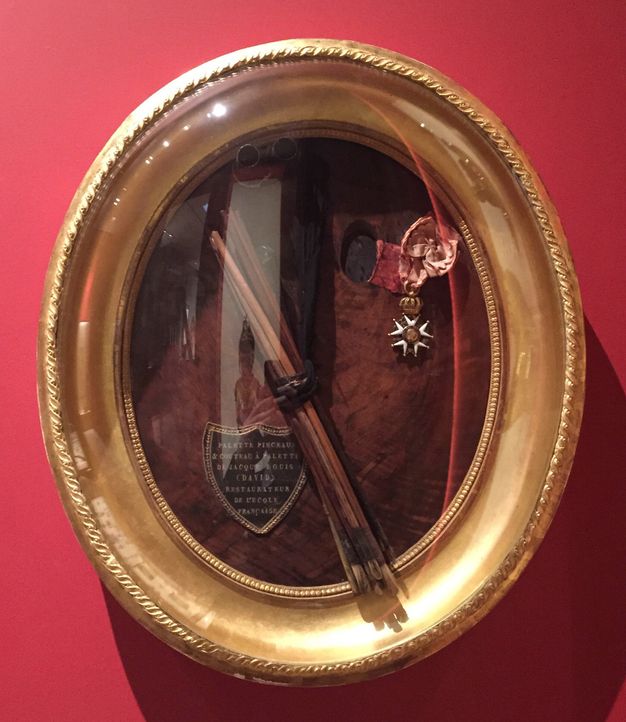
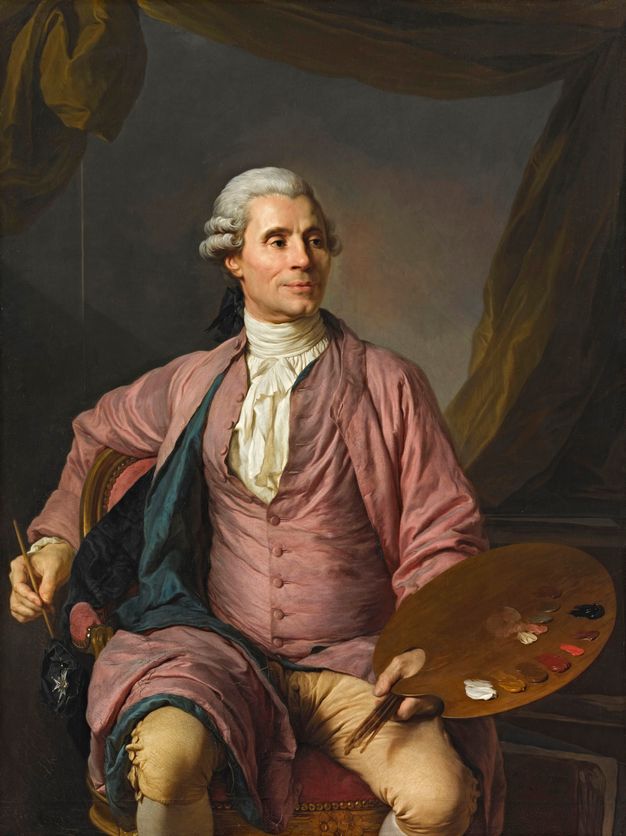
As a color laboratory, site of self-definition, and embodied extension of the creative agent, Vigée-Lebrun’s palette was, like that of every painter, perhaps the most representative possession in her working life. No surprise, then, that in death the palette became her commemorative marker. Her gravestone in the cemetery of Louveciennes is adorned with a tombstone maker’s crude line carving showing a palette resting atop a plinth: a memorial to the painter engraved into this memorial to the painter (fig. 126). This monumentalizing of the painter’s palette in death reaches its zenith in a very different commemorative object for one of Vigée-Lebrun’s contemporaries, Jacques-Louis David. Few eighteenth-century palettes have survived still attached in provenance to their owners, but, at the Musée de la Légion d’Honneur in Paris, David’s is now preserved in a quasi reliquary (fig. 127). Framed and encased under a glass dome, his palette is the centerpiece of an arrangement of items: a double godet clipped to its edge; a bunch of brushes and utensils suspended over the cutaway; and David’s as commandeur of the Légion d’Honneur (awarded by Napoleon in 1815) hanging through the thumbhole. An inscription affixed on a leather shield serves as tombstone, in both senses, a museum label with elegiac shades: “Palette, brushes, and palette knife of Jacques-Louis David, restorer of the French School.”13 Assembled sometime after his death in 1825, this object is a testament to David’s renown, and also to the cults of artistic celebrity that began emerging in the nineteenth century. Like Vigée-Lebrun’s grave, this was an honorific act of memorialization by an anonymous maker, but rather than remaining in the symbolic realm, this one transformed the palette itself into a —a precious physical remnant of the great painter. ‡
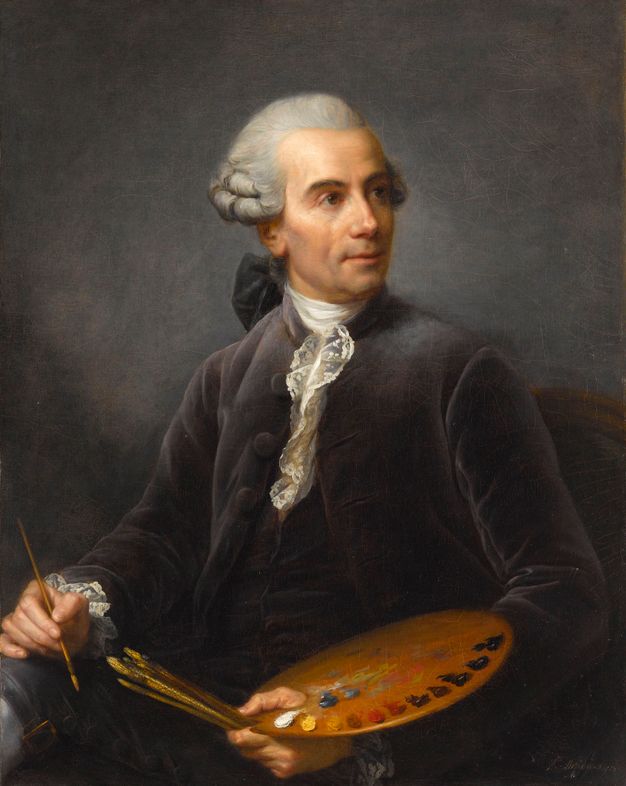
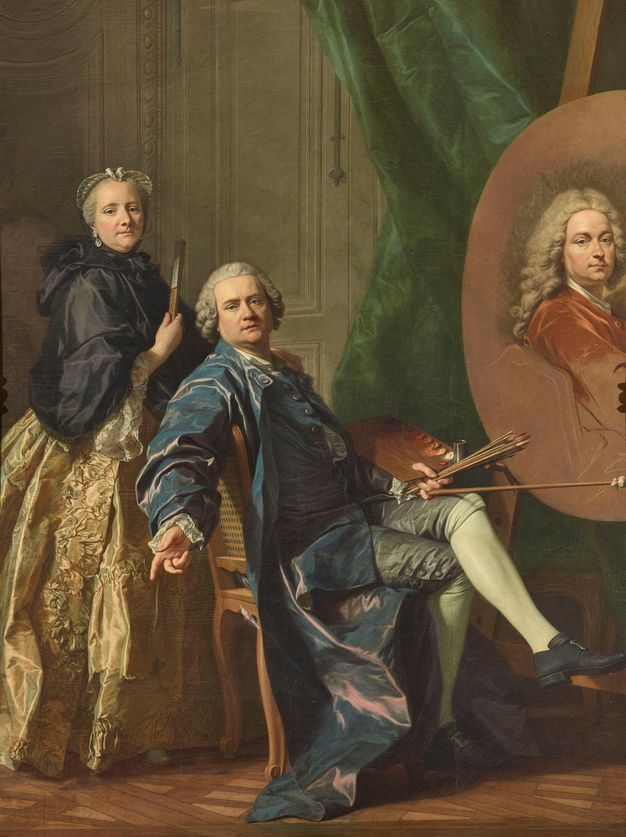
-
This anecdote is recounted in Elisabeth Vigée-Lebrun, Memoirs of Vigée Lebrun, trans. Lionel Strachey (New York: Doubleday, Page & Company, 1903), 18. ↩︎
-
Vigée-Lebrun, Memoirs, 18. ↩︎
-
Charles-Antoine Coypel and Jacques-Louis David are examples of artists who had multiple working and living spaces, as discussed in and . ↩︎
-
Encyclopédie, https://encyclopedie.uchicago.edu/, s.v. “Palette,” 11:781. ↩︎
-
“Palette,” Encyclopédie. ↩︎
-
Jean-Felix Watin, L’art du peintre, doreur, vernisseur (Paris: Grangé, 1773), 54; and Roger de Piles, Les premiers éléments de la peinture pratique (Paris: Nicolas Langlois, 1684), 61. ↩︎
-
Bertin holds a rectangular palette in his portrait by Jacques-François Delyen (1725, Château de Versailles), while Van Loo holds one in his Self-Portrait with His Sister (see fig. 141). ↩︎
-
Mignard’s “left-handed” palette designed for his right hand is depicted in his portrait by Paul Mignard (1672, Musée des Beaux-Arts, Lyon). ↩︎
-
De Piles, Les premiers éléments, 59. ↩︎
-
Charlotte Guichard, “Palettes et tableaux: Des laboratoires de la couleur?,” Dix-huitième siècle 51, no. 1 (2019): 187–204. ↩︎
-
“Palette,” Encyclopédie. ↩︎
-
Philip Sohm, “Palettes as Signatures and Encoded Identities in Early Modern Self-Portraits,” Art History 40, no. 5 (2017): 995. ↩︎
-
“Palette pinceaux / & couteau à palette / de Jacque [sic] Louis/ (David) / restaurateur / de l’école / française.” ↩︎